![]()
CHAPTER II
SOME OLD STRAINS
IN the eighteenth century the red spaniel must have been at its best. For over a hundred years Irishmen had nothing to interfere with their sporting pursuits. From the time of King William III. to the unfortunate rising of 1798 rural Ireland was the fairest field in the civilized world for manly sport, and the inhabitants, rich and poor, were as they are to-day—keen and the best of sportsmen. What wonder that their charming shooting companion, the red spaniel, should have prospered under such favourable conditions, and acquiring his master’s rollicking love of sport, gradually developed into one of the best of sporting dogs? I have no doubt but that the Irish setter really developed at this period.
Pedigrees of dogs were rarely kept in Ireland before the institution of shows, consequently it is difficult to trace the breeding of setters of this period except in a few well-known kennels. The pedigrees of the early dog show winners often refer back to certain strains designated as celebrated. How far back these strains go it is not easy to determine, but some of them can be traced into the eighteenth century before the rising. Uneducated Irish usually remember dates by reference to the principal events of the year, such as the year of the great wind, 1839; the famine year, 1848; the year of the rebellion, 1798. These so-called celebrated strains were simply the kennels of the well-to-do sportsmen in times when most country gentlemen kept sporting dogs and paid attention to their breeding. There were at the same time a large number of sportsmen with one or more dogs who occasionally bred a litter of good puppies.
There were no doubt many Irish setters in use at the end of the eighteenth century, and some of the noted strains of the last century began at that time. Mr. Arthur French boasted about a fine brace he had in 1793. He was the father of the first Lord de Freyne, and the French Park strain was no doubt prospering at that time. The Rev. John French, second Lord de Freyne, Rector of Grange Silvae, County Kilkenny, was born in 1788 and was very greatly interested in red setters. He had trouble in bringing them about in the old coaching days of the last century, when he was generally accompanied by a handsome brace of broken dogs which he had brought to great perfection. The following letter is from Lieutenant-Colonel O. L. F. Lloyd, who saw the last of the breed at French Park in January, 1879:
“There is no record,” he writes, “that can be relied on as to the origin of the breed. From letters that have been found lying about from former shooting guests at French Park it is certain that this breed was well established at the time of Parson John, afterwards second Lord de Freyne, who inherited several of the breed, and was devoted to them, and always prided himself on their wonderful steadiness and good looks. There was no white on any of them excepting on the breast. After the death of John, the second Lord, the breed was much neglected, and became so inbred that few, if any, were found worth keeping, and it was decided to destroy them. Up to this date the breed of French Park red setters was kept with the greatest care and judgment during the latter half of the eighteenth century. It was hoped to recover the breed from friends who were known to hold some that had been given away from time to time, but only one was found that was of genuine French Park blood, and he belonged to a manager of a bank at Wicklow. Thus this beautiful strain ceased to exist.”
I have no information about the looks of the French Park setters, but Lieutenant-Colonel Lloyd describes them as red, though he only knew them from about 1869. I have no doubt they were like the other red dogs with more or less white in their coats. The late Mr. A. F. Nuttall told me that he bred from one of these setters and that it had a shower of hail through its coat.
There was a celebrated strain of red setters in King’s County called the O’Connor setters. They were brought to great perfection by Mr. Maurice Nugent O’Connor of Mount Pleasant (now called Gort-na-mona, its old name). In a book written by his grandson, Mr. William O’Connor Maurice—“Memories and Thoughts of a Life”—the following appears:
“Maurice Nugent O’Connor settled on his Irish estate as a bachelor about the year 1779. He became one of the best sportsmen of his day, was breeder of the famous O’Connor setters—dogs whose equal I have never seen—and was one of the first Irishmen to rent a grouse moor in Scotland.”
Mr. O’Connor Maurice shot over the setters when a young man, and they were red with a touch of white. Mr. Maurice O’Connor died in 1818. I expect the setters went to the family of La Touches of Harristown, County Kildare. The following letter from the late Mr. La Touche gives a description of his father’s kennel:
“HARRISTOWN, BRANNOCKSTOWN,
“COUNTY KILDARE,
“August 23.
“DEAR SIR,—Dane has forwarded me your query as to the red setters that used to be here. I am afraid I cannot give you any useful information about them as I was only a boy when my father sold them in the early sixties. They were sold by auction in the yard, and a Sir A. Chichester, I think, bought them all—some four brace. I know he bought one dog called York for seventy guineas, which was thought to be a fabulous price in those days. Sir A. Chichester was, I think, a Devonshire man, and had a moor a few miles off Port William, where my father and I saw the setters the following season. My father kept a dog called Flop and a bitch called Dido. The latter never came in season, which I hear was a not uncommon failing with the breed here, as it became extinct as far as my family was concerned. There were apparently no annals kept of the pedigrees of these setters, and the old keeper who had care of them for more than forty years has been dead for many years. I heard that my father got the strain from my mother’s grandfather, Mr. O’Connor of Gart-na-mona, King’s County, and I remember the breed being spoken of as the O’Connor setter. They were not very big and of a rich, dark red colour with well-feathered sterns and perhaps rather light of bone. I thought a dog called Palmerston, which was a champion some fifty years since, very like the type, but I remember showing him to my father at a show in Dublin and he said he was too coarse and heavy a dog. I always heard that my father’s dogs were very good in their work and were easily broken, and I expect they were, as he shot a hundred and fifty brace of grouse in one day in the early fifties in Caithness. I am sorry that this letter conveys so little information, but perhaps the representatives of Sir Chichester might be able to tell you what became of the strain. I have no pictures of any of them.
“Very truly yours,
“PERCY LA TOUCHE.”
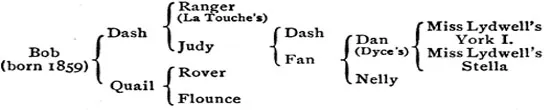
It might be added that writing about the Irish setter, Mr. Laverack said that as far as his researches and observations went, the late Mr. La Touche of Harristown possessed the breed in its greatest purity. The Harristown keeper pointed out to me, when I visited his kennels, a blood red and white setter as the best dog he had. The Misses Lydwell, of Beggars Bush, County Dublin, had some splendid red and white setters. This strain came from the O’Connor setters and were much the same as the La Touche breed. The O’Connor kennel, by the way, was in existence in the first half of the last century. Mr. Laverack mentions Miss Lydwell’s red and white setters as being very handsome, and said he believed they were as pure as any in Ireland. He also said that Stella was the dam of Dyce’s Dan, and that Old Dan was the sire of Captain Hutchinson’s Bob, but this is not quite correct as Captain Hutchinson gives the pedigree of Bob as follows:—
Shortly before the time of show dogs Dyce’s Dan was alive in Dublin. If reports of old Dublin sportsmen are to be believed, Dan must have been a grand dog. Good Irish setters were highly valued then, as quite a big price was given for a pair sold at Dyce’s in Dublin. A fine tribute to the value of the Irish setter is contained in the following letter from Colonel Gresson, who has been a breeder of the variety for many years:—
“NEWBERRY, HARRISTOWN,
“COUNTY KILDARE.
“My father often told me of the La Touche setters, red spaniels as he always called them; the late Mr. Tom Hendrick of Kerdiffstown, the owner of Squib, etc., and Mrs. Falconer (Miss Warburton), the owner of Venus and Lily; Venus an ancestor of your Frisco. They also often spoke of the La...