- 468 pages
- English
- ePUB (mobile friendly)
- Available on iOS & Android
eBook - ePub
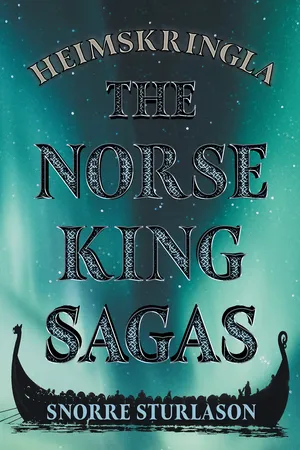
Heimskringla - The Norse King Sagas
About this book
This early work of poetry is both expensive and hard to find in its first edition. Written in the early thirteenth century, it contains a collection of sagas about Norwegian kings. This is a fascinating work and is thoroughly recommended for anyone interested in Norse history.
Contents Include: Dedication to King Haakon VII - Editor's Introduction - Translator's Preface - Snorre's Preface - The Ynglinga Saga, Semi-Mythical - Historic Sagas - Halfdan the Black - Harald the Fairhaired - Haakon the Good - Eric's Sons - Earl Haakon - King Olaf Tryguesson - King Olaf the Saint - Magnus the Good - Harald the Stern - Olaf the Quiet - Magnus Barefoot - The Sons of Magnus - Magnus the Blind and Harald Gille - The Sons of Harald - Haakon the Broad-Shouldered - Magnus Erlingson - List of Old Sagas - List of Kings of Sweden, Denmark, Norway - Index of Names and Places.
Information
Topic
Theology & ReligionSubtopic
Folklore & MythologyX
HARALD THE STERN1 [1030-66]
CHAPTER I. HARALD ESCAPES FROM THE BATTLE OF STIKLESTAD [1030].—Harald, son of Sigurd Syr, brother of Olaf the Saint by the same mother, was at the battle of Stiklestad, and was fifteen years old when King Olaf the Saint fell, as before related. Harald was wounded, and escaped with other fugitives. Of this Thjodolf the scald makes mention in the poem he composed about King Harald, which he called “Sexstefia”:
At Haug2 the fire-sparks from his shield
Flew round the king’s head on the field,
As blow for blow, for Olaf’s sake,
His sword and shield would give and take.
Bulgaria’s conqueror,3 I ween,
Had scarcely fifteen winters seen,
When from his murdered brother’s side
His unhelmed head he had to hide.
Flew round the king’s head on the field,
As blow for blow, for Olaf’s sake,
His sword and shield would give and take.
Bulgaria’s conqueror,3 I ween,
Had scarcely fifteen winters seen,
When from his murdered brother’s side
His unhelmed head he had to hide.
Rognvald Bruseson4 led Harald from the battle, and the night after the fray took him to a bonde who dwelt in the forest far from other people. The peasant received Harald, and kept him concealed; and Harald was waited upon until he was quite cured of his wounds. Then the bonde’s son attended him on the way east over Kjölen, and they went by all the forest paths they could, avoiding the common road. The bonders son did not know who it was he was attending; and as they were riding together between two uninhabited forests, Harald made these verses:
My wounds were bleeding as I rode;
And down below the bonder strode,
Killing the wounded with the sword,
The followers of their rightful lord.
From wood to wood I crept along,
Unnoticed by the bonder-throng;
“Who knows,” I thought, “a day may come
My name will yet be great at home.”
And down below the bonder strode,
Killing the wounded with the sword,
The followers of their rightful lord.
From wood to wood I crept along,
Unnoticed by the bonder-throng;
“Who knows,” I thought, “a day may come
My name will yet be great at home.”
He went eastward over the ridge through Jemteland and Helsingeland, and came to Sweden, where he found Rognvald Bruseson, and many others of King Olaf’s men who had fled from the battle at Stiklestad, and they remained there till winter was over.
CHAPTER II. HARALD’S JOURNEY TO CONSTANTINOPLE [1031].—The spring after, Harald and Rognvald got ships, and went east in summer to Russia to King Jarisleif, and were with him all the following winter. So says the scald Bolverk, in the poem he composed about King Harald:
The king’s sharp sword lies clean and bright,
Prepared in foreign lands to fight:
Our ravens croak to have their fill,
The wolf howls from the distant hill.
Our brave king is to Russia gone—
Braver than he on earth there’s none:
His sharp sword will carve many a feast
To wolf and raven in the East.
Prepared in foreign lands to fight:
Our ravens croak to have their fill,
The wolf howls from the distant hill.
Our brave king is to Russia gone—
Braver than he on earth there’s none:
His sharp sword will carve many a feast
To wolf and raven in the East.
King Jarisleif gave Harald and Rognvald a kind reception, and made Harald and Eilif, the son of Earl Rognvald,1 chiefs over the land-defence 2 men of the king. So says Thjodolf:
Where Eilif was, one heart and hand
The two chiefs had in their command;
In wedge or line their battle order
Was ranged by both without disorder.
The eastern Vendland3 men they drove
Into a corner; and they move
The Lesians,4 although ill at ease,
To take the laws their conquerors please.
The two chiefs had in their command;
In wedge or line their battle order
Was ranged by both without disorder.
The eastern Vendland3 men they drove
Into a corner; and they move
The Lesians,4 although ill at ease,
To take the laws their conquerors please.
Arnor, the earl’s scald, related that Rognvald Bruseson was for a long time land-defence man in Russia, and fought many battles there:
In Russia, though now grown old,
The battle-loving earl, the bold,
Of Gondul5 favoured, in the field
Raised in ten fights his battered shield.
The battle-loving earl, the bold,
Of Gondul5 favoured, in the field
Raised in ten fights his battered shield.
Harald remained several years in Russia, and travelled far and wide in the Eastern land. Then he began his expedition out to Greece, and had a great suite of men with him; and on he went to Constantinople.1 So says Bolverk:
Before the cold sea-curling blast
The cutter from the land flew past,
Her black yards swinging to and fro,
Her shield-hung gunwale dipping low.
The king saw glancing o’er the bow
Constantinople’s metal glow
From tower and roof, and painted sails
Gliding past towns and wooded vales.
The cutter from the land flew past,
Her black yards swinging to and fro,
Her shield-hung gunwale dipping low.
The king saw glancing o’er the bow
Constantinople’s metal glow
From tower and roof, and painted sails
Gliding past towns and wooded vales.
CHAPTER III. OF HARALD.—At that time the Greek empire was ruled by the empress Zoe the Great,2 and with her Michael Catalactus. Now when Harald came to Constantinople he presented himself to the empress, and went into her pay; and immediately, in autumn, went on board the galleys manned with troops which went out to the Greek sea.3 Harald had his own men along with him. Now Harald had been but a short time in the army before all the Væringer 4 flocked to him, and they all joined together when there was a battle. It thus came to pass that Harald was made chief of the Væringer. There was a chief over all the troops who was called Gyrge,5 and who was a relation of the empress. Gyrge and Harald went round among all the Greek islands, and fought much against the corsairs.
CHAPTER IV. OF HARALD AND GYRGE CASTING LOTS.—It happened once that Gyrge and the Væringer were going through the country, and they resolved to take their night quarters in a wood; and as the Væringer came first to the ground, they chose the place which was best for pitching their tents upon, which was the highest ground; for it is the nature of the land there to be soft when rain falls, and therefore it is bad to choose a low situation for tents. Now when Gyrge, the chief of the army, came up, and saw where the Væringer had set up their tents, he told them to remove, and pitch their tents elsewhere, saying he would himself pitch his tents on their ground, Harald replies, “If you come first to the night quarter, you take up your ground, and we must go pitch our tents at some other place where we best can. Now do you so, in the same way, and find a place where you will. It is, I think, the privilege of us Væringer here in the dominions of the Greek emperor to be free, and independent of all but their own commanders, and bound only to serve the emperor and empress.” They disputed long and hotly about this, and both sides armed themselves, and were on the way to fight for it; but men of understanding came between and separated them. They said it would be better to come to an agreement about such questions, so that in future no dispute could arise. It came thus to an arbitration between them, at which the best and most sagacious men should give their judgment in the case. At this arbitration it was determined, with the consent of all parties, that lots should be thrown into a box, and the Greeks and Væringer should draw which was first to ride, or to row, or to take place in a harbour, or to choose tent ground; and each side should be satisfied with what the drawing of the lots gave them. Accordingly the lots were made, and marked. Harald said to Gyrge, “Let me see what mark thou hast put upon thy lot, that we may not both mark our lots in the same way.” He did so. Then Harald marked his lot, and put it into the box along with the other, The man who was to draw out the lots then took up one of the lots between his fingers, held it up in the air, and said, “This lot shall be the first to ride, and to row, and to take place in harbour and on the tent field.” Harald seized his hand, snatched the die, and threw it into the sea, and called out, “That was our lot!” Gyrge said, “Why did you not let other people see it?” Harald replies, “Look at the one remaining in the box—there you see your own mark upon it.” Accordingly the lot which was left behind was examined, and all men saw that Gyrge’s mark was upon it, and accordingly the judgment was given that the Væringer had gained the first choice in all they had been quarrelling about. There were many things they quarrelled about, but the end always was that Harald got his own way.
CHAPTER V. HARALD’S EXPEDITION IN THE LAND OF THE SARACENS.—They went out all on a campaign in summer. When the whole army was thus assembled Harald kept his men out of the battle, or wherever he saw the least danger, under pretext of saving his men; but where he was alone with his own men only, he fought so desperately that they must either come off victorious or die. It thus happened often that when he commanded the army he gained victories, while Gyrge could do nothing. The troops observed this, and insisted they would be more successful if Harald alone was chief of the whole army, and upbraided the general with never effecting anything, neither himself, nor his people. Gyrge again said that the Væringer would give him no assistance, and ordered Harald to go with his men somewhere else, and he, with the rest of his army, would win what they could. Harald accordingly left the army with the Væringer and the Latin men,1 and Gyrge on his side went off with the Greek troops. Then it was seen what each could do. Harald always gained victories and booty; but the Greeks went home to Constantinople with their army, all except a few brave men, who, to gain booty and money, joined themselves to Harald, and took him for their leader. He then went with his troops westward to Africa, which the Væringer, call Saracen’s land,2 where he was strengthened with many men. In the Saracen’s land he took eighty castles, some of which surrendered, and others were stormed. He then went to Sicily. So says Thjodolf:
The serpent’s bed of glowing gold
He hates 3—the generous king, the bold!
He who four score towers laid low,
Ta’en from the Saracenic foe.
Before upon Sicilian plains,
Shield joined to shield, the fight he gains,
The victory at Hilda’s game,4
And now the heathens dread his name.
He hates 3—the generous king, the bold!
He who four score towers laid low,
Ta’en from the Saracenic foe.
Before upon Sicilian plains,
Shield joined to shield, the fight he gains,
The victory at Hilda’s game,4
And now the heathens dread his name.
So says also Illuge Bryndæla-scald 1:
For Michael’s empire Harald fought,
And southern lands to Michael brought;
So Budle’s son his friendship showed
When he brought friends to his abode.2
And southern lands to Michael brought;
So Budle’s son his friendship showed
When he brought friends to his abode.2
Here it is said that Michael was king of the Greeks at that time. Harald remained many years in Africa, where he gathered great wealth in gold, jewels, and all sorts of precious things; and all the wealth he gathered there which he did not need for his expenses, he sent with trusty men of his own north to Novgorod to King Jarisleif’s care and keeping. He gathered together there extraordinary treasure, as is reasonable to suppose; for he had the plundering of the part of the world richest in gold and valuable things, and he had done such great deeds as with truth are related, such as taking eighty strongholds by his valour.
CHAPTER VI. BATTLE IN SICILY.—Now when Harald came to Sicily he plundered there also, and sat down with his army before a strong and populous castle. He surrounded the castle; but the walls were so thick there was no possibility of breaking into it, an...
Table of contents
- Cover
- Title
- Contents
- Editor’s Introduction
- Translator’s Preface
- Snorre’s Preface
- I. The Ynglinga Saga. Semi-Mythical
- II. Halfdan the Black
- III. Harald the Fairhaired
- IV. Haakon the Good
- V. Eric’s Sons
- VI. Earl Haakon
- VII. [King Olaf Trygvesson.] See Vol. 717, Everyman’s Library
- VIII. [King Olaf the Saint.] See Vol. 717, Everyman’s Library
- IX. Magnus the Good
- X. Harald the Stern
- XI. Olaf the Quiet
- XII. Magnus Barefoot
- XIII. The Sons of Magnus
- XIV. Magnus the Blind and Harald Gille
- XV. The Sons of Harald
- XVI. Haakon the Broad-shouldered
- XVII. Magnus Erlingson
- Appendix I. List of Old Sagas
- Appendix II. List of Kings of Sweden, Denmark, Norway
- Index of Names and Places
Trusted by 375,005 students
Access to over 1.5 million titles for a fair monthly price.
Study more efficiently using our study tools.
Frequently asked questions
Yes, you can cancel anytime from the Subscription tab in your account settings on the Perlego website. Your subscription will stay active until the end of your current billing period. Learn how to cancel your subscription
No, books cannot be downloaded as external files, such as PDFs, for use outside of Perlego. However, you can download books within the Perlego app for offline reading on mobile or tablet. Learn how to download books offline
Perlego offers two plans: Essential and Complete
- Essential is ideal for learners and professionals who enjoy exploring a wide range of subjects. Access the Essential Library with 800,000+ trusted titles and best-sellers across business, personal growth, and the humanities. Includes unlimited reading time and Standard Read Aloud voice.
- Complete: Perfect for advanced learners and researchers needing full, unrestricted access. Unlock 1.5M+ books across hundreds of subjects, including academic and specialized titles. The Complete Plan also includes advanced features like Premium Read Aloud and Research Assistant.
We are an online textbook subscription service, where you can get access to an entire online library for less than the price of a single book per month. With over 1.5 million books across 990+ topics, we’ve got you covered! Learn about our mission
Look out for the read-aloud symbol on your next book to see if you can listen to it. The read-aloud tool reads text aloud for you, highlighting the text as it is being read. You can pause it, speed it up and slow it down. Learn more about Read Aloud
Yes! You can use the Perlego app on both iOS and Android devices to read anytime, anywhere — even offline. Perfect for commutes or when you’re on the go.
Please note we cannot support devices running on iOS 13 and Android 7 or earlier. Learn more about using the app
Please note we cannot support devices running on iOS 13 and Android 7 or earlier. Learn more about using the app
Yes, you can access Heimskringla - The Norse King Sagas by Snorre Sturlason in PDF and/or ePUB format, as well as other popular books in Theology & Religion & Folklore & Mythology. We have over 1.5 million books available in our catalogue for you to explore.