eBook - ePub
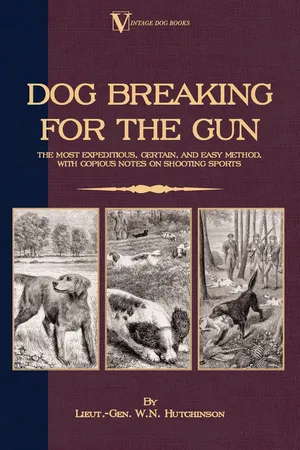
Dog Breaking for the Gun: The Most Expeditious, Certain and Easy Method, with Copious Notes on Shooting Sports
- 372 pages
- English
- ePUB (mobile friendly)
- Available on iOS & Android
eBook - ePub
Dog Breaking for the Gun: The Most Expeditious, Certain and Easy Method, with Copious Notes on Shooting Sports
About this book
Originally published in 1848, this book was so well received by sportsmen and dog owners alike, that several more editions were published in ensuing years. All of these early editions are now very scarce and increasingly hard to find. VINTAGE DOG BOOKS has now republished the fifth, revised and enlarged edition of 1869, using the original text and engravings, as part of their CLASSIC BREED BOOK series. The author was a well respected dog breeder and trainer with a lifetime's experience of working dogs in the field. His book is still considered by many to be the finest work on gundog training ever written. The book's substantial three hundred and seventy two pages contain twenty three comprehensive, illustrated chapters: - Preliminary Observations. Qualifications, in Breaker and Dog. - Initiatory Lessons Indoors. Shooting Ponies. - Initiatory Lessons with Spaniels. - Retrievers. - Lessons Out of Doors. - First Lesson in September. Ranging. - Caution. Nature's Mysterious Influences. - Cunning of Age. Range of from Two to Six Dogs. - Pointing. - Vermin. -Bar, Leg Strap and Spike Collar. - Shooting Hares. - Hints to Purchasers. - Sheep Killing. - Anecdotes on Dogs on Service at Home. - Service Abroad. - Russian Setters. - Whistles, "Backing", Ranging, Runners. - Retrieving with Setters. - Bloodhounds. - Health. - Shooting. - Loading. - Trapping. - Vermin Control. - Pheasant Rearing. - Poachers. - Keepers. - Night Dogs etc. The book also contains many steel and wood engravings of dogs and sporting scenes. This is essential reading for anyone requiring information on dog training, whether it be for the field or home. "Be to his virtues ever kind Be to his faults a little blind." Many of the earliest dog breed books, particularly those dating back to the 1900s and before, are now extremely scarce and increasingly expensive. VINTAGE DOG BOOKS are republishing these classic works in affordable, high quality, modern editions, using the original text and artwork.
Information
Print ISBN
9781846640346
9781846640353
DOG-BREAKING.

CHAPTER I.
PRELIMINARY OBSERVATIONS. QUALIFICATIONS, IN BREAKER,—IN DOG.
1. Dog-breaking an Art easily acquired.—2. Most expeditious Mode of imparting every Degree of Education. Time bestowed determines Grade of Education. In note, Col. Hawker’s opinion.—3. Sportsmen recommended to break in their own Dogs.—4. Men of property too easily satisfied with badly-broken Dogs. Keepers have no Excuse for Dogs being badly broken.—5. Great Experience in Dog-breaking, or Excellence in Shooting, not necessary. Dispositions of Dogs vary.—6. What is required in an Instructor.—7. Early in a Season any Dog will answer, a good one necessary afterwards. Hallooing, rating Dogs, and loud whistling spoil Sport. In note, Age and choice of birds. Several shots fired from Stooks at Grouse without alarming them. American Partridges and our Pheasants killed while at roost.—8. What a well-broken Dog ought to do.—9. Severity reprobated.—10. Astley’s Method of teaching his Horses.—11. Fran-coni’s Cirque National de Paris.—12. Initiatory Lessons recommended—to be given when alone with Dog—given fasting.—13. Success promised if rules be followed. Advantages of an expeditious Education. September shooting not sacrificed.
1. DOG-BREAKING, so far from being a mystery, is an art easily acquired when it is commenced and continued on rational principles.
2. I think you will be convinced of this if you will have the patience to follow me, whilst I endeavour to explain what, I am satisfied, is the most certain and rapid method of breaking in your dogs, whether you require great proficiency in them, or are contented with an inferior education. No quicker system has yet been devised, however humble the education may be. The education in fact, of the peasant, and that of the future double-first collegian, begins and proceeds on the same principle. You know your own circumstances, and you must yourself determine what time you choose to devote to tuition; and, as a consequence, the degree of excellence to which you aspire. I can only assure you of my firm conviction, that no other means will enable you to gain your object so quickly; and I speak with a confidence derived from long experience in many parts of the world, on a subject that was, for several years, my great hobby.*
3. Every writer is presumed to take some interest in his reader; I therefore feel privileged to address you as a friend, and will commence my lecture by strongly recommending, that, if your occupations will allow it, you take earnestly and heartily to educating your dogs yourself. If you possess temper and some judgment, and will implicity attend to my advice, I will go bail for your success; and much as you may now love shooting, you will then like it infinitely more. Try the plan I recommend, and I will guarantee that the Pointer or Setter pup which I will, for example sake, suppose to be now in your kennel, shall be a better dog by the end of next season (I mean a more killing dog) than probably any you ever yet shot over.
4. Possibly, you will urge, that you are unable to spare the time which I consider necessary for giving him a high education, (brief as that time is, compared with the many, many months wasted in the tedious methods usually employed), and that you must, perforce, content yourself with humbler qualifications. Be it so. I can only condole with you, for in your case this may be partly true; mind I only say partly true. But how a man of property, who keeps a regular gamekeeper, can be satisfied with the disorderly, disobedient troop, to which he often shoots, I cannot understand. Where the gamekeeper is permitted to accompany his master in the field, and hunt the dogs himself, there can be no valid excuse for the deficiency in their education. The deficiency must arise either from the incapacity, or from the idleness of the keeper.
5. Unlike most other arts, dog-breaking does not require much experience; but such a knowledge of dogs, as will enable you to discriminate between their different tempers and dispositions (I had almost said characters)—and they vary greatly—is very advantageous. Some require constant encouragement; some you must never beat; whilst, to gain the required ascendancy over others, the whip must be occasionally employed. Nor is it necessary that the instructor should be a very good shot; which probably is a more fortunate circumstance for me than for you. It should even be received as a principle that birds ought to be now and then missed to young dogs, lest some day, if your nerves happen to be out of order, or a cockney companion be harmlessly blazing away, your dog take it into his head and heels to run home in disgust, as I have seen a bitch, called Countess, do more than once, in Haddingtonshire.
6. The chief requisites in a breaker are:—Firstly, command of temper, that he may never be betrayed into giving one unnecessary blow, for, with dogs as with horses, no work is so well done as that which is done cheerfully; secondly, consistency, that in the exhilaration of his spirits, or in his eagerness to secure a bird, he may not permit a fault to pass unreproved (I do not say unpunished) which at a less exciting moment he would have noticed—and that, on the other hand, he may not correct a dog the more harshly, because the shot has been missed, or the game lost; and lastly, the exercise of a little reflection, to enable him to judge what meaning an unreasoning animal is likely to attach to every word and sign, nay to every look.
7. With the coarsest tackle, and worst flies, trout can be taken in unflogged waters, while it requires much science, and the finest gut, to kill persecuted fish. It is the same in shooting. With almost any sporting-dog, game can be killed early in the season, when the birds lie like stones, and the dog can get within a few yards of them; but you will require one highly broken, to obtain many shots when they are wild. Then any incautious approach of the dog, or any noise, would flush the game, and your own experience will tell you that nothing so soon puts birds on the run, and makes them so ready to take flight, as the sound of the human voice, especially now-a-days, when farmers generally prefer the scythe to the sickle, and clean husbandry, large fields, and trim narrow hedges, (affording no shelter from wet) have forced the partridge—a short-winged* bird—unwillingly to seek protection (when arrived at maturity) in ready flight rather than in concealment. Even the report of a gun does not so much alarm them as the command, “Toho,” or “Down charge,”* usually, too, as if to make matters worse, hallooed to the extent of the breaker’s lungs. There are anglers who recommend silence as conducive to success, and there are no experienced sportsmen who do not acknowledge its great value in shooting. Rate or beat a dog at one end of a field, and the birds at the other will lift their heads, become uneasy, and be ready to take wing the moment you get near them. “Penn,” in his clever maxims on Angling and Chess, observes to this effect, “if you wish to see the fish, do not let him see you;” and with respect to shooting, we may as truly say, “if you wish, birds to hear your gun, do not let them hear your voice.” Even a loud whistle disturbs them. Mr. O——t of C——e says, a gamekeeper’s motto ought to be,—“No whistling—no whipping—no noise, when master goes out for sport.”
8. These observations lead unavoidably to the inference, that no dog can be considered perfectly broken, that does not make his point when first he feels assured of the presence of game, and remain stationary where he makes it, until urged on by you to draw nearer—that does not, as a matter of course, lie down without any word of command the moment you have fired, and afterwards perseveringly seek for the dead bird in the direction you may point out,—and all this without your once having occasion to speak, more than to say in a low voice, “Find,” when he gets near the dead bird, as will be hereafter explained. Moreover, it must be obvious that he risks leaving game behind him if he does not hunt every part of a field, and, on the other hand, that he wastes your time and his strength, if he travel twice over the same ground, nay, over any ground which his powers of scent have already reached. Of course, I am now speaking of a dog hunted without a companion to share his labours.
9. You may say, “How is all this, which sounds so well in theory, to be obtained in practice without great severity?” Believe me, with severity it never can be attained. If flogging would make a dog perfect, few would be found unbroken in England or Scotland, and scarcely one in Ireland.
10. Astley’s method was to give each horse his preparatory lessons alone, and when there was no noise or anything to divert his attention from his instructor. If the horse was interrupted during the lesson, or his attention in any way withdrawn, he was dismissed for that day. When perfect in certain lessons by himself, he was associated with other horses, whose education was further advanced. And it was the practice of that great master to reward his horses with slices of carrot or apple when they performed well.
11. Mons. A. Franconi in a similar manner rewards his horses. One evening I was in such a position, at a performance of the Cirque National de Paris, that I could clearly see, during the Lutte des Voltigeurs, that the broad-backed horse held for the men to jump over was continually coaxed with small slices of carrots to remain stationary, whilst receiving their hard thumps as they sprang upon him. I could not make out why the horse was sniffing and apparently nibbling at the chest of the man standing in front of him with a rein in each hand to keep his tail towards the spring-board, until I remarked that a second man, placed in the rear of the other, every now and then, slily passed his hand under his neighbour’s arm to give the horse a small piece of carrot.
12. Astley may give us a useful hint in our far easier task of dog-breaking. We see that he endeavoured by kindness and patience to make the horse thoroughly comprehend the meaning of certain words and signals before he allowed him any companion. So ought you, by what may be termed “initiatory lessons,” to make your young dog perfectly understand the meaning of certain words and signs, before you hunt him in the company of another dog—nay, before you hunt him at all; and, in pursuance of Astley’s plan, you ought to give these lessons when you are alone with the dog, and his attention is not likely to be withdrawn to other matters. Give them, also, when he is fasting, as his faculties will then be clearer, and he will be more eager to obtain any rewards of biscuit or other food.
13. Be assured, that by a consistent adherence to the simple rules which I will explain, you can obtain the perfection I have described, (8) with more ease and expedition than you probably imagine to be practicable; and, if you will zealously follow my advice, I promise, that, instead of having to give up your shooting in September, (for I am supposing you to be in England) while you break in your pup, you shall then be able to take him into the field, provided he is tolerably well bred and well disposed, perfectly obedient, and, except that he will not have a well-confirmed, judicious range, almost perfectly made; at least so far made, that he will only commit such faults, as naturally arise from want of experience. Let me remind you also, that the keep of dogs is expensive, and supplies an argument for making them earn their bread by hunting to a useful purpose, as soon as they are of an age to work without injury to their constitution. Time, moreover, is valuable to us all, or most of us fancy it is. Surely, then, that system of education is best which imparts the most expeditiously the required degree of knowledge.
* It may be satisfactory to others to know the opinion of so undeniable an authority as Colonel Hawker. The Colonel, in the Tenth Edition of his invaluable Book on Shooting, writes, (page 285)—“Since the publication of the last edition, Lieutenant-Col. Hutchinson’s valuable work on ‘Dog-breaking’ has appeared. It is a perfect vade mecum for both Sportsmen and Keeper, and I have great pleasure in giving a cordial welcome to a work which so ably supplies my own deficiencies.”
* Rounded, too, at the extremities—the outer feathers not being the longest—a formation adverse to rapid flight. The extreme outer feather of young birds is pointed, and, until late in the season, accompanies soft quills, weak brown beaks, and yellow legs. These (beaks and legs) become grey on maturity, or rather of the bluish hue of London milk—and the quills get white and hard—facts which should be attended to by those who are making a selection for the table. Hold an old and a young bird by their under beaks between your fore-finger and thumb, and you will soon see how little, comparatively, the old beak yields to the weight. This rule applies equally to grouse, the legs of which birds when young are not much feathered, but late in the season it is difficult to determine their age. Yet a knowing hand will find a difference, the old birds’ legs will still be the more feathered of the two; and its feet will be more worn and extended. If you spread open the wing of any game bird, you will find the upper part (near the second joint) more or less bare. The less that part is covered with feathers the younger is the bird.
A poulterer once told me that at the end of the season he judged much of the age of birds by the appearance of their heads.
“Ware” sunken eyes, and tainted or discoloured vents—they have been too long out of the kitchen.
* The following facts are strong evidences of the correctness of this assertion. Late in the season far more grouse than ought to be are shot by “gunners,” to use an American expression,—“true sportsmen” I can hardly term them—who conceal themselves in large stooks of grain, to fire at the birds which come from the hills to feed; and, curious to say, several shots are often obtained before the pack takes wing. The first few reports frequently no more alarm them, than to make the most cautious of the number jump up to look around, when, observing nothing that ought to intimidate them, they recommence feeding. By commencing with the undermost birds, the Americans sometimes shoot in daylight all the Partridges (as they erroneously call them) roosting on a tree; and poachers in this country, by making a similar selection, often kill at night (using diminished charges) several Pheasants before those that are on the topmost branches fly away. A strong breeze much favours the poacher by diminishing the chance of the birds much hearing him.
CHAPTER II.
INITIATORY LESSONS WITHIN DOORS. SHOOTING PONIES.
14. One Instructor better than two.—15. Age at which Education commences.—In-door breaking for hours, better than Out-door for weeks.—16. To obey all necessary Words of Command and all Signals before shown Game.—17. Unreasonableness of not always giving Initiatory Lessons—leads to Punishment—thence to Blinking.—18. Dog to be your constant Companion, not another’s.—19, 21, 22. Instruct when alone with him. Initiatory Lessons in his Whistle—in ‘“Dead”—“Toho”—“On”—20. All Commands and Whistling to be given in a low Tone.—23 to 26. Lessons in “Drop”—Head between fore-legs—Setters crouch more than Pointers.—24. Slovenly to employ right arm both for “Drop” and “Toho.”—27. Lessons in “Down-charge”—Taught at Pigeon-match—Rewards taken from Hand.—28. Cavalry Horses fed at discharge of Pistol—Same plan pursued with Dogs.—29. Dog unusually timid to be coupled to another.—30. Lessons at Feeding Time, with Checkcords.—31. Obedience of Hounds contrasted with that of most Pointers and Setters.—32. Shooting Ponies—how broken in.—33. Horse’s rushing at his Fences cured—Pony anchored.
14. IT is seldom of any advantage to a dog to have more than one instructor. The methods of teaching m...
Table of contents
- Cover
- Title
- Preface to Fourth Edition
- Preface to Third Edition
- Preface to Second Edition
- Preface no Preface
- Contents
- List of Illustrations
- Chapter I. Preliminary Observations. Qualifications, in Breaker,—in Dog
- Chapter II. Initiatory Lessons Within Doors. Shooting Ponies
- Chapter III. Initiatory Lessons Continued. Spaniels
- Chapter IV. Lessons in “Fetching.”—Retrievers
- Chapter V. Initiatory Lessons Out of Doors.—Tricks
- Chapter VI. First Lesson in September Commenced. Ranging
- Chapter VII. First Lessons in September Continued. Caution.—Nature’s Mysterious Influences
- Chapter VIII. First Lesson in September Continued. Cunning of Age.—Range of from Two to Six Dogs
- Chapter IX. First Lesson in September Continued. “Point” Not Relinquished for “Down Charge”
- Chapter X. First Lesson in September Continued. Assistant.—Vermin
- Chapter XI. First Lesson in September Concluded. Bar.—Leg Strap.—Spike-Collar
- Chapter XII. Shooting Hares. Courage Imparted.—“Backing” Taught
- Chapter XIII. Hints to Purchasers. Price of Dogs.—Sheep Killing
- Chapter XIV. A Rest Beyond “Half-Way House.” Anecdotes of Dogs on Service at Home
- Chapter XV. Anecdotes of Dogs on Service Abroad. Russian Setters
- Chapter XVI. Distinguishing Whistles. “Backing” the Gun. Retreat from and Resumption of Point. Range Unaccompanied By Gun. Heading Running Birds
- Chapter XVII. Setter to Retrieve. Bloodhounds. Retrievers to “Beat.” Wounded Wild-Fowl Retrieved Before the Killed
- Chapter XVIII. Beckford. ST. John. Condition. Inoculation. Vaccination. Conclusion
- Postscript: MR. L—G’s Letter
- Appendix:
- Index
Trusted by 375,005 students
Access to over 1.5 million titles for a fair monthly price.
Study more efficiently using our study tools.