![]()
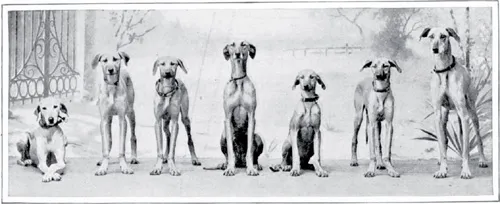
GROUP OF NORTH AFRICAN GAZELLE HOUNDS.
THE PROPERTY OF HERR MICHEL LA FONTIJN.
ORIENTAL GREYHOUNDS.
BY THE HON. FLORENCE AMHERST.
“L’Orient est le berceau de la Civilisation parce que l’Orient est la
patrie du Chien.”—TOUSSENEL.
“No bolder horseman in the youthful band
E’er rode in gay chase of the shy gazelle.”
EDWIN ARNOLD.
1. The Slughi, Tazi, or Gazelle Hound.*—The original home of the Slughi is difficult to determine. It is shown by the monuments of ancient Egypt that these Gazelle Hounds were kept in that country for hunting purposes, but they seem to have been of foreign importation—both from Asia and Africa.
In Persia the Slughi is known as the “Sag-i Tazi” (Arabian Hound), or merely as the “Tazi,” which literally means “Arabian” (a term also applied there to Arab horses), denoting an Arab origin. According to tradition at the present day on the Persian Gulf, it is said that these dogs came originally from Syria with the horse. Arabic writers say that the Slughi was only known to the Pharaohs, thanks to the Arabs and to their constant caravans that plied from immemorial times between the two countries.
The name Slughi, which means a Greyhound, bears with it a history recalling the vanished glories of Selukia and the Greek Empire in Syria, and Saluk, in the Yemen, that rich land of mystery and romance. The word originated from these places, once famous for their “Saluki” armour, and “Saluki” hounds. Other districts bearing similar names are quoted as being connected with these hounds.
Although now, as formerly, valued by the amateurs of the chase, it is in the lone deserts, among the Bedawin tribes, that the real home of the Slughi is to be found. There, in spite of the changes in the world around, the life remains the same as in bygone ages. There has been no need to alter the standard to suit the varying fashions in sport. It is the fact that these beautiful dogs of to-day are the same as those of thousands of years ago which adds such a special importance to the breed.
The Slughi (Tazi) is to be found in Arabia (including the Hedjaz), Syria, Mesopotamia, Valleys of the Euphrates and Tigris, Kurdistan, Persia, Turkestan, Sinai Peninsula, Egypt, the Nile Valley, Abyssinia, and Northern Africa. By examining the extent and position of the deserts inhabited by the great nomadic Arab tribes connected by pilgrim ways and caravan routes, the distribution of the Gazelle Hound can easily be followed.
The different types of the Slughi are known by the distinctive names of the Shami, Yamani, Omani, and Nejdi. The Shami has silky hair on its ears, and long feathery hair on its tail. The Yemen and Oman breeds have not much feathering on ears or tail. The Nejdi has shorter hair than any of the above varieties. Native experts can tell them apart. In some districts the smooth and in others the feathered varieties predominate.
The feathered type of Slughi having been kept throughout Persia from the earliest times by the sporting Khans, has led Europeans to apply the name “Persian” Greyhound to this variety, and thence also to infer that it came from Persia southwards, though the word “Tazi” (Arabian) and the distinctive name “Shami” (Syrian) denote the contrary. It is also stated that after two or three generations in Persia Greyhounds become much bigger and heavier and have longer hair; sportsmen are therefore constantly importing fresh stock from the south. In some districts in Persia, however, the smooth-coated variety predominates.
As with his famous horses and camels, the Bedawi attaches much importance to the pedigree of his Slughi. Though different types are found in the same localities, natives are very careful not to mix the breeds. Some families of the Gazelle Hound are especially renowned. A celebrated dog was looted as a puppy from south of Mecca. His descendants are now famous among the tribes on the north of the Persian Gulf.
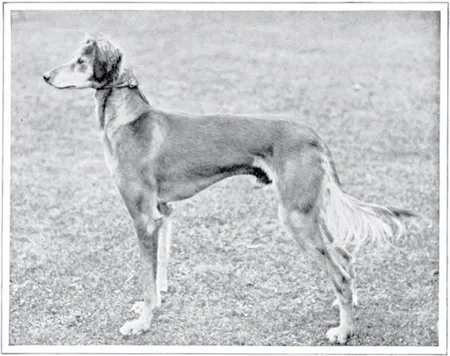
A TYPICAL SLUGHI (SHAMI).
BRED IN ENGLAND BY THE HON. FLORENCE AMHERST.
Photograph by T. Fall.
The Slughi or “hound” is highly valued, and not treated like the despised “dog” or “kelb” of the East. The Arab speaks of him as “el hor” the “noble,” and he is held to be as the “Gre” hound was of old in England, “the dogge of high degree,” as referred to by Caius. He has the thoughtful care of his master, and, unlike the other dogs which are kept outside the encampment, is allowed to stretch himself at ease on the carpet of his master’s tent. The children play with him, and he is decorated with shells, beads, and talismans. On the march he is often placed on camel-back, and at times when hunting, till the game is approached, is carried on horseback in front of his master. A French writer in describing the Bedawin says: “If I want to point out how truly the Arabs are gentlemen I should give one simple proof, namely, the affection they show to their Greyhounds.” The Arabs themselves say: “Ah, he is a gentleman indeed, he has been brought up with the Slughi.” In 1216 a Persian historian quotes the story of a great prince, who contrasts the hard life he has out hunting all day with the merry life of his much spoilt and pampered Tazi.
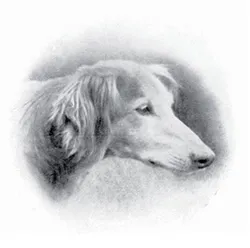
SLUGHI LUMAN (
AGE 11
YEARS)
PROPERTY OF THE HON. FLORENCE AMHERST.
Not only to those who seek the distractions of sport is the Gazelle Hound of value. In the far off deserts he has a more important part to play. It is to the “prince of swiftness” that the Arab must often trust for his supply of food.
The Slughi is used in the present day, as in ancient times, for hunting gazelle, antelope, hares, foxes, and other desert animals. It is employed for hawking, coursing, and all such sports. He can pull down the gazelle, hares, and foxes alone, and although, as a rule, hawks are used to assist, the test of a good dog is that he can bring down a gazelle by himself. He is described as having “a most perfect eye,” and is also said to have “a wonderful nose for game.”
There are various methods of using the Gazelle Hound for sport. “The hawk, when free, rises in the air, and, perceiving its prey, swoops down upon it, and attacks the head of the gazelle and confuses it till it falls an easy prey to the Greyhounds in pursuit.” Where the bushes are high the dogs are said to pursue the hare by following the flight of the hawk.
On the desert round Cairo a Khedivial hawking party is described. The princes ride out, “with a gay retinue, with hawk on wrist, and Sluhgi in the leash.” When the gazelle is sighted, “with a peculiar shrill cry” the prince lets his hawk fly, the Greyhounds following with their tails waving like banners, which are said to “steer them over the breezy plain.” A favourite sport in Persia is to gallop on horseback and shoot mouflon from the saddle, driven from the mountains and pursued by Tazi on the plain.
A Sheikh of the Anezeh (in the Hauran), giving his opinion of hawking, adds: “We prefer to run down the gazelle with our Greyhounds . . . for therein is more sport.” A great hunter in the Sinai Peninsula thus speaks of hunting gazelle without a hawk: “The sportsman keeps hold of his dog up wind, till within about 500 yards of them, and then sends him away, and he easily catches the prey. They run over the desert hare almost in a moment.” Dogs are sometimes placed along the track where the game is likely to pass. Throwing-sticks are also used for catching hares, assisted by the Slughi. Hunting with the Khan of Kelat they are described as “galloping over country that was boulder strewn,” and have been seen in Arabia to course hares “over ground that would have broken every bone in an English Greyhound, without hurting themselves.” They can also jump a very great height. Coursing matches are known in the East. The speed Gazelle Hounds are credited with is 20 to 30 mètres (about 21 to 32 yards) per second in spite of the sand in which their paws dive heavily. Added to the above qualities they are endowed with sagacity and great powers of endurance. So fully qualified for their work, no wonder they are preserved with so much care, and the Arabs may well say of them as of their treasured horses, “Are not these the inheritance of our fathers, and shall not we to our sons bequeath them?”
The natives give great attention to the rearing of their Slughi. They bring them up for a year on sheep’s milk, which is said to make them strong, and especially swift. When they are old enough they are fed with the hawks.
When quite young they are taught to bring back to their master bones and desert rats which have been thrown for them to retrieve. The children assist at their early education. At about six months old the puppies are taken out to hunt rats and jerboa, and are subsequently taught to course hares, and finally gazelle. They are occasionally trained only by accompanying a well-trained dog. At two years old they should be fully qualified for sport. They are kept in lean condition to make them keen.
The scattered tribe of the Soleyb, the great hunters of the desert, in parts of Syria and Mesopotamia, are especially famed as breeders of the Slughi. A Soleyb will occasionally do a little dog dealing, and will go far across the desert to complete a bargain. As a rule, however, the Slughi is presented as a gift by one chief to another, or as a mark of esteem to travellers, the owners refusing money for them,...