eBook - ePub
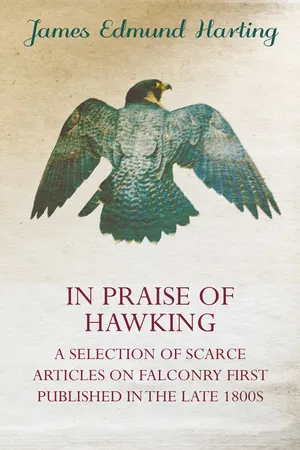
In Praise of Hawking - A Selection of Scarce Articles on Falconry First Published in the Late 1800s
- 142 pages
- English
- ePUB (mobile friendly)
- Available on iOS & Android
eBook - ePub
In Praise of Hawking - A Selection of Scarce Articles on Falconry First Published in the Late 1800s
About this book
This collection of scarce articles on falconry have been gleaned from sporting publications of the late 1800s. Both Harting and Freeman were well known falconers who wrote various books on the sport. They also contributed many learned articles to the sporting press of the time and were often requested for chapters on falconry for insertion in other authors books. This book carries selected items from the above, most of which will have been unread by the many devotees of this fast-growing pastime. The book consists of 160 pages with superb black and white illustrations by famous wildlife artists Archibald Thorburn and George E. Lodge. Contents Include: Hawks and Hawking. Origins and History. The Boke of St. Albans. Hawking as Taught by the Boke of St. Albans. Taking Passage Hawks in Holland. How to Train a Passage Hawk. In Praise of Hawking. Rabbit Hawking. Partridge Hawking. Falcons and Falconry. Deer Hawking in India. etc. This book will appeal greatly to all with a serious interest in falcons and falconry. Many of the earliest sporting books, particularly those dating back to the 1800s are now extremely scarce and very expensive. We are republishing these classic works in affordable, high quality, modern editions, using the original text and artwork.
Information
Print ISBN
9781846640780
9781846640797
Subtopic
ZoologyHAWKS AND HAWKING
By James Edmund Harting
An Abstract of One of the "Davis Lectures"
Delivered at the Zoological Gardens, June 24th, 1880
Delivered at the Zoological Gardens, June 24th, 1880
IT has been said that the history of animals interests us in proportion as they are of service to us, or are the means of providing us with amusement. Hawks are capable of both, and on this account, therefore, may be said to deserve a greater share of attention than is generally accorded to them at the present day. We are all hunters by nature. We have an inherent passion for chasing and taking wild animals, and feel an inward satisfaction in outwitting their natural instinct which prompts them to fly from us, by our reason, which is exercised by observation of their habits. Our ancestors were hunters through necessity. They had to chase and kill wild animals in order to live. They either pursued them with hounds till they were brought to bay, and then slew them with sword or spear, or stalked them in the forest, and killed them with bow and arrow, or with a sling. The larger animals were taken in nets, pitfalls, or other devices, and succumbed to the united strength of numerous assailants.
Birds which in their own element, the air, evaded pursuit, were taken either in snares or with birdlime, the use of which appears to have been known at a very early date. By degrees, it would seem, from continued observation of their predatory habits, hunters conceived the idea of snaring birds of prey and of training them to be of use to them in the chase; in other words, they instituted the art of Falconry or Hawking.
The origin of this art it is now impossible to discover. From the earliest times of which history takes cognizance people of all nations, but more particularly those of eastern origin, have practised the sport; and we may form some idea of its antiquity from Sir A. H. Layard’s discovery of a bas-relief amongst the ruins of Khorsabad, in which a falconer is represented carrying a hawk upon his wrist. From this it is to be inferred that hawking was practised there some 1700 years B.C. In China it was known even at an earlier date than this; for in an old Japanese work, of which a French translation appeared at the beginning of the present century,[1] it is stated that falcons were amongst the presents made to princes in the time of the Hia dynasty, which commenced in the year 2205 B.C. The records of King Wen Wang, who reigned over the province of Hunan between 689 and 675 B.C. show that in his day hawking was much in vogue there.[2] In Japan it seems to have been known many centuries before the Christian era, and probably at an equally early date in India, Arabia, Persia, and Syria.
From the East it was introduced into Europe, although the precise date of such introduction is unknown; but from the allusions made to the sport by Aristotle,[3] Pliny[4], Ælian,[5] Martial,[6] and Oppian,[7] brief and even vague though they be, we may infer that hawking was known to, if not practised by, Europeans at least three centuries before the Christian era.
John of Salisbury, who died in 1182, discussing the question of the origin of Falconry in Europe,[8] arrived at the conclusion that it was introduced into Greece by Ulysses after the siege of Troy, an opinion which has been ...
Table of contents
- FALCONRY
- HAWKS AND HAWKING
- THE BOKE OF ST. ALBANS
- HAWKING AS TAUGHT BY THE BOOK OF ST. ALBANS
- TAKING PASSAGE HAWKS IN HOLLAND
- HOW TO TRAIN A PASSAGE HAWK
- IN PRAISE OF HAWKING
- RABBIT HAWKING
- PARTRIDGE HAWKING
- FALCONS AND FALCONRY
- DEER HAWKING IN INDIA
Trusted by 375,005 students
Access to over 1.5 million titles for a fair monthly price.
Study more efficiently using our study tools.
Frequently asked questions
Yes, you can cancel anytime from the Subscription tab in your account settings on the Perlego website. Your subscription will stay active until the end of your current billing period. Learn how to cancel your subscription
No, books cannot be downloaded as external files, such as PDFs, for use outside of Perlego. However, you can download books within the Perlego app for offline reading on mobile or tablet. Learn how to download books offline
Perlego offers two plans: Essential and Complete
- Essential is ideal for learners and professionals who enjoy exploring a wide range of subjects. Access the Essential Library with 800,000+ trusted titles and best-sellers across business, personal growth, and the humanities. Includes unlimited reading time and Standard Read Aloud voice.
- Complete: Perfect for advanced learners and researchers needing full, unrestricted access. Unlock 1.5M+ books across hundreds of subjects, including academic and specialized titles. The Complete Plan also includes advanced features like Premium Read Aloud and Research Assistant.
We are an online textbook subscription service, where you can get access to an entire online library for less than the price of a single book per month. With over 1.5 million books across 990+ topics, we’ve got you covered! Learn about our mission
Look out for the read-aloud symbol on your next book to see if you can listen to it. The read-aloud tool reads text aloud for you, highlighting the text as it is being read. You can pause it, speed it up and slow it down. Learn more about Read Aloud
Yes! You can use the Perlego app on both iOS and Android devices to read anytime, anywhere — even offline. Perfect for commutes or when you’re on the go.
Please note we cannot support devices running on iOS 13 and Android 7 or earlier. Learn more about using the app
Please note we cannot support devices running on iOS 13 and Android 7 or earlier. Learn more about using the app
Yes, you can access In Praise of Hawking - A Selection of Scarce Articles on Falconry First Published in the Late 1800s by James Edmund Harting in PDF and/or ePUB format. We have over 1.5 million books available in our catalogue for you to explore.