- 334 pages
- English
- ePUB (mobile friendly)
- Available on iOS & Android
eBook - ePub
About this book
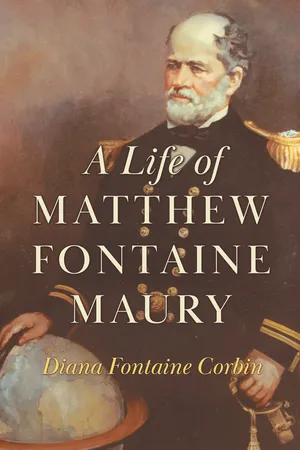
Matthew Fontaine Maury has been nicknamed the "pathfinder of the seas" and the "father of modern oceanography". This is a detailed biography of the man who created a science. Many of the earliest books, particularly those dating back to the 1900s and before, are now extremely scarce and increasingly expensive. We are republishing these classic works in affordable, high quality, modern editions, using the original text and artwork.
Information
Topic
Physical SciencesSubtopic
OceanographyA LIFE
OF
MATTHEW FONTAINE MAURY,
U.S.N. AND C.S.N.

CHAPTER I.
Ancestry of Matthew Fontaine Maury—Virginian Planters—Huguenots in Virginia—The Rev. James Maury—His School and Scholars—Thomas Jefferson and the Great North-West—Richard Maury and Diana Maury—Birth of Matthew Fontaine Maury—Emigration to Tennessee—State of society in Tennessee—Occupations and amusements of Maury and his brothers—Religious training—School life.
THE subject of the present biography was one whose life-story deserves to be studied and held in reverence, not only by that great American nation which produced him, but by the whole civilised world; for the best part of his life was devoted to the performance of services which conferred benefits on the seafaring classes of all countries, while the ideas to which he first gave birth have since borne fruit, and are likely to be useful to the whole human race. In Maury we find two characteristics, each valuable in itself, but which almost invariably produce great results when they are combined. He was endowed with extraordinary powers of application and unflagging industry in working out the dryest details. But he also possessed a vivid imagination, so that the dry bones of his new science were endowed with life and interest by the magic touch of his descriptive pen. It was Maury who created the science of the physical geography of the sea, and gave that impetus to its study which, in other hands, continues to produce results alike of practical and speculative importance. The higher qualities of the illustrious hydrographer, his self-denying zeal, his single-minded patriotism, his private virtues, will appear in the course of the narrative.
It is desirable that the student of Maury’s life should know something of the stock from which he was derived. Matthew Fontaine Maury was descended from a Huguenot family on the father’s side, while his maternal ancestor received a grant of land in Virginia from King Charles II. Dudas Minor, in whose favour this grant was made in 1665, was an English gentleman who became the ancestor of the family of Minor in Virginia; branches of which have since moved into Louisiana, Missouri, Kentucky, and other Southern States. The Virginian planters formed a colonial aristocracy with practical exemption from taxation, great command of labour, and almost a monopoly in the production of tobacco. Some of these planters possessed estates of such extent that they amounted to principalities. Lord Fairfax owned all the land between the waters of the Potomac and the Rappahannock. Twenty-six of the finest counties of Virginia were the property of a single nobleman but little over a century ago, whose descendants of to-day do not own an acre of that vast inheritance. Many of the Virginian estates were granted by Queen Anne, and some are still held under deeds from her. She was a favourite in Virginia, was good Queen Anne, and her name was bestowed upon a whole system of rivers.* In the revolutionary war the Virginian planters displayed a patriotic munificence which sufficiently proved their wealth. On one occasion Governor Nelson bought 1000 horses for the service of his State; on another he subscribed 200,000 dollars. Mann Page, afterwards governor, fed Washington’s army for a week from the supplies of his own plantations.
These Virginians had become a proud and happy race. It is to them we owe that scheme of civil liberty which has blessed the American people, and is to-day extending its happy influences over the world. Inheriting ample fortunes, they were educated in the best schools of the old country, whence they returned to their estates, and passed their lives in contemplating the great possibilities awaiting the new world, and in devising the means by which the capabilities of their adopted country could be developed. Living like patriarchs, served by the willing hands of kindly slaves, freed from all monetary cares, with minds stored with the precedents of history, and knowing no short cuts to knowledge, these men thought out and finally proclaimed that plan of self-government which is to-day the admiration and desire of all the peoples of the earth. Thus George Mason of Gunston composed that “Bill of Rights of Virginia,” on which Jefferson afterwards based the Declaration of Independence of the United States.
The Church of England was the only church of the colony. Its edifices, built of English bricks, still stand amidst the graves of old Virginia. Many of them are empty and silent now, serving only as monuments of the dead generations of a noble race. Others have been repaired and modernised by the iconoclasts of these times, and still resound with the grand old ritual of the Church.
Into this Virginian community the Huguenots came, bringing with them the simple service of their creed, the influence of which is still felt in the Low Church observances of their adopted country. These Huguenots, after the Revocation of the Edict of Nantes, became a persecuted community. Some abjured their religion, for the penalties of nonconformity were cruel; but many thousands of braver spirits, who spurned the offers and defied the threats of Louvois, left France for ever and braved exile and poverty for their faith. They brought with them their names, their courage, and their resolve to worship God according to their consciences. In Virginia they could have no grants of land, for all was already occupied. But they had absolute freedom to think, to work, and to worship God in their own way, amidst a people who welcomed and loved them for their fidelity to a common faith.
Amongst these exiles the families of Fontaine and Maury, who had borne a prominent part in the resistance offered by the Huguenots of France to the dragonnades of Louvois, arrived in Virginia in 1714. Identified in a common cause and a common misfortune, they were connected by marriage before leaving France, and became still more closely affiliated in Virginia. In 1722 the Rev. James Fontaine wrote his autobiography, when he was sixty-four years of age, beginning the record of his family with the birth of his ancestor, Jean de la Fontaine, who was born in the year 1500. This worthy resided in the province of Maine, near the borders of Normandy. He was a staunch supporter of the Protestant Church, and occupied an elevated position at Court. But, having become a convert in about 1535, he was hated on account of his zeal for the pure worship of God, and it was deemed expedient to get rid of so prominent a heretic as soon as possible. Charles IX. was then in his minority, and Catherine de Medici held almost unlimited power. Accordingly a band of ruffians was despatched from the city of Le Mans—in the year 1563—to attack his house at night. He and his wife were foully murdered. “Oh, my children,” exclaims the pious biographer, “let us never forget that the blood of martyrs flows in our veins, and may God, of His infinite mercy, grant that the remembrance of it may enliven our faith, so that we prove not unworthy scions of so noble a stock! God has promised to bestow special blessings upon the seed of the righteous. I have been young and now am old, yet have I never seen the righteous forsaken, nor His seed begging their bread. And we can generally see His providential care guarding the children of those whose blood has been shed in His service.” The three young sons of these Christian martyrs were providentially saved, and lived to rear a numerous progeny in the fear of God and the faith of their murdered parents.
This narrative was written in French by the Rev. James Fontaine for the use and edification of his children, some years after he was driven from France by the persecutions following the Revocation of the Edict of Nantes. It was found, 150 years afterwards, at Rock Castle in Hanover County, Virginia, the residence of Mr. James Fontaine, and was translated from the French and published under the title of ‘Memoirs of a Huguenot Family.’ The editor was Miss Ann Maury, great-granddaughter of Mary Ann Fontaine (the only daughter of the Rev. James Fontaine, the writer of the Memoirs), and of Matthew Maury, a Huguenot gentleman. The subject of this biography was also a great-grandchild of Matthew Maury and Mary Ann Fontaine.
Richard Maury, father of the subject of this biography, was the sixth son of the Rev. James Maury, who was son of Matthew Maury and Mary Ann Fontaine. The Rev. James Maury was an episcopal clergyman and instructor of youth in Walker parish, Albemarle County, Virginia; and he numbered among his pupils three boys who afterwards became Presidents of the United States, and five signers of the Declaration of Independence.
He was a quiet thinker—a serene old man, who gave the week to contemplative thought and to his school, and Sunday to the service of the sanctuary. In 1756 he was already dazzled by the rising glory of the new country. He was intensely interested in the Great North-West. The Missouri river was a myth at that time: Cox had ascended the Mississippi to the Falls of St. Anthony, and reported the existence of such a stream, but all beyond was shrouded in mystery. “But see,” said the aged clergyman, pointing with trembling finger and eager eye to the map of the North American Continent—“see, there must be a large river in that direction: mountains are there, and beyond them there must be a stream to correspond with the vast river on this side of the chain.” And by a process of reasoning based on physical geography, he pointed out to his pupils (Thomas Jefferson among them) the existence and line of the river as accurately as Le Verrier did the place of Neptune in the firmament, and predicted that a great highway to the West would some day be opened in this direction.
Thomas Jefferson became interested in the grand thought. Amid the excitement and splendours of the Court of France he cherished the idea of that hypothetical river, its advantages to the United States, the establishment of trading-posts and kindred plans. He urged its exploration upon Ledyard, the celebrated African explorer. Ledyard consented to undertake it, but was prevented owing to subsequent misfortunes.* Though foiled thus in his first effort, Jefferson still clung to his favourite project, and at last the time came for its fulfilment. Elected to the Presidency of the United States, he planned the expedition of Lewis and Clarke, secured the consent of Congress, and despatched them on their mission of discovery.
In 1790 Richard Maury, son of the Rev. James Maury, married Diana, daughter of Major John Minor, of Topping Castle in Caroline County, Virginia, descended from the settler who had received a grant of land in the reign of Charles II. There were nine children of this marriage; and thus the blood of Protestant England was commingled with that of Huguenot France in the veins of this Virginian family. After their marriage, Richard and Diana Maury first settled in Spottsylvania County, about ten miles west of Fredericksburg. There, on January 24th, 1806, their fourth son, Matthew Fontaine, was born, and was named after his two paternal great-grandfathers. When little Matthew was in his fifth year, his father emigrated to Tennessee with his young family. Their worldly goods were transported in large waggons. Little Matthew, when tired of walking and cramped from riding, was frequently carried on the back of his sister Matilda.
The Maury family established themselves near Franklin, a village eighteen miles north of Nashville. Here young Matthew assisted his father and brothers in the labours of the farm, while his mother and sisters spun, wove, knitted, and fashioned the garments they wore. In short, the family lived the lives of early settlers in what was then a new country.
Wyoming is not wilder to-day than Tennessee was eighty years ago. There were no steamboats then; no railroads, no turnpikes, and no stage-coaches nor stage-roads in all the State. Bridle-paths and rough farm-roads alone enabled the scattered settlers to meet each other. School-houses were few and distant; they, as well as the meeting-houses and homes, were mostly built of logs hewn from the surrounding forests. But few of the public buildings were of brick or stone, and only men of wealth and enterprise solaced their self-respect, and recalled the memories of their Virginian homes, in residences of boards or brick.
The planter’s life in that day was self-sustaining. The women, by an occasional visit to the village, purchased their ribbons and finery. These visits were few and brief: they broke the routine of the home life to the women, as hunting did to the men, and were usually made on horseback.
In the planters’ homes there was plenty of poultry and beef, mutton, and Virginia hams, cured by immemorial recipes, beet biscuit, light bread, butter-cakes, buck-wheats, tea, and coffee. There was whiskey, also, to comfort and cheer the wayfarer, and in Tennessee “the latch-string was always out,” and has ever been so, even until now.
The day of obedient parents had not then dawned upon the young folks, and in the Maury household there was an unconscious repressive sway. Good and gentle were the parents, but the children became silent in their presence. Matthew’s father was very exact in the religious training of his family, now numbering five sons and four daughters, viz., John Minor, Mary, Walker, Matilda, Betsy, Richard Launcelot, Matthew Fontaine, Catherine, and Charles.
He would assemble them night and morning to read the Psalter for the day, verse and verse about; and in this way, so familiar did this barefooted boy become with the Psalms of David, that in after life he could cite a quotation, and give chapter and verse, as if he had the Bible open before him.
Surrounded by all these pure and simple influences, amidst the solitude and silence of the primeval forests, young Maury passed his youth. The cotton-field found him farm-work, and a racoon or bear hunt, with the negroes and hounds brought from Virginia, made up his field-sports. These, and earnest attention to all the opportunities of learning at school, prepared him for the great work of his life.
“It was about this time,” he says, “that my first ambition to become a mathematician was excited by an old cobbler, Neal by name, who lived not far from my father’s house, and who used to send the shoes home to his customers with the soles all scratched over with little x’s and y’s.”
After obtaining such elementary instruction as the “old field” schools of that period and region afforded, young Maury entered Harpeth Academy,* subsequently under the charge of Rev. J. H. Otey (afterwards Bishop of Tennessee), assisted by William C. Hasbrouck, who subsequently became a distinguished lawyer of New York.
The quick active mind, and studious habits of the youth soon attracted the notice and secured the regard of his instructors; and so long as the good bishop and the eminent barrister lived, there existed between both and their former pupil the warmest friendship.
* The North Anna, South Anna, Rivanna, Fluvianna, and Rapid Ann, perpetuate her memory.
* Ledyard had been a corporal of marines in Captain Cook’s third voyage. He undertook a journey across Siberia, but was arrested, sent back under a guard, and turned adrift at the Polish frontier. He was afterwards employed by Sir Joseph Banks, and the African Association, to explore the interior of that continent; but he died at Cairo in 1788.
* When in his twelfth year he had fallen from a high tree one day, a height of forty-five feet, and was taken up apparently lifeless. It was found upon examination that he had bitten his tongue almost off, and had injured his back so much that his father thought be would never be fit for work on the farm again. He therefore determined to yield to the lad’s earnest wish for more schooling, and permitted him to attend Harpeth Academy.
CHAPTER II.
Notice of the Career of Maury’s eldest brother—His Life in the Navy—He is left on the Marquesas Islands for two years—He is taken on board the ‘Essex’ by Commodore Porter—Capture of the ‘Essex’ at Valparaiso—At the Battle of Lake Champlain—Dies at Sea—Matthew receives a Midshipman’s Warrant—His Journey to take up his ap...
Table of contents
- Cover
- Title
- Dedication
- Contents
- Preface
- Chapter I
- Chapter II
- Chapter III
- Chapter IV
- Chapter V
- Chapter VI
- Chapter VII
- Chapter VIII
- Chapter IX
- Chapter X
- Chapter XI
- Chapter XII
- Chapter XIII
- Chapter XIV
- Chapter XV
- Chapter XVI
- Chapter XVII
- Appendices
Trusted by 375,005 students
Access to over 1.5 million titles for a fair monthly price.
Study more efficiently using our study tools.
Frequently asked questions
Yes, you can cancel anytime from the Subscription tab in your account settings on the Perlego website. Your subscription will stay active until the end of your current billing period. Learn how to cancel your subscription
No, books cannot be downloaded as external files, such as PDFs, for use outside of Perlego. However, you can download books within the Perlego app for offline reading on mobile or tablet. Learn how to download books offline
Perlego offers two plans: Essential and Complete
- Essential is ideal for learners and professionals who enjoy exploring a wide range of subjects. Access the Essential Library with 800,000+ trusted titles and best-sellers across business, personal growth, and the humanities. Includes unlimited reading time and Standard Read Aloud voice.
- Complete: Perfect for advanced learners and researchers needing full, unrestricted access. Unlock 1.5M+ books across hundreds of subjects, including academic and specialized titles. The Complete Plan also includes advanced features like Premium Read Aloud and Research Assistant.
We are an online textbook subscription service, where you can get access to an entire online library for less than the price of a single book per month. With over 1.5 million books across 990+ topics, we’ve got you covered! Learn about our mission
Look out for the read-aloud symbol on your next book to see if you can listen to it. The read-aloud tool reads text aloud for you, highlighting the text as it is being read. You can pause it, speed it up and slow it down. Learn more about Read Aloud
Yes! You can use the Perlego app on both iOS and Android devices to read anytime, anywhere — even offline. Perfect for commutes or when you’re on the go.
Please note we cannot support devices running on iOS 13 and Android 7 or earlier. Learn more about using the app
Please note we cannot support devices running on iOS 13 and Android 7 or earlier. Learn more about using the app
Yes, you can access A Life of Matthew Fontaine Maury by Diana Fontaine Corbin in PDF and/or ePUB format, as well as other popular books in Physical Sciences & Oceanography. We have over 1.5 million books available in our catalogue for you to explore.