- 120 pages
- English
- ePUB (mobile friendly)
- Available on iOS & Android
eBook - ePub
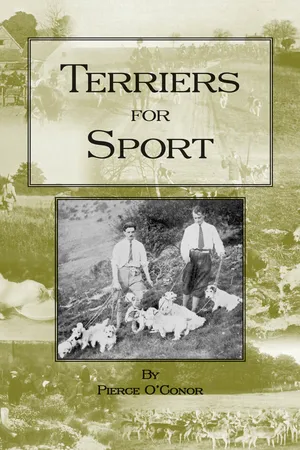
Terriers for Sport (History of Hunting Series - Terrier Earth Dogs)
About this book
Pierce O'Conor was a highly regarded Terrier Man of his day. This, his first book, "Terriers for Sport" which was published in 1922, has never before been reprinted and only a few copies of the original still remain. Read Country Books has now republished this early work using the original text and its rare vintage terrier work photos. The book is divided into concise chapters including: Getting a Team together Fox and Badger Digging. Badger Digging. Badger Hunting at Night. Otter Hunting. Otter Dogs and their Training. Stoat Hunting. Rats and Ratting. Rabbits. Water Hens. Casualties and First Aid. Management etc. The chapters on Otter Dogs and Otter Hunting with Spears were among the earliest recorded writings on this type of terrier work. In addition, the publishers have also added a significant amount of extra material gleaned from other early writings on working terriers. There are two new chapters by distinguished dog writer Theo Marples - The Sealyham Terrier as a Sporting Companion and Symptoms + Treatment of Common Ailments - plus 3 other articles by noted sportsmen of the day - Cairns are Working Terriers, Working Terriers Past amp Present and The Hunt Terrier Man and His Dogs. The book also contains a large number of B+W photos of terriers and terriermen that have never been reprinted before. Pierce O'Conor's wealth of knowledge and experience shines through the pages of this fascinating book which deserves a place on any true terrier man's shelf. N.B. The author has written two working terrier books, and this title should not be confused with his other book :- "Sporting Terriers. History, Training and Management." which was published in 1926. "Terriers For Sport" is available in a quality soft cover format.
Information
Print ISBN
9781905124312
9787770047701
FOOD.
The feeding of dogs is much more of a problem in these days of high prices than in the days of yore, when meal was cheap, and butchers’ offal to be had for the asking. Now, even four or five small terriers may well run one into considerable expense in the way af food.
In large households the scraps left over from the table, if carefully saved, will generally provide a meal for two or three dogs at least, but in small establishments there may not be enough leavings to feed more than one; the rest must be begged or bought.
If you happen to have any good friends in the hotel or restaurant business, you may perhaps persuade them to put a pailful of scraps on one side for you daily; and as you will probably have to fetch it yourself, a small covered pail is recommended as being less conspicuous in the street.
I am a great believer in working dogs getting plenty of flesh meat, and if you are driven to purchase the same, the cheapest obtainable is generally lights and throttles from the butcher. For the rest, condemned ships’ biscuit is sometimes to be had at a low figure, and if only slightly damaged is cheap food; but rotten, cavilly stuff is dear at any price, and should never be used. Rice and oatmeal are also sometimes obtainable in a slightly damaged condition, and make good porridge for dogs, whilst boiled fish heads, mixed with broken bread or potatoes, are much appreciated.
A certain amount of green food is very desirable, and a little sulphur mixed up with the food, once a week or so, will keep dogs’ coats in fine condition.
A stick of sulphur placed in the water pan is quite useless.
Do not feed all the dogs from one dish. Terriers are naturally quarrelsome creatures, and the weaker and slower eating dogs never get their full share. Give each dog his own portion, and stand by yourself to see fair play and no squabbling. If left to themselves, the stronger dogs are apt to wolf their own whack and then have a go at some other fellow’s; they even forget their accustomed chivalry at such times, and are not by any means above driving a bitch away from her dinner and eating it themselves.
Rabbit and chicken bones are better cut out of the menu, but large beef and mutton bones are good, and dogs get a lot of satisfaction out of gnawing them. You cannot prevent dogs taking bones into their beds, but they should be removed next day, and disposed of in some place where they cannot be resurrected.
The Sealyham Terrier as a Sporting Companion.
THEEE are few breeds that make a better sporting “pal” than the Sealyham Terrier, and many not nearly so good. He is, in the first place, a “hardy annual,” and usually “as game as they make ’em,” and withal intelligent and sensible. There is, moreover, no breed better adapted anatomically and physically for underground work in connection with the badger, a very hard-bitten animal, and in the haunts of the otter, which is perhaps a harder-bitten animal still, and a semi-aquatic animal, which can consequently take refuge in and under water, in addition to his subterranean retreats. Sealyham Terriers, as a rule, are good swimmers, their heavy-boned legs, big pads, and rotund bodies serving them well lor purposes of water work.
Sealyhams may be trained and used with success upon fox, stoat, weasel, rabbit, rat, and may even be broken to the gun, with, however, somewhat less success, speaking generally. The dog’s great fort in the field of sport, and for which he is better adapted than any other dog probably, is in connection with the badger, hunting “Mr. Brock,” and taking part in ousting him out of his natural earth, which provides some very bracing and exhilarating sport both for the dog and its human followers.
For purely “badgering” purposes some sportsmen prefer the Sealyham a little crooked in his forelegs, somewhat on the lines of the Dachshund—the German badger dog. The theory of this is that the dog with such foreleg formation is better adapted to scratching the earth away behind him when digging for the badger. But—and it is a big BUT—dogs so formed usually are wide in the brisket, and dogs wide in brisket are usually shallow in chest. Wider the brisket and wider must be the aperture of the earth—and, indeed, the whole burrow—which has to be made in an endeavour to reach the badger; whereas if the dog’s front was comparatively narrow, and his chest deep instead of wide, with short, straight, and stout forelegs, which all Sealyhams ought to have, he would have ample play for his work of excavation and require a smaller burrow, and the displacement of less earth, which presents no disadvantage in the performance of the pursuit of badger digging, but, on the other hand, every advantage.
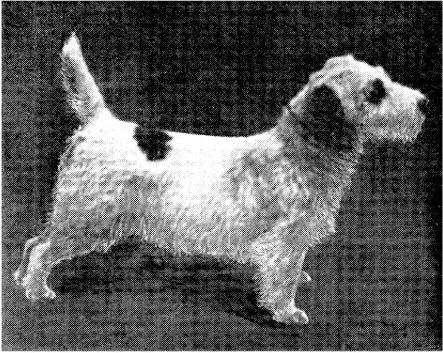
BOWHIT BETTY.
The following are the Rules formulated by the Sealyham Terrier Club for badger-digging trials:—
RULES FOR BADGER-DIGGING TRIALS.
1. That the object of this Committee is to test the efficiency of Sealyham and other working Terriers in natural earths.
2. That the names of any dogs required to be tested for certificates must be sent to the Secretary not later than the Saturday night previous to the Dig.
3. That there shall be Club Digs on the second and fourth Thursday of each month, from May in one year to the end of December in the following year.
4. All dogs must be at the place selected for the digs not later than 11 o’clock on the morning of the date fixed.
5. All dogs to be chained up a sufficient distance from the earth, so as not to interfere or hamper the competing Terriers, and no other dogs shall be permitted near the earth while the trials are in progress.
6. All digging arrangements to be left entirely to the duly appointed officials, and no interference will be permitted on any pretence whatsoever.
7. No dog to be put to ground until the owner receives notice from the judges that they are ready.
8. No persons except the judges, officials, and diggers, and the person working his or her dog, to be allowed near the earth.
9. All dogs to be given a reasonable time to enter, and if at the expiration of that time they decline to work, the judges can order that they shall be taken up and the next dog shall be called for.
10. There shall be one or more Club judges officiating at all Trials, it being understood that no dog owned or otherwise connected with a judge shall be presented for trial on the day he officiates as judge at such trial.
11. That is. Entry Fee will be charged for each dog presented for trial, such fee to be applied towards the expenses incurred in connection with the trial.
12. That not more than ten or less than six dogs shall compete at each trial unless the judge rules otherwise.
13. That all uncertificated dogs shall have preference over those holding certificates.
14. Should there be an insufficient number of dogs entered for a particular Trial the Secretary shall have power to notify the owners, and hold the entries over until the next dig.
15. A non-member of the Sealyham Terrier Club or Working Terrier Club shall not, whether working his or any other person’s dogs, interfere ia any way.
16. The decision of the judges shall in all cases be final, and any person or member adversely criticising the action of the judges shall have his name brought before the General Committee, who may penalise him by withholding the certificate.
17. The Committee beg to ask that all members will preserve badgers, and not frequent the earths with dogs where the Club digs are to take place.
18. Only dogs entered for competition will be allowed to be present at the Trials.
These Rules are subject to alterations and additions.
The best treatise on “badgering,” in respect of its proper and practical prosecution, appears in the little book, “Terriers for Sport,” by Pierce O’Conor, which every sporting-terrier enthusiast should have in his possession. We therefore reproduce that portion of Mr. O’Conor’s article on badger digging, which is as follows:—
BADGER DIGGING.
PERSONNEL AND EQUIPMENT.
PERSONNEL AND EQUIPMENT.
Three things are above all necessary to success in badger digging—good dogs, good diggers, and a good ear. Add to these a good slice of patience and a capacity for suffering disappointment without becoming unduly discouraged, and you have it ail.
I have already remarked on the importance of having hard, well-entered dogs. With dogs that come out of the earth, every half-hour, you may as well go home, for you will never handle a badger in a week, except by demolishing the whole earth, in which case that locality is lost to you for sport in the future. No fox or badger will go there again for many a long day, if ever.
Next to good dogs come good diggers. Lazy, idle fellows, or bad workmen who don’t know their business, spoil many a promising hunt.
Except in very large, difficult places, where it may be necessary to sink two, or even three, trenches, or where the work is so extensive as to require relays of diggers, two or three good men will do all you want. But they must be keen, and have a real taste for the work.
The late war afforded excellent practice in trench digging to some of us, and many old soldiers are first-rate hands with the pick and shovel; they are generally good sportsmen, too.
The idle loafer picked up outside the village pub is, as a rule, useless, and spends most of his time mopping his brow and trying to get a pull at the beer-jar; and, talking of beer, it is well to make a hard-and-fast rule that refreshment is only for those who earn it, and not for spectators.
With some Terrier clubs it is the custom to take round a “cap” after the dig, to pay the diggers and meet other casual expenses. One should have an understanding with the diggers that they are to be paid so much per day (or half a day, as the case may be), with a bonus for every full-grown beast taken, or else to divide the cap money, less a percentage. Personally, I much prefer the former plan, but much depends on the class of men with whom you have to deal.
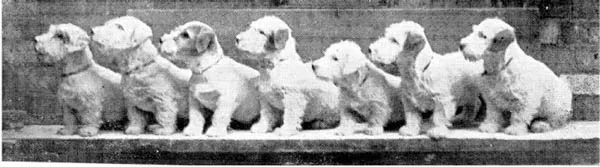
LITTER BY HAMPTONIA TARTAR.
Finally, a good ear is important, that you may readily ascertain the exact spot below which the dog and badger are situated, and so commence your digging operations in the right place. Nothing is more discouraging to men than to find, after half an hour’s work on a hot day, that their labour has been in vain, and a fresh start has to be made somewhere else.
EQUIPMENT.
With regard to the question of equipment generally, this should be kept as simple as possible; a multitude of fancy tools and appliances is very inconvenient to transport, and generally unnecessary.
A couple of spades, a pick or two with adze-shaped heads (such as are known as “twobills” or “diggers” in some parts of the country), a crowbar, a shovel, a chopper or hatchet for cutting roots, and badger tongs are the essentials. There are also one or two little special tools known as spuds and scrapers, which are useful in small places. A stout canvas sack, ventilated with brass eyelet holes, and having a draw-string and strap and buckle at the neck, is also required to put your quarry in when captured.
THE DIG.
Being now fully equipped with the necessary dogs and tools, and attended by a couple of good spade men, we may take the field. The first thing to do, having acquired information as to the position of the earths you mean to work, is to make a thorough inspection of the ground, ascertain what openings there are, and whether they have been recently used, and by what animals. The earth will commonly be situated on the side of a hill, with entrances above and below, and some men hold that the dog should always be put in at the lower hole, while others favour that on the higher ground. There is really nothing whatever in it; it is purely a matter of chance. Just loose your best and most reliable dog and leave matters to him, and he will soon decide for himself which passage will lead him most quickly to his foe. If the earth is unoccupied a good dog will lose no time in letting you see that such is the case, for he will leave the earth altogether and go hunting for a better place.
If, on the other hand, your dog goes to ground and remains there, listen attentively at the mouth of the hole for the first sounds of combat, and then cheer your dog on with all the power of your lungs. After a few minutes you may expect a period of silence, and then the fight will commence anew in some other part of the earth. If the place is a big one you may now slip another dog to assist, but not if there is a likelihood of the dogs fighting each other. A dog and bitch are best suited for this job, as there is then no danger of a row. After two or three sparring matches and running fights things will probably settle down below, and then, with your ear to the ground or against a crowbar driven in, you must endeavour to arrive at the spot immediately above the fight, and commence digging.
As has been indicated in a previous chapter, it is not always easy to know at first sight what animal you have got to deal with in an earth, whether fox or badger; the external evidences are not invariably unmistakable, but when you know your dogs their manner of working will generally not leave you long in doubt.
Having engaged in two or three lively duels with the dogs in different chambers and passages, the badger as a rule sets up pretty quickly, and the continuous baying of the Terriers in one place leaves little doubt as to where digging operations must begin. With a fox the procedure will be much the same where the earth is small, but in a big working, where he has lots of room, things are somewhat different. After the first sounds of warfare, which will only last a few minutes, there will be a rush and a scuffle, and then silence. After a while out will come your dog in great ...
Table of contents
- Cover
- Half title
- Copyright
- Title
- Contents
- Index to Illustrations
- Introductory
- Getting a Team Together
- Fox and Badger Digging
- Badger Digging
- Badger Hunting at Night
- Otter Hunting
- Otter Dogs and their Training
- Otter Hunting—The Hunt
- Stoat Hunting
- Rats and Ratting
- Rabbits
- Water Hens
- Casualties and First Aid
- Medicines
- Housing
- Food
Trusted by 375,005 students
Access to over 1.5 million titles for a fair monthly price.
Study more efficiently using our study tools.