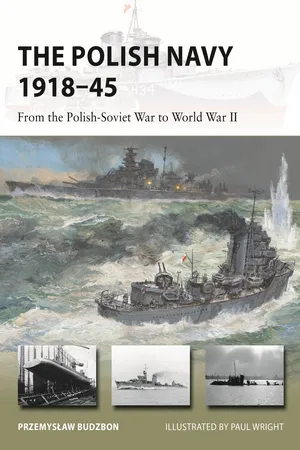
Packed with illustrations, this is a study of the Polish warships such as the Grom-class destroyers that were developed and built in the interwar years.
Newly independent Poland's naval force was created in 1920, initially with six ex-German torpedo boats. However, after German-Soviet exercises off the Polish coast in 1924, funding for warships was hastily allocated. Two destroyers and three submarines were built in France but, disappointed with their quality, Poland ordered new ships, mostly from British and Dutch shipyards.
By summer 1939, the Polish Navy comprised four destroyers, five submarines, one minelayer, six minesweepers and a handful of lesser ships. Although the Grom-class destroyers were two of the fastest and best-armed destroyers of the war, the tiny Polish fleet would stand little chance against the Kriegsmarine, and on 30 August three destroyers were dispatched to Britain, followed by two submarines that escaped internment. The remaining Polish surface fleet was sunk by 3 September.
In exile, the Polish Navy operated not only their own ships, but also Royal Navy warships, including a cruiser, destroyers, submarines and motor torpedo boats which fought alongside the Allies in the Battle of the Atlantic, the Arctic Convoys, and at the Normandy landings. This detailed account not only describes the Polish Navy's contribution to the Allied war effort but also the episode of the Polish destroyer Piorun which took on the Bismarck in a lone gun duel leading to the sinking of the great German battleship.
eBook - ePub
The Polish Navy 1918–45
From the Polish-Soviet War to World War II
- 48 pages
- English
- ePUB (mobile friendly)
- Available on iOS & Android
eBook - ePub
About this book
Information
POLISH NAVY DEVELOPMENT 1921–39
The navy from World War I remnants, 1921
The first stage of the Paris Peace Conference after World War 1 was concluded by the Treaty of Versailles, signed on 28 June 1919, which tried to resolve the problem of Poland’s lack of access to the Baltic Sea by carving out the so called ‘Polish Corridor’ between the bulk of Germany to the west and East Prussia to the east. The only problem was that the 42nmi (78km) strip of Polish coastline lacked a harbour of any importance, except for the local fishing ports at Puck and Hela, while Danzig became a Free City under international jurisdiction.

The fishing port of Puck late in 1922, crowded with almost all of the Polish Navy. Berthed at the right side of the pier, looking from the left: first row: the surveying vessel Pomorzanin (ex-German Wotan) and the gunboat Generał Haller (ex-Russian Lun); second row: the minesweepers Mewa and Czapla; in the background: the gunboat Komendant Piłsudski (ex-Russian Vodorez). (Narodowe Archiwum Cyfrowe)
Poland’s claims for a share of the German and Austro-Hungarian fleets were ignored, however the Allies did agree that Poland could have six small, unarmed German torpedo boats on condition that they be used only for border-guard duties with limited armament. It was clear that the Polish Navy and any harbours would have to be built from scratch. The Poles requested help from the British naval mission, which arrived in Warsaw in September 1919.
The first Polish Navy seagoing ship was the survey vessel Pomorzanin, commissioned in May 1920. A former German passenger coaster, it had been purchased the previous year to guarantee Poland’s obligations to cover the area around the coast with a hydrographic service.
In May 1920 Rear-Admiral Kazimierz Porębski, a former Imperial Russian Navy officer who had been appointed head of the Polish Navy the previous year, issued a plan for a naval expansion programme. The plan was good but Poland’s poor economy meant that it was never realized in full. In reality, the Navy was limited to the acquisition of four German FM-type minesweepers bought via Denmark (German export restrictions forbade the selling of ships to Poland) and two gunboats bought from the Crichton shipyard in Abo in Finland. The gunboats had originally been ordered by the Imperial Russian Navy, but their construction had not been completed before the Bolshevik coup of November 1917. In January 1921, eight months later than planned, the four river monitors ordered for the Pińsk Flotilla were accepted. The ex-German torpedo boats finally arrived from Britain in September 1921.
| Ślązak-class torpedo boats specifications (1922) | |
| Displacement | 325 tons (Kujawiak 330 tons) |
| Dimensions | length: 61.0m; beam: 6.40m; draught: 2.3m |
| Armament | 2 Hotchkiss 47mm Model 1885 guns |
| 2 Maxim 7.92mm Model 1908 machine guns | |
| mine rails | |
| Machinery | 2 AEG Vulcan steam turbines driving two shafts; 2 Yarrow boilers |
Table of contents
- Cover
- Title Page
- Table of Contents
- Introduction
- The Polish–Bolshevik War
- Polish Navy Development 1921–39
- The Polish Navy in World War II
- Conclusion
- Further Reading
- eCopyright
Trusted by 375,005 students
Access to over 1.5 million titles for a fair monthly price.
Study more efficiently using our study tools.
Frequently asked questions
Yes, you can cancel anytime from the Subscription tab in your account settings on the Perlego website. Your subscription will stay active until the end of your current billing period. Learn how to cancel your subscription
No, books cannot be downloaded as external files, such as PDFs, for use outside of Perlego. However, you can download books within the Perlego app for offline reading on mobile or tablet. Learn how to download books offline
Perlego offers two plans: Essential and Complete
- Essential is ideal for learners and professionals who enjoy exploring a wide range of subjects. Access the Essential Library with 800,000+ trusted titles and best-sellers across business, personal growth, and the humanities. Includes unlimited reading time and Standard Read Aloud voice.
- Complete: Perfect for advanced learners and researchers needing full, unrestricted access. Unlock 1.5M+ books across hundreds of subjects, including academic and specialized titles. The Complete Plan also includes advanced features like Premium Read Aloud and Research Assistant.
We are an online textbook subscription service, where you can get access to an entire online library for less than the price of a single book per month. With over 1.5 million books across 990+ topics, we’ve got you covered! Learn about our mission
Look out for the read-aloud symbol on your next book to see if you can listen to it. The read-aloud tool reads text aloud for you, highlighting the text as it is being read. You can pause it, speed it up and slow it down. Learn more about Read Aloud
Yes! You can use the Perlego app on both iOS and Android devices to read anytime, anywhere — even offline. Perfect for commutes or when you’re on the go.
Please note we cannot support devices running on iOS 13 and Android 7 or earlier. Learn more about using the app
Please note we cannot support devices running on iOS 13 and Android 7 or earlier. Learn more about using the app
Yes, you can access The Polish Navy 1918–45 by Przemyslaw Budzbon,Paul Wright in PDF and/or ePUB format, as well as other popular books in History & European History. We have over 1.5 million books available in our catalogue for you to explore.