An illustrated history of how Japan devised and launched a new kind of air campaign in late 1944 – the suicidal assaults of the kamikaze units against the approaching Allied fleets.
As summer changed to autumn in 1944, Japan was losing the war. Still unwilling to surrender, Japan's last hope was to try to wear down US resolve enough to reach a negotiated settlement. Extraordinary measures seemed necessary, and the most extraordinary was the formation of Special Attack Units – known to the Allies as the kamikazes.
The concept of organized suicide squadrons was first raised on June 15, 1944. By August, formations were being trained. These formations were first used in the October 1944 US invasion of the Philippine Islands, where they offered some tactical success. The program was expanded into a major campaign over the rest of the Pacific War, seeing a crescendo during the struggle for Okinawa in April through May 1945.
This highly illustrated history examines not just the horrific missions themselves, but the decisions behind the kamikaze campaign, how it developed, and how it became a key part of Japanese strategy. Although the attacks started on an almost ad hoc basis, the kamikaze soon became a major Japanese policy. By the end of the war, Japan was manufacturing aircraft specifically for kamikaze missions, including a rocket-powered manned missile. A plan for a massive use of kamikazes to defend the Japanese Home Islands from invasion was developed, but never executed because of Japan's surrender in August 1945.
Packed with diagrams, maps and 3D reconstructions of the attacks, this book also assesses the Allied mitigation techniques and strategies and the reasons and the degree to which they were successful.
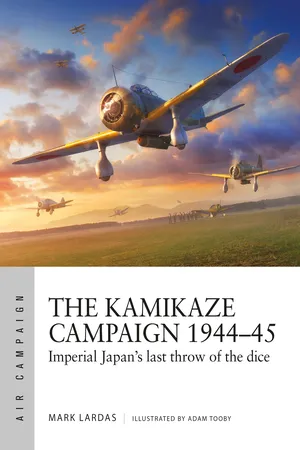
eBook - ePub
The Kamikaze Campaign 1944–45
Imperial Japan's last throw of the dice
- 96 pages
- English
- ePUB (mobile friendly)
- Available on iOS & Android
eBook - ePub
About this book
Information
THE CAMPAIGN
Dying for the Emperor
Self-sacrifice is part of warfare, closely linked to heroism. US soldiers joke that the surest way of winning the Medal of Honor, the nation’s highest reward for heroism, is to throw yourself on a live grenade to save your buddies. The almost certainty of individual death is measured against the lives saved by that sacrifice. Nor is fighting to the death unknown in Western culture: the Alamo and Custer’s Last Stand are honored in the United States, while in Europe, events as remote at the battle of Roncevaux Pass and as recent as the 1943 Warsaw Ghetto uprising are remembered.

No side had a monopoly on courage or the willingness to sacrifice one’s own life when called for. US Navy sailors frequently took near-suicidal risks battling fires aboard their ships, especially when necessary to save shipmates. (AC)
The kamikaze campaign was different. The entire campaign was an exercise in deliberate, mass suicide. No other air campaign was fought under those conditions. However, it was unique among the Japanese Pacific War effort only in its scale. For whereas an Allied soldier might fall on a live grenade to save his buddies, Japanese troops would hold one next to their bodies to avoid the shame of surrender.
The last stands of Western culture were fought when surrender was impossible or when a fight to the death was necessary to delay the enemy for strategic reasons. The Jews of the Warsaw Ghetto fought because they knew the Nazis were going to kill them anyway, so they decided to take as many Nazis as possible with them before they died. In Japan during the Pacific War, when defeat seemed inevitable, soldiers frequently threw themselves on the enemy in a suicidal attack, known to GIs and Marines as a Banzai charge. The primary purpose of the attack was to obtain an honorable death. Enemy casualties, while a desirable byproduct, were secondary.
The roots of this belief lay in Japanese culture and society, especially its religion. Imperial Japan’s emperor was its supreme deity, the highest in a vast pantheon. The Japanese Bushido, the military code of its feudal warriors, meant there was no higher honor than to die for the emperor. There was no greater disgrace than to disappoint the emperor through surrender.
This belief was carefully cultivated by the military dictatorship which took control of Japan in the 1920s. In 1931, outside Shanghai, three Japanese soldiers carrying a breaching charge through barbed wire defences deliberately blew the charge while next to it to ensure a breach was effected. A statue was raised to the men, who were hailed as examples to be emulated. They, and all those who died in military service for the emperor, were enshrined at Yasukuni Shrine in Tokyo as kami (deities). To die for the emperor was to gain divinity.

Japanese kamikaze pilots prepare for battle somewhere in the Philippines. A comrade tightens a hachimaki, a folded cloth to keep perspiration from the eyes, for a kamikaze pilot ready to sortie. The hachimaki symbolized the manly composure of kamikaze pilots. (USNHHC)
This belief was the basis of the kamikaze campaign and fueled the kamikaze spirit. Lieutenant General Kawabe, commander of the IJA’s air general headquarters, stated after the war: “Everyone who participated in these attacks died happily in the conviction that he would win the final victory by his own death. The Japanese … believed that by spiritual means they could fight on equal terms with you, yet by any other comparison it would not appear equal. We believed our spiritual conviction in victory would balance any scientific advantage [held by the Allies].”
He added:
You call our Kamikaze attacks “suicide attacks.” This is a misnomer, and we felt very badly about your calling them “suicide” attacks. They were in no sense “suicide.” The pilot did not start out on his mission with the intention of committing suicide. He looked upon himself as a human bomb which would destroy a certain part of the enemy fleet for his country. They considered it a glorious thing, while a “suicide” may not be so glorious.
The early kamikazes were all volunteers, filled with this attitude. Even after this pool of men was exhausted, and Japan resorted to conscripting “volunteers” into tokko units, most of those so selected still willingly participated. One such volunteer, saved from death by surrender, stated afterwards that he was “saddened to tears at receiving the death sentence [although] it is unmanly to say so.”
This was the context in which Japan started the kamikaze campaign. The result was a no-holds-barred fight, with literally no quarter asked for or received by either the Japanese or Allies. It began when activated by the Allied invasion of the Philippines in October 1944 and reached a climax during the ten-week struggle for Okinawa, but continued until the war ended in August 1945. Even the war’s end brought a spate of kamikaze attacks by volunteers unwilling to accept their emperor’s command to lay down their arms.
The first round: October 25–November 30, 1944
The kamikaze campaign opened quietly. On October 19, 1944, Vice Admiral Ōnishi Takijirō, commanding the First Air Fleet in the Philippines, activated the Kamikaze Special Attack Corps, in response to Japan activating Sho-Go. The IJN’s planned response to an anticipated Allied invasion of the Philippines, Sho-Go was activated the previous day after intelligence indicated Allied fleets were moving towards the Philippines.
The Kamikaze Special Attack Corps was organized from 24 volunteer pilots from the Navy’s 201st (Fighter) Group, stationed near Manila. The pilots were organized into four units, each with six pilots, and were assigned converted Zeros. Thriftily, the Japanese stripped these aircraft of radio, guns, and all but essential flight instruments, and armed each with a single 250kg bomb. The force was then dispersed, with some units sent to bases in Cebu and Davao in Mindanao. The rest operated out of Mabalacat, a satellite of Clark Field.
Pilots were instructed to execute crash attacks only against major Allied warships. Aircraft carriers had priority, while battleships were also acceptable. Smaller ships, however, were to be ignored. By Ōnishi’s calculation, 24 kamikazes were sufficient against the US Fast Carrier Task Force, estimated at between 12 and 20 fast carriers. Without the fast carriers, the Allies would be forced to withdraw their invasion force. Diluting the attacks by hitting minor warships meant too few kamikazes would remain to sufficiently cripple the fast carriers.
When the kamikaze sorties began on October 21, the initial attacks were ineffective. An unexpected strike by US carrier aircraft destroyed the entire six-plane unit on Cebu. The kamikaze pilots used three unmodified Zeros, the only surviving aircraft at the base, to conduct the mission regardless. Two of these were forced to return to base, weather preventing them from finding the Allied fleet. The third aircraft did find the fleet and launched its attack.
It apparently crashed into HMAS Australia, a heavy cruiser operating with the US Seventh Fleet, supporting the upcoming Leyte invasion. It was the first successful kamikaze attack and the first of four times Australia would be hit by kamikazes. Ironically, the attack went unrecognized as a kamikaze strike as it occurred intermixed with conventional bombing attacks on TF77, the Seventh Fleet’s battle force. Allied commanders debated whether the crash was deliberate, but most concluded it was either accidental or spontaneous.
The First Kamikaze Special Attack Group flew additional missions on October 22 and 23 with three of the group’s four units. However, these were unsuccessful. Either the searches failed to find enemy warships or t...
Table of contents
- Cover
- Title Page
- Table of Contents
- Introduction
- Chronology
- Attacker’s Capabilities
- Defender’s Capabilities
- Campaign Objectives
- The Campaign
- Aftermath and Analysis
- Further Reading
- eCopyright
Trusted by 375,005 students
Access to over 1.5 million titles for a fair monthly price.
Study more efficiently using our study tools.
Frequently asked questions
Yes, you can cancel anytime from the Subscription tab in your account settings on the Perlego website. Your subscription will stay active until the end of your current billing period. Learn how to cancel your subscription
No, books cannot be downloaded as external files, such as PDFs, for use outside of Perlego. However, you can download books within the Perlego app for offline reading on mobile or tablet. Learn how to download books offline
Perlego offers two plans: Essential and Complete
- Essential is ideal for learners and professionals who enjoy exploring a wide range of subjects. Access the Essential Library with 800,000+ trusted titles and best-sellers across business, personal growth, and the humanities. Includes unlimited reading time and Standard Read Aloud voice.
- Complete: Perfect for advanced learners and researchers needing full, unrestricted access. Unlock 1.5M+ books across hundreds of subjects, including academic and specialized titles. The Complete Plan also includes advanced features like Premium Read Aloud and Research Assistant.
We are an online textbook subscription service, where you can get access to an entire online library for less than the price of a single book per month. With over 1.5 million books across 990+ topics, we’ve got you covered! Learn about our mission
Look out for the read-aloud symbol on your next book to see if you can listen to it. The read-aloud tool reads text aloud for you, highlighting the text as it is being read. You can pause it, speed it up and slow it down. Learn more about Read Aloud
Yes! You can use the Perlego app on both iOS and Android devices to read anytime, anywhere — even offline. Perfect for commutes or when you’re on the go.
Please note we cannot support devices running on iOS 13 and Android 7 or earlier. Learn more about using the app
Please note we cannot support devices running on iOS 13 and Android 7 or earlier. Learn more about using the app
Yes, you can access The Kamikaze Campaign 1944–45 by Mark Lardas,Adam Tooby in PDF and/or ePUB format, as well as other popular books in History & Military & Maritime History. We have over 1.5 million books available in our catalogue for you to explore.