A rigorous new analysis of America's legendary 'Big Week' air campaign which enabled the Allies to gain air superiority before D-Day.
The USAAF's mighty World War II bomber forces were designed for unescorted, precision daylight bombing, but no-one foresaw the devastation that German radar-directed interceptors would inflict on them. Following the failures of 1943's Schweinfurt-Regensburg raids, and with D-Day looming, the Allies urgently needed to crush the Luftwaffe's ability to oppose the landings.
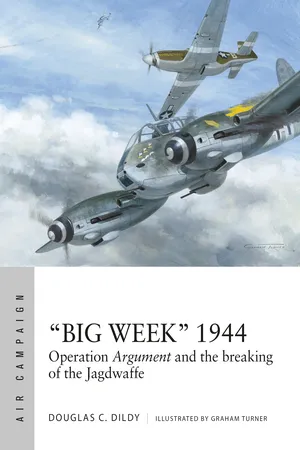
In February 1944, the Allies conceived and fought history's first-ever successful offensive counterair (OCA) campaign, Operation Argument or "Big Week." Attacking German aircraft factories with hundreds of heavy bombers, escorted by the new long-range P-51 Mustang, it aimed both to slash aircraft production and force the Luftwaffe into combat, allowing the new Mustangs to take their toll on the German interceptors. This expertly written, illustration-packed account explains how the Allies finally began to win air superiority over Europe, and how Operation Argument marked the beginning of the Luftwaffe's fall.
eBook - ePub
“Big Week” 1944
Operation Argument and the breaking of the Jagdwaffe
- 96 pages
- English
- ePUB (mobile friendly)
- Available on iOS & Android
eBook - ePub
About this book
Information
ATTACKER’S CAPABILITIES
The spectacle of huge air forces meeting in [battle in] the air is the figment of imagination of the uninitiated.
Captain Harold L. George, ACTS Instructor, October 31, 1935

Republic P-47D-2-RE 42-8009 – an early Razorback Thunderbolt – on a test flight while assigned to the National Advisory Committee for Aeronautics (NACA, the forerunner of NASA) Glenn Research Center at Cleveland, Ohio. A big, robust, and powerful fighter, it was affectionately called “the Jug” because its rotund fuselage had the shape of a moonshine bottle. (NMUSAF 020930-O-9999G-013)
The Pointblank Directive
Initially commanded by now Major General Spaatz, in June 1942 the Eighth AF began moving to England, establishing itself in East Anglia with three bomber groups and 119 B-17Es. Because the Americans completely lacked combat experience, at the outset the command was essentially an on-the-job training organization. In fact, after a few raids to build experience, one bomb group (92nd BG) became a combat crew replacement training unit and did not fly operational missions until the next summer. Additionally, as soon as units were declared combat-ready, most were reassigned to the newly established Twelfth AF in September and October, destined to support the Allies’ North African campaign, which began with Operation Torch on November 8.
To become General Dwight Eisenhower’s European Theater of Operations Air Commander, Spaatz was transferred to North Africa in that same month. On 1 December, Brigadier General Ira C. Eaker, then in charge of VIII Bomber Command (VIII BC), was promoted to command the Eighth AF.
With the six B-17 bombardment groups remaining in England, Eaker was directed to mount a submarine pen campaign, attempting to destroy German U-boats in their steel-reinforced concrete bunkers at the French ports of Saint-Nazaire and Lorient, as well as Bordeaux, Brest, and La Pallice. This ...
Table of contents
- Cover
- Title Page
- Table of Contents
- Introduction
- Chronology
- Attacker’s Capabilities
- Defender’s Capabilities
- Campaign Objectives
- The Campaign
- Aftermath and Assessment
- Bibliography
- eCopyright
Trusted by 375,005 students
Access to over 1.5 million titles for a fair monthly price.
Study more efficiently using our study tools.
Frequently asked questions
Yes, you can cancel anytime from the Subscription tab in your account settings on the Perlego website. Your subscription will stay active until the end of your current billing period. Learn how to cancel your subscription
No, books cannot be downloaded as external files, such as PDFs, for use outside of Perlego. However, you can download books within the Perlego app for offline reading on mobile or tablet. Learn how to download books offline
Perlego offers two plans: Essential and Complete
- Essential is ideal for learners and professionals who enjoy exploring a wide range of subjects. Access the Essential Library with 800,000+ trusted titles and best-sellers across business, personal growth, and the humanities. Includes unlimited reading time and Standard Read Aloud voice.
- Complete: Perfect for advanced learners and researchers needing full, unrestricted access. Unlock 1.5M+ books across hundreds of subjects, including academic and specialized titles. The Complete Plan also includes advanced features like Premium Read Aloud and Research Assistant.
We are an online textbook subscription service, where you can get access to an entire online library for less than the price of a single book per month. With over 1.5 million books across 990+ topics, we’ve got you covered! Learn about our mission
Look out for the read-aloud symbol on your next book to see if you can listen to it. The read-aloud tool reads text aloud for you, highlighting the text as it is being read. You can pause it, speed it up and slow it down. Learn more about Read Aloud
Yes! You can use the Perlego app on both iOS and Android devices to read anytime, anywhere — even offline. Perfect for commutes or when you’re on the go.
Please note we cannot support devices running on iOS 13 and Android 7 or earlier. Learn more about using the app
Please note we cannot support devices running on iOS 13 and Android 7 or earlier. Learn more about using the app
Yes, you can access “Big Week” 1944 by Douglas C. Dildy,Graham Turner in PDF and/or ePUB format, as well as other popular books in History & Military & Maritime History. We have over 1.5 million books available in our catalogue for you to explore.