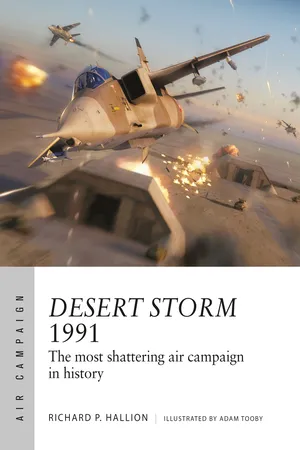
An expertly written, illustrated new analysis of the Desert Storm air campaign fought against Saddam Hussein's Iraq, which shattered the world's fourth-largest army and sixth-largest air force in just 39 days, and revolutionized the world's ideas about modern air power.
Operation Desert Storm took just over six weeks to destroy Saddam Hussein's war machine: a 39-day air campaign followed by a four-day ground assault. It shattered what had been the world's fourth-largest army and sixth-largest air force, and overturned conventional military assumptions about the effectiveness and value of air power.
In this book, Richard P. Hallion, one of the world's foremost experts on air warfare, explains why Desert Storm was a revolutionary victory, a war won with no single climatic battle. Instead, victory came thanks largely to a rigorously planned air campaign. It began with an opening night that smashed Iraq's advanced air defense system, and allowed systematic follow-on strikes to savage its military infrastructure and field capabilities. When the Coalition tanks finally rolled into Iraq, it was less an assault than an occupation.
The rapid victory in Desert Storm, which surprised many observers, led to widespread military reform as the world saw the new capabilities of precision air power, and it ushered in today's era of high-tech air warfare.
eBook - ePub
Desert Storm 1991
The most shattering air campaign in history
- 96 pages
- English
- ePUB (mobile friendly)
- Available on iOS & Android
eBook - ePub
About this book
Information
THE CAMPAIGN
42 days to Kuwait City
When January 15, 1991 passed without Iraqi troops leaving Kuwait, President Bush issued National Security Directive 54, authorizing force to expel them. Chairman of the JCS Gen Colin Powell, brought Secretary of Defense Dick Cheney the “execute” order. Cheney signed it, and asked Powell to do so as well. There was a sense of moral right: Britain’s Lt Gen Peter de la Billière recalled, “We were all facing a criminal lunatic who cared nothing for his own people and was prepared to sacrifice them by the thousand for his own glorification.”

A Boeing B-52G Stratofortress of the 1708th Bomb Wing (Provisional) takes off from Jeddah on a Desert Storm bombing mission. B-52Gs only constituted three percent of total combat aircraft, but they dropped 72,000 bombs (totaling 27,000 tons) on a wide range of targets, roughly a third of all American tonnage dropped in the war. (DoD)
Final countdown
On the afternoon of January 15, Gen Schwarzkopf went to the Black Hole for a final Master Attack Plan briefing from Horner, Glosson, and Deptula. It went well until he asked, “Where are the B-52 strikes on the Republican Guard?” Told that Buffs weren’t hitting the Guard on the opening night because of the dense and redundant SAM risk over Kuwait, the infamously mercurial Schwarzkopf erupted like a long-dormant volcano, shouting “You guys have lied to me!” As he raved, Glosson asked, “How many B-52s are you willing to lose?” Deptula started lecturing on the risks to Buffs from SAMs, then concluded it was “probably best to pause and let Gen Horner answer this one.” Schwarzkopf’s rage filled the room and, standing to the side, Maj Mark “Buck” Rogers, who ran Glosson’s Guidance, Apportioning, and Targeting (GAT) cell, thought with bleak humor, “This is going well!” Fortunately, Horner saved the briefing, taking Schwarzkopf into his office and quietly reviewing each chart, emphasizing the Buffs would attack the Guard the moment they could safely do so. Schwarzkopf cooled down almost as rapidly as he had heated up, even apologizing for his outburst. It was the only time he blew up at his air campaign team, but despite his apology, “it left,” as Glosson recollected, “an everlasting scar.”

Storm before the Storm: Lt Col Dave Deptula briefs Gen Schwarzkopf in the Black Hole on the air campaign plan, January 15, 1991, minutes before Schwarzkopf erupted over the issue of B-52G strikes on the Republican Guard. (L–R): Lt Gen Horner, Brig Gen Glosson, Gen Schwarzkopf, and Lt Col Deptula. (DoD from Deptula Collection)
“Execute Wolfpack:” launching the Gulf War’s most consequential air strikes
Afterwards, at 0600L in Riyadh on January 16, Horner sent a Coalition-wide alert to airmen, and at 1200L, he issued “Execute Wolfpack,” commencing Phase I of the air campaign: H-Hour was set for 0000Z, 0300L Baghdad time, in the early morning of January 17.
Back in the United States, it was just after 0400 Washington time, and 0300 at Barksdale Air Force Base, Louisiana. There, as a picked team of maintainers readied their aircraft, seven select B-52G crews of Strategic Air Command’s 2nd Bomb Wing were starting their final pre-mission briefing for what would be, at that time, the longest non-stop military air strike in aviation history, Operation Senior Surprise. Dubbed “Secret Squirrel” by its crews (so they could refer to it openly), it launched just over three hours later, at 0636 (1536L in Riyadh). Then, mission commander Lt Col John “Jay” Beard, CO of the 596th Bomb Squadron, and Crew S-91 under Capt Michael G. Wilson, thundered smokily down Barksdale’s runway in B-52G Petie 3rd, call-sign Doom 31, leading six other Buffs into a rainy sky. They swiftly disappeared in the murk and clouds, the first combat mission launched in Desert Storm. Altogether they carried 39 Boeing AGM-86C Conventional Air Launched Cruise Missiles (CALCMs), a highly classified weapon, to help shatter Iraq’s electrical grid by hitting eight key targets including the al Musayyib Thermal Power Plant, and transmission facilities at Mosul.
At sea, ashore, and at Diego Garcia, maintainers readied aircraft and weapons; aircrews suited up, checked their survival gear and sidearms, attended final briefings and reviewed their place in the campaign’s first ATO; engines burst into life, aircraft taxied out and, after final “last chance” checks, accelerated down runways and into the night. There was no moon; it would rise at 0817L on January 17, not quite an hour after sunrise. At 2309Z (2009L in Riyadh) on January 16, 18 B-52Gs from SAC’s 4300 BW (P) on Diego Garcia roared aloft; five “air spares” soon returned to base, leaving 13 pregnant with bombs bound for Iraq. Then, at midnight, Schwarzkopf issued “Execute Order – USCINCCENT OPORD 001 for Desert Storm.”
In advance of the scheduled H-Hour of 0300, there were two “prequel” attacks. Shortly before 0100L on January 17, four Air Force MH-53J Pave Low helicopters and eight Army AH-64A Apache gunships completed engine run-ups, communications checks, and taxied out to the runway at Al Jouf, a forward operating base in northwest Saudi Arabia; right on the hour, they took off to attack border radar sites. At 0022L, the first of two dozen F-117As from the 37th TFW (P) left Khamis Mushait (dubbed “Tonopah East”) to strike sector air defense, interceptor operations centers, other command and control, and leadership targets across Iraq and Baghdad.
At 0100L, Horner went to the Tactical Air Control Center (TACC), recalling the wait to H-Hour as “the worst minutes of my life.” Privately he worried whether the F-117A – upon which so much depended – would live up to its pre-war hype: analysts had told Tactical Air Command’s Gen Robert “Bob” Russ to expect to lose as many as one in every seven. Glosson asked how many Coalition aircraft Horner thought might be lost. Horner, thinking only of the USAF, scribbled “42.” (Overall he thought Coalition losses might reach 100 airplanes.)
The “Secret Squirrel Seven’s” Senior Surprise
On January 16, 1991, at 0636 local time, mission commander Lt Col John “Jay” Beard, aircraft commander Capt Michael G. Wilson, co-pilot 1Lt Kent R. Beck, and Crew S-91 lifted their massive eight-engine Boeing B-52G Stratofortress SN 58-0177 Petie 3rd, call-sign Doom 31, off the runway at Barksdale Air Force Base, Louisiana. Climbing smokily into rainy skies, six more thundering Buffs of the USAF Strategic Air Command’s 596th Bomb Squadron, 2nd Bomb Wing, 8th Air Force followed them aloft.
Thus began Operation Senior Surprise, a highly classified mission its aircrew dubbed “Secret Squirrel,” after a cartoon crime-fighter. The bombers were off to destroy portions of Iraq’s electrical grid and communications infrastructure by attacking eight key targets with 39 long-range precision cruise missiles.
Beneath each airplane’s inner wings were pylons mounting streamlined gray shapes looking like slab-sided fuel tanks. They were, instead, Boeing AGM-86C Conventional Air-Launched Cruise Missiles. The CALCM was a top-secret special access codeword-shielded weapon. Boeing had developed a short-range subsonic cruise missile, the AGM-86A, in the late 1970s, and then had stretched it, producing the long-range nuclear-armed AGM-86B. In turn, it spawned a non-nuclear derivative, the AGM-86C CALCM, with a 1,000lb special-purpose warhead. Powered by a Williams F107-WR-10 turbofan producing 600lb (2.67kN) of thrust, the CALCM had an effective range up to 1,000 miles, flying at low altitude, relying on both terrain-masking and its small visible and radar signatures to shield it from enemy fire. Unlike terrain-matching cruise missiles, it found its way using an onboard Global Positioning System (GPS) satellite navigation system.
Aboard the bombers were 57 aircrew. Six of the B-52Gs carried eight, the regular six-person pilot, co-pilot, radar navigator, navigator, electronic warfare officer, and tail gunner being augmented by another pilot and another navigator. The seventh B-52G, with a second augmentee pilot, had nine crew aboard.
After takeoff, the B-52Gs crossed the southern US, passed over the Atlantic, southern Europe, the Mediterranean, then down to the Red Sea and into western Saudi Arabia. They refueled multiple times, supported by 38 KC-135 tanker sorties out of Lajes Air Base, Azores, and 19 KC-10 tanker sorties from Morón Air Base, Spain. Early on January 17, the Buffs arrived over two launch areas 60 miles south of the Iraqi border between Al Jouf and Ar’ar. Pre-launch checks failed four missiles, but the other 35 were healthy, and so each aircraft launched its load. Last to strike was B-52G SN 58-0185 El Lobo II, Doom 37, flown by Capt Stephen D. Sicking and Crew S-93.
While one CALCM descended and crashed into the Saudi desert, the others continued onwards at low altitude, and of these, 28 hit their targets including the al-Musayyib Thermal Power Plant. SAC intelligence analysts concluded six targets ceased operation, one other was damaged, and one remained untouched.
As for the bombers, the “Secret Squirrel Seven” turned back to the United States, where, after facing dauntingly stiff headwinds and bad weather, they all safely returned between 33.9 hours and 35.4hrs after take-off, having completed (what was at that time) the longest strategic attack mission in aviation history.
Senior Surprise/Secret Squirrel blended all the qualities of modern air power: speed, range, flexibility, precision, and lethality. It thus constituted a fitting demonstration of the Air Force’s new Global Reach–Global Power strategic planning concept issued in June 1990.
The artwork shows Sicking’s El Lobo II launching Secret Squirrel’s last CALCM, with one of the four failed missiles still locked on its pylon. El Lobo II is now exhibited at the Air Force Armament Museum, Eglin AFB, Florida.

By now, Secret Squirrel’s Barksdale Buffs were nearing Libya, on track to reach their launch sites over the western Saudi desert. In the Red Sea and Gulf, four carriers from VADM Stan Arthur’s two CTF’s – Saratoga, Kennedy, Midway, and Ranger – were poised to launch their first strikes. Twenty Air Force F-15Cs from the 1st TFW (P), 4th TFW (P), and 33rd TFW (P) headed north from Dhahran, Al Kharj, and Tabuk. RSAF F-15Cs and RAF Tornado F.3s “capped” tankers and command and control aircraft over Saudi Arabia. Nineteen 4th TFW (P) F-15Es departed Al Kharj to strike five fixed Al Hussein launch sites in western Iraq.
F-111Fs from the 48th TFW (P) left Taif to attack Ad Diwaniyah, Ahmad Al Jaber, Ali Al Salem, Balad (al-Bakr), H-3, Jalibah, and Salman Pak (Shaykh Mazhar) air bases and chemical warfare sites, relying on eight PPN-19 navigation beacons and radar reflectors placed along the Saudi–Iraqi border by an Air Force–Army special operations team to update the F-111Fs’ navigation systems.
RAF Tornado GR.1s and crews drawn from nine squadrons – IX, 14, XV, 16, 17, 20, 27, 31, and 617 – departed Dhahran, Muharraq, and Tabuk, bound for Tallil (Abu Talib AB), Mudaysis (Talha AB), Qadisiyah (al-Asad AB), and al-Taqaddum (Tammuz AB); a second wave wou...
Table of contents
- Cover
- Title Page
- Table of Contents
- Introduction
- Chronology
- Attacker’s Capabilities
- Defender’s Capabilities
- Campaign Objectives
- The Campaign
- Aftermath and Analysis
- Further Reading
- eCopyright
Trusted by 375,005 students
Access to over 1.5 million titles for a fair monthly price.
Study more efficiently using our study tools.
Frequently asked questions
Yes, you can cancel anytime from the Subscription tab in your account settings on the Perlego website. Your subscription will stay active until the end of your current billing period. Learn how to cancel your subscription
No, books cannot be downloaded as external files, such as PDFs, for use outside of Perlego. However, you can download books within the Perlego app for offline reading on mobile or tablet. Learn how to download books offline
Perlego offers two plans: Essential and Complete
- Essential is ideal for learners and professionals who enjoy exploring a wide range of subjects. Access the Essential Library with 800,000+ trusted titles and best-sellers across business, personal growth, and the humanities. Includes unlimited reading time and Standard Read Aloud voice.
- Complete: Perfect for advanced learners and researchers needing full, unrestricted access. Unlock 1.5M+ books across hundreds of subjects, including academic and specialized titles. The Complete Plan also includes advanced features like Premium Read Aloud and Research Assistant.
We are an online textbook subscription service, where you can get access to an entire online library for less than the price of a single book per month. With over 1.5 million books across 990+ topics, we’ve got you covered! Learn about our mission
Look out for the read-aloud symbol on your next book to see if you can listen to it. The read-aloud tool reads text aloud for you, highlighting the text as it is being read. You can pause it, speed it up and slow it down. Learn more about Read Aloud
Yes! You can use the Perlego app on both iOS and Android devices to read anytime, anywhere — even offline. Perfect for commutes or when you’re on the go.
Please note we cannot support devices running on iOS 13 and Android 7 or earlier. Learn more about using the app
Please note we cannot support devices running on iOS 13 and Android 7 or earlier. Learn more about using the app
Yes, you can access Desert Storm 1991 by Richard P. Hallion,Adam Tooby in PDF and/or ePUB format, as well as other popular books in History & Military & Maritime History. We have over 1.5 million books available in our catalogue for you to explore.