eBook - ePub
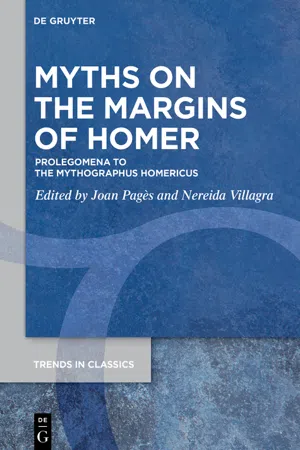
Myths on the Margins of Homer
Prolegomena to the ›Mythographus Homericus‹
- 253 pages
- English
- ePUB (mobile friendly)
- Available on iOS & Android
eBook - ePub
Myths on the Margins of Homer
Prolegomena to the ›Mythographus Homericus‹
About this book
Even though there is agreement on the existence of an Imperial commentary on Homer, going under the name Mythographus Homericus, a large-scale study of this work has been lacking. The objective of this collective volume is to fill this blank. The authors represent diverse opinions, a consequence of the complex nature of the textual tradition but also of the difficulty of defining the nature of this mythographic work itself. This volume offers a study of Mythographus Homericus from different perspectives: the place of the work in the history of scholarship, the state of the text, which has been transmitted by scholia and papyri, its readership, its place in mythography and in Homeric scholarship, its intertextual relationship to other mythographic works or scholiastic corpora and its contribution to the study of myth from a typological perspective.
Information
Part I: The Historical Context of the Birth of the Mythographus Homericus
Panzer, the Mythographus Homericus, and fin de siècle German Scholarship
Jordi Pàmias
Abstract
This paper provides the historical and scientific context of the period in which Panzer’s thesis on the MH came into light. The philological perspective was the dominant approach in German Scholarship of the late nineteenth century. This had consequences in the way the study of myth was tackled. But more to the point here, the author aims at showing how Panzer’s insights continue to loom large in modern approaches to the MH.
1 The birth of the Mythographus Homericus
In 1892 Johannes Panzer produced his dissertation thesis De Mythographo Homerico restituendo, in which he tentatively restored a lost scholarly work dealing with Homeric myths, the so-called Mythographus Homericus.1 The purpose of this paper is to describe the intellectual and cultural background of this piece of scholarship. In addition, it is my aim to show how Panzer’s insights linger in modern approaches to this mythographical text.
Panzer’s theoretical reconstruction of a lost work does not emerge in a historical vacuum. On the contrary, this product originates on fertile ground, which is the result of a generation of scholars working on myth on a strictly philological basis in late nineteenth-century German universities. In order to better understand the transformation of German classical scholarship in this period, it can be helpful to address the monumental Symbolik und Mythologie der alten Völker (1810–1812) by Friedrich Creuzer, and particularly the reception of this work, which triggered a “Kampf um Creuzers Symbolik”.2 Indeed, its significance reaches beyond studies of Greek mythology and religion. The controversy between the Creuzerian reception of myth (a ‘romantic’ one) and historicist and philological criticism becomes clear from the epistolary exchange, originally published in 1818, between Friedrich Creuzer and Gottfried Hermann.3 To Creuzer, who rejects the study of myths as ‘concepts’ or ‘ideas’, their understanding is only feasible through vision (Anschauung) and feeling (Sinn). In opposition to his correspondent, Hermann stays firmly within the realm of history. By disapproving of any sort of symbolic or mystic interpretation of archaic epics and, by extension, Greek myth, Hermann conceives mythology as the scientific study of ideas and concepts belonging to a people. The quarrel between Creuzer and Hermann is significant, since it occurs at a crucial moment in the history of the reception of myth. Mythology is ultimately the battleground on which theologicalromantic speculation and historical-critical science confront each other.4
The future of the study of Greek myth belongs to the latter. The establishment and institutionalization of Classical Philology in the new German universities defined the identity of the Prussian elite and secured the model of Greek culture in the emerging German identity.5 In this atmosphere, the historical-critical method and the longing for scientific respectability pervaded the studies of myth. Creuzer’s defeat and the “victory of rationalism over Romanticism”6 mean that the study of mythology, which must prove its scientific integrity, will become a strictly historical enterprise.7 But this will have another consequence, and one that is far more instrumental in our understanding of the discovery of the Mythographus Homericus at the end of the century—namely how the discipline of Classical Philology as such would be oriented toward more positivistic domains, such as source criticism, textual history, and linguistics.8 Accordingly, it is in this context that the philological reconstruction of Panzer’s Mythographus Homericus has to be defined and described.
2 Johannes Panzer in context
Contemporary to Panzer, other German scholars were working along similar lines. Five years prior to Panzer’s study, Erich Bethe published in Göttingen his own dissertation on Quaestiones Diodoreae Mythographae.9 As a result of his scrutiny of sources and comparison of mythographical models, Bethe claimed that Apollodorus (Library), Hyginus (Fabulae), and Diodorus Siculus (fourth book) made use of a common mythological source. The German scholar supposed that this handbook was also a mythographical model for Ovid in writing his Metamorphoses. In the same years, a painstaking research on the mythographical Catasterisms and on the purported Hellenistic origins of this text was being conducted.10 Thus, in 1878, Carl Robert synoptically reconstructed a unitary astralmythological manual attributed to the all too famous Alexandrian scholar Eratosthenes; but in 1883, Ernst Maass staunchly rejected the Eratosthenic authorship of the opuscule. Indeed, both scholars became critically involved in the so-called ‘Eratosthenic Question’, which would remain open until the beginning of the twentieth century.11 The young Johannes Panzer was disciple of both Robert and Maass precisely in the hottest moments of the debate.12
As for the MH, it comes as no wonder that critical scrutiny of sources is, in the same way, the cornerstone of Panzer’s reconstruction of this lost mythographical collection. German philology at that time was dominated by a prevailing and prestigious scientific method, the so-called Quellenforschung or ‘textual source research’. This method is a particular technique which aims at two goals, as Glenn Most has convincingly explained.13 On the one hand, it tries to break apart the ancient texts that their authors had composed from the various sources they consulted. Such an ana...
Table of contents
- Title Page
- Copyright
- Contents
- List of Tables and Figures
- Introduction
- Part I: The Historical Context of the Birth of the Mythographus Homericus
- Part II: The Text
- Part III: The Mythographical Work
- Part IV: The Mythographus Homericus in Context: Intertextuality, Parallels and the Study of Myth
- Afterword
- List of Contributors
- Index Nominum et Rerum
- Index Locorum
Trusted by 375,005 students
Access to over 1.5 million titles for a fair monthly price.
Study more efficiently using our study tools.
Frequently asked questions
Yes, you can cancel anytime from the Subscription tab in your account settings on the Perlego website. Your subscription will stay active until the end of your current billing period. Learn how to cancel your subscription
No, books cannot be downloaded as external files, such as PDFs, for use outside of Perlego. However, you can download books within the Perlego app for offline reading on mobile or tablet. Learn how to download books offline
Perlego offers two plans: Essential and Complete
- Essential is ideal for learners and professionals who enjoy exploring a wide range of subjects. Access the Essential Library with 800,000+ trusted titles and best-sellers across business, personal growth, and the humanities. Includes unlimited reading time and Standard Read Aloud voice.
- Complete: Perfect for advanced learners and researchers needing full, unrestricted access. Unlock 1.5M+ books across hundreds of subjects, including academic and specialized titles. The Complete Plan also includes advanced features like Premium Read Aloud and Research Assistant.
We are an online textbook subscription service, where you can get access to an entire online library for less than the price of a single book per month. With over 1.5 million books across 990+ topics, we’ve got you covered! Learn about our mission
Look out for the read-aloud symbol on your next book to see if you can listen to it. The read-aloud tool reads text aloud for you, highlighting the text as it is being read. You can pause it, speed it up and slow it down. Learn more about Read Aloud
Yes! You can use the Perlego app on both iOS and Android devices to read anytime, anywhere — even offline. Perfect for commutes or when you’re on the go.
Please note we cannot support devices running on iOS 13 and Android 7 or earlier. Learn more about using the app
Please note we cannot support devices running on iOS 13 and Android 7 or earlier. Learn more about using the app
Yes, you can access Myths on the Margins of Homer by Joan Pagès, Nereida Villagra, Joan Pagès,Nereida Villagra in PDF and/or ePUB format, as well as other popular books in Literature & Ancient History. We have over 1.5 million books available in our catalogue for you to explore.