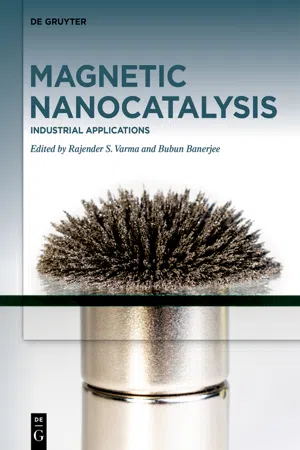
Magnetic nanocatalysts are garnering attention for development of greener catalytic processes due to their ease of recovery from a reaction medium. This book delves into a variety of magnetic nanocatalysts, their use in the industrial context, and recyclability. Topics covered include wastewater treatment, drug delivery, and industrial catalysis; another available volume focuses on the use of magnetic nanocatalysts in synthetic appliances and transformations.
eBook - ePub
Industrial Applications
- 177 pages
- English
- ePUB (mobile friendly)
- Available on iOS & Android
eBook - ePub
Industrial Applications
About this book
Trusted by 375,005 students
Access to over 1.5 million titles for a fair monthly price.
Study more efficiently using our study tools.
Information
Topic
Scienze fisicheSubtopic
Ingegneria chimica e biochimicaChapter 1 Nanoscale zerovalent iron (nZVI): an efficient heterogeneous catalyst for environment remediation
Sandeep Kumar *
Ravinderdeep Singh Brar
Department of Chemistry, Akal University, Bathinda, India
J. Nagendra Babu
Department of Chemistry, School of Basic and Applied Science, Central University of Punjab, Bathinda, India
Khadim Hussain
Department of Chemistry, School of Basic and Applied Science, Central University of Punjab, Bathinda, India
1.1 Introduction
Since the beginning of the Iron Age, the discovery of iron has proved a boon to the human race through the role it played in the evolution of various civilizations [1]. The twentieth century has witnessed the enormous applications of steel, an alloy of iron, as the hardest material used for the development of large infrastructures. Similarly, iron-based salts like FeSO4 and FeCl3 are being used in primary treatment like coagulation and flocculation of wastewater [2]. Iron is characterized by unique redox properties which could be exploited under ambient atmospheric conditions [3]. At the same time, the emergence of nanotechnology explored the various prospects of nanoscaled iron particles and rendered the nanoscale zerovalent iron (nZVI) the most effective properties such as high reactivity, better mobility than microscale zerovalent iron (mZVI) particles, intrinsic magnetic interactions, good adsorption capacities, low toxicity, and cost to act as a versatile engineered nanomaterial for environmental remediation [4]. The high reactivity of nZVI is attributed to inherent strong reducing tendencies of Fe(0) and is proficiently exploited for its reaction with a number of inorganic and organic substrates such as heavy metal ions, dyes, drugs, halogenated hydrocarbons, and reduction of organic compounds [5]. In recent years, nZVI has been progressively utilized in groundwater remediation and hazardous waste treatment. However, the applications of bare nZVI in catalytic processes are retarded by the surface passivation of nZVI on contact with air/moisture and/or by aggregation of nZVI [6]. The use of immobilizers as support and to act as stabilizing agents increases the catalytic efficiencies of nZVI [7, 8]. Thus, this chapter focuses on the mechanism and applications of nZVI in development of efficient nanocomposite materials as heterogeneous catalysts to perform the Fenton process for the environmental remediation of wastewaters containing complex organic materials.
1.2 Synthesis of nZVI
The reactivity and applicability of nZVI as an efficient environment remediating agent depends on its size, capping material, surface oxide layer, support material, and so on. Therefore, the process employed for manufacturing of nZVI plays a significant role in deciding the efficiency of the nanocatalyst formed [1]. Literature supports the higher reactivity of bare nZVI (10–103 times) than granular ZVI, owing to its high surface energy and magnetic properties [9]. A thin layer of oxide is formed on its surface when in contact with air and moisture. A mixed Fe(0)/Fe(II)/Fe(III) phase appeared on the surface when nZVI came in contact with water with major phase as lepidocrocite, that is, FeOOH [10, 11]. Core–shell particles, with protective oxide layer of appropriate thickness not prohibiting the transfer of electrons from the iron core, are more stable than the bare pyrophoric iron nanoparticles (FeNPs) and thus are found advantageous in practical applicability [1]. Prevention of agglomeration by using support or dispersing agents, capping of nZVI, and improving colloidal properties by using organic polymers may also result in enhanced efficiencies of nZVI [12]. Two general approaches are used for the synthesis of nZVI: top-down approach, that is, reducing the size of bulk iron to nanoscale; or bottom-up approach, that is, building nanoiron from atoms formed from ions or molecules [13].
1.2.1 Top-down synthesis
In top-down approach, large-sized iron materials are converted to nZVI using mechanical or chemical processes such as milling [14], etching [15], pulsed laser ablation [16], and noble gas sputtering [17]. Milling is the most commonly employed process in which millimeter-sized iron fillings are milled to nanosized iron using vibrating mills and stirred ball mills. Being economical, this method is used for industrial-scale production of nZVI, as it does not require the use of expensive harmful chemicals. Capping agents are added as a grinding medium to prevent highly reactive pyrophoric iron particles from undergoing combustion and result in reduced reactivity of nanoparticles (NPs).
1.2.2 Bottom-up synthesis
Bottom-up approaches are based on the “growth” of nZVI atom by atom starting from dissolved iron salts via chemical synthesis or self-assembly process.
1.2.2.1 Solution synthesis
The most commonly used process for nZVI synthesis involved the reduction and precipitation of ZVI under inert atmosphere from aqueous iron salts, usually chlorides or sulfates, using sodium borohydride as the reducing agent [18] as follows:
(1.1)...
Table of contents
- Title Page
- Copyright
- Contents
- About Prof. Ganapati D. Yadav
- Chapter 1 Nanoscale zerovalent iron (nZVI): an efficient heterogeneous catalyst for environment remediation
- Chapter 2 Ferrite nanoparticles in the modern catalytic processes
- Chapter 3 Polymer-grafted magnetic nanoparticles toward intelligent designing of drug delivery: recent advances and future perspectives
- Chapter 4 Magnetic nanocatalysts for wastewater treatment
- Chapter 5 Combination of green chemistry and magnetic nanocatalyst: a sustainable approach for the synthesis of value-added materials
- Index
Frequently asked questions
Yes, you can cancel anytime from the Subscription tab in your account settings on the Perlego website. Your subscription will stay active until the end of your current billing period. Learn how to cancel your subscription
No, books cannot be downloaded as external files, such as PDFs, for use outside of Perlego. However, you can download books within the Perlego app for offline reading on mobile or tablet. Learn how to download books offline
Perlego offers two plans: Essential and Complete
- Essential is ideal for learners and professionals who enjoy exploring a wide range of subjects. Access the Essential Library with 800,000+ trusted titles and best-sellers across business, personal growth, and the humanities. Includes unlimited reading time and Standard Read Aloud voice.
- Complete: Perfect for advanced learners and researchers needing full, unrestricted access. Unlock 1.5M+ books across hundreds of subjects, including academic and specialized titles. The Complete Plan also includes advanced features like Premium Read Aloud and Research Assistant.
We are an online textbook subscription service, where you can get access to an entire online library for less than the price of a single book per month. With over 1.5 million books across 990+ topics, we’ve got you covered! Learn about our mission
Look out for the read-aloud symbol on your next book to see if you can listen to it. The read-aloud tool reads text aloud for you, highlighting the text as it is being read. You can pause it, speed it up and slow it down. Learn more about Read Aloud
Yes! You can use the Perlego app on both iOS and Android devices to read anytime, anywhere — even offline. Perfect for commutes or when you’re on the go.
Please note we cannot support devices running on iOS 13 and Android 7 or earlier. Learn more about using the app
Please note we cannot support devices running on iOS 13 and Android 7 or earlier. Learn more about using the app
Yes, you can access Industrial Applications by Rajender S. Varma, Bubun Banerjee, Rajender S. Varma,Bubun Banerjee in PDF and/or ePUB format, as well as other popular books in Scienze fisiche & Ingegneria chimica e biochimica. We have over 1.5 million books available in our catalogue for you to explore.