
eBook - ePub
Evolution of Neurosensory Cells and Systems
Gene regulation and cellular networks and processes
- 344 pages
- English
- ePUB (mobile friendly)
- Available on iOS & Android
eBook - ePub
Evolution of Neurosensory Cells and Systems
Gene regulation and cellular networks and processes
About this book
This book is an overview of primary sensory maps of vertebrates, characterized by continuous and discrete properties. The eight primary sensory maps of vertebrates have unique features and use distinct molecular cues, cell cycle exit, and activity combinations during development, regeneration, and plasticity. As an introduction and overview, the book provides a short overview for all eight sensory senses and presents through evolution and gene regulatory networks, the molecular cues needed for sensory processing. Independent contributions are included for olfactory, vision, trigeminal, taste, vestibular, auditory, lateral line, and electroreception.
Information
1The SensesPerspectives from Brain, Sensory Ganglia, and Sensory Cell Development in Vertebrates
Bernd Fritzsch, Karen L. Elliott
DOI: 10.1201/9781003092810-1
CONTENTS
- 1.1 Introduction of Primary Neurosensory Organization
- 1.2 Neural Induction
- 1.2.1 Formation of the Neural Plate and Neural Tube
- 1.2.2 Patterning of the Neural Tube
- 1.3 Placode and Neural Crest Development into Sensory Cells and Neurons
- 1.3.1 Olfactory Receptors are Found on Olfactory Sensory Neurons Which Project Directly to the Forebrain
- 1.3.2 The Retina and Lens have Different Embryonic Origins
- 1.3.3 Cranial Ganglion Neurons Develop from Both Placodes and Neural Crest
- 1.3.4 Otic Placode Development uses Common and Unique Gene Regulatory Networks
- 1.3.5 Hair Cells of the Inner Ear, Lateral Line, and Electroreception have a Shared Developmental Program
- 1.4 Summary and Conclusion
- Acknowledgements
- References
1.1 INTRODUCTION OF PRIMARY NEUROSENSORY ORGANIZATION
Responding to an environment is a demand placed on all organisms and necessitates the ability to sense external stimuli. For organisms that have complex interactions with their environment, such as vertebrates, this ability has been evolutionary optimized to ensure precise methods of discriminating sensory information. Such optimization has been driven by coordinated development of a centralized processing center that is connected to peripheral sensory organs by way of peripheral neurons. Many studies have investigated the origins of the nervous system (Layden, 2019). Current evidence suggests a common ancestor for cnidarians and bilaterian nervous systems (Galliot et al., 2009). In chordates, the central nervous system (CNS) develops from the dorsal ectoderm. However, the urbilaterian ancestor likely had a similar organization to protostomes with a ventrally positioned central nervous system (Gerhart, 2000). The evolution of deuterostomes saw an inversion of that body plan. Multiple ideas have been proposed to explain these differing dorso-ventral developmental inversion schemes and originated primarily from comparative data on neuron, heart, and mouth location (Arendt and Nübler-Jung, 1997; Fritzsch et al., 2017; Gee, 2007). Among protostomes, the central nervous system is located ventrally, whereas the heart is found dorsally in the body (Gerhart, 2000). In contrast, among deuterostomes, the central nervous system is located dorsally and the heart is ventral (Gerhart, 2000). The ancestral deuterostome mouth is hypothesized to have originally formed dorsally following the inversion of the body plan, suggesting the mouth had to migrate ventrally (Lacalli, 2008). Closer examination showed that this inversion of body plan may have happened in different steps, as shown in the lateral positioning of the mouth in developing lancelets, which migrates ventrally during development (Kaji et al., 2016; Lacalli, 2008). The tunicates, which are the sister group to vertebrates, form their mouth directly from the neuropore, the opening at the rostral end of the neural tube (Veeman and Reeves, 2015), confirming the independent connection of the neuropores with the opening of the gut (Veeman et al., 2010) to forming a new ventral opening of vertebrates (Figure 1.1). Movement of the deuterostome mouth ventrally allows for the entire gut to remain ventrally, whereas in protostomes, the gut passes from the ventral mouth through an opening in the brain to then run dorsally in the organism (Gerhart, 2000). Elimination of the gut passing through the brain in deuterostomes would have allowed for the evolution of larger brains in vertebrates and thus acquisition of more complex processing centers. Gaining these new and more complex sensory processing occurred following duplication and diversification of gene regulatory networks (Fritzsch and Elliott, 2017).
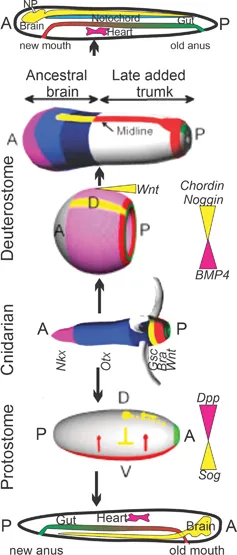
FIGURE 1.1 Understanding evolution explains how Cnidarians, with polarized Wnt expression (green) and the ‘heart’ (Nkx, lilac) is transformed independently to generate a ring-to-rod transformation by downregulation of BMP2/4 in Deuterostomes. This contrasts with a ventral midline (red, Sog) that results a dorsal signaling (green, Dpp) in Protostomes. Cnidarians start with Wnt expression at the posterior part, followed by Bra, Gsc, Otx, and Nkx (most anterior). Deuterostome development follows the Spemann organizer that will induce a symmetry break by Wnt and suppression of BMP2/4 to generate a strip of ectoderm that produces the brain and spinal cord, followed by convergent extension. Earliest expression of heart genes (Nkx) is anterior to the head in hagfish and migrates ventrally during vertebrate development; a master reorganization consistent with heart homology between Deuterostomes and Cnidarians. Note the unique opening of the neuropore (NP) in chordates. Nearly identical genes are present among Protostomes, but they have a different expression of Dpp (the BMP homolog): In contrast to being downregulated in Deuterostomes under dorsal expressing genes (Chordin, Noggin, lilac), they are upregulated from dorsal Dpp (lilac, Protostomes) and specify the dorsal expression of the heart. The A/P is different, flipping the old mouth in Protostomes into the old anus in Deuterostomes. (Modified from Layden, 2019; Meinhardt, 2015b.)
Development from a single cell to a complex adult individual foremost requires establishing the two body axes: antero-posterior and dorso-ventral (Meinhardt, 2015b). Several genes are involved in this two-step process (Figure 1.1): First, factors define the antero-posterior organization. Wnt signaling has been shown to be a key component in establishing the antero-posterior axis across various organisms, including Cnidarians (Hobmayer et al., 2000; Meinhardt, 2015b). Also, Hox genes become expressed in a time-dependent, segmental pattern along the antero-posterior axis to further specify regions along the length of this axis (Wacker et al., 2004). Second, additional factors establish the dorso-ventral organization. Bilaterally-symmetrical protostomes and deuterostomes express Chordin and Noggin dorsally, which inhibit the expression of BMPs (Meinhardt, 2015a). In addition, BMPs antagonize the expression of Chordin (Lele et al., 2001; Xue et al., 2014). Thus, Chordin and Noggin define dorsal and BMPs define ventral. In protostomes, Chordin and BMP are referred to as short gastrulation (Sog) and decapentaplegic (Dpp), respectively (Meinhardt, 2015a). Thus in Drosophila and other protostomes, ventral identity is defined by Sog and dorsal by Dpp (Heingård and Janssen, 2020). Like Chordin, Sog is an antagonist of Dpp expression (Akiyama-Od...
Table of contents
- Cover Page
- Half-Title Page
- Series Page
- Title Page
- Copyright Page
- Contents
- Contributors
- Preface
- Chapter 1 The Senses: Perspectives from Brain, Sensory Ganglia, and Sensory Cell Development in Vertebrates
- Chapter 2 Development of the Olfactory System: From Sensory Neurons to Cortical Projections
- Chapter 3 Vision and Retina Information Processing: From Opsins to the Visual Cortex
- Chapter 4 Trigeminal and Related Spinal Projections: How to Cross or Not the Multisensory Projections
- Chapter 5 Taste Buds Explained: From Taste Sensing to Taste Processing in the Forebrain
- Chapter 6 Assembly and Functional Organization of the Vestibular System
- Chapter 7 Morphological and Molecular Ontogeny of the Auditory System
- Chapter 8 Lateral Line Input to ‘Almost’ All Vertebrates Shares a Common Organization with Different Distinct Connections
- Chapter 9 Electroreception Depends on Hair Cell-Derived Senses in Some Vertebrates
- Chapter 10 An Integrated Perspective of Commonalities and Differences across Sensory Receptors and Their Distinct Central Inputs
- Index
Trusted by 375,005 students
Access to over 1.5 million titles for a fair monthly price.
Study more efficiently using our study tools.
Frequently asked questions
Yes, you can cancel anytime from the Subscription tab in your account settings on the Perlego website. Your subscription will stay active until the end of your current billing period. Learn how to cancel your subscription
No, books cannot be downloaded as external files, such as PDFs, for use outside of Perlego. However, you can download books within the Perlego app for offline reading on mobile or tablet. Learn how to download books offline
Perlego offers two plans: Essential and Complete
- Essential is ideal for learners and professionals who enjoy exploring a wide range of subjects. Access the Essential Library with 800,000+ trusted titles and best-sellers across business, personal growth, and the humanities. Includes unlimited reading time and Standard Read Aloud voice.
- Complete: Perfect for advanced learners and researchers needing full, unrestricted access. Unlock 1.5M+ books across hundreds of subjects, including academic and specialized titles. The Complete Plan also includes advanced features like Premium Read Aloud and Research Assistant.
We are an online textbook subscription service, where you can get access to an entire online library for less than the price of a single book per month. With over 1.5 million books across 990+ topics, we’ve got you covered! Learn about our mission
Look out for the read-aloud symbol on your next book to see if you can listen to it. The read-aloud tool reads text aloud for you, highlighting the text as it is being read. You can pause it, speed it up and slow it down. Learn more about Read Aloud
Yes! You can use the Perlego app on both iOS and Android devices to read anytime, anywhere — even offline. Perfect for commutes or when you’re on the go.
Please note we cannot support devices running on iOS 13 and Android 7 or earlier. Learn more about using the app
Please note we cannot support devices running on iOS 13 and Android 7 or earlier. Learn more about using the app
Yes, you can access Evolution of Neurosensory Cells and Systems by Bernd Fritzsch, Karen Elliott, Bernd Fritzsch,Karen Elliott,Karen L. Elliott, Bernd Fritzsch, Karen L. Elliott in PDF and/or ePUB format, as well as other popular books in Biological Sciences & Neurology. We have over 1.5 million books available in our catalogue for you to explore.