Timely and accessible, this edited volume brings together leading scholars to discuss methods for supporting reconciliation, peace, and sustainable and social change in English language teaching. Around the world, peace and reconciliation are urgent themes that are inextricably connected to the study and practice of teaching English.
The book features a diversity of voices and addresses pedagogies of peace, universal responsibility, and global interdependence in the domain of English language education. Organized in three strands, Part 1 addresses policy and implementation, Part 2 addresses teacher education, and Part 3 addresses content and lesson planning. With chapters drawn from a dozen countries and contexts, this book paves the way for English language teachers to harness their social capital and pedagogical agency to create sustainable peace globally and locally, and in and outside the classroom. It is essential reading for scholars and students in TESOL, applied linguistics, and peace education.
1SPECIES IDENTITY AND CREATING CLASSROOMS OF PEACE
Barbara M. Birch
FRESNO, CALIFORNIA, USA
DOI: 10.4324/9781003147039-1
Boulding’s concepts of species identity and civic culture were the inspiration for my 2009 book The English Language Teacher in Global Civil Society and for this book as well. These concepts can be found in the following quote:
Whether based on religious or secular-humanist beliefs, there are people in all countries who feel allegiance to a community that in one sense does not exist—the community of humankind. It is this allegiance that we are calling species identity. The community of humankind is a country without borders, with no capital city and with only one law—to avoid doing harm to any fellow human beings. However, one cannot feel allegiance to an abstraction. That is where the concept of civic culture comes in. It can only become operational through a set of common understandings developed on the basis of interaction in all the ways we have been describing in these chapters: between governments, in the United Nations, and between people across national borders. We have to enter into more social interaction and become more consciously linked across national borders, to give substance to that civic culture.
(Boulding, 1990, pp. 65–66)
Boulding (1920–2010) was born in Norway, and although she moved to the United States as a small child, her family felt the effects of the German invasion of Norway. Boulding understood early on that war was both a global concern and a local personal concern. She married, raised five children with her husband, earned a doctorate, and became one of the co-founders of the field of study now known as Peace and Conflict Studies. A prolific writer, she was a big-picture theorist and visionary who saw connections between family, culture, and spirituality as the foundations for lasting peace. Boulding has been a role model for me for decades, although I am far from being as illustrious or productive as she was. I have been a proponent for peace since childhood but I became an activist in 1988 when my family, living in Islamabad, Pakistan at the time, suffered from the sabotage of a weapons depot in Rawalpindi, Pakistan. Although the falling bombs didn’t kill anyone in my family, the random danger to everyone made me realize in a visceral way that wars and violence seem to occur at national and global levels but their primary effects victimize women, children, men, families, and neighbors locally, at the home and neighborhood level.
In 1992, Robertson used the term glocalization, a blend of globalization and localization that pointed to a new sociopsychological space for innovative dialogue and agency to emerge. War and violence are glocal, an adjective that signals the crucial bidirectionality between national/world concerns and local cities, towns, and neighborhoods and crucially the people who inhabit them. My motivation for peacebuilding is to help English language teachers find a place in that creative tension where they take advantage of their social capital and pedagogical agency to extend the cause of peace in their classrooms. A cliché can be a truism: we simply need to learn to get along better to create a more just world. I have asked the authors in this volume to write their stories of how they became interested in teaching peace. Peace must be practical, and reach into the daily lives of all citizens of the planet. Peace must become part of our common identity as a human race.
The English Language Teacher in Global Civil Society used the Earth Charter vision of a sustainable world that embraces species identity, civic culture, common interest, and reciprocity to create peaceful societies and nations. The Earth Charter is still a relevant symbolic act today; it legitimizes a ‘we’ as the unified voice of a species, an imagined community with a common destiny at a transitional time in history. The Preamble to the Earth Charter ends with a humanist prayer: “Let ours be a time remembered for the awakening of a new reverence for life, the firm resolve to achieve sustainability, the quickening of the struggle for justice and peace, and the joyful celebration of life.” Is this too lofty or too challenging a goal? Not if we keep it local so that it can percolate upwards. What is the global but a million local intentions and actions?
Committed Comprehensive Investment
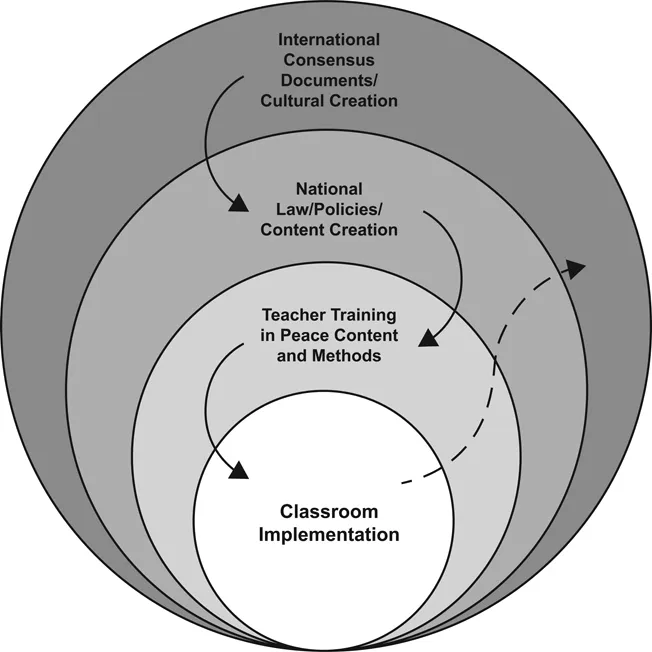
Peace education must lead to more sustainable, that is, long-term and sturdy, models of peace. It cannot be subject to the whims of policy makers or administrators. Part 1 of this volume details the policies enacted in one war-torn country, Colombia, in order to change the educational system and curriculum. Chapter 2 (Ferrer Ariza, Forero, and Sánchez Cardona) argues that educational policies and institutions at the national level can play a strategic role in the construction of more harmonious and empathetic local and global societies. Chapter 3 (Ferrer Ariza, Forero, and Sánchez Cardona) describes how national policies on peace education are implemented in a Masters Program in English Language Teaching in Colombia. Teachers need meaningful systematic training in order to feel comfortable teaching about peace (Part 2) and creating peaceful classrooms where students learn about peace peacefully (Part 3). For peace education to be sustainable and comprehensive in extended areas of the world, significant large-scale commitment, funding, planning, and implementation are necessary at the national (and even possibly international) level, as shown in Figure 1.1.
FIGURE1.1 Sustainable comprehensive investment in peace education
The Goals of Peace Education in ELT
Species identity names a felt sense of affiliation with other people, strangers; it is a glocal (vertical) and collective (horizontal) experience of identity with humanity. Species identity is the basis for the expressions of human reciprocity in all religions and philosophies in one form or other: “do unto others as they would have you do unto them.” This ethic underpins the core values that guide moral behavior, encourage cooperation, and, crucially, moderate self-interest. The empathic ability to assume another’s perspective is a step forward towards peace, but taking another perspective is not enough to break down the stubborn self-interest of humans in positions of power and control. Often they see another perspective but dismiss it or ignore it for their own gain. Species identity must be the overarching goal for education in the 21st century.
Reciprocity and Other-Interest
One important challenge for teachers in social justice and peace education is superficiality. Peace education sometimes focuses on ideas/concepts, myths/stereotypes, and even laws/policies, but it leaves aside the deeply seated self-interest that motivates them. We naively think that if people understand the issues, they will make necessary changes. However, that rarely happens. As peace educators, we must confront individual and group self-interest in order to lessen or even eradicate the social injustices that lead to conflict and war. Making significant sociopolitical change inevitably means that some people must relinquish some of their selfish investment and join in the ethic of species identity, common interest, and reciprocity. Peace education must radically transform, morally and even spiritually, every individual participating in the learning experience.
Anti-racism
Kendi, in his 2019 book, How to Be an Anti-Racist, develops a thesis about racism and anti-racism that 1) individuals/groups in power have self-interested investment in power, money, control, and privileges that they want to keep, so 2) they create unfair laws and policies to keep themselves and their investment in power. In order to justify unfair laws and policies, 3) they create ideas and concepts that legitimize and magnify differences based on social categories like class, race, gender, language, and so on. Clear examples are the anti-miscegenation laws enacted in the early history of the United States when it was clear that many white women were marrying men of other races. Laws against race-mixing perpetuated white men in power over white women and people of color. This did not prevent white men from illicit intercourse with enslaved women, which is the source of the genetic diversity among black and indigenous people of color, while at the same time most white Americans are predominantly of European ancestry. Many racial myths and stereotypes saturated the culture to justify those laws, contributing to the pervasive genetic color divide in the States. Other laws and policies enacting slavery, discrimination, and segregation have similar origins. So, self-interests > laws/policies > ideas/concepts> myths/stereotypes. It is not enough to focus on the latter and ignore the former.
Metacultural Awareness
Metacultural awareness is the ability to transcend the local culture in order to perceive a larger perspective. People’s way of thinking can radically change, according to Kumaravadivelu, if they develop global cultural consciousness, a critical and reflective approach to evaluating their own and other cultures to select the best features, allowing people to stay rooted in a home culture but adopting aspects of other cultures.
What lies behind my lived experience, and that of a multitude of others, is a complex process of creating critical cultural consciousness through constant and continual self-reflection. What guides us in such critical self-reflection is our inherited culture derived from the time-tested traditions of the cultural community into which each of us is born. Our learned knowledge and lived experiences of other cultural discourse domains not only expand our cultural horizon but also clarify and solidify our individual inherited cultural heritage. This critical self-reflection helps us to identify and understand what is good and bad about our own culture, and what is good and bad about other cultures. In other words, in understanding other cultures, we understand our own culture better; in understanding our own, we understand other cultures better. This is the hallmark of an individual’s complex cultural growth.
(Kumaravadivelu, 2008, pp. 5–6)
The goal of culture learning is cultural transition because it requires participants to question personal identity, collective identities, society and culture, and stereotypes. Kumaravadivelu notes that “difficult and sometimes disturbing dialogues can bring about a change of basic attitudes toward one’s own culture and toward others” (Kumaravadivelu, 2008, p. 181). It is through global cultural consciousness that people become aware of and begin to address their own contribution to social injustice and inequity. We can see this happening in the US and elsewhere around the area of Black Lives Matter. Several chapters in this volume suggest that even virtual intercultural exchanges offer learning spaces for students to explore their cultural identities and build metalinguistic and multicultural awareness. For instance, in Chapter 5 in Part 2, Gage examines the characteristics of global citizenship supported in a travel-study or Student Mobility Experience (SME). Not everyone can travel overseas, however, so Gage offers an alternative in Collaborative Online Intercultural Learning (COIL) experiences designed for students to build metalinguistic and metacultural awareness, which are the hallmark of intercultural growth. In the same vein, Guamguami and R’boul’s Chapter 12 in Part 3 showcases how ELT practitioners could exploit their classroom pedagogies in virtual settings to approach issues of identity, empathy, transition, peace, and global citizenship.
Metacultural awareness involves critical consciousness and critical loyalty (Staub, 1989, 2003). Critical consciousness is the capacity to evaluate information independently rather than simply adopting group or authority opinions. Critical loyalty is a commitment to finding a fairer balance between personal/group welfare and other/universal welfare. Critical loyalty means that people balance their good with the good of others, lessening the allure of self-interest. In these days of rampant conspiracy theories and Big Lies, cultural consciousness and critical loyalty are even more crucial than ever before.
Metalinguistic Awareness
Metalinguistic awareness is the ability to think and speak about language as an object in its own right and to control subtle language functions. It is probably not strange to posit awareness of language as a goal in English language teaching but in peace education, metalinguistic awareness goes beyond knowledge of parts of speech and word meanings. Crucially, metalinguistic awareness changes people’s experience of the world, that is, their subjectivities, their cognitive abilities, and possibly their identities, in positive ways. Cook (1995, p. 94) coined the term multicompetence for “an individual’s knowledge of a native language and a second language, that is, L1 linguistic competence plus L2 inter-language.” In recent years, others have extended the term to the superior meta-linguistic awareness of mul...
Table of contents
Cover
Half Title
Series
Title
Copyright
Contents
Preface
Acknowledgments
1 Species Identity and Creating Classrooms of Peace
Part 1 Policy and Implementation for Peace
Part 2 Teacher Education for Peace
Part 3 Content and Lesson Planning for Peace
Index
Trusted by 375,005 students
Access to over 1.5 million titles for a fair monthly price.
Study more efficiently using our study tools.
Frequently asked questions
Yes, you can cancel anytime from the Subscription tab in your account settings on the Perlego website. Your subscription will stay active until the end of your current billing period. Learn how to cancel your subscription
No, books cannot be downloaded as external files, such as PDFs, for use outside of Perlego. However, you can download books within the Perlego app for offline reading on mobile or tablet. Learn how to download books offline
Perlego offers two plans: Essential and Complete
Essential is ideal for learners and professionals who enjoy exploring a wide range of subjects. Access the Essential Library with 800,000+ trusted titles and best-sellers across business, personal growth, and the humanities. Includes unlimited reading time and Standard Read Aloud voice.
Complete: Perfect for advanced learners and researchers needing full, unrestricted access. Unlock 1.5M+ books across hundreds of subjects, including academic and specialized titles. The Complete Plan also includes advanced features like Premium Read Aloud and Research Assistant.
Both plans are available with monthly, semester, or annual billing cycles.
We are an online textbook subscription service, where you can get access to an entire online library for less than the price of a single book per month. With over 1.5 million books across 990+ topics, we’ve got you covered! Learn about our mission
Look out for the read-aloud symbol on your next book to see if you can listen to it. The read-aloud tool reads text aloud for you, highlighting the text as it is being read. You can pause it, speed it up and slow it down. Learn more about Read Aloud
Yes! You can use the Perlego app on both iOS and Android devices to read anytime, anywhere — even offline. Perfect for commutes or when you’re on the go. Please note we cannot support devices running on iOS 13 and Android 7 or earlier. Learn more about using the app
Yes, you can access Creating Classrooms of Peace in English Language Teaching by Barbara M. Birch in PDF and/or ePUB format, as well as other popular books in Education & Education General. We have over 1.5 million books available in our catalogue for you to explore.