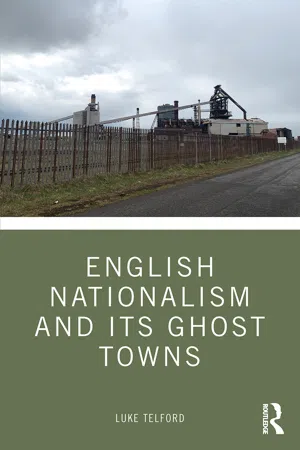
This is the book’s first of three contextual chapters, outlining Steel Town and the wider Teesside region’s history. This historical sketch extends to the broader locale of Teesside as the historical development of the wider area during the late nineteenth and early twentieth century had myriad implications for Steel Town.1 Indeed, it begins with capitalism’s Victorian era, highlighting how the area was at the centre of the Industrial Revolution, owing its existence to early capitalists’ demands for capital accumulation, market expansion and the maximisation of profitability.2 The chapter then discusses the early twentieth century’s social hardships, including myriad economic inequality, inadequate housing and slum conditions. It then addresses the inter-war years, shedding light on how Steel Town became one of England’s most popular coastal resorts because of its proximity to the coast and various cultural amenities.
As the 1929 Great Depression further dislocated the lives of the working classes, social inequalities, unemployment and political discontent continued to accumulate. Whilst austerity was implemented to try address capitalist crises and steady the economy, arguably it was not until the onset of the Second World War in 1939 that people in the Teesside region were paradoxically put to work again, providing a degree of stability and certainty. Therefore, how Teesside was central to the nation’s defence efforts abroad will be outlined, demonstrating how its industrial prowess played an important role in deterring enemy attack. Although capitalism failed to provide social and economic security for most during the early twentieth century, victory in the Second World War meant the system had to change; it would have been unacceptable for war heroes to return home to mass unemployment and impoverishment.3 This chapter analyses how the industrial working class in Teesside witnessed relative socio-economic betterment during the post-war period, branded as the somewhat mythical golden age.4
As we will encounter, this did not continue indefinitely; the post-war era encountered structural shocks and neoliberal policies were enacted. The impact of the great change 5 in the late 1970s will then be briefly discussed to further elucidate how capitalism’s historical development has myriad socio-cultural implications. The chapter’s aim is to lay bare the book’s historical foundations, providing context for the social and political dissatisfaction expressed in the second half of the book.
The Victorian era
The industrial revolution has been cast as one of history’s most important processes as it transformed England and many of its localities like Teesside.6 The onset of manufacturing work was geographically variegated due to each area’s natural conditions; on 8 June 1850 in Teesside, large quantities of iron ore were discovered by the mining engineer John Marley and ironmaster John Vaughan.7 Such a discovery ushered in the epoch of: ‘heavy industry; the industrial revolution, which set in motion a powerful process of rapid economic development in Teesside’.8 Capitalists favoured the Teesside region because it possessed conditions for maximising profitability that were unmatched across the country. Limestone and coking coal were secured from Durham, around 25 miles from Teesside, which fuelled the area’s blast furnaces.9 Teesside also possessed flat land in abundance, enabling the formation of the railways to transport raw materials to Teesside’s River Tees and then the North Sea to ship them across the globe.
Whilst the locale’s ecological conditions enabled the rapid construction of industrial plants, there was a dearth of labour available to provide the required manual labour to fuel the plants.10 Economic migrants from across the globe thus moved to Teesside in the 1840s and 1850s—many emigrated from the British Colonies and European countries like Ireland because of the Great Hunger.11 Starvation and disease were prevalent across Ireland because crops, particularly potatoes, were infected on an unprecedented scale. All the while, occupied Ireland still exported what little food was available to England including millions of bushels of grain, countless gallons of butter and thousands of Irish calves in the ‘famine years’.12 One million Irish people died and a further million emigrated to survive. The arrival of migrants generated tensions in the area—namely, involving Irish workers who arrived from Lancashire in the 1840s in Middlesbrough, nine miles from Steel Town. The migrants had to be escorted to work by the police because they were derided by over 350 residents, who eventually attacked them which forced the Irishmen to flee the area.13
The onset of the industrial revolution generated Teesside’s great iron rush. Thirty years after iron ore was discovered in the region, 120 blast furnaces were built in Teesside. The region became the global leader in iron ore production, acquiring the nickname Ironopolis. Prominent politicians visited Teesside to witness its industrial prowess and the consequential bursts of flame and smoke, including former Prime Minister William Gladstone who claimed ‘Teesside was a remarkable place, the youngest child of England’s enterprise, is an infant, but if an infant, an infant Hercules’.14
Whilst a mass industrial labour force was put to work, workers’ living standards did not increase; instead, wealth was concentrated amongst the capitalists. Such economic insecurity meant industrial workers’ pay would principally be given immediately to their wives, and every penny was carefully spent. This financial and social hardship meant men drank regularly and gambled on horse-racing, engendering debt and household friction.15 Although the area was branded as Ironopolis, iron production in Teesside reached its maturity in 1883, since cheaper and better-quality iron ore was imported from elsewhere including Spain.16 However, the decline of Teesside’s iron industry occurred at the same time as the onset of the great steel age. Although many men in Steel Town obtained employment in Teesside’s steel plants, health and safety conditions were poor. In 1885 at Steel Town’s steelworks, 11 men died after a site explosion and many others were injured.17 Such hazardous conditions were occasionally reinforced by male workers—Smith’s Dock opened in Teesside in 1908, employing thousands of men within several years; however, there was a culture of indifference towards safety measures like hard hats and earplugs, which were branded as pointless and feminine.18
Whilst the industrial plants provided tough and difficult employment opportunities, they also engendered clouds of thick smoke, potentially impacting detrimentally on industrial worker’s health. Although ‘even the birds coughed’19 in many of Teesside’s localities, Steel Town’s proximity to the coastline meant it offered a transient leisurely relief to Teesside’s industrial working class. Branded as ‘the lung of the great industrial population of Teesside’,20 Steel Town offered a boating lake and an open-air swimming pool. At the same time, Teesside:
was a mighty centre of industry. Along the lower reaches of the River Tees innumerable furnaces belched flames and smoke into the sky. Long regimented rows of terraced houses huddled close by. Iron ships filled the docks and lined the quays, while cranes busily emptied their bowels in the seemingly never-ending task of satisfying the ravenous furnaces. Elsewhere, the finished iron and steel was transformed into huge engineering masterpieces, bridges, framed ships and industrial plant.21
Although Teesside’s vast industrial plants meant it was relatively easy for locals to obtain work, the locale’s dependence on manufacturing resulted in higher than national average levels of unemployment during the Great Depression years. However, Steel Town paradoxically burgeoned in popularity with both locals and tourists, becoming one of the most popular coastal resorts in England between the First and Second World Wars.22