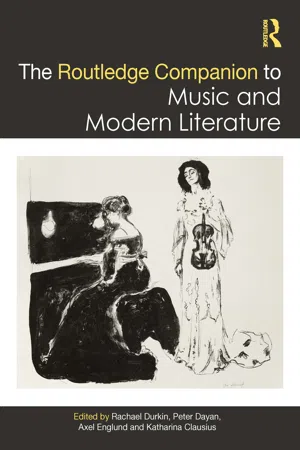
Modern literature has always been obsessed by music. It cannot seem to think about itself without obsessing about music. And music has returned the favour. The Routledge Companion to Music and Modern Literature addresses this relationship as a significant contribution to the burgeoning field of word and music studies. The 37 chapters within consider the partnership through four lenses—the universal, opera and literature, musical and literary forms, and popular music and literature—and touch upon diverse and pertinent themes for our modern times, ranging from misogyny to queerness, racial inequality to the claimed universality of whiteness. This Companion therefore offers an essential resource for all who try to decode the musico-literary exchange.
- 442 pages
- English
- ePUB (mobile friendly)
- Available on iOS & Android
eBook - ePub
The Routledge Companion to Music and Modern Literature
About this book
Information
Part I Questioning the Universal
1 The Universal Now You See It, Now You Don’t
Peter Dayan
DOI: 10.4324/9780367237288-3
* * *Most of the countries in the Northern Hemisphere that have long poetic traditions are blessed to receive the visit of the nightingale or one of its cousins in the summer. All these happy nations have for centuries praised its song in their poetry. All hear that song as song, as music, analogous to the music we humans make. All recognise its beauty.
There is no comparable verbal phenomenon. There are no words in nature, and no words whose beauty can be admired, without mediation or translation, by people from all nations. Does this not prove that music is a universal language, whereas literature, in practice, cannot be?
A counter-argument is often trotted out: not every piece of music is universally accessible to every listener. Classical Chinese music is not easy for the untrained Western ear to appreciate, and vice versa. True, certainly; but this avoids the essential point that the obstacles to musical appreciation are uniquely difficult to map onto the borders between species, nations, ethnicities, or linguistic communities. Medieval English art music is more difficult than Indian raga for many modern English ears. The sound of K-pop has conquered the world; could one imagine the unmusicalised sound of Korean words doing the same? When Stravinsky and Schoenberg moved to America to escape the Nazi domination of Europe, both knowing little English, their music needed no translation to win them a new audience in their new home. Debussy was able to appreciate and assimilate the traditional music of Java on first hearing, in a way that surely no French person would have been able to hear and assimilate the traditional poetry of Java. And jazz from the American South spoke to him directly, though he knew very little either of the verbal language or of the cultural history of its creators. Yes, not all music is always obviously immediately universal. But we receive music as more universal, less hampered by borders, than literature, less threatened by the petty bounds of our national purview.
All religions of the book have to contend with the question of the language of God, the language in which God speaks, and its apparent specificity to particular peoples, which might be felt to limit its universality. None have ever worried about the universality of the music which they all imagine to exist in Heaven. God’s music is in a language as unproblematically universal as the song of the nightingale.
That apparent universality of music fed into the idealism which the nineteenth century, in Europe, sought to express in art. It wanted to tell us that all humanity is one, and all humanity has one eternal shared aesthetic sense. Literature has difficulty in incarnating this. Music, however, appears able to prove it; and poetry that celebrates this universality of music can take back into itself the sense of that oneness of humanity. Thanks to the nightingale and its cousins, it can also bring nature into the fold. Humanity wants to believe it shares an aesthetic sense with nature; even Darwin seemed, on occasion, to base his love of nature on this premise. Music justifies that belief, and literature teaches us the lesson.
It is E.T.A. Hoffmann who is usually credited with using these ideas to cement a marriage, perceived as natural, between contemporary music and contemporary literature, through his celebration of Beethoven’s symphonies. Beethoven (following Haydn) had brought the nightingale into music, in his Pastoral Symphony. A different but no less universally valued bird is symbolically present in his Choral Symphony. It is under the gentle wing of joy, we hear in its famous finale, that all people, in the words of Schiller, become brothers. The effect, the force of the symphony is to deviate our sense of the source of that brotherhood, so that we feel it derives from the wing, not of joy, but of music itself; and its central property is its universality. At the end of the last movement, Schiller’s poem is shattered. Certain little fragments of it are obsessively repeated by the chorus: those which express the quality of universality, as resumed in the single kiss given to the whole world, the brotherhood of all people, and the oneness of the divine Father. Poetry is thus pulled apart to let out its aspiration to the universal. But as that aspiration is released, it calls for music. The symphony ends, not with singing, but with what the century learned to call pure music, which is instrumental music. The symphony began with a falling fifth. The last words sung are to a falling fifth. The last notes played are a falling fifth. The music uses Schiller’s German words, then swallows them, as if it could reduce them to a single interval – a mathematically pure and thus natural interval, used in the music of every nation.
The power of that transnational intermedial idealism was, and remains, immense. That is why the theme of Beethoven’s finale has become the anthem of the European Union. Few symbols of its transnationality could be more powerful than the simple fact that Emmanuel Macron chose to play it when he strode across the esplanade of the Louvre in May 2017 to give his victory speech after being elected President of France – the country whose military rivalry with Germany had caused Beethoven personally so much grief. The French nationalist party, the Front National, naturally disapproved of Macron’s choice. Universalists exulted. They saw in it Macron’s defiance of the narrow nationalism not only of the French Front National, but of Trump in America and Brexit across the Channel. Schiller’s poem, written in German, had effortlessly dissolved in Beethoven’s music. As Macron strode to give his speech, the music was played without words.
And yet – as he spoke, from the courtyard of the former royal palace, another hymn was played, again wordlessly: ‘La Marseillaise’. It is, we recognise, the national anthem of France. Its words, an artfully versified poem, are an unapologetic and bloodthirsty glorification of war, of a war waged by France as a nation, in defence of universal Republican values, principally against Germany, precisely during Beethoven’s formative years.
Universal values, in music as in literature, and above all as music and literature hide behind each other, turn out to have a shadow, a dark side. It seems that they can only be defended by means of fragmentation. As soon as we try to project the universal as a value in its own right, the very words we use (or find ourselves having to bury) seem to betray its ideals, by oppressing an other whose separate identity becomes obscured or demonised. An extraordinary proportion of the drama, the force, the torment of modern literature is produced by that twist.
The essays that compose this section illustrate that torment, that danger, which plays itself out in the words of those who dare to bring together music, in its desired universality, and literature, in the unavoidable nationality of its language. A shocking example is laid bare by Ryan Weber. For the composers Percy Grainger and John Powell, not all music is equal. Surely we can all agree on that? Some music is better than other music. What gives the best music its quality? Again, surely we can agree that it has something to do with its universality. Now, who has produced the best, the most universal music? The most universally superior peoples, of course ... who happen to be the white ‘races’ to which Grainger and Powell claim to belong, and which are thus justified in setting themselves up above all others. Following the same logic, the Nazis, not much later, were able to profit from the general sense that universal music was an originally German tradition, in order to present the German ‘race’ as the chosen people of the universal. Anglo-Saxon or Nordic culture, for Grainger and Powell, like German culture for the Nazis, served to express this universal yet simultaneously national superiority. Universalism has never recovered from this. Or rather, it had from the beginning been contaminated by that abominable propensity.
Berlioz’s Euphonia gives another illustration which perhaps only seems less terrifying because it is politically further from us. Euphonia, the land of music, as Nina Rolland shows, becomes a dystopia, because as music claims universality, it requires to be produced by masters; and masters cannot be masters unless they have slaves, who can all too easily be turned into victims when the masters cease to master their own emotions. Universality plus universal human weakness equals tyranny: this sum had been calculated by those who, after the French Revolution, had sought to understand the Terror, and we can see all too readily how music in literature tends to feed the dynamic.
The tyranny that is the cursed offspring of music’s universalism thrives on discrimination. Powell and Grainger are ‘racialists’, as Powell proudly asserted; for him, it is the ‘negro’ who must be kept in his place for the pure universal to flourish. In modern literary fictions, we find the discrimination more often exercised through gender and sexuality. But always, oppression takes its power from the fantasised revenge of the oppressed. Powell, writing his Rhapsodie Nègre at the time when jazz is the American music sweeping the world, shows both his fear of the black man’s music and his sense of its force, in his drive to dominate it by giving himself the role of composing maestro that no black man, for him, could ever occupy. This mechanism is precisely mirrored in the gender politics of the novels analysed by Nina Rolland, where the patriarchal male refuses to the woman the right to compose and produce music of true universality, and yet it is clear to the reader that the force of the music he loves actually has its living source in her. Rolland asks: ‘how can music be considered as universal [...] if its modes of manifestation are so clearly divided along gender lines?’ Part of the answer is that there is in artistic practice no universality without divided modes of manifestation; and the situation of that division is never free of sexual connotations. Zsolt Bojti portrays it at work in attitudes to homosexuality. There are men for whom the ‘music that drives men mad’ is as unhealthy as the music of the ‘negro’ for Powell, or of the adulterous woman in the novels Nina Rolland analyses; yet it is also, like them, at the same time, music itself, the cursed and repressed but indispensible source of the power of music that the composing mind masters only at the perpetual peril of destroying, by its discrimination, our faith in its universality.
This peril can seem curiously less urgent in the works of Samuel Beckett. Helen Bailey leads us to accompany him on an uncompromising pursuit of the unbounded, the universal, the spirit; that pursuit is inspired by a gaze that wanders restlessly away from all the places on this earth, and an ear that almost manages to hear beyond its music. Beckett’s struggle with language can, as Bailey says, be seen as centred on its failure to express an essence which would be the ‘final music’; but that very concept of a ‘final music’ has already silenced all the music that has ever been written or played. This we could read as a kind of universal discrimination, disqualifying, after all the musics which Beckett did not appreciate (those he did not feel to be universal), also those which he loved. But Beckett’s words also bring home to us that while we remain in this life, we cannot escape from the identity politics of the music we cannot help hearing. That is what we were taught not to ignore by the New Musicology of the late twentieth century, as Sarah Hickmott reminds us. Postcolonial literary studies teach us the same lesson. Christin Hoene shows us how the postcolonial condition allows the previously oppressed a voice; but whenever that voice seeks a musical incarnation, it creates a new potential site of discrimination, of the production of ever new elitisms and otherings, as well as the embodiment of the power of the voiceless. Music cannot but be a means to express identity, the distinctive identity of a community that opposes it to others. The nightingale’s song is doubtless not much appreciated by the female robin.
Unless, it would seem ... we are able to follow the lead that so many characters in modern literature give us, from Beckett’s ‘Words’ to Hanif Kureishi’s Shahid (and the figure of Prince as...
Table of contents
- Cover
- Half Title
- Title Page
- Copyright Page
- Table of Contents
- List of figures
- Notes on contributors
- Acknowledgements
- Anacrusis: Upbeat
- Part I Questioning the Universal
- Part II Opera and Literature
- Part III Musical Form, Literary Form
- Part IV Popular Music and Literature
Trusted by 375,005 students
Access to over 1.5 million titles for a fair monthly price.
Study more efficiently using our study tools.
Frequently asked questions
Yes, you can cancel anytime from the Subscription tab in your account settings on the Perlego website. Your subscription will stay active until the end of your current billing period. Learn how to cancel your subscription
No, books cannot be downloaded as external files, such as PDFs, for use outside of Perlego. However, you can download books within the Perlego app for offline reading on mobile or tablet. Learn how to download books offline
Perlego offers two plans: Essential and Complete
- Essential is ideal for learners and professionals who enjoy exploring a wide range of subjects. Access the Essential Library with 800,000+ trusted titles and best-sellers across business, personal growth, and the humanities. Includes unlimited reading time and Standard Read Aloud voice.
- Complete: Perfect for advanced learners and researchers needing full, unrestricted access. Unlock 1.5M+ books across hundreds of subjects, including academic and specialized titles. The Complete Plan also includes advanced features like Premium Read Aloud and Research Assistant.
We are an online textbook subscription service, where you can get access to an entire online library for less than the price of a single book per month. With over 1.5 million books across 990+ topics, we’ve got you covered! Learn about our mission
Look out for the read-aloud symbol on your next book to see if you can listen to it. The read-aloud tool reads text aloud for you, highlighting the text as it is being read. You can pause it, speed it up and slow it down. Learn more about Read Aloud
Yes! You can use the Perlego app on both iOS and Android devices to read anytime, anywhere — even offline. Perfect for commutes or when you’re on the go.
Please note we cannot support devices running on iOS 13 and Android 7 or earlier. Learn more about using the app
Please note we cannot support devices running on iOS 13 and Android 7 or earlier. Learn more about using the app
Yes, you can access The Routledge Companion to Music and Modern Literature by Rachael Durkin in PDF and/or ePUB format, as well as other popular books in Literature & Literary Criticism for Comparative Literature. We have over 1.5 million books available in our catalogue for you to explore.