Photography on analog film has simply put received a recent renaissance.In our digital age, I guess a romantic veil surrounds the analog approach to photography. Even when shooting digital cameras, we do postprocessing to simulate the look of analog film. We talk about the specific and beloved look of certain films, and how their sensitivity and grain add a charm to the image.Delving deeper, a reason for the analog renaissance might be our growing desire to slow down; to immerse ourselves and sharpen our creative senses by restraining the means with which we photograph. Where the digital camera is soon so perfect that we as photographers can sometimes feel redundant, the analog camera requires our undivided presence.These cameras are subject to the same limitations as they were in the dawn of photography. You must visualize what you want to create beforehand, and you cannot rely on an lcd to feed you the result.Thus, in analog photography we are forced to slow down, plan, create the right circumstances, and capture the wanted picture at the decisive moment.
- 88 pages
- English
- ePUB (mobile friendly)
- Available on iOS & Android
eBook - ePub
About this book
Information
Camera types
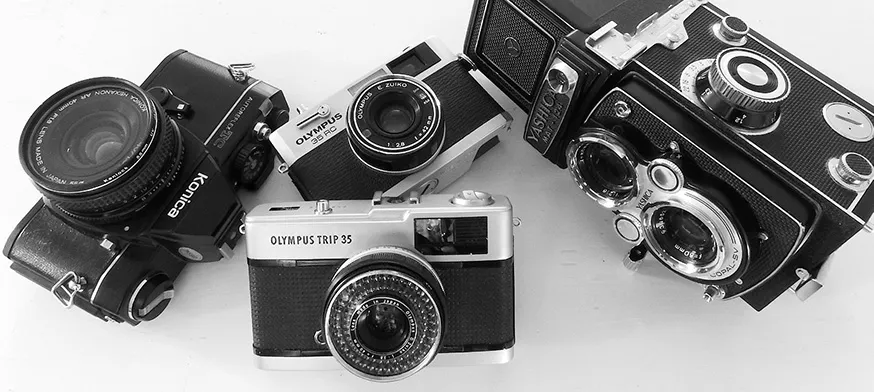
In this book I’ll cover the use of three main types of camera:
Single Lens Reflex cameras (SLR) Rangefinder cameras
Compact and point & shoot cameras
Add to this a bunch of camera types, that are very different, and will not be treated, as I don’t consider them relevant for the beginner - but certainly very exciting to use once beyond the initial start. It could be cameras like TLRs cameras, Twin Lens Reflex, and pinhole cameras. Do note that the SLR camera can easily be converted to a pinhole camera, nevertheless it is outside the scope of this book, no matter how interesting this kind of photography is.
I will treat a couple of cameras in the experimental category, but only briefly as they, unlike most of the cameras I describe in detail, don’t necessarily deliver sharp and correctly exposed results. They are more oriented to the photographer, who wants to do some artistic experiments.
I can begin with an overall advice, if you don’t want to spend to much getting started. Go for the lesser known brands. They are just as good as the well known brands, sometimes even better. What I consider known brands are: Canon, Nikon, Minolta, Pentax, Olympus, and the crazy expensive end Leica. Additionally, be aware that the well known brands didn’t always produce their own cameras. One of the lesser known producers often delivering cameras, that were rebranded by the well known brands, are Cosina. They have during long time produced cameras for all the high end brands as well as some lesser known like Praktica, Petri, Chinon, and even the highly regarded brand Voigtländer, a name that they achieved the rights for in 1999. By all this I’ll convey the message, that quality is not bound to the known brands, and you will often get more bang for the buck with a lesser known brand.
Single Lens Reflex
Single Lens Reflex or abbreviated SLR has, as its name indicates, an image that is reflected from the lens into the viewfinder. That means what you see through the viewfinder is also the view that will hit the film, and you can compose and set focus with great precision. The moment you press the shutter button, the mirror flips away, blocking your view, and making it possible for the light to hit the film. Nevertheless, the film is still blocked by the shutter, that activates microseconds after the mirror flips away, making the exposure of the film. As soon as the shutter closes, the mirror flips back in place, in order for you to see your motive again.
This description covers the majority of SLR cameras, but there are exceptions. For instance on some older cameras the mirror doesn’t return automatically after taking the image. When you advance the film, the mirror finally returns to its position, so you again can see through the viewfinder. Another type of exception is more rare as implemented in the Canon EOS RT. This camera has a semi transparent mirror, that does not move away on exposure. You can see through the viewfinder all the time, no so-called “black-out,” but that also means less light is hitting the film. An advantage is, that there is no “mirror slap” that can cause shake and image blur.
One commonality of all SLRs is, that the lenses can be changed. That give the opportunity to uses lenses from the most extreme wideangle lenses like the so-called fish eyes, that results in a round image, and where you must be aware not to get your own hair in the frame, to the most powerful telephoto lenses, that make even distant objects seem very close.
These characteristics are not the only thing the swappable lenses can provide, as the lenses provide a huge part of the “filmic look” of you images. There are a huge amounts of lenses, that each provide their own special rendering of your motive. Through the years I have tested hundreds of different lenses, and I still frequently publish new test reports on my homepage. Once in while, I am still astonished by one of these forgotten gems, that a company has produced a long time ago. Some of these lenses are so special, that they only fit one specific type of photography eg. portrait, but are unsuited for anything else. That is the case when photography is not a question of creating a digital, clinical one to one copy of the scene in front of you. When you work creatively with your photography, certain lenses can impose a new style to your work. That is wildly fascinating.
But enough about what SLR is, and why it is such an amazingly flexible tool, that make it possbile to continue your photographic journey even after - in my case - almost 60 years of photography.
SLR camera examples
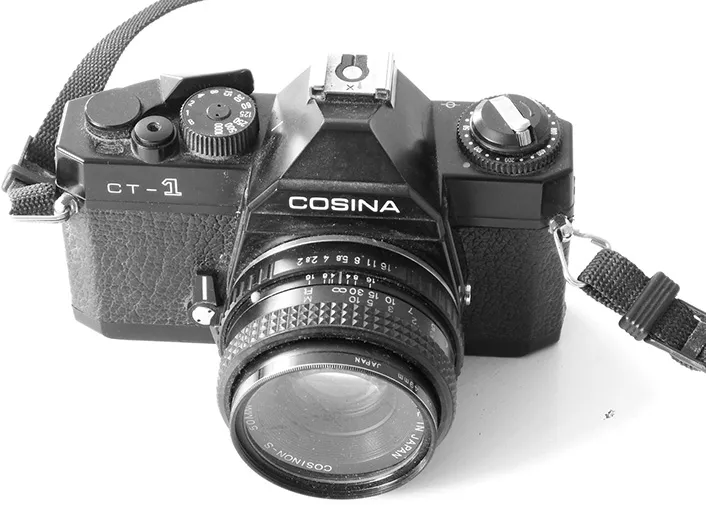
Cosina CT-1: It is one of the most underestimated cameras on this list. Virtually no one knows the brand, that, as mentioned, has produced cameras for all the other brands. It is Japanese quality at its best. CT-1 is a relatively simple camera, that has one huge advantage: It doesn’t require a battery to snap images. There is a build-in light meter, that depends on a battery, but if you learn to judge the available light yourself from the so-called “Sunny 16 rule” (we’ll get to it later), or do you use a light meter in your mobile phone, the battery is superfluous. The camera shoots purely mechanically on all shutter times from 1 second to 1/1000 second and on B (for longer lasting exposures).
Similar cameras, that does almost the same: Cosina CT-1G, Chinon CE-4 - last mentioned depending on batteries though.
Petri GX-1 Super: What I mentioned on the Cosina CT-1 goes for this camera, that is actually produced by Cosina. The main difference is that the GX-1 goes al the way to 1/2000 second, a huge benefit in bright sunlight.
Pentax MX: A really nice kamera from Pentax with, what I regard as a huge advantage, a mechanical shutter working without batteries. If you have batteries, you also have a light meter. Conversely, like with other mechanical shutters, at the buy you must make sure the longer shutter times work. Set the camera to one second and open the back side, release shutter while looking through the lens. Does it seem like one second? On most older cameras it may be open a bit longer, but now you know and can compensate for it. My MX doesn’t work at all at one second, and ½ second is more like one second, but after that it seems to level out. The camera also has a B setting for long exposures, and it has a depth of field button (DOF), so it’s possible to judge sharpness levels in front and behind your main motive. We’ll discuss this feature later.
Similar cameras, that does almost the same: Pentax K2 - heavy but sturdy, Pentax K1000 - delicious, but hyped to high expense, Pentax ME super - fully electronic and only working with batteries, however you can use aperture priority as well as use full manual. Though there is no DOF button. One important note for all the aforementioned cameras is, that they all use Pentax K lens mount (bayonet), which means that all lenses for Pentax K will fit on the mentioned cameras. And there is a huge selection of lenses available at sensible prices.
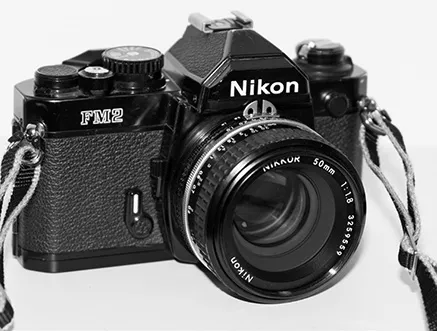
Nikon FM2: A real juvel of a camera, with everything that a photographer could want. Shutter with exposures from 1 second to 1/4000 second, an unusually fast shutter for a fully mechanical, DOF button, built-in light meter, Nikons F bayonet with access to a huge selection of lenses produced over a long year span. The camera house is solidly build in metal, actually, the only con is the prices that has risen considerably.
Similar cameras, that does almost the same: Nikon FM - the predecessor to FM2, that only has shutter speeds up to 1/1000 second, but otherwise is largely the same.
Minolta X-300: I’m generally not fan of the older cameras from Minolta.
They are great, when they work, and Minolta optics are generally very good, but the electronics are unstable. When I do list one here, the cause is the relatively low price. Additionally, when it works, it contains most of what you need: Aperture priority or manual exposure, light meter, electronic self timer, unfortunately no DOF button and dependence on batteries. Before buying, you should check that the shutter releases, otherwise the capacitors are probably dead, and check that the shutter curtain opens completely. If these thing are not working, it could become an expensive camera. Better go for something else.
Similar cameras, that does almost the same: Minolta X-500, X-570 both has the weaknesses as the X-300 and are more expensive. The older Minolta SRT cameras are more reliable, has mechanical shutters, and are therefore not battery dependent, but they are heavier and more clumsy.
Konica Autoreflex TC: Konica is probably more known for their point&shoots in fancy colors. Actually, they produced a number of SLRs from which I will highlight the relatively simple Autoreflex TC. It can run without batteries, where you choose both shutter time and aperture, but if you load a battery, you will get the unusual possibility of shutter priority automatic shooting, where the camera sets the aperture. You will be a bit limited in shutter times: 1/8 second to 1/1000 plus B, but as you can get this camera at rather low prices maybe even with the extremely nice 40mm f1.8 lens, this is a very good option.
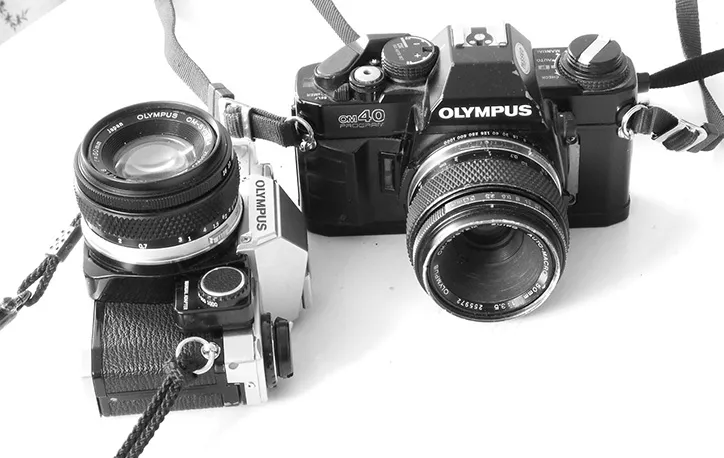
Olympus OM-10: This is probably one of the most demanded beginners cameras, and for a lot of reasons, but I would question if it´s one of the best. Firstly, you are depending on a battery to shoot, and you can’t grow with the camera, as it initially only has aperture priority, and no possibility for manual shooting. You can buy a small device for the camera, thus adding manual mode, but these are not frequently available. Nevertheless, it is a gorgeous camera, easy to use, and if you are using Olympus lenses, you are getting some of the best available. It is often sold with a 50mm f1.8 lens, an awesome lens providing good sharpness and the ability to let the background disappear in a nice soft blur. If the shutter is open on inspection,check that it closes when you insert batteries, otherwise it will probably need an expensive repair.
Olympus OM-40: If you like Olympus cameras and their wonderful lenses, I would suggest that you look towards OM-40, which is marginally more expensive, but gives you three modes: 1). Full automatic, where the camera sets both shutter and aperture. 2). Aperture priority. 3). Last but not least full manual control. Like the OM-10 it has the weakness not to work without batteries. With the added opportunity of full manual, it’s a better camera to grow with as a photographer.
Similar cameras, that does almost the same: Olympus OM1 and OM2 are more professional Olympus cameras, where OM-1 is fully mechanical, and OM-2 is dependent on batteries. But as prices for both these have sky rocketed, I don’t consider them alternatives for the beginner.
Canon AE-1 and AE-1 Program: There shall be no doubt, Canon has through the years mad a lot of fantastic cameras, and their lenses can be really nice, even though they have sometimes made some cheap junk. A fully working Canon AE-1/AE-1 Program is a very decent camera, what many buyers have found, unfortunately also resulting in a considerable price rise. You could be lucky to find one at a reasonable price, if you are patient. There is a huge amount of lenses to choose from for the FD mount, that these cameras use, both lenses from Canon, but even from many third party producers like Tokina, Vivitar, Sigma, Tamron among others.
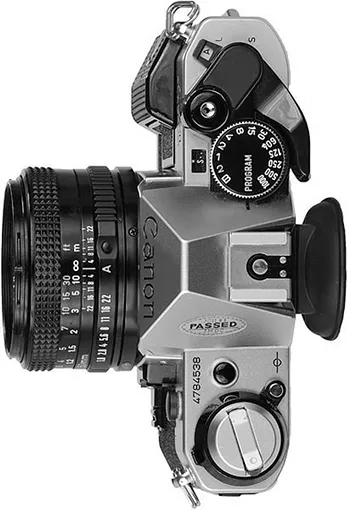
Similar cameras, that does almost the same: Canon A-1 is seemingly a similar camera, that also have become too expensive, but it is really a delicious camera. A-1 is somewhat more advanced camera that delivers both program mode, shutter priority, aperture priority as well as full manual. There is also a row of fully mechanical models, that are very robust, but weighs a ton.
Canon EOS 500/500n: This is a much more modern camera, that uses another mount then the previous mentioned FD models. It has the EF (Electronic Focus) mount, that Canon has used until they started producing digital mirrorless cameras. One of the advantages of the EOS series of cameras is, that they can use all the EF lenses, Canon has produced since the first EOS camera was introduced in 1987. Furthermore, the third party producers Sigma, Tamron among others have produced lots of lenses for this mount, and some of these for instance Sigmas AR...
Table of contents
- Other books by the same author (only english titles)
- Table of Contents
- Preface and basics on analog vs. digital
- What you need to know from the start
- Film types and formats.
- Film sensitivity
- Camera types
- Readying your camera
- Basisc technique
- More advanced techniques
- Portrait
- Environmental portrait
- Landscape
- Street photography
- Action photography
- Macro photography
- Double exposure
- Word list and abbreviations
- Litterature
- Copyright
Trusted by 375,005 students
Access to over 1.5 million titles for a fair monthly price.
Study more efficiently using our study tools.
Frequently asked questions
Yes, you can cancel anytime from the Subscription tab in your account settings on the Perlego website. Your subscription will stay active until the end of your current billing period. Learn how to cancel your subscription
No, books cannot be downloaded as external files, such as PDFs, for use outside of Perlego. However, you can download books within the Perlego app for offline reading on mobile or tablet. Learn how to download books offline
Perlego offers two plans: Essential and Complete
- Essential is ideal for learners and professionals who enjoy exploring a wide range of subjects. Access the Essential Library with 800,000+ trusted titles and best-sellers across business, personal growth, and the humanities. Includes unlimited reading time and Standard Read Aloud voice.
- Complete: Perfect for advanced learners and researchers needing full, unrestricted access. Unlock 1.5M+ books across hundreds of subjects, including academic and specialized titles. The Complete Plan also includes advanced features like Premium Read Aloud and Research Assistant.
We are an online textbook subscription service, where you can get access to an entire online library for less than the price of a single book per month. With over 1.5 million books across 990+ topics, we’ve got you covered! Learn about our mission
Look out for the read-aloud symbol on your next book to see if you can listen to it. The read-aloud tool reads text aloud for you, highlighting the text as it is being read. You can pause it, speed it up and slow it down. Learn more about Read Aloud
Yes! You can use the Perlego app on both iOS and Android devices to read anytime, anywhere — even offline. Perfect for commutes or when you’re on the go.
Please note we cannot support devices running on iOS 13 and Android 7 or earlier. Learn more about using the app
Please note we cannot support devices running on iOS 13 and Android 7 or earlier. Learn more about using the app
Yes, you can access Analog Photography by Bo Belvedere Christensen in PDF and/or ePUB format, as well as other popular books in Arte & Arte general. We have over 1.5 million books available in our catalogue for you to explore.