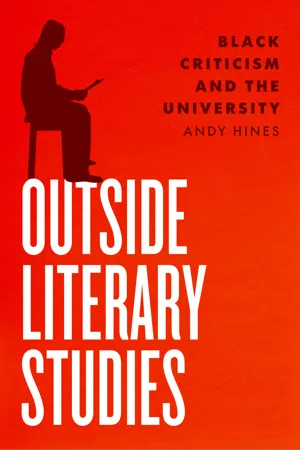
A timely reconsideration of the history of the profession, Outside Literary Studies investigates how midcentury Black writers built a critical practice tuned to the struggle against racism and colonialism.
This striking contribution to Black literary studies examines the practices of Black writers in the mid-twentieth century to revise our understanding of the institutionalization of literary studies in America. Andy Hines uncovers a vibrant history of interpretive resistance to university-based New Criticism by Black writers of the American left. These include well-known figures such as Langston Hughes and Lorraine Hansberry as well as still underappreciated writers like Melvin B. Tolson and Doxey Wilkerson. In their critical practice, these and other Black writers levied their critique from "outside" venues: behind the closed doors of the Senate Permanent Subcommittee on Investigations, in the classroom at a communist labor school under FBI surveillance, and in a host of journals. From these vantages, Black writers not only called out the racist assumptions of the New Criticism, but also defined Black literary and interpretive practices to support communist and other radical world-making efforts in the mid-twentieth century. Hines's book thus offers a number of urgent contributions to literary studies: it spotlights a canon of Black literary texts that belong to an important era of anti-racist struggle, and it fills in the pre-history of the rise of Black studies and of ongoing Black dissent against the neoliberal university.
- English
- ePUB (mobile friendly)
- Available on iOS & Android
eBook - ePub
About this book
Information
Publisher
University of Chicago PressYear
2022Print ISBN
9780226818580
9780226818566
eBook ISBN
9780226818573
· 1 ·
New Criticism and the Object of American Democracy
In the first sentence of Understanding Poetry, Cleanth Brooks and Robert Penn Warren identify their textbook’s lodestar: “This book has been conceived on the assumption that if poetry is worth teaching at all it is worth teaching as poetry.”1 Or, as they put it several sentences later, “The poem in itself, if literature is to be studied as literature, remains finally the object for study.” These simple statements set up both a taxonomical program and an interpretive method that would become known as the New Criticism, the foundation for literary studies in the academy since the middle of the twentieth century. Accordingly, this idea—“Literature is to be studied as literature”—has garnered ample scholarly attention. However, an essential question about the midcentury New Critical formulation has been pursued far less often: What political, economic and social formations does this tautological, even enigmatic principle lead its practitioners to establish and support? This chapter answers that question, suggests why it is asked so infrequently, and wagers that some fundamental but obscured aspects of the connection of academic literary study to the world beyond it are made visible in its answering.
Black writers on the left who were contemporaries of the New Critics in the 1940s and 1950s recognized the New Criticism as a literary program, a social and economic proposal, and a state-supported means to enforce anti-Black racism and, at times, anticommunism. As will become clear later in the book, Black writers’ challenges to the New Criticism invoke a radical project that pushes against the intersecting exploitation of race, class, gender, and sexuality that the New Critical platform posits. When scholars see the New Criticism in only one of its dimensions, it becomes difficult to identify parlays against the movement from outside of the academy, particularly those leveled by Black writers.
Through its definitional and methodological insistence that literature is literature, the New Criticism modulated the actual and imagined differences between (white) citizens and Black others in terms that were on their surface devoid of race, but were fully racialized underneath. When the Harvard Redbook, a veritable guide for liberal arts education in the United States, cites the New Criticism as an answer to “a centrifugal culture in extreme need of unifying forces,” it insists that the aesthetic principles can mold divergent subjects into the white citizen standard.2 The separation of aesthetic and political activity the New Criticism promoted with its definition dovetailed with the US federal government’s emphasis on culture as an instrument for forming a clear national identity domestically, and for advertising the liberty of the US political and economic system abroad. As has been well documented of Cold War cultural efforts, the US state sought to suppress the rampant inequalities of the country’s social and political reality to project a liberal capitalist vision of freedom that was freer and more democratic than Soviet Communism.3 At the same time, as John Thelin suggests, universities, where the New Criticism became firmly established, were newly figured as “integral to the national interest, including its international and social roles as well as national defense.”4 Managing and measuring people by the terms of US racial liberalism meant enacting and enforcing a program of anticommunism that marked Black people as potential subversives. The Agrarian New Critics carried a long history of pairing anticommunist and anti-Black sentiment—what David Caute describes as “the equation between the red and the black”—and thus proved well-suited to the American national interest at midcentury.5
The New Criticism formalized and institutionalized the separation of the literary from the historical, the social, and the political—a bracketing that has also been a hallmark of their scholarly reception. Aside from the method of close reading, the New Critical legacy lingering within literary studies is a myopia when it comes to joining interpretive method with its material ramifications. As well versed as they were readers of poetry, the New Critical group marshaled the full range of liberal-capitalist mystification strategies to ensure that what scholars and students exchanged at the marketplace (close reading) was kept far from the shop floor (the political-economic connection of the racial state, university, and literary criticism) necessary to produce it. Karl Marx’s explanation of commodity fetishism offers a broad paradigm for understanding how the New Critical emphasis on the literary object obscures the process of its production, valuation, and exchange.6 One way that Marx describes the exchange of commodities is that “the definite social relation between men themselves . . . assumes here, for them, the fantastic form of a relation between things.”7 That fantastic form, the fetishism of commodities, is at the heart of Marx’s theory of value, pivotal for his understanding of capital more broadly. Thus, its interpretation is highly contested. As other critics have suggested, the commodity fetish is a way to invoke the illusion that social processes are objectified, a means for understanding an “epistemic problem,” “a form of domination,” or a site to examine the use and exchange value of “signifiers of raciality.”8 These readings of commodity fetishism operate simultaneously in my argument about how the New Critics imbue literature with supernatural qualities, seemingly from nowhere, that the critic merely discovers.
New Critics naturalize the literary object in a number of ways, but Brooks and Warren’s frequent insistence that the poem ought to be compared to “something organic like a plant” highlights how social processes are evacuated from literary objects. They favor the organic explanation because they fear that a sense of a poem as made from “mechanically combined elements . . . as bricks are put together to make a wall”—a process of human production—is wrong because the relationship of the elements in a poem is “far more intimate and fundamental.”9 For Brooks and Warren, the intimate and fundamental relationship resides beyond the sphere of the poem’s social production and, at the same time, comes to define poetry as unique.
In this chapter, I argue that the New Critics first separate literature, then criticism, and finally the New Criticism itself from the state-academic apparatus. This separation process requires the racialized exploitation of some to make possible the various political and economic freedoms of others. As Lisa Lowe argues, the condition of possibility of US liberalism is “the modern distinction between definitions of the human and those to whom such definitions do not extend,” a condition that the New Critics extend in their objectification of the social processes of reading, interpreting, and writing literature.10 Investigating the New Criticism through a frame that attends to its racialized fetishism provides a glimpse of how this literary-critical project supported and established the supernatural idea of American liberal democracy circulated by the US federal government in a number of spheres.
I begin this chapter by illustrating how the Agrarian program stated its aesthetic principles by suppressing the racism inherent in its political economic aims, especially as argued in the group’s manifesto, I’ll Take My Stand. In particular, I examine how the Agrarian insistence of literature’s status as an “organic” or natural object supports and masks a racially ordered labor system in the Agrarian society for which they advocate. The second part of the chapter examines how this fetishization process expands to criticism itself. It traces how New Critical interpretive principles became entangled with various functions of the US federal government as the United States turned to managing difference on the terms of racial liberalism. Building on historical accounts of the political coalitions formed after World War II, I show how the New Criticism offered a useful framework for modes of governance while also supplying an argument for the so-called democratic function of literature and higher education. The final section considers what has become known as the Bollingen controversy to show how the Agrarian New Critics effectively cemented the movement as fully literary, despite its ongoing social and political connections. It was only after a group of New Critics who were affiliated with the Library of Congress awarded Ezra Pound, a known fascist and anti-Semite, the federally supported Bollingen Prize that the New Criticism became a proper noun. It was this event that concretized the New Criticism’s fetishization, which has been nearly impossible to sustainably demystify in academic scholarly practice. I conclude briefly by suggesting that the response of Black writers to Pound’s award shows that the New Criticism remained for them an object by which they could critique the separation of art and politics, modes of America’s imperial capitalism, and anti-Black racism. That critique allowed for imagining new possibilities for critical practice and the world that contained it, which I describe in the book’s next three chapters.
The Southern Agrarians, Aesthetic Reflection, and the Plantation
In their 1930 manifesto I’ll Take My Stand, the Nashville Agrarians sutured their aesthetic preferences to a set of material conditions required to sustain aesthetic attention. Those material conditions were that of an agrarian society. The Nashville group defines such a society as one “in which agriculture is the leading vocation, whether for wealth, for pleasure, or for prestige—a form of labor that is pursued with intelligence and leisure and that becomes the model to which the other forms approach as well as they may.”11 This Agrarian vision of the world is set against the rising tide of industrialism in the Southern United States and, more implicitly, the fear that such industrialism would inevitably lead to the spread of communism. The initially proposed title for the Agrarian volume was not a line from the song “Dixie,” but the more clinical “Tracts against Communism.”12 The Agrarian concern is that with industrialism, by insuring business “against fluctuation” the federal government would become an “economic super-organization,” seemingly akin to the government of the Soviet Union.13 At the same time, there is a more quietly stated concern that “the militancy of labor” fomented by industrial capitalism will seek to “bring about a fairer division of the spoils.”14 For the Agrarians, rampant industrialism either leads to a continued incursion on the rights of Southern states by the US federal government, or a coalition of class-united workers fighting against the unequal accumulations of capital. While the anxiety about big government and a racialized working class resonates with twenty-first-century conservativism, it also reaches backward.15 As W. E. B. Du Bois stated plainly in his 1935 Black Reconstruction, in the Civil War “the South was fighting for the protection and expansion of its agrarian feudalism.”16
With nostalgia for the plantocratic South animating their manifesto, the Agrarians did not directly address at any length the exploitation of labor that must take place in order for planters to accumulate wealth, pleasure, and prestige. The primary mode of engaging the South’s slave past is through omission, though the volume does feature one essay by Robert Penn Warren that discusses race at length. That essay calls for the assimilation of Black people into a racialized hierarchy of labor in the Agrarian South largely via an extended critique of W. E. B. Du Bois’s arguments about education in The Souls of Black Folk, though Warren avoids mentioning Du Bois by name.17 The omission of a discussion of slavery reflects the political economic logic of the Agrarian gambit; accumulations of capital are made possible through an invisible, racialized class of Black laborers. As a whole, I’ll Take My Stand emblematizes a continued effort to suppress this essential and violent fact of the political economy of the United States.
Scholars like Michael Kreyling and Paul V. Murphy have pointed to I’ll Take My Stand as crucial in establishing a Southern identity rooted in nostalgia for the South as it was imagined to have once been.18 Such a retrenchment was necessary in the aftermath of the 1925 Scopes trial in Dayton, Tennessee. Thanks to the widely circulated writing of H. L. Mencken, The State of Tennessee v. John Thomas Scopes turned a Tennessee teacher’s refusal to abide by the state’s mandate to teach creationism into a nationwide debate about Southern identity. Mencken’s assertion that the South was “plainly incompatible with civilized progress” ignited Robert Penn Warren, Allen Tate, John Crowe Ransom, and others to define the South otherwise.19 The Agrarian definition valorized a white planter class with a detached aesthetic refinement rooted in tradition in labor and politics. This Agrarian defense came at the expense of poor whites, lambasted by Mencken for being the base of the resurgent Ku Klux Klan, and of the complete elision of the role of Black labor in the region.20 In reaction to Mencken’s challenge to a civilized South, the Agrarians, in Kreyling’s phrasing, “invented”—and, I add, imposed a cultural understanding of—the South based simultaneously on a political-economic order (an agriculturally driven capitalism), a race-class hierarchy (genteel whiteness above poor whites above invisibilized Blackness), and aesthetic principles (the disinterested, metaphysical poetics that would come to define the New Criticism).
The aesthetic principles of the Agrarian project relied upon the racialized division of labor that otherwise subtended the Agrarian desire for the accumulation of wealth, pleasure, and prestige. One of I’ll Take My Stand’s general principles, composed by John Crowe Ransom, reads: “Art depended, in general, like religion on a right attitude to nature; and in particular on a free and disinterested observation of nature that occurs only in leisure.”21 Art thus relies upon a “disinterested observation,” and therefore requires free subjects who have a distinct capacity to separate themselves from the immediacy of the world around them. In Ransom’s phrase there echoes what Denise Ferreira da Silva defines as the “core statement of racial subjection.” Ferreira da Silva suggests that “while the tools of universal reason (the ‘laws of nature’) produce and regulate human conditions, in each global region it establishes mentally (morally and intellectually) distinct kinds of human beings, namely, the self-determined subject and its outer-determined others, the ones whose minds are subjected to their natural (in the scientific sense) conditions.”22 She comes to this statement through a reading of Western Enlightenment philosophers like Kant who suggest that rationality or reason is the distinguishing characteristic of man. Put differently, if a subject is fully determined by nature—the world beyond the self—rather than being self-regulating or disinterested, then such a subject violates the natural law of man and is effectively excluded from humanity.23 That subject is outer-determined, “affectable,” and inescapably embodied, while the subject self-governed by reason becomes fully transparent. Ferreira da Silva argues that this becomes the basis for the social and political processes of modernity, thus linking a philosophical and aesthetic discourse to the racialized, material world. For the Agrarians, the creation and interpretation of art rely upon...
Table of contents
- Cover
- Title Page
- Copyright Page
- Dedication
- Contents
- Introduction
- 1 · New Criticism and the Object of American Democracy
- 2 · Melvin B. Tolson’s Belated Bomb
- 3 · Tactical Criticism
- 4 · Culture as a Powerful Weapon
- Epilogue
- Acknowledgments
- Notes
- Archives and Collections Consulted
- Bibliography
- Index
Trusted by 375,005 students
Access to over 1.5 million titles for a fair monthly price.
Study more efficiently using our study tools.
Frequently asked questions
Yes, you can cancel anytime from the Subscription tab in your account settings on the Perlego website. Your subscription will stay active until the end of your current billing period. Learn how to cancel your subscription
No, books cannot be downloaded as external files, such as PDFs, for use outside of Perlego. However, you can download books within the Perlego app for offline reading on mobile or tablet. Learn how to download books offline
Perlego offers two plans: Essential and Complete
- Essential is ideal for learners and professionals who enjoy exploring a wide range of subjects. Access the Essential Library with 800,000+ trusted titles and best-sellers across business, personal growth, and the humanities. Includes unlimited reading time and Standard Read Aloud voice.
- Complete: Perfect for advanced learners and researchers needing full, unrestricted access. Unlock 1.5M+ books across hundreds of subjects, including academic and specialized titles. The Complete Plan also includes advanced features like Premium Read Aloud and Research Assistant.
We are an online textbook subscription service, where you can get access to an entire online library for less than the price of a single book per month. With over 1.5 million books across 990+ topics, we’ve got you covered! Learn about our mission
Look out for the read-aloud symbol on your next book to see if you can listen to it. The read-aloud tool reads text aloud for you, highlighting the text as it is being read. You can pause it, speed it up and slow it down. Learn more about Read Aloud
Yes! You can use the Perlego app on both iOS and Android devices to read anytime, anywhere — even offline. Perfect for commutes or when you’re on the go.
Please note we cannot support devices running on iOS 13 and Android 7 or earlier. Learn more about using the app
Please note we cannot support devices running on iOS 13 and Android 7 or earlier. Learn more about using the app
Yes, you can access Outside Literary Studies by Andy Hines in PDF and/or ePUB format, as well as other popular books in Literature & Literary Criticism. We have over 1.5 million books available in our catalogue for you to explore.