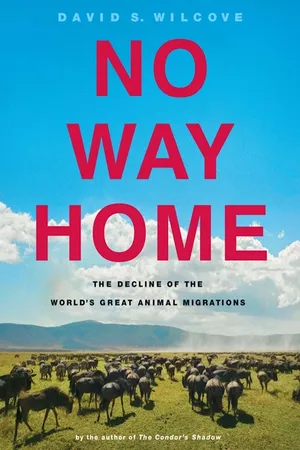
Animal migration is a magnificent sight: a mile-long blanket of cranes rising from a Nebraska river and filling the sky; hundreds of thousands of wildebeests marching across the Serengeti; a blaze of orange as millions of monarch butterflies spread their wings to take flight. Nature’s great migrations have captivated countless spectators, none more so than premier ecologist David S. Wilcove. In No Way Home, his awe is palpable—as are the growing threats to migratory animals.
We may be witnessing a dying phenomenon among many species. Migration has always been arduous, but today’s travelers face unprecedented dangers. Skyscrapers and cell towers lure birds and bats to untimely deaths, fences and farms block herds of antelope, salmon are caught en route between ocean and river, breeding and wintering grounds are paved over or plowed, and global warming disrupts the synchronized schedules of predators and prey. The result is a dramatic decline in the number of migrants.
Wilcove guides us on their treacherous journeys, describing the barriers to migration and exploring what compels animals to keep on trekking. He also brings to life the adventures of scientists who study migrants. Often as bold as their subjects, researchers speed wildly along deserted roads to track birds soaring overhead, explore glaciers in search of frozen locusts, and outfit dragonflies with transmitters weighing less than one one-hundredth of an ounce.
Scientific discoveries and advanced technologies are helping us to understand migrations better, but alone, they won’t stop sea turtles and songbirds from going the way of the bison or passenger pigeon. What’s required is the commitment and cooperation of the far-flung countries migrants cross—long before extinction is a threat. As Wilcove writes, “protecting the abundance of migration is key to protecting the glory of migration.” No Way Home offers powerful inspiration to preserve those glorious journeys.
- English
- ePUB (mobile friendly)
- Available on iOS & Android
eBook - ePub
About this book
Information
Notes
INTRODUCTION: ON THE MOVE
1
In “Let’s Do It,” Porter refers to “educated fleas,” rather than bats with fleas. How ectoparasites such as fleas handle the migrations of their hosts is a fascinating and underresearched question in ecology.
2
A. Calhoun, University of Maine, pers. comm.
3
In some cases, the definition of migration can be stretched to include daily movements of animals such as krill, provided the animals in question spend blocks of time in each locale as opposed to hustling back and forth many times over the course of the day.
4
There is some controversy as to how many bison actually inhabited the Great Plains. For more information, see D. S. Wilcove (2000), The Condor’s Shadow: The Loss and Recovery of Wildlife in America (New York: Anchor Books).
5
BirdLife International (2007), Expedition solves aquatic warbler mystery, February 22, www.birdlife.org/news/nes/2007/02/aquatic_warbler_senegal.html (accessed February 23, 2007).
CHAPTER 1: EMPTY SKIES
1
See M. Wikelski, E. M. Tarlow, A. Raim, R. H. Diehl, R. P. Larkin, and G. H. Visser (2003), Costs of migration in free-flying songbirds, Nature 423:704. My account of these researchers’ exploits is a composite based on this paper, an interview with Wikelski, and a night I spent in the field with him and his colleagues chasing thrushes.
2
M. S. Bowlin, W. W. Cochran, and M. C. Wikelski (2005), Biotelemetry of New World thrushes during migration: Physiology, energetics and orientation in the wild, Integrative and Comparative Biology 45:295–304.
3
S. A. Gauthreaux Jr.,J. E. Michi, and C. G. Belser (2005), The temporal and spatial structure of the atmosphere and its influence on bird migration strategies, in Birds of Two Worlds: The Ecology and Evolution of Migration, ed. R. Greenberg and P. P. Marra, 182–93 (Baltimore: Johns Hopkins University Press).
4
A. Feduccia (1980), The Age of Birds (Cambridge, MA: Harvard University Press).
5
Data on Rock Creek Park and other U.S. sites are taken from D. S. Wilcove and S. K. Robinson (1990), The impact of forest fragmentation on bird communities in eastern North America, in Biogeography and Ecology of Forest Bird Communities, ed. A. Keast, 319–31 (The Hague, Netherlands: SPB Academic Publishing).
6
J. Faaborg (2002), Saving Migrant Birds: Developing Strategies for the Future (Austin: University of Texas Press).
7
My discussion of the effects of forest fragmentation, cowbird parasitism, and nest predation on migratory songbirds is taken primarily from Faaborg (2002); and J. W. Terborgh (1989), Where Have All the Birds Gone? (Princeton, NJ: Princeton University Press).
8
D. S. Wilcove (1985), Nest predation in forest tracts and the decline of migratory songbirds, Ecology 66:1211–14.
9
H. Mayfield (1977), Brown-headed cowbird: Agent of extermination? American Birds 31:107–13; M. C. Brittingham and S. A. Temple (1983), Have cowbirds caused forest songbirds to decline? BioScience 33:31–35.
10
J. P. Hoover and S. K. Robinson (2007), Retaliatory mafia behavior by a parasitic cowbird favors host acceptance of parasitic eggs, Proceedings of the National Academy of Sciences 104: 4479–83.
11
It is also possible that even within heavily fragmented forests there are occasional “good years” of low parasitism and predation, perhaps occurring just often enough to allow songbird populations to persist.
12
M. Monkkonen, P. Helle, and D. Welsh (1992), Perspectives on Palaearctic and Nearctic bird migration: Comparisons and overview of life-history and ecology of migrant passerines, Ibis 134 (supplement): 7–13.
13
My discussion of Old World songbirds wintering in Africa is taken primarily from C. H. Fry (1992), The Moreau ecological overview, Ibis 134 (supplement): 3–6; Monkkonen et al. (1992); and Faaborg (2002).
14
J. W. Terborgh (1980), The conservation status of neotropical migrants: Present and future, in Migrant Birds in the Neotropics: Ecology, Behavior, Distribution, and Conservation, ed. A. Keast and E. S. Morton, 22 (Washington, DC: Smithsonian Institution Press).
15
Deforestation statistics compare forest cover in 2000 with presumed forest cover eight thousand years ago and are taken from World Resources Institute’s Earth Trends country profiles, http://earthtrends.wri.org (accessed February 2005).
16
P. P. Marra, K. A. Hobson, and R. T. Holmes (1998), Linking winter and summer events in a migratory bird by using stable-carbon isotopes, Science 282:1884–86; D. R. Norris, P. P. Marra, T. K. Kyser, T. W. Sherry, and L. M. Ratcliffe (2004), Tropical winter habitat limits reproductive success on the temperate breeding grounds in a migratory bird, Proceedings of the Royal Society of London, Series B: Biological Sciences 271:59–64.
17
T. S. Sillett and R. T. Holmes (2002), Variation in survivorship of a migratory songbird throughout its annual cycle, Journal of Animal Ecology 71:296–308.
18
My discussion of bird hunting in Europe and North Africa is taken from M. N. McCulloch, G. M. Tucker, and S. R. Baillie (1992), The hunting of migratory birds in Europe: A ringing recovery analysis, Ibis 134 (supplement): 55–65; Environmental News Service (2005), Cyprus tries education to halt songbird slaughter, September 20, www.ens-newswire.com/ens/sep2005/2005-09-20-02.asp (accessed May 16, 2007); and H. Youth (2003), Winged Messengers: The Decline of Birds, Worldwatch Paper 165 (Washington, DC: Worldwatch Institute).
19
My discussion of the red knots and Delaware Bay is taken primarily from: A. J. Baker et al. (2004), Rapid population decline in red knots: Fitness consequences of decreased refueling rates and late arrival in Delaware Bay, Proceedings of the Royal Society of London, Series B: Biological Sciences 271: 875–882; R. I. G. Morrison, R. K. Ross, and L. J. Niles (2004), Declines in wintering populations of red knots in southern South America, Condor 106: 60–70; and L.J. Niles et al. (2007), Status of the red knot (Calidris canutus rufa) in the Western Hemisphere, report to the U.S. Fish and Wildlife Service (Trenton, NJ: New Jersey Department of Environmental Protection, Endangered & Nongame Species Program).
20
See P. F. Battley, T. Piersma, M. W. Dietz, S. Tang, A. Dekinga, and K. Hulsman (2000), Empirical evidence for differential organ reductions during trans-oceanic bird flight, Proceedings of the Royal Society of London, Ser...
Table of contents
- Title Page
- Copyright Page
- Dedication
- Table of Contents
- INTRODUCTION - On the Move
- In the Air~
- On Land ~
- In the Water ~
- CONCLUSION - No Way Home?
- Notes
- Acknowledgments
- Index
- About the Author
- About Island Press
- Island Press Board of Directors
Trusted by 375,005 students
Access to over 1.5 million titles for a fair monthly price.
Study more efficiently using our study tools.
Frequently asked questions
Yes, you can cancel anytime from the Subscription tab in your account settings on the Perlego website. Your subscription will stay active until the end of your current billing period. Learn how to cancel your subscription
No, books cannot be downloaded as external files, such as PDFs, for use outside of Perlego. However, you can download books within the Perlego app for offline reading on mobile or tablet. Learn how to download books offline
Perlego offers two plans: Essential and Complete
- Essential is ideal for learners and professionals who enjoy exploring a wide range of subjects. Access the Essential Library with 800,000+ trusted titles and best-sellers across business, personal growth, and the humanities. Includes unlimited reading time and Standard Read Aloud voice.
- Complete: Perfect for advanced learners and researchers needing full, unrestricted access. Unlock 1.5M+ books across hundreds of subjects, including academic and specialized titles. The Complete Plan also includes advanced features like Premium Read Aloud and Research Assistant.
We are an online textbook subscription service, where you can get access to an entire online library for less than the price of a single book per month. With over 1.5 million books across 990+ topics, we’ve got you covered! Learn about our mission
Look out for the read-aloud symbol on your next book to see if you can listen to it. The read-aloud tool reads text aloud for you, highlighting the text as it is being read. You can pause it, speed it up and slow it down. Learn more about Read Aloud
Yes! You can use the Perlego app on both iOS and Android devices to read anytime, anywhere — even offline. Perfect for commutes or when you’re on the go.
Please note we cannot support devices running on iOS 13 and Android 7 or earlier. Learn more about using the app
Please note we cannot support devices running on iOS 13 and Android 7 or earlier. Learn more about using the app
Yes, you can access No Way Home by David S. Wilcove in PDF and/or ePUB format, as well as other popular books in Biological Sciences & Zoology. We have over 1.5 million books available in our catalogue for you to explore.