Having manipulated water for irrigation, energy, and burgeoning urban centers, humans are facing the reality that although fresh water is renewable, it is as finite as any other resource. Countries, states, and cities are now scrambling to develop an intelligent, well-informed approach to mitigate the growing global water crisis. Water Ethics is based on the belief that responding to contemporary water problems requires attending to questions of value and culture. How should we capture, store, and distribute water? At what cost? For whom? How do we reconcile water's dual roles as a practical resource and spiritual symbol?
According to the editors of this collection of foundational essays, questions surrounding water are inherently ethical. Peter Brown and Jeremy Schmidt contend that all approaches to managing water, no matter how grounded in empirical data, involve value judgments and cultural assumptions. Each of the six sections of the book discuses a different approach to thinking about the relationship between water and humanity, from utilitarianism to eco-feminism to religious beliefs, including Islam, Hinduism, and Christianity. Contributors range from Bartholemew, Ecumenical Patriarch of the Orthodox Church to Nobel Laureate economist Elinor Ostrom and water policy expert Sandra Postel. Each section is framed by an original introductory essay written by the editors.
Water Ethics will help readers understand how various moral perspectives, even when unstated, have guided and will continue to guide water policy around the globe.
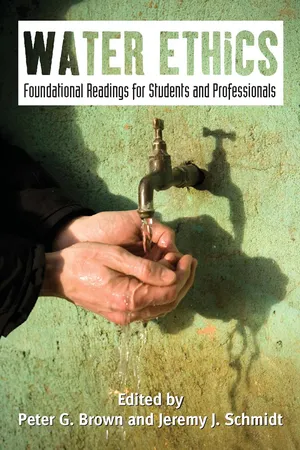
eBook - ePub
Water Ethics
Foundational Readings for Students and Professionals
- English
- ePUB (mobile friendly)
- Available on iOS & Android
eBook - ePub
Water Ethics
Foundational Readings for Students and Professionals
About this book
Information
Part One
Introduction
Chapter 1
Water Ethics and Water Management
WATER IS ESSENTIAL FOR LIFE, yet we have no systematic way to think about its value. For years water was considered as renewable as sunlight or wind, and the potential for its development seemed limitless. Now, having manipulated water for irrigation, energy, and burgeoning urban centers, we face the reality that although freshwater is renewable, it is as finite as many other resources.1 It is now imperative to develop a cogent, grounded approach toward water management to curtail the growing, global water crisis.
The lack of such a strategy for managing water has meant that it is often used callously, carelessly, and without regard to ethical concerns. For instance, over the last fifty years 3,300 dams in India have inundated vast land areas and displaced an estimated 40 million people.2 In Australia, the effects of severe drought have been exacerbated by reliance on infrastructure designed to increase water supply. Between 1975 and 1997, Perth received 14% less rainfall than the 20th century average but saw a 48% reduction in reservoir levels. From 1998 to 2006 rainfall managed just 48% of the 20th century average and reservoir levels dropped by 66%.3 In both cases, entire watersheds have been manipulated based on beliefs regarding what ought to be done with water. Yet both instances failed to follow these manipulations through to their normative consequences for, respectively, displaced people or long-term sustainability.
Responding to contemporary water problems requires attending to questions of value. How should we capture, store, or distribute water? At what cost? For whom? And for how long? Further, these questions are inherently ethical because, as with any essential resource, determining a fair and just distribution of water has direct effects on human and nonhuman lives and the systems that sustain them. Despite the layered, interwoven nature of water use decisions and ethical values, moral questions have received comparatively little attention in the decision-making frameworks that dominate water policy and management. As such, this book looks explicitly at ethical issues regarding water. It begins by clarifying the connection between water and ethics, and showing how ethical considerations are unavoidable in water management decisions. This introduction ends by outlining the book’s structure, content, and rationale for a systematic evaluation of water’s value. The principal purpose of the book is to provide an overview of the emerging field of water ethics by drawing on representative points of view regarding ethical issues with respect to water.
What Is a Water Ethic?
Ethics deals with problems that arise in disagreements regarding what ought to be done. These disagreements may arise in at least three areas:
- Claims about facts or states of affairs, such as those about adequate water quantity or quality—because we need to know what we mean by “adequate”
- Claims about correctly ordered social relationships, such as whether water should be allocated according to economics or on the basis of factors such as human rights or rights to property or healthy ecosystems
- Claims about personal experiences, such as water’s significance to people of a particular culture or belief.4
Given water’s pervasiveness and its necessity for life, these three types of disagreements often overlap; one person may float a gift down a river, believing it to be part of healthy spiritual and biophysical renewal. Another may view this same act as pollution. Thus a water ethic is best defined broadly, as a normative framework guiding actions that affect water.
The last two decades have witnessed a global movement by water policy experts to connect ethics and water. In 1997, the United Nations Educational, Scientific, and Cultural Organization’s (UNESCO’s) World Commission on the Ethics of Scientific Knowledge and Technology (COMEST) initiated investigations into the use of freshwater.The subsequent COMEST report was organized around three themes: (1) a sense of shared purpose and harmony with nature, (2) a balance between traditional human values and technological innovation, and (3) harmony between “the sacred and utilitarian in water, between the rational and the emotional.”5 In 2004, UNESCO published a series of fourteen essays that were initially produced to provide input into the 3rd World Water Forum in Kyoto in 2003. The overview essay for this “Water and Ethics” series argues that two central problems confront a water ethic: (1) finding an appropriate scale for an ethic and (2) respecting value differences among individuals, groups, and society.6 In 2007, the 3rd Marcelino Botin Foundation Water Workshop was held in Santander (Spain) where water experts focused on the manifold ways in which ethics and water are critically linked to issues of water management, economics, and poverty (among others).7
The rise of ethical discourse in global water policy networks has already led to a key debate regarding how a water ethic fits with other normative claims. From one perspective, a water ethic may be viewed as another aspect of existing concerns over the value of nature or regulating best management practices in natural resource policy. In this case, establishing a water ethic is similar to debates in environmental philosophy and applied ethics insofar as the aim is to provide an evaluative framework that prescribes correct behavior. An alternate view argues that the long history of religious myths, legal mores, and social institutions means that a water ethic does not fit well within the neatly defined categories used in other debates or disciplines.8 To date, global policy discourse on water ethics takes the latter view. For instance, the COMEST report appeals to several principles that often compete with one another in environmental philosophy such as intrinsic value, equality, the common good, stewardship, and economic pricing.9 It is difficult to predict how, or whether, this debate will be resolved but here it is worthwhile to note the divergent and influential sources of the water ethics discourse in order to understand some of the different perspectives of water policy experts, academics, and philosophers.
Regardless of whether we think of a water ethic as its own distinctive area of concern or as an instance of more general debates, our water use decisions have real consequences for both human and nonhuman lives. And if we are to support our decisions we must offer reasons. One logical question may arise: If we have good reasons for our water use decisions, is it possible to avoid talking about ethics altogether? The next section shows why ethical judgments are unavoidable, even when we have well-developed, rational frameworks for water use decisions.
Ethics and Water Management
The field of water and environmental management is concerned with the actual decisions made regarding resource allocation and use.10 Hence resource managers seek to understand the characteristics of particular problems in order to clearly define what may count as a solution. By looking within this process, it is evident that water management frameworks unavoidably make a number of ethical judgments. So, while this section focuses on the concepts of integrated water resources management and adaptive management, it is important to bear in mind that any decision-making framework requires value judgments regarding how to define and resolve problems. It should be noted that the management approaches discussed here are not the only ones that exist, nor are they necessarily the best ones. Rather, they were chosen because they are extremely influential conceptual frameworks and because their underlying concepts offer interesting examples of how rational decision making, in itself, does not obviate the need for ethical judgment.
Integrated Water Resources Management
The concept of integrated water resources management (IWRM) dominates the global discourse in water management. Though its precursors extend back centuries, the modern history of IWRM has been traced to Spain, where in the 1920s water managers began using river basins as the natural unit for decisions.11 Similarly, North American water managers increasingly promoted the coordinated development of water projects for multiple uses through institutions such as the Tennessee Valley Authority, which was created in the 1930s. From the 1960s onward, increasing attention was given to the social and environmental consequences of water development, with a push to manage both within a single system of decision making.12 As IWRM ascended to a global policy phenomenon in the 20th century, it developed three core agendas: (1) the integration of “cross-sectoral” concerns from agriculture, industry, and urban uses; (2) the evaluation of water’s full ecological, economic, and social value; and (3) the promotion of decision making at scales appropriate to coordination and resolution of water-related concerns.13 Given IWRM’s wide ambit, defining it in succinct terms has proven problematic. Nonetheless, an oft-cited definition was offered by the Global Water Partnership’s Technical Advisory Committee, which defines IWRM as,
a process which promotes the co-ordinated development and management of water, land and related resources, in order to maximize the resultant economic and social welfare in an equitable manner without compromising the sustainability of vital ecosystems.14
Ethical Judgments in IWRM
Defining the normative position of IWRM ...
Table of contents
- Title Page
- Copyright Page
- Dedication
- Table of Contents
- Part One - Introduction
- Part Two - Dominion and the Human Claim to Water
- Part Three - Utilitarianism
- Part Four - Water as a Community Resource
- Part Five - Water: Life’s Common Wealth
- Part Six - Ethics in Complex Systems
- Acknowledgments
- Contributors
- Advisory Board
- Index
- Island Press, Board of Directors
Trusted by 375,005 students
Access to over 1.5 million titles for a fair monthly price.
Study more efficiently using our study tools.
Frequently asked questions
Yes, you can cancel anytime from the Subscription tab in your account settings on the Perlego website. Your subscription will stay active until the end of your current billing period. Learn how to cancel your subscription
No, books cannot be downloaded as external files, such as PDFs, for use outside of Perlego. However, you can download books within the Perlego app for offline reading on mobile or tablet. Learn how to download books offline
Perlego offers two plans: Essential and Complete
- Essential is ideal for learners and professionals who enjoy exploring a wide range of subjects. Access the Essential Library with 800,000+ trusted titles and best-sellers across business, personal growth, and the humanities. Includes unlimited reading time and Standard Read Aloud voice.
- Complete: Perfect for advanced learners and researchers needing full, unrestricted access. Unlock 1.5M+ books across hundreds of subjects, including academic and specialized titles. The Complete Plan also includes advanced features like Premium Read Aloud and Research Assistant.
We are an online textbook subscription service, where you can get access to an entire online library for less than the price of a single book per month. With over 1.5 million books across 990+ topics, we’ve got you covered! Learn about our mission
Look out for the read-aloud symbol on your next book to see if you can listen to it. The read-aloud tool reads text aloud for you, highlighting the text as it is being read. You can pause it, speed it up and slow it down. Learn more about Read Aloud
Yes! You can use the Perlego app on both iOS and Android devices to read anytime, anywhere — even offline. Perfect for commutes or when you’re on the go.
Please note we cannot support devices running on iOS 13 and Android 7 or earlier. Learn more about using the app
Please note we cannot support devices running on iOS 13 and Android 7 or earlier. Learn more about using the app
Yes, you can access Water Ethics by Peter G. Brown, Jeremy J. Schmidt, Peter G. Brown,Jeremy J. Schmidt in PDF and/or ePUB format, as well as other popular books in Biological Sciences & Global Development Studies. We have over 1.5 million books available in our catalogue for you to explore.