Fairoz is a book-length poetry sequence in which Moniza Alvi explores an imagined teenage girl's susceptibility to extremism. The book's fragmented, collaging narrative draws together fairytale elements, glimpses of Fairoz's thoughts, and pieces of dialogue. A folkloric representation of God and the devil acts as a wry counterpoint, touching on questions of morality. Fairoz is a powerful portrayal of human vulnerability.
eBook - ePub
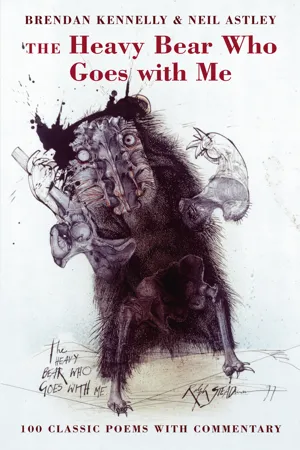
The Heavy Bear Who Goes with Me
- 352 pages
- English
- ePUB (mobile friendly)
- Available on iOS & Android
eBook - ePub
The Heavy Bear Who Goes with Me
About this book
Information
5
CONTENTS
- title page
- dedication
- Neil Astley: preface: The Making of the Heavy Bear
- Delmore Schwartz (1913–1966)
introduction: The Heavy Bear Who Goes with Me [1938] - Sir Thomas Wyatt (1503–1542)
‘They flee from me that sometime did me seek’ - Henry Howard, Earl of Surrey (1517–1547)
‘Wyatt resteth here’ c. 1542 [1542] - Sir Philip Sidney (1554–1586)
‘Thou blind man’s mark’ c. 1581 [1591] - Edmund Spenser (1552–1599)
‘One day I wrote her name upon the strand’ [1595] - Chidiock Tichborne (c.1558–1586)
Tichborne’s Elegy 1585 [1586] - Christopher Marlowe (1564–1593)
Elegia VI 1580s [1580s] - Sir Walter Ralegh (1552–1618)
The Lie c. 1592 [1608] - Robert Southwell (1561–1595)
The Burning Babe c. 1595 [1595] - Michael Drayton (1563–1631)
Since There’s No Help 1590s? [1619] - William Shakespeare (1564–1616)
Sonnet 73: ‘That time of year…’ [1609] - T...
Table of contents
- Description
- Title Page
- Dedication
- Contents
- Preface: Neil Astley: Preface: The Making of the Heavy Bear
- Delmore Schwartz (1913–1966): Introduction: The Heavy Bear Who Goes with Me [1938]
- Sir Thomas Wyatt (1503–1542): ‘They flee from me that sometime did me seek’
- Henry Howard, Earl of Surrey (1517–1547): ‘Wyatt resteth here’ c. 1542 [1542]
- Sir Philip Sidney (1554–1586): ‘Thou blind man’s mark’ c. 1581 [1591]
- Edmund Spenser (1552–1599): ‘One day I wrote her name upon the strand’ [1595]
- Chidiock Tichborne (c.1558–1586): Tichborne’s Elegy 1585 [1586]
- Christopher Marlowe (1564–1593): Elegia VI 1580s [1580s]
- Sir Walter Ralegh (1552–1618): The Lie c. 1592 [1608]
- Robert Southwell (1561–1595): The Burning Babe c. 1595 [1595]
- Michael Drayton (1563–1631): Since There’s No Help 1590s? [1619]
- William Shakespeare (1564–1616): Sonnet 73: ‘That time of year…’ [1609]
- Thomas Nashe (1567–1601): ‘Adieu, farewell, earth’s bliss’ 1592 [1600]
- Thomas Campion (1567–1620): What if a Day c. 1600? [1606]
- John Donne (1572–1631): The Flea 1590s? [1635]
- Ben Jonson (1572–1637): On My First Son 1603 [1616]
- Robert Herrick (1591–1674): To the Virgins, to Make Much of Time
- Henry King (1592–1669): Exequy upon His Wife c. 1624 [1657]
- George Herbert (1593–1633): Love (III) [1633]
- Edmund Waller (1606–1687): Go, Lovely Rose Late 1620s? [1645]
- Richard Crashaw (1612–1649): from The Flaming Heart [1652]
- Richard Lovelace (1618–1657): To Althea, from Prison 1642
- Anne Bradstreet (1612–1672): A Letter to her Husband, Absent upon Publick Employment Mid 1640s? [1678]
- Henry Vaughan (1621–1695): They Are All Gone into the World of Light! [1655]
- Andrew Marvell (1621–1678): To His Coy Mistress Early 1650s (?) [1681]
- John Milton (1606–1687): from Paradise Lost 1658–64 [1667/1674]
- Thomas Traherne (1636–1674): Dreams
- John Dryden (1636–1674): from Absalom and Achitophel [1681]
- John Oldham (1653–1683): from The third satire of Juvenal, imitated 1682 [1683]
- Jonathan Swift (1667–1745): A Description of a City Shower 1710 [1710]
- Alexander Pope (1688–1744): Epistle to Miss Blount, On Her Leaving the Town, After the Coronation 1714 [1717]
- Samuel Johnson (1709–1784): from London: A Poem 1738 [1738]
- Thomas Gray (1716–1771): Elegy Written in a Country Churchyard 1742-50 [1751]
- Christopher Smart (1722–1771): from Jubilate Agno 1759-63 [1939]
- Oliver Goldsmith (c.1730–1774): from The Deserted Village [1770]
- William Cowper (1731–1800): The Poplar Field 1784 [1785]
- William Blake (1757–1827): The Tyger [1794]
- Samuel Taylor Coleridge (1772–1834): Kubla Khan 1797 [1816]
- William Wordsworth (1770–1850): Composed upon Westminster Bridge, September 3, 1802 [1807]
- Lord Byron (1788–1824): Darkness 1816 [1816]
- Percy Bysshe Shelley (1792–1822): Ode to the West Wind 1819 [1820]
- John Keats (1795–1821): Ode to a Nightingale 1819 [1820]
- Thomas Hood (1799–1845): I Remember, I Remember [1826]
- Alfred, Lord Tennyson (1809–1891): Tithonus 1833/1859 [1860]
- John Clare (1793–1864): I Am c.1844-45 [1848]
- Robert Browning (1812–1889): My Last Duchess [1842]
- Elizabeth Barrett Browning (1806–1861): ‘How do I love thee?’ 1845 [1850]
- Charlotte Brontë (1816–1855): Stanzas (attr.) [1850]
- Emily Brontë (1818–1848): Remembrance 1845 [1846]
- Matthew Arnold (1822–1888): Dover Beach 1851 [1867]
- Christina Rossetti (1830–1894): Remember 1849 [1862]
- Dante Gabriel Rossetti (1828–1882): Sudden Light 1853-54 [1863]
- Walt Whitman (1819–1892): Native Moments [1860]
- Emily Dickinson (1830–1886): ‘Because I could not stop for Death’ c. 1863 [1890]
- Alice Meynell (1847–1922): Renouncement [1875]
- Gerard Manley Hopkins (1844–1899): The Windhover 1877 [1918]
- George Meredith (1828–1909): Lucifer in Starlight [1883]
- Edwin Arlington Robinson (1869–1935): Luke Havergal 1895 [1896]
- Oscar Wilde (1854–1900): from The Ballad of Reading Gaol 1897 [1898]
- A.E. Housman (1859–1936): ‘Good creatures, do you love your lives’ [1936]
- Thomas Hardy (1840–1928): The Voice 1912 [1914]
- Charlotte Mew (1869–1928): Madeleine in Church 1914–15 [1916]
- Walter de la Mare (1873–1956): The Listeners [1912]
- Robert Frost (1874–1967): The Road Not Taken 1914 [1915]
- Edward Thomas (1878–1918): Adlestrop 1915 [1917]
- Isaac Rosenberg (1890–1918): Break of Day in the Trenches 1916 [1916]
- Siegfried Sassoon (1886–1967): Base Details 1917 [1918]
- Wilfred Owen (1893–1918): Strange Meeting 1918 [1919]
- W.B. Yeats (1865–1939): The Second Coming 1919 [1920]
- Leda and the Swan 1923 [1924]
- Hart Crane (1899–1932): My Grandmother’s Love Letters [1920]
- D.H. Lawrence (1885–1930): Snake 1920 [1923]
- Edna St Vincent Millay (1892–1950): ‘What lips my lips have kissed…’ [1920]
- Langston Hughes (1902–1967): The Negro Speaks of Rivers [1921]
- Marianne Moore (1887–1972): A Grave [1921]
- Wallace Stevens (1879–1955): The Snow Man [1921]
- Elinor Wylie (1885–1928): Full Moon [1923]
- E.E. Cummings (1894–1962): ‘next to of course god america i’ 1926 [1926]
- Archibald MacLeish (1892–1982): Ars Poetica [1926]
- T.S. Eliot (1888–1965): The Journey of the Magi 1927 [1927]
- Patrick Kavanagh (1905–1967): Shancoduff 1934 [1938]
- Epic [1951]
- Brendan Kennelly: ‘A Man I Knew’ [1968]
- Ruth Pitter (1897–1992): The Coffin Worm [1934]
- Elizabeth Daryush (1887–1977): ‘Anger lay by me all night long’ [1936]
- Sheila Wingfield (1906–1992): from Beat Drum, Beat Heart late 1930s [1946]
- W.H. Auden (1907–1973): In Memory of W.B. Yeats 1939 [1939]
- Keith Douglas (1920–1944): How to Kill c. 1943 [1946]
- Louis MacNeice (1907–1963): Prayer before Birth 1944 [1944]
- Dylan Thomas (1914–1953): Do Not Go Gentle into That Good Night 1947 [1951]
- Stevie Smith (1902–1971): The River God [1950]
- Ted Hughes (1930–1998): The Thought-Fox [1957]
- from The Burnt Fox 1993 [1994]
- Sylvia Plath (1932–1963): Morning Song 1961 [1965]
- Denise Levertov (1923–1997): Living [1967]
- Geoffrey Hill (1932–2016): September Song [1967]
- Austin Clarke (1894–1974): The Redemptorist [1967]
- W.S. Graham (1918–1986): The Beast in the Space [1967]
- Adrienne Rich (1929–2012): Diving into the Wreck 1972 [1973]
- Michael Longley (b. 1939): Wounds 1972 [1973]
- Derek Mahon (1939–2020): A Disused Shed in Co. Wexford [1973]
- Elizabeth Bishop (1914–1979): One Art 1975 [1976]
- Derek Walcott (1930–2017): Love after Love [1976]
- Philip Larkin (1922–1985): Aubade [1977]
- Anne Stevenson (1933–2020): Poem for a Daughter 1978 [1982]
- Ken Smith (1938–2003): Being the third song of Urias [1980]
- Seamus Heaney (1939–2013): from Sweeney Astray [1983]
- Eavan Boland (1944–2020): The Journey [1983]
- Acknowledgements
- Copyright
Trusted by 375,005 students
Access to over 1.5 million titles for a fair monthly price.
Study more efficiently using our study tools.
Frequently asked questions
Yes, you can cancel anytime from the Subscription tab in your account settings on the Perlego website. Your subscription will stay active until the end of your current billing period. Learn how to cancel your subscription
No, books cannot be downloaded as external files, such as PDFs, for use outside of Perlego. However, you can download books within the Perlego app for offline reading on mobile or tablet. Learn how to download books offline
Perlego offers two plans: Essential and Complete
- Essential is ideal for learners and professionals who enjoy exploring a wide range of subjects. Access the Essential Library with 800,000+ trusted titles and best-sellers across business, personal growth, and the humanities. Includes unlimited reading time and Standard Read Aloud voice.
- Complete: Perfect for advanced learners and researchers needing full, unrestricted access. Unlock 1.5M+ books across hundreds of subjects, including academic and specialized titles. The Complete Plan also includes advanced features like Premium Read Aloud and Research Assistant.
We are an online textbook subscription service, where you can get access to an entire online library for less than the price of a single book per month. With over 1.5 million books across 990+ topics, we’ve got you covered! Learn about our mission
Look out for the read-aloud symbol on your next book to see if you can listen to it. The read-aloud tool reads text aloud for you, highlighting the text as it is being read. You can pause it, speed it up and slow it down. Learn more about Read Aloud
Yes! You can use the Perlego app on both iOS and Android devices to read anytime, anywhere — even offline. Perfect for commutes or when you’re on the go.
Please note we cannot support devices running on iOS 13 and Android 7 or earlier. Learn more about using the app
Please note we cannot support devices running on iOS 13 and Android 7 or earlier. Learn more about using the app
Yes, you can access The Heavy Bear Who Goes with Me by Brendan Kennelly, Neil Astley, Brendan Kennelly,Neil Astley in PDF and/or ePUB format, as well as other popular books in Literature & Poetry. We have over 1.5 million books available in our catalogue for you to explore.