- 384 pages
- English
- ePUB (mobile friendly)
- Available on iOS & Android
eBook - ePub
About this book
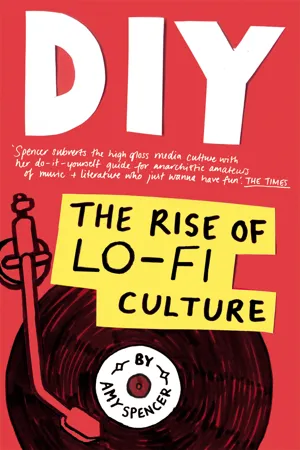
A well informed study that champions the unsung heroes and heroines of DIY distribution in art, music, literary zines and culture. This exploration of lo-fi culture traces the origin of the DIY ethic to the skiffle movement of the 1950s, mail art, Black Mountain poetry and Avant-Garde art in the 1950s, the punk scene of the 1970s and 80s, right the way through to the current music scene. Through interviews with key writers, promoters and musicians (including Bikini Kill and Bratmobile) Amy charts the development of music outside of the publicity machine of the large companies, and examines the politics behind the production of the many 'home-made' recordings and publications available today.
Information
PART I: THE ZINE REVOLUTION
A Platform for the Individual
The Writer
Zines are non-commercial, small-circulation publications which are produced and distributed by their creators. Generally the zine writer is not a professional writer, nor are they being paid for their efforts, so who exactly is producing zines and why? The basic appeal of creating these home-made ‘magazines’ is easy to see – the opportunity to write whatever you want and tap into a willing audience, with no restrictions. The drawbacks are just as obvious – the time it takes to produce the zine as well as the costs involved. Many zine writers barely break even on their expenses.
Fredric Wertham, a New York psychiatrist, became interested in the fanzine phenomenon in the early 40s, while researching the links between psychology and literature. His work at first focused on the negative effects that popular culture could potentially have on an individual. He became well respected on the subject and invited to give evidence before the Senate Subcommittee on Juvenile Delinquency in the 1950s. By the 1970s, he began to shift his attention to comic fandom subcultures. He tried to find out why people were publishing their own zines when they could instead be reading the mainstream commercial magazines. Instead of criticizing their work, he became intrigued by the fanzine founders – by their lack of commercial motivation and their celebration of the amateur writer. He later published these findings in his book The World of Fanzines1 and is credited as one of the first people to be interested in the psychology of zine writing2 – so the man who warned America of the dangers of popular culture became one of the first academics to be intrigued by underground publishing. In his book Wertham explains that: ‘Zines give a voice to the everyday anonymous person. The basic idea is that someone sits down, writes, collects, draws or edits a bunch of stuff they are interested in or care deeply about, photocopies or prints up some copies of it and distributes it. The zine creating process is a direct one, remaining under the writer’s control at all times. Perhaps its outstanding facet is that it exists without any outside interference, without any control from above, without any censorship, without any supervision or manipulation. This is no mere formal matter; it goes to the heart of what fanzines are.’
Zine writers are constantly asked why they write their zine. If they have something to say, why don’t they submit their work to mainstream magazines and newspapers? The reasons are as varied as the zines they produce. Some aim to relieve a sense of boredom or loneliness. Some want to feel part of a wider community. Some want to discuss their personal obsessions. Others want to validate their lives and make people understand their way of thinking. There are also those who use zines as a means of distributing information and resources to others.
Money is rarely a motivation to start writing a zine, as they are frequently created on a small budget and sold for little or no profit. In reality, as many zine writers will not break even on their printing costs, it seems odd that they are willing to invest the time and money into these paper projects. However, after the initial idea to begin a zine, the process can become addictive. The writer has an outlet to express their ideas and experiences the enjoyment of physically designing the layout of the zine and putting together the finished product.
Since their beginnings in the sci-fi community of the 30s, zines have been traded amongst writers and it continues to be common practice for them to swap zines. This enables both parties involved to avoid commercial dealings and idealistically reverts the process back to a time when exchange of goods was more common than monetary exchange. A code of etiquette has therefore developed that involves sending trades, writing personal letters and reviewing each other’s zines in your own. The zine is viewed differently from a commercial product. It resembles a gift more than a product, as it typically bypasses the profit motive. The flow of zines, and the personal network that has developed around them, resembles human contact. The zine is passed physically through the network connecting people together, sharing the sense of solidarity in their interest in the underground of independent culture.
Zine writing has thus become a culture in itself. Zine writers write about other zines and often feature interviews with their writers. Writers such as Aaron Cometbus and Dishwasher Pete (see later) have become celebrities in the zine world.
As many zines document what is going on in a particular scene and with their origins as ‘fanzines’ being produced by self-proclaimed fans, the identity of the zine-maker can be problematic. Many may not want to be restricted to this role of fan. Particularly in the music scene, they may not want those who are producing the culture that they are writing about to view them simply as consumers who then rave about them in print. This is one of the problems of the zine experience, for writers to be taken seriously as producers in their own right.
Working away from a corporate culture, which divides the population into carefully researched demographics, zine writers form their own networks around their identities. Many writers create their zines as a conscious reaction against a consumerist society. They adopt the DIY principle that you should create your own cultural experience. It is this message that they pass on to their readers – that you can create your own space. Unlike the message of mass media, which is to encourage people to consume, the zine encourages people to take part and produce something for themselves.
The zine is run differently from a big commercial magazine, as the creators have the freedom of being able to produce what they what and when they want to without the pressure of deadlines. There is little censorship, and contributors make the most of this freedom. Zines come and go, they can appear for just one issue and then disappear. They are a temporal form of media, which isn’t aimed at filling a commercially viable niche in the market but features whatever the writer feels like writing about. Sometimes, this can prove to be so popular that issue after issue is produced for decades.
As with many underground cultures there is a sense of possessiveness about zine culture. If a zine makes the transition into a mainstream magazine then it is often criticized, viewed with suspicion or seen as ‘selling out.’ Many feel that zines which do this are betraying the zine’s amateur status, one of the things that is so celebrated in the zine world.
But is the ethos of the zine really concerned with producing an amateur form of media? It is interesting to look at the origins of the word ‘amateur’ which, although often carrying negative connotations, is derived from the Latin word for ‘lover’. These little known origins remind us that the amateur approach can be a more personal form of communication and does not have to be equated with sloppiness, an unprofessional production or a lack of talent.
Zine writers often write about their own personal take on the world and address social and political issues. It is also clear that earlier self-published newspapers and magazines of the 60s were indeed a very important form of journalism, one which contrasted the restrictive media of the time. But can the same be said of the zines which have been published since the emergence of punk at the end of the 70s, that mix serious journalism with the zine format? Many people have argued the valid point that zine writers cannot be said to be journalists because they are not professionals and are not being commissioned to produce their work. However, some zine writing is so articulate that it could easily stand alongside professional journalism. Not all zine contributors are happy to produce work in this style, there are those who work hard to set themselves apart from the mainstream. As the independent newspapers of the 60s worked hard to create an alternative to the established papers, many zines have attempted to provide a radically different alternative to mainstream magazines.
Though it is to an extent true that zines are open to everyone – anyone can publish their own work and anyone can read it – this is slightly over-idealistic. The thousands of zines currently available have content as diverse as sci-fi, music, personal confessions and political rants. However, the writers often fit a particular profile.
Many zine writers are employed in temporary or seemingly menial jobs where they feel little satisfaction. Some writers use this as material for their zine: writers like Tyler Starr, who passes time at factory jobs by jotting down stories from his co-workers and sketching his surroundings for his zine, The Buck in the Field. He captures the lives of people working with no job satisfaction who are unable to leave due to financial constraints. Zine writers like Starr react against their experiences at work by writing zines – a creative outlet necessary to alleviate boredom.
There are countless exceptions but the zine tends to be written by a middle class, white population in their teens and early twenties. Many zine writers have challenged this assumption and produced radically different publications or have tackled the subject directly in print, but having the time and freedom to put together a zine is a privilege which many in this demographic do not question.
Zines can be criticized as being an elitist form of media. You can only have access to the information if you know exactly where to look, by talking to the right people or happening across a flyer or a zine being sold at a gig. Many people may miss out due to a complete lack of publicity and very small print runs. But the zine appears to be the perfect participatory cultural experience. Mainstream media can be, to some extent, bypassed and those involved in the scene can document their own history.
For many, the focus of zine writing is celebrating their position outside of the mainstream, having unusual interests, being a geek, rejecting the status quo. In his documentation of zine culture in Notes from Underground Zines and The Politics of Alternative Culture, Steve Duncombe claims: ‘They [zine writers] celebrate the everyperson in a world of celebrity, losers in a society that rewards the best and brightest.’3 It is this definition that best describes the position of the zine writers.
The Offbeat
That anyone can write about anything when producing a zine is both the blessing and the curse of the zine format. Some zines can be truly awful, scrappy illogical rants stapled together, others are brilliant and unique documents. As the historical development of the zine illustrates, the format can be used for any imaginable subject, and some of the most popular are those which defy classification. In some instances, before they begin writing the editors know nothing of the zine tradition and are simply inventing their own suitable format; thus creating almost by accident a publication that is recognized as a zine. These are often the best, these most cryptic and offbeat of zine offerings, giving an irreverent and truly individual perspective on the world from the writer’s point of view. Amongst these zine-oddities is Mark Saltveit’s zine The Palindromist, for people who write and read palindromes. Others focus on TV, such as Geraldo Must Die!, a rant against daytime TV talk shows, or the one-off issue in 1994 of I Hate Brenda by Darby Romeo, which was a zine devoted to attacking actress Shannon Doherty who played Brenda Walsh on the TV programme Beverly Hills 90210. Another quirky zine is Convention Crasher, where an anonymous writer sneaks into New York City’s best trade shows using fake press passes and then writes about what he witnesses.
With zines being relatively easy to produce, it is evident that people will risk publishing almost anything. As they are radically different from the commercial magazine and don’t face the same pressure to be commercially viable, and as there are no demographics, no markets, no profit and loss margins and no financial need to attract a large readership, writers don’t feel they have to be too cautious in terms of what they print. Zines celebrate the idea that you can print anything and at least one other person will want to read it.
Murder Can Be Fun
Another zine that’s certainly unique in terms of content is John Marr’s Murder Can Be Fun. Where other zines may focus on music or community, this zine, named after a favourite Fredric Brown detective novel, is dedicated to the documenting of murders. Marr is a self-taught expert on the subject, spending his weekends doing extensive research in the library. He has written a historically accurate account of the Great Boston Molasses Flood of 1919 (in which 2.3 million gallons of molasses deluged city streets, knocking over buildings and killing twenty people); chronicled every death at Disneyland since it opened in 1955, every death to occur in a zoo and also written extensively about postal-worker killings (complete with graphs!).
The Duplex Planet
David Greenberger takes a different approach, and has the changed the way many people view the zine-writing genre. He fills the pages of his zine, The Duplex Planet, not with the reckless exploits of young punks, but with interviews with the residents of nursing homes with the aim of presenting the realities of the experiences of older people in America. The project first kicked off in 1979, when, after graduating with a fine arts degree, David Greenberger began working as activities director at a nursing home called The Duplex, in Boston. He assumed that he could include the residents in his passion for painting and help them to create their own work. What he found was unexpected and radically changed his assumptions about the elderly and ideas about art. Realizing that the recreational facilities offered to the residents did little to challenge them, he connected with the residents by simply talking to them and asking, for example, what their fears were or what they thought about love. He began to produce a newsletter that encouraged the residents to write poems and answer unusual questions such as, ‘What does it mean to sell out?’, ‘If Gone with the Wind didn’t exist, what would be your favourite movie?’, ‘Would you swim in coffee if it wasn’t too hot?’, ‘Who invented sitting down?’ and ‘Which do you prefer, coffee or meat?’ These original questions, designed to provoke instantaneous answers, gave an insight into the minds of the residents. The answers were often surreal, almost visionary at times. Using humour to get to know the participants, and to encourage them to share their views, Greenberger used the newsletter as a form of emotional exchange, a means of connection. Although the questions were sometimes sill...
Table of contents
- Cover
- Title Page
- Dedication
- Table of Contents
- INTRODUCTION
- PART I: THE ZINE REVOLUTION
- PART II: THE HISTORY OF SELF-PUBLISHING
- PART III: THE RISE OF LO-FI MUSIC
- Endnotes and References
- Further Resources
- Copyright
Trusted by 375,005 students
Access to over 1.5 million titles for a fair monthly price.
Study more efficiently using our study tools.
Frequently asked questions
Yes, you can cancel anytime from the Subscription tab in your account settings on the Perlego website. Your subscription will stay active until the end of your current billing period. Learn how to cancel your subscription
No, books cannot be downloaded as external files, such as PDFs, for use outside of Perlego. However, you can download books within the Perlego app for offline reading on mobile or tablet. Learn how to download books offline
Perlego offers two plans: Essential and Complete
- Essential is ideal for learners and professionals who enjoy exploring a wide range of subjects. Access the Essential Library with 800,000+ trusted titles and best-sellers across business, personal growth, and the humanities. Includes unlimited reading time and Standard Read Aloud voice.
- Complete: Perfect for advanced learners and researchers needing full, unrestricted access. Unlock 1.5M+ books across hundreds of subjects, including academic and specialized titles. The Complete Plan also includes advanced features like Premium Read Aloud and Research Assistant.
We are an online textbook subscription service, where you can get access to an entire online library for less than the price of a single book per month. With over 1.5 million books across 990+ topics, we’ve got you covered! Learn about our mission
Look out for the read-aloud symbol on your next book to see if you can listen to it. The read-aloud tool reads text aloud for you, highlighting the text as it is being read. You can pause it, speed it up and slow it down. Learn more about Read Aloud
Yes! You can use the Perlego app on both iOS and Android devices to read anytime, anywhere — even offline. Perfect for commutes or when you’re on the go.
Please note we cannot support devices running on iOS 13 and Android 7 or earlier. Learn more about using the app
Please note we cannot support devices running on iOS 13 and Android 7 or earlier. Learn more about using the app
Yes, you can access DIY by Amy Spencer in PDF and/or ePUB format, as well as other popular books in Social Sciences & Cultural & Social Anthropology. We have over 1.5 million books available in our catalogue for you to explore.