A systemic account of how institutions shape economic development
Institutions matter for economic development. Yet despite this accepted wisdom, new institutional economics (NIE) has yet to provide a comprehensive look at what constitutes the institutional foundation of economic development (IFED). Bringing together findings from a range a fields, from development economics and development studies to political science and sociology, The Institutional Foundation of Economic Development explores the precise mechanisms through which institutions affect growth.
Shiping Tang contends that institutions shape economic development through four "Big Things": possibility, incentive, capability, and opportunity. From this perspective, IFED has six major dimensions: political hierarchy, property rights, social mobility, redistribution, innovation protection, and equal opportunity. Tang further argues that IFED is only one pillar within the New Development Triangle (NDT): sustained economic development also requires strong state capacity and sound socioeconomic policies.
Arguing for an evolutionary approach tied to a country's stage of development, The Institutional Foundation of Economic Development advances an understanding of institutions and economic development through a holistic, interdisciplinary lens.
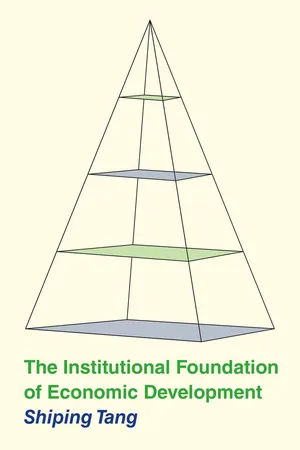
- 329 pages
- English
- PDF
- Available on iOS & Android
eBook - PDF
The Institutional Foundation of Economic Development
About this book
Information
Publisher
Princeton University PressYear
2022Print ISBN
9780691235578
9780691235561
eBook ISBN
9780691235585
Table of contents
- Cover
- Contents
- List of Illustrations
- Abbreviations
- Preface
- Introduction: Institutions Matter?
- 1. Laying the Groundwork: What Do We Know about IFED?
- 2. A Systematic Statement of IFED
- Excursion: Three Inequalities
- 3. The Positional Market and Development: Social Mobility as an Incentive
- 4. Redistribution and Development: Good Redistribution as Empowerment
- 5. Hierarchy, Liberty, and Innovation: A New Institutional Theory and Qualitative Evidence
- 6. Democracy’s Unique Advantage in Promoting Development: Quantitative Evidence
- 7. Development as a Social Evolutionary Process
- 8. The New Development Triangle: State Capacity, Institutional Foundation, and Socioeconomic Policy
- Conclusion: Laying the Foundation for Development
- Appendixes
- Notes
- Bibliography
- Index
Trusted by 375,005 students
Access to over 1.5 million titles for a fair monthly price.
Study more efficiently using our study tools.
Frequently asked questions
Yes, you can cancel anytime from the Subscription tab in your account settings on the Perlego website. Your subscription will stay active until the end of your current billing period. Learn how to cancel your subscription
No, books cannot be downloaded as external files, such as PDFs, for use outside of Perlego. However, you can download books within the Perlego app for offline reading on mobile or tablet. Learn how to download books offline
Perlego offers two plans: Essential and Complete
- Essential is ideal for learners and professionals who enjoy exploring a wide range of subjects. Access the Essential Library with 800,000+ trusted titles and best-sellers across business, personal growth, and the humanities. Includes unlimited reading time and Standard Read Aloud voice.
- Complete: Perfect for advanced learners and researchers needing full, unrestricted access. Unlock 1.5M+ books across hundreds of subjects, including academic and specialized titles. The Complete Plan also includes advanced features like Premium Read Aloud and Research Assistant.
We are an online textbook subscription service, where you can get access to an entire online library for less than the price of a single book per month. With over 1.5 million books across 990+ topics, we’ve got you covered! Learn about our mission
Look out for the read-aloud symbol on your next book to see if you can listen to it. The read-aloud tool reads text aloud for you, highlighting the text as it is being read. You can pause it, speed it up and slow it down. Learn more about Read Aloud
Yes! You can use the Perlego app on both iOS and Android devices to read anytime, anywhere — even offline. Perfect for commutes or when you’re on the go.
Please note we cannot support devices running on iOS 13 and Android 7 or earlier. Learn more about using the app
Please note we cannot support devices running on iOS 13 and Android 7 or earlier. Learn more about using the app
Yes, you can access The Institutional Foundation of Economic Development by Shiping Tang in PDF and/or ePUB format, as well as other popular books in Economics & Development Economics. We have over 1.5 million books available in our catalogue for you to explore.