Selected as one of LitHub's 38 Favorite Books of 2022
Finalist for the 2022 Big Other Book Award for Nonfiction
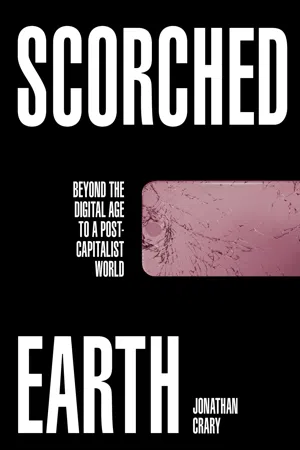
In this uncompromising essay, Jonathan Crary presents the obvious but unsayable reality: our 'digital age' is synonymous with the disastrous terminal stage of global capitalism and its financialization of social existence, mass impoverishment, ecocide, and military terror. Scorched Earth surveys the wrecking of a living world by the internet complex and its devastation of communities and their capacities for mutual support. This polemic by the author of 24/7 dismantles the presumption that social media could be instruments of radical change and contends that the networks and platforms of transnational corporations are intrinsically incompatible with a habitable earth or with the human interdependence needed to build egalitarian post-capitalist forms of life.
- 144 pages
- English
- ePUB (mobile friendly)
- Available on iOS & Android
eBook - ePub
About this book
Information
Topic
Negocios y empresaSubtopic
Historia y teoría política1
Yes, it’s night and another world is rising. Harsh, cynical, illiterate, amnesiac, revolving without reason … Spread out, flattened, as if perspective and vanishing point had been abolished … And the strange thing is that the living dead of this world are based on the world before …
Philippe Sollers, cited in Jean-Luc Godard,
Histoire(s) du cinéma
Histoire(s) du cinéma
If there is to be a livable and shared future on our planet, it will be a future offline, uncoupled from the world-destroying systems and operations of 24/7 capitalism. In whatever endures of the world, the grid, as we live within it today, will have become a fractured and peripheral part of the ruins on which new communities and interhuman projects may possibly arise. If we’re fortunate, a short-lived digital age will have been overtaken by a hybrid material culture based on both old and new ways of living and subsisting cooperatively. Now, amid intensifying social and environmental breakdown, there is a growing realization that daily life overshadowed on every level by the internet complex has crossed a threshold of irreparability and toxicity. More and more people know or sense this, as they silently experience its damaging consequences. The digital tools and services used by people everywhere are subordinated to the power of transnational corporations, intelligence agencies, criminal cartels, and a sociopathic billionaire elite. For the majority of the earth’s population on whom it has been imposed, the internet complex is the implacable engine of addiction, loneliness, false hopes, cruelty, psychosis, indebtedness, squandered life, the corrosion of memory, and social disintegration. All of its touted benefits are rendered irrelevant or secondary by its injurious and sociocidal impacts.
The internet complex has become inseparable from the immense, incalculable scope of 24/7 capitalism and its frenzy of accumulation, extraction, circulation, production, transport, and construction, on a global scale. Behaviors that are inimical to the possibility of a livable and just world are incited in almost every feature of online operations. Fueled by artificially manufactured appetites, the speed and ubiquity of digital networks maximize the incontestable priority of getting, having, coveting, resenting, envying; all of which furthers the deterioration of the world—a world operating without pause, without the possibility of renewal or recovery, choking on its heat and waste. The techno-modernist dream of the planet as a colossal worksite of innovation, invention and material progress continues to attract defenders and apologists. Most of the many projects and industries of “renewable” energy are designed for perpetuating business as usual, for maintaining devastating patterns of consumption, competition, and heightened inequality. Market-driven schemes such as the Green New Deal are absurdly pointless because they do nothing to switch off the expansion of senseless economic activity, the needless uses of electrical power, or the global industries of resource extraction incited by 24/7 capitalism.
This book is aligned with a tradition of social pamphleteering that aims to give voice to what is experienced in common, to what is known or partly known in common but is negated by an overpowering barrage of messages that insist on the unalterability of our administered lives. Many people, on a daily basis, have a visceral grasp of the immiseration of their lives and hopes, but may only have a hesitant awareness of how widely their insights are shared with others. My goal here is not to present a nuanced theoretical analysis, but, in a time of emergency, to affirm the truth of shared understandings and experiences and to insist that forms of radical refusal, rather than adaptation and resignation, are not only possible but necessary. The internet complex functions as an unending announcement of its indispensability and of the insignificance of whatever life remains unassimilable to its protocols. Its omnipresence and embeddedness within almost every sphere of personal and institutional activity makes any notion of its impermanence or post-capitalist marginalization seem unthinkable. But this impression marks a collective failure of imagination, in its passive acceptance of numbing online routines as synonymous with living. It is unthinkable only to the extent that our desires and our bonds with other peoples and species have been wounded and incapacitated.
The philosopher Alain Badiou noted that it is at this point of apparent impossibility that the conditions for insurgency arise: “Emancipatory politics always consist in making seem possible precisely that which, from within the situation, is declared to be impossible.”1 The loudest voices declaring this impossibility are those who benefit from the perpetuation of the way things are, who thrive on the uninterrupted functioning of a capitalist world. These are anyone with a professional, financial, or narcissistic stake in the ascendancy and expansion of the internet complex. How, they will ask incredulously, could we do without something on which every aspect of financial and economic life depends? Translated, this question is actually: How could we possibly do without one of the core elements of the techno-consumerist culture and economy that has brought life on earth to the edge of collapse? To have a world not dominated by the internet, they will say, would mean changing everything. Yes, precisely.
Any possible path to a survivable planet will be far more wrenching than most recognize or will openly admit. A crucial layer of the struggle for an equitable society in the years ahead is the creation of social and personal arrangements that abandon the dominance of the market and money over our lives together. This means rejecting our digital isolation, reclaiming time as lived time, rediscovering collective needs, and resisting mounting levels of barbarism, including the cruelty and hatred that emanate from online. Equally important is the task of humbly reconnecting with what remains of a world filled with other species and forms of life. There are innumerable ways in which this may occur and, although unheralded, groups and communities in all parts of the planet are moving ahead with some of these restorative endeavors.
However, many of those who understand the urgency of transitioning to some form of eco-socialism or no-growth post-capitalism carelessly presume that the internet and its current applications and services will somehow persist and function as usual in the future, alongside efforts for a habitable planet and for more egalitarian social arrangements. There is an anachronistic misconception that the internet could simply “change hands,” as if it were a mid-twentieth-century telecommunications utility, like Western Union or radio and TV stations, which would be put to different uses in a transformed political and economic situation. But the notion that the internet could function independently of the catastrophic operations of global capitalism is one of the stupefying delusions of this moment. They are structurally interwoven, and the dissolution of capitalism, when it happens, will be the end of a market-driven world shaped by the networked technologies of the present. Of course, there will be means of communication in a post-capitalist world, as there always have been in every society, but they will bear little resemblance to the financialized and militarized networks in which we are entangled today. The many digital devices and services we use now are made possible through unending exacerbation of economic inequality and the accelerated disfiguring of the earth’s biosphere by resource extraction and needless energy consumption.
Capitalism has always been a conjunction of an abstract system of value and the physical and human externalizations of that system, but, with contemporary digital networks, there is a more complete integration of the two. All of the interconnected phones, laptops, cables, supercomputers, modems, server farms, and cell towers are concretizations of the quantifiable processes of financialized capitalism. The distinction between fixed and circulating capital becomes permanently blurred. Yet many remain attached to the fallacious image of the internet as a free-standing technological assemblage, like a set of tools, and the prevalence of hand-held devices amplifies this illusion.2 In the early 1970s, the social critic Ivan Illich developed an expansive definition of a tool that included “rationally designed artifacts, productive institutions, and engineered functions.” Tools, he wrote, are intrinsically social and he evaluated them in relation to a fundamental opposition: “An individual relates himself in action to his society either through the use of tools he actively masters or by which he is passively acted upon.”3 Illich insisted that people derive happiness and satisfaction through the use of tools that are “least controlled by others,” and warned that “the growth of tools beyond a certain point increases regimentation, dependence, exploitation and impotence.” In the late 1990s, a few years before his death, he noted the disappearance of technique as a tool that was a means to an end, an instrument through which an individual could invest the world with meaning. Instead, he saw the spread of technologies into whose rules and operations people are integrated. Actions that once were at least partly autonomous now became “system-adaptive” behaviors.4 Within this historically unprecedented reality, any goals or ends we pursue cease to be ones we have truly chosen.
For all its historical novelty, the internet complex is a magnification and consolidation of arrangements that have been operative or partially realized for many years. Hardly monolithic, it’s a patchwork of elements from different eras made for a variety of uses, some of which are traceable back to the configurations for financializing flows of electricity devised in the 1880s by Edison and Westinghouse and then usurped by J. P. Morgan. Currently we’re witnessing the final act of the mad, incendiary project of a totally wired world, of the reckless belief that 24/7 availability of electrical power to a planet of 8 billion people was achievable without the disastrous consequences now occurring everywhere.
The near instantaneity of the internet’s connectivity makes it a fulfillment of Marx’s forecast in the 1850s of a global market (Weltmarkt). He saw the inevitability of a capitalist unification of the world in which constraints on the speed of circulation and exchange would be progressively diminished through “the annihilation of space by time.”5 Marx also understood that the development of a world market would necessarily lead to “the dissolution of community” and of any social relations independent of the “universalizing tendency of capital.” Thus, even if more pervasive now, the isolation associated with digital media is continuous with the social fragmentation produced by institutional and economic forces throughout the twentieth century. Media materialities may change, but the same social experiences of separation, disempowerment, and disruption of community not only persist but intensify. The internet complex quickly became an integral part of neoliberal austerity in its ongoing erosion of civil society and its replacement by monetized, online simulations of social relations. It fosters the belief that we no longer depend on each other, that we are autonomous administrators of our lives, that we can manage our friends in the same way we manage all our online accounts. It also heightens what social theorist Elena Pulcini calls the “narcissistic apathy” of individuals emptied of desire for community and who live in passive conformity with the existing social order.6
Ever since the late 1990s we’ve heard repeatedly that the dominant digital technologies are “here to stay.” The master narrative that world civilization has entered “the digital age” promotes the illusion of a historical epoch whose material determinations are beyond any possible intervention or alteration. One result has been the apparent naturalization of the internet which many now assume to be something immutably installed onto the planet. The numerous mystifications of information technologies all conceal their inseparability from the flailing stratagems of a global system in terminal crisis. Little is ever said about how the internet’s financialization is intrinsically reliant on a house-of-cards world economy already tottering and threatened further by the plural impacts of planetary warming and infrastructure collapse.
The initial claims of the internet’s permanence and inevitability coincided with various “end of history” celebrations, in which free market global capitalism was declared triumphant, without rivals, dominant in perpetuity. Even though, in geopolitical terms, this fiction quickly exploded in the early 2000s, the internet seemed to validate the post-history mirage. It appeared to introduce a uniform, default reality defined by consumption, unhinged from a physical world and its mounting social conflicts and environmental disasters. The advent of social media, with all its apparent opportunities for self-expression, briefly suggested a debased fulfillment of Hegel’s horizon of autonomy and recognition for everyone. But now, as a constitutive component of twenty-first-century capitalism, the internet’s key functions include the disabling of memory and the absorption of lived temporalities, not ending history but rendering it unreal and incomprehensible. The paralysis of remembrance occurs individually and collectively: we see this in the transience of any “analog” artifacts that are digitized: rather than preservation, their fate is oblivion and loss, noted by no one. In the same way, our own disposability is mirrored in our self-defining devices that quickly become useless pieces of digital trash. The very arrangements that supposedly are “here to stay” depend on the ephemerality, disappearance and forgetting of anything durable or lasting to which there might be shared commitments. In the late 1980s, Guy Debord saw the pervasiveness of these temporalities: “When social significance is attributed only to what is immediate, and to what will be immediate immediately afterwards, always replacing another, identical, immediacy it can be seen that the uses of the media guarantee an eternity of noisy insignificance.”7
The transformation of the internet from a network used for several decades mainly by military and research institutions into universally available online services in the mid-1990s did not happen simply because of advances in systems engineering. Rather, the shift occurred as an essential part of the massive reorganization of capital flows and the remaking of individuals into “entrepreneurs of their human capital.” The widespread introduction of informal, flexible, and decentralized forms of labor were noted by many, but in the early 1980s a smaller number of commentators were able to grasp what was at stake on a deeper level. To take one example, the French economist Jean-Paul de Gaudemar identified a fundamental reconfiguration of capitalism that involved far more than the reorganization of labor and the global dispersion of production. “In effect, we are now living in an age in which it has become clear that capital must henceforth reconquer the entire social space from which the previous system had tended to separate it. It must now reincorporate this social body in order more than ever to dominate it.”8 It would have been impossible for anyone in 1980 to foresee the concrete ways in which this reconquering would proceed, or the relentlessness with which it continues, decades later, to subsume more and more layers of lived experience. Countless spheres of the social, with their distinctive autonomies and local textures, have disappeared or been standardized into online simulations. The internet complex is now the comprehensive global apparatus for the dissolution of society.
Beginning in the mid-1990s, the internet complex was promoted as inherently democratic, decentralizing, and anti-hierarchical. It was said to be an unprecedented means for the free exchange of ideas, independent of top-down control, that would level the playing field of media access. But it was none of these. There was a short-lived phase of naïve enthusiasm, similar to the unrealized hopes voiced at the wide availability of cable TV in the 1970s. The narrative now—of an egalitarian technology endangered by monopolistic corporations, the rescinding of net neutrality, and invasions of privacy—is plainly false. There never was or will be a “digital commons.” From the start, internet access for a global public was always about the capture of time, about disempowerment and depersonalized connectedness. The only reason the internet seemed “freer” or more open initially was because the projects of financializing and expropriation did not occur all at once and took a number of years to reach an acceleration point in the early 2000s. For transnational corporations, universal access to the internet allowed the reshaping of both work and consumption into 24/7 occupations, freed from the constraints of time or location. This also created vast and interrelated possibilities of monitoring and solicitation of anyone online, and the simultaneous intensification of social privatization. Using the perspective of media historian Harold Innis, the corporate control of digital networks can be understood as a “monopoly of knowledge” which serves the ambitions of a dominant empire or state.9 While seeming to provide popular or democratic access to information, Innis saw that the larger goal of communication systems throughout history has been to break up local and regional communities by drawing them into larger spheres over which the knowledge monopoly is maintained, thus ensuring cultural and economic domination. Rarely, he noted, did subjugated groups ever effectively appropriate communications media for their own political ends.
By the mid-1990s, the destabilization of work, intensifying economic inequality, dismantling of public services, structural creation of indebtedness, and many other factors required new ways of maintaining political docility. Limitless digital diversions were a deterrent to the rise of anti-systemic mass movements. Part of the optimistic reception of the internet was the expectation that it would be an indispensable organizing tool for non-mainstream political movements, leveraging the impact of smaller or marginal forms of opposition. In reality, the internet has proven to be a set of arrangements that prevent or close off even the tentative emergence of sustained anti-systemic organizing and action. Certainly, the internet can function instrumentally transmitting information to large numbers of recipients, for example, in aid of short-term, single-issue mobilization, often linked to identity politics, “color revolutions,” climate marches, or transient expressions of outrage. Also, it should be remembered that broad-based radical movements and far larger mass mobilizations were achieved in the 1960s and early ’70s without any fetishization of the material means used for organizing.
Accounts of the internet as an egalitarian, horizontal field of “public spheres” have deleted any class-based language or advocacy of class struggle at a historical moment when class antagonisms are as acute as ever. Indeed, the internet complex has never been deployed with even minor success in furthering an anti-capitalist or anti-war agenda. It disperses the disempowered into a cafeteria of separate identities, sects, and interests and is especially effective at solidifying reactionary group formations. The insularity it produces becomes an incubator of particularisms, racisms, and neo-fascisms. Identity politics, as Nancy Fraser and others have argued, has been crucial to the strategies of “progressive” neoliberal elites: to ensure that a potentially powerful majority cannot recognize itself, being split into separate and competing factions from which a handful of representatives are allowed conspicuous entry into the meritocracy.10 The internet carries this strategy of highlighting diversity ...
Table of contents
- Cover Page
- Halftitle Page
- Title Page
- Copyright Page
- Contents
- Acknowledgments
- 1
- 2
- 3
- Notes
Trusted by 375,005 students
Access to over 1.5 million titles for a fair monthly price.
Study more efficiently using our study tools.
Frequently asked questions
Yes, you can cancel anytime from the Subscription tab in your account settings on the Perlego website. Your subscription will stay active until the end of your current billing period. Learn how to cancel your subscription
No, books cannot be downloaded as external files, such as PDFs, for use outside of Perlego. However, you can download books within the Perlego app for offline reading on mobile or tablet. Learn how to download books offline
Perlego offers two plans: Essential and Complete
- Essential is ideal for learners and professionals who enjoy exploring a wide range of subjects. Access the Essential Library with 800,000+ trusted titles and best-sellers across business, personal growth, and the humanities. Includes unlimited reading time and Standard Read Aloud voice.
- Complete: Perfect for advanced learners and researchers needing full, unrestricted access. Unlock 1.5M+ books across hundreds of subjects, including academic and specialized titles. The Complete Plan also includes advanced features like Premium Read Aloud and Research Assistant.
We are an online textbook subscription service, where you can get access to an entire online library for less than the price of a single book per month. With over 1.5 million books across 990+ topics, we’ve got you covered! Learn about our mission
Look out for the read-aloud symbol on your next book to see if you can listen to it. The read-aloud tool reads text aloud for you, highlighting the text as it is being read. You can pause it, speed it up and slow it down. Learn more about Read Aloud
Yes! You can use the Perlego app on both iOS and Android devices to read anytime, anywhere — even offline. Perfect for commutes or when you’re on the go.
Please note we cannot support devices running on iOS 13 and Android 7 or earlier. Learn more about using the app
Please note we cannot support devices running on iOS 13 and Android 7 or earlier. Learn more about using the app
Yes, you can access Scorched Earth by Jonathan Crary in PDF and/or ePUB format, as well as other popular books in Negocios y empresa & Historia y teoría política. We have over 1.5 million books available in our catalogue for you to explore.