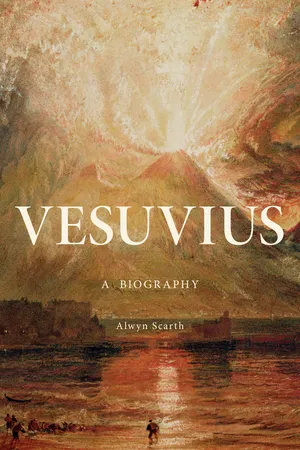
The volcano that has fascinated scientists, writers, and poets for two millennia
Capricious, vibrant, and volatile, Vesuvius has been and remains one of the world's most dangerous volcanoes. In its rage, it has destroyed whole cities and buried thousands alive. In its calm, its ashes have fertilized the soil, providing for the people who have lived in its shadows. For over two millennia, the dynamic presence of this volcano has fascinated scientists, artists, writers, and thinkers, and inspired religious fervor, Roman architecture, and Western literature. In Vesuvius, Alwyn Scarth draws from the latest research, classical and eyewitness accounts, and a diverse range of other sources to tell the riveting story of this spectacular natural phenomenon.
Scarth follows Vesuvius across time, examining the volcano's destruction of Pompeii and Herculaneum in 79 A.D., its eruptions during the Counter-Reformation that were viewed as God's punishment of sinners, and the building of the world's first volcano observatory on Vesuvius in the 1840s. Scarth explores the volcano's current position overlooking a population of more than three million people and the complex attitudes maintained by the residents, at once reverent, protective, and fearful. He also considers the next major eruption of Vesuvius, which experts have indicated could be the most powerful since 1631. The longer Vesuvius remains dormant, the more violent its reawakening will be, and despite scientific advances for predicting when this might occur, more people are vulnerable than ever before.
Exploring this celebrated wonder from scientific, historical, and cultural perspectives, Vesuvius provides a colorful portrait of a formidable force of nature.
eBook - PDF
About this book
Information
Topic
Physical SciencesSubtopic
Science HistoryTable of contents
- Cover Page
- Half-title page
- Title page
- Copyright page
- Contents page
- Preface
- Acknowledgements
- 1. Introduction
- 2. Campanian volcanoes: in the beginning
- 3. The Avellino eruption: a prelude to Pompeii
- 4. The eruption in AD 79: the day of wrath
- 5. From antiquity to the Renaissance: tall stories
- 6. The eruption of Monte Nuovo: a new approach
- 7. The eruption in 1631: the Counter Reformation
- 8. The old cities rediscovered: antiquity protected
- 9. Hamilton and Vesuvius: volcano-watching
- 10. Vesuvius as a tourist attraction: the Grand Tour
- 11. Persistent activity 1822–1944: scientific scrutiny
- 12. The Campi Flegrei: an eruption that failed
- 13. The future: the eruption to be avoided
- Appendix 1: The two letters of Pliny the Younger to Tacitus about the eruption of AD 79
- Appendix 2: Cassiodorus: Variae Epistolae, letter 50
- Glossary
- Bibliography
- Index
Trusted by 375,005 students
Access to over 1.5 million titles for a fair monthly price.
Study more efficiently using our study tools.
Frequently asked questions
Yes, you can cancel anytime from the Subscription tab in your account settings on the Perlego website. Your subscription will stay active until the end of your current billing period. Learn how to cancel your subscription
No, books cannot be downloaded as external files, such as PDFs, for use outside of Perlego. However, you can download books within the Perlego app for offline reading on mobile or tablet. Learn how to download books offline
Perlego offers two plans: Essential and Complete
- Essential is ideal for learners and professionals who enjoy exploring a wide range of subjects. Access the Essential Library with 800,000+ trusted titles and best-sellers across business, personal growth, and the humanities. Includes unlimited reading time and Standard Read Aloud voice.
- Complete: Perfect for advanced learners and researchers needing full, unrestricted access. Unlock 1.5M+ books across hundreds of subjects, including academic and specialized titles. The Complete Plan also includes advanced features like Premium Read Aloud and Research Assistant.
We are an online textbook subscription service, where you can get access to an entire online library for less than the price of a single book per month. With over 1.5 million books across 990+ topics, we’ve got you covered! Learn about our mission
Look out for the read-aloud symbol on your next book to see if you can listen to it. The read-aloud tool reads text aloud for you, highlighting the text as it is being read. You can pause it, speed it up and slow it down. Learn more about Read Aloud
Yes! You can use the Perlego app on both iOS and Android devices to read anytime, anywhere — even offline. Perfect for commutes or when you’re on the go.
Please note we cannot support devices running on iOS 13 and Android 7 or earlier. Learn more about using the app
Please note we cannot support devices running on iOS 13 and Android 7 or earlier. Learn more about using the app
Yes, you can access Vesuvius by Alwyn Scarth in PDF and/or ePUB format, as well as other popular books in Physical Sciences & Science History. We have over 1.5 million books available in our catalogue for you to explore.