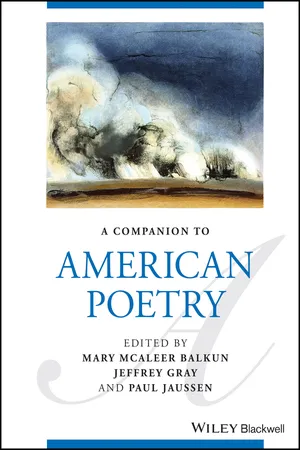
A Companion to American Poetry
  1. English
  2. ePUB (mobile friendly)
  3. Available on iOS & Android
eBook - ePub

About this book

A COMPANION TO AMERICAN POETRY

A Companion to American Poetry brings together original essays by both established scholars and emerging critical voices to explore the latest topics and debates in American poetry and its study. Highlighting the diverse nature of poetic practice and scholarship, this comprehensive volume addresses a broad range of individual poets, movements, genres, and concepts from the seventeenth century to the present day.

Organized thematically, the Companion's thirty-seven chapters address a variety of emerging trends in American poetry, providing historical context and new perspectives on topics such as poetics and identity, poetry and the arts, early and late experimentalisms, poetry and the transcendent, transnational poetics, poetry of engagement, poetry in cinema and popular music, Queer and Trans poetics, poetry and politics in the 21st century, and African American, Asian American, Latinx, and Indigenous poetries.

Both a nuanced survey of American poetry and a catalyst for future scholarship, A Companion to American Poetry is essential reading for advanced undergraduate and graduate students, academic researchers and scholars, and general readers with interest in current trends in American poetry.

Information

Year
2022
Print ISBN
9781119669722
9781119669685
Edition
1
eBook ISBN
9781119669227

1
Introduction

Mary McAleer Balkun, Jeffrey Gray, and Paul Jaussen
In his 1919 essay “Tradition and the Individual Talent,” T.S. Eliot observed that the creation of a new work of art necessarily changes those that preceded it: “The existing monuments form an ideal order among themselves, which is modified by the introduction of the new (the really new) work of art among them” (1920, para. 4). In the case of poetry, new work changes the way we look at Emily Dickinson’s fascicles or modernist images, for example, or indeed what we decide to call “American” poetry. Like works of art, critical paradigms can refine methods, broaden contexts, and reorganize the field of poetics, transforming what scholars value or understand about poems. The New Criticism, for instance, raised the profile of the lyric poem in the early twentieth century, an elevation that was later challenged, first, in the late twentieth century by the New Historicism, which restored the elements of identity and context and privileged narrative over lyric, and more recently by the “new lyric studies,” which questions the critical stance toward this genre over the past century, one that has often ignored the diversity of poetry and its historical dimension. The twenty-first century has seen a growing interest in documentary and archival poetry, a further remove from New Critical impersonality. As a result of changes in both poetic practice and critical paradigms, often in a reciprocal relation with one another, the study of poetry has evolved at a rapid rate.
This volume was conceived and written during a period of accelerating global instability, with the re-emergence of authoritarian political regimes, the increasingly obvious effects of climate change, and, in the final years of writing and editing, the COVID-19 pandemic. These challenges highlight the dynamism between present concerns and the ways in which the past helps us understand those concerns. In the development of the Companion to American Poetry, we have tried to broaden our critical map so as to address the fact that our American pasts often entertained very different ideas of the poet and of poetry’s place and purpose. We solicited essays that both took those historical concepts on their own terms but also, crucially, reconceptualized the past in dialogue with the present. Not only is the past unstable, but it changes according to the questions we ask of it. In this volume, we sought to pose new questions that respect long-standing concerns of American poetry and criticism as well as recast those questions according to our present lights. How, for instance, has the inescapable experience of death and dying been transformed through the decades by the poetic imagination? How has American poetry staged the struggles over language and nation in the wake of US settler colonialism? How have queer and trans voices used poetry to articulate identities that have been otherwise repressed in the United States? Where do we see poetry engaging “nature” as a transcendent concept and the anthropocene as a material activity of planetary destruction? How does the very term “American poetry” become redefined when read through the forces of globalization? Questions such as these express critical and poetic continuities—traditionally at the heart of a volume such as this one—but also demonstrate important discontinuities. These include poetry’s relationship to other genres and other fields, the way conceptions of the poem itself have changed, and the way poetry responds to contemporary events and trends.
The challenge for such a project is not only its scale but also the demands of portraying American poetry as a whole. Instead of offering a singular narrative, as we developed this Companion to American Poetry we committed to two principles: first, to highlight new approaches, unexplored research areas, and emerging practices within American poetry and poetics writ large; and, second, to prompt a wide-ranging discussion about the expanding edges of poetry scholarship. The Companion brings together a group of scholars and scholar–poets, from those in the early stages of their careers to more established voices, and with expertise in a cross-section of historical periods and forms: from the time before there was an “American” poetry to the present day, and from the traditional to the experimental. These essays reflect a poetry that is broadly conceived and that acknowledges the porousness of boundaries, whether cultural, temporal, or generic.
While each chapter presents an individual argument, we have organized the volume according to clusters of concerns. Each section title gestures toward earlier paradigms in American poetry criticism while also attempting to widen our definitions of those conceptual frameworks. We begin with “Poetry before ‘American Poetry,’” calling attention to the problematic definition of “America” through chapters on pre-colonial writings, indigenous politics, and the role that poetry played in forming the early national imaginary. We follow this with “Poetry and the Transcendent,” considering the flourishing of nineteenth-century poetry in dialogue with transcendentalist philosophy while also exploring the ongoing role of experiences of the sacred and epiphanic in contemporary writing. Acknowledging that the “experimental/traditional” divide is both operative and problematic in many accounts of American poetry, our third section stresses “experimentalisms,” whether in modernist and contemporary poetry or in experimental critical practices, such as philosophical readings or digital fabrications. Sections four and five examine the related topics of identity and nation, with essays that take up queer, transgender, and transnational concerns. Section six expands the field of poetry’s relationship to other arts and media, with reconsiderations of ekphrastic and cinematic poetries, along with chapters on bio art and rap music. Section seven exemplifies our commitment to moving between past, present, and future through readings of the various ways that ecology, nature, and the anthropocene have shaped our vision of planetary existence. In our final section, we gather a diverse collection of essays on poetry that engages with public struggles: over borders, war, capitalism, or racial inequality.
Some scholars claim that shifts in literary critical practice, notably the rise of New Historicism and various reactions to it, have led to the sidelining of poetry in favor of narrative. However, as we can see from the intellectual diversity and depth of this volume, the death of poetry has been greatly exaggerated. The 37 essays in A Companion to American Poetry demonstrate the continued relevance of poetry and poetics for broader fields that animate literary scholarship today, including indigenous studies, queer and transgender studies, diasporic and Black studies, maker methodologies, science and technology studies, and visual cultural studies, among others. We hope these essays not only offer new understandings and perspectives but also speak to the ongoing vitality of American poetry, as well as its important, always timely, contributions to American and world culture.
References

  1. Eliot, T.S. (1920). Tradition and the Individual Talent. The Sacred Wood. Available at https://www.gutenberg.org/files/57795/57795-h/57795-h.htm. (Accessed: 13 July 2021).

SECTION 1
Poetry before “American Poetry”

2
Worldmaking and Ambition in History Poems by Early American Women: The Examples of Anne Bradstreet and Sarah Wentworth Morton

Tamara Harvey
George Mason University
Arme, arme, Soldado’s arme, Horse, Horse, speed to your Horses,
Gentle-women, make head, they vent their plot in Verses;
They write of Monarchies, a most seditious word,
It signifies Oppression, Tyranny, and Sword:
March amain to London, they’l rise, for there they flock,
But stay a while, they seldome rise till ten a clock.
R.Q. (Bradstreet, 1650, n.p.)
The humor in R.Q.’s prefatory poem to Anne Bradstreet’s The Tenth Muse (1650) is neither original nor subtle, which may explain why it was the only prefatory poem to be dropped from Several Poems (1678).1 And yet its representation of both monarchy and literary gentle-women epitomizes the broad trends in scholarship on the poem R.Q. would seem to have in mind, Bradstreet’s “The Four Monarchies.” Bradstreet renders Sir Walter Ralegh’s2 five volume The Historie of the World in over 3500 lines of iambic pentameter couplets. According to Gillian Wright, Bradstreet’s poem is a “politic history,” a subgenre of early modern verse history that uses condensation and an epigrammatic style to render its subject (p. 85). At times this yields pithy epitomes of long, scholarly discourse, though just as frequently the effort to turn Ralegh’s prose into poetry leads to confusing inversions and other infelicities. Modern readers, it is fair to say, don’t love this poem. To make sense of it, scholars have read it as a reflection of extratextual concerns that resonate more readily with modern interests, situating Bradstreet politically within transatlantic Puritan concerns during the English Civil War and literarily as a woman writer who must work against broad characterizations of women’s abilities and nature. How the poem fails and how it treats failure is a frequent focus of these approaches. Bradstreet herself attributed faults in the poem to her gender and personal circumstances: “To fill the world with terrour and with woe,/My tyred brain leavs to some better pen,/This task befits not women like to men” (1678, p. 185).3 In this poem, written during the English Civil War and published in the year following the beheading of Charles I, Bradstreet also repeatedly demonstrates that “Royalty no good conditions brings” (1678, p. 172), but falters in concluding the poem in ways that may be attributed to her unwillingness to imagine political solutions that fully reject monarchy.4
In this chapter, I argue that attention to the concept of worldmaking and its attendant failures provides useful grounds for comparing women writers across time. I expand on recent readings of Bradstreet’s longest and most neglected poem, “The Four Monarchies,” and then consider The Virtues of Society (1799), one of three long history poems written by Sarah Wentworth Morton during the early US republic. My goal is to suggest that understanding the ways these poets engage the intellectual project of imagining and theorizing the world at moments of significant global transformation provides insights into their work individually as well as providing a framework for examining the work of other early women writers. In each case I focus on the poet’s representation of a heroic woman situated in world-historical space, Semiramis and Lady Harriet Ackland, respectively, in order to explore their engagement with historical genres, learned debates, and depictions of exceptional women.
Though both personal and political approaches to literature are relevant and revelatory, they often sidestep the manifest purpose of a poem such as Bradstreet’s—to tell the history of the world. Recent attention to worldmaking and a rapidly changing global imaginary during the early modern period provides a more robust framework for reading Bradstreet’s ambitious attempt at a universal history. Ayesha Ramachandran describes early modern “worldmaking” as “the methods by which early modern thinkers sought to imagine, shape, revise, control, and articulate the dimensions of the world,” synthesizing fragments into a comprehensive whole (pp. 6–7). Understanding Bradstreet’s poem as a form of worldmaking helps us better appreciate her literary ambition. It also helps us account for her evident failures in this poem without attributing them solely to her gender and personal circumstances or the responses of New England Puritans to the English Civil War. “[T]he great secret of the early modern system-makers,” Ramachandran explains, is that “worldmaking is possible, even necessary, because of the insurmountable gap between our fragmentary apprehension of the phenomenal world and our desire for complete knowledge of it” (p. 10). Early modern worldmaking frequently drew on metaphors of the body to imagine the world (Ramachandran 2015, p....

Table of contents

  1. Cover
  2. Blackwell Companions to Literature and Culture
  3. Title page
  4. Copyright
  5. Dedication
  6. Table of Contents
  7. 1 Introduction
  8. Section 1: Poetry before “American Poetry”
  9. Section 2: Poetry and The Transcendent
  10. Section 3: Experimentalisms, Early and Late
  11. Section 4: Poetry and Identity
  12. Section 5: Transnational Poetry
  13. Section 6: Poetry and the Arts
  14. Section 7: Nature and After
  15. Section 8: Poetry of Engagement
  16. Index
  17. End User License Agreement

Trusted by 375,005 students

Access to over 1.5 million titles for a fair monthly price.

Study more efficiently using our study tools.

Frequently asked questions

Yes, you can cancel anytime from the Subscription tab in your account settings on the Perlego website. Your subscription will stay active until the end of your current billing period. Learn how to cancel your subscription
No, books cannot be downloaded as external files, such as PDFs, for use outside of Perlego. However, you can download books within the Perlego app for offline reading on mobile or tablet. Learn how to download books offline
Perlego offers two plans: Essential and Complete
  • Essential is ideal for learners and professionals who enjoy exploring a wide range of subjects. Access the Essential Library with 800,000+ trusted titles and best-sellers across business, personal growth, and the humanities. Includes unlimited reading time and Standard Read Aloud voice.
  • Complete: Perfect for advanced learners and researchers needing full, unrestricted access. Unlock 1.5M+ books across hundreds of subjects, including academic and specialized titles. The Complete Plan also includes advanced features like Premium Read Aloud and Research Assistant.
Both plans are available with monthly, semester, or annual billing cycles.
We are an online textbook subscription service, where you can get access to an entire online library for less than the price of a single book per month. With over 1.5 million books across 990+ topics, we’ve got you covered! Learn about our mission
Look out for the read-aloud symbol on your next book to see if you can listen to it. The read-aloud tool reads text aloud for you, highlighting the text as it is being read. You can pause it, speed it up and slow it down. Learn more about Read Aloud
Yes! You can use the Perlego app on both iOS and Android devices to read anytime, anywhere — even offline. Perfect for commutes or when you’re on the go.
Please note we cannot support devices running on iOS 13 and Android 7 or earlier. Learn more about using the app
Yes, you can access A Companion to American Poetry by Mary McAleer Balkun, Jeffrey Gray, Paul Jaussen, Mary McAleer Balkun,Jeffrey H. Gray,Paul Jaussen,Jeffrey Gray, Mary McAleer Balkun, Jeffrey H. Gray, Paul Jaussen in PDF and/or ePUB format, as well as other popular books in Literature & North American Literary Criticism. We have over 1.5 million books available in our catalogue for you to explore.