Addressing the intense debate in science and religion in light of evolutionary population genetics, Andrew Ter Ern Loke argues that the theory of evolution as understood by mainstream scientists is compatible with Scripture. Loke asserts that resolving this area of perceived conflict would greatly benefit both scientific and religious communities, and contribute to the spiritual quest of humankind.
Whilst affirming that the Bible should be interpreted according to proper hermeneutical principles such as considering the literary genre, literary context, meaning of words, grammatical relationship, and the background and concerns of the ancient authors, this book also assesses the scientific data according to proper mainstream scientific methodology. Having accomplished these tasks, it proposes a model which argues that all humans today have Adam as common ancestor even though this ancestor is not our sole ancestor.
eBook - ePub
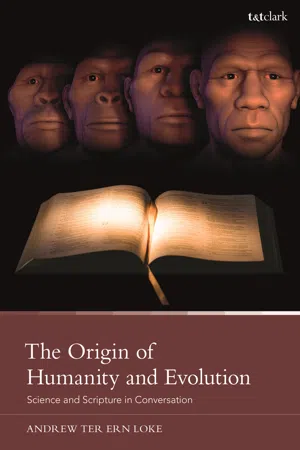
The Origin of Humanity and Evolution
Science and Scripture in Conversation
- 200 pages
- English
- ePUB (mobile friendly)
- Available on iOS & Android
eBook - ePub
About this book
Information
Chapter 1
A transdisciplinary approach concerning human origins
1.1 A defence of a transdisciplinary approach concerning human origins
1.1.1 Significance of the topic
The question of our origins has fascinated us from time immemorial. From ancient myths, philosophical writings, religious texts to modern science, many theories have been proposed to explain where we come from. There is no evidence that other species ever wrestled with this question as we do.
In our contemporary world, science and religion are two of the most significant influences shaping people’s opinions concerning human origins. Modern science has undoubtedly helped us gain a better understanding of the natural world. On the other hand, religion has provided for billions of people worldwide their views concerning humanity’s biggest questions, including the question of our origins and how this is related to vital issues such as the value and meaning of life. An understanding of the relationship between science and religion is therefore of great importance for understanding our world and the deep existential issues that concern our human race.
In recent years, there has been intense debate in science and religion in light of evolutionary population genetics, which indicates that the genetic diversity of the current Homo sapiens population requires that Homo sapiens descended from a large population (polygenism) (Yang 2002), rather than from a single pair (monogenism) as traditionally held by Christians, Judaists and Muslims. Polygenism had been brought into theological discussions earlier by Isaac La Peyrère in the seventeenth century following the ‘discovery’ of the New World with people living on the other side of the globe (antipodeans) (Livingstone 2008). It was rejected by the Roman Catholic Church because it denied the universal descent of humankind from Adam and Eve (Humani Generis, 1950). However, as a result of the findings of population genetics, many contemporary theologians, philosophers and scientists have called for a re-evaluation of the Scriptural account of human origins (e.g. Cole-Turner 2016, 2020; Ruse 2017; Venema and McKnight 2016). Many others have resisted their call on exegetical and theological grounds (Riches 2017; Halton ed. 2015), but offered no good response to the objections. Among Christians, those who resisted include not only American Evangelicals and Fundamentalists but also Christians of other stripes (e.g. Roman Catholics and Eastern Orthodox Christians) around the world (see Chapter 2). The debate has generated significant global public interest, with well-known atheist biologist Jerry Coyne (2011) calling it ‘the ultimate standoff between science and faith’.
This book fills a gap in the literature by addressing the above-mentioned issues using a transdisciplinary approach, that is, one which integrates different disciplines (in this case, involving philosophy of religion, natural sciences, social sciences, historical-critical biblical studies and theology) to create a new methodology that moves beyond discipline-specific approaches to address a problem. The difference between Multidisciplinary, Interdisciplinary and Transdisciplinary is as follows: ‘Multidisciplinarity draws on knowledge from different disciplines but stays within their boundaries. Interdisciplinarity analyzes, synthesizes and harmonizes links between disciplines into a coordinated and coherent whole. Transdisciplinarity integrates the natural, social and health sciences in a humanities context, and transcends their traditional boundaries.’1 My work fits the last category. It engages with contemporary science while it also advances theological conclusions that are rooted in classical Christian traditions. Specifically, my work utilizes ancient and biblically grounded theological views to formulate a new model of human origins which addresses the apparent conflict between the historicity of Adam and the theory of evolution (including evolutionary population genetics).2 This model shows that all humans today could have a common ancestor (Adam) even though they descended from a large population of anatomical Homo as indicated by population genetics.
To elaborate, I reply to the objections to monogenesis using a unique variant of the Genealogical Adam and Eve (GAE) model which responds to more recent criticisms against the model (e.g. Houck 2020). My model draws on the important recent work on this model by Joshua Swamidass (2018; 2019; though my variation of the model differs from his in some respects; see Loke 2020b),3 the biblical exegetical work of Walton (2009, 2015) and Collins (2018) and recent philosophical theological literature on humans as embodied souls (e.g. Visala 2014; Farris 2016b; Loose ed. 2018). It also builds on an earlier paper in which I distinguish between Task (A) ‘interpreting the Bible’, Task (B) ‘showing that the Biblical account is true’ and Task (C) ‘showing that there is no incompatibility between human evolution and Bible’ (Loke 2016). For (A), one would ask for evidences for what the human biblical authors had in mind, but for (C) it is perfectly legitimate to suggest a possible model which the biblical authors may not have thought of, as long as the possibility is not contradictory to what they stated. I develop such a possible model which distinguishes between ‘anatomical Homo which possessed the image of God’ (God’s-Image-Bearer, Adam being the first of these) and anatomical Homo which did not possess the image of God. By associating the image of God with Divine election for royal function (Moritz 2011b) and the associated capacities, I propose that God could have chosen a pre-existing anatomical Homo and made that organism a human being (i.e. a God’s-Image-Bearer) in a localized environment (the Garden of Eden). After the Fall, the image of God was passed down from this person (Adam) to his descendants some of whom procreated with non-imago-Dei-Homo outside the Garden. Their descendants were fully human, while non-imago-Dei-Homo contributed to the genetic diversity. In this way, all humans today could have a common ancestor even though this ancestor is not our sole ancestor. This conclusion is consistent with evolutionary population genetics, and with scientific studies published in the pre-eminent science journal Nature which have shown that all human beings today are very likely to have had a very recent common ancestor even if substantial forms of population subdivision existed with a very low rate of migration (Rohde, Olson and Chang 2004; Hein 2004). By tying various strands of arguments in recent discussions with this model, this book makes an original and significant contribution to scholarly debates on the origin of humanity which is important to both secular and religious scholars.
In addition, this book provides a comprehensive assessment of alternative proposals and engages with the arguments of scholars from a wide variety of world views, including
- Atheists/Agnostics: for example, Michael Ruse, David Christian, Richard Dawkins, Yuval Harari, Jason Rosenhouse, Jerry Coyne, Othmar Keel.
- Judaists: for example, Nahum Sarna.
- Roman Catholics: for example, John Haught, Gerald O’Collins, Pierre Teilhard de Chardin, Aaron Riches, Pope Pius XII.
- Mainline Protestants: for example, Rowan Williams, Ian McFarland, J. Wentzel van Huyssteen, Christopher Southgate, David Clough, Joshua Moritz, Cole-Turner, John Day, Daniel Harlow, Claus Westermann.
- Eastern Orthodox Christians: for example, David Bentley Hart, George Nicozisin.
- Evangelical Christians.
The last group deserves special mention. Despite the enormous efforts of science educators, the resistance of many (though not all) Evangelical Christians4 towards mainstream scientific theories such as evolution has spread globally (Numbers 2006). One reason is that many academic writings have failed to adequately understand and engage with the detailed Scriptural reasoning and motivation that undergird their view. Given that the Bible is of central importance to the faith of Christians worldwide, these scientific theories are unlikely to find widespread acceptance among Christians (not only Evangelicals but also many Roman Catholics and Eastern Orthodox Christians) unless their concerns with regard to the compatibility of these theories with the Bible are seriously considered and adequately addressed. This book will help the wider academic world understand the motivations for these concerns and why the enormous efforts of those science educators have failed. It will provide a better way forward by addressing these concerns regarding science and the Bible and offer a systematic response to their theological objections in an academically responsible manner. Given that this subgroup of Evangelicals are the ones who have raised the strongest objections to evolutionary science among Christian groups today and that this has been a major obstacle for conversations between Science and Christianity, the removal of an important aspect of this obstacle is another significant contribution of this book. It should, however, be emphasized that the debate concerning monogenism is of great interest not only to Evangelicals but also to Roman Catholics (e.g. Pope Pius XII, Humani Generis 1950; Riches 2017), Eastern Orthodox Christians (e.g. Nicozisin 2017), Mainline Protestants (e.g. Cole-Turner 2016, 2020), Atheists and Agnostics (e.g. Ruse 2017), as well as Judaists and Muslims. Much of my book engages with the views of scholars from these wide variety of religious traditions and different world views, and thus my book would be of interest and a resource for these audiences as well.
1.2 On the use of a transdisciplinary approach
With regard to my use of a transdisciplinary approach to address the Big Question concerning our origins, proponents of scientism might object by claiming that science5 is the only way for understanding the nature of reality. On the other hand, radical postmodernists would be sceptical about what science can tell us and whether such Big Questions can in principle be answered.
Scientism, however, is susceptible to the objection that scientism cannot be proven by science itself, and that its advocates ‘rely in their argument not merely on scientific but also on philosophical premises’ (Stenmark 2003, pp. 783–5). Moreover, the scientific method itself requires various forms of philosophical reasoning, such as deductive and inductive reasoning, for the development of its explanations. Additionally, science itself cannot answer the question ‘why scientific results should be valued’; the answer to this question is philosophical rather than scientific. With respect to the criteria for a good scientific theory, cosmologist George Ellis observes the following four areas of assessment:
- Satisfactory structure: (a) internal consistency, (b) simplicity (Ockham’s razor) and (c) aesthetic appeal (‘beauty’ or ‘elegance’);
- Intrinsic explanatory power: (a) logical tightness, (b) scope of the theory – the ability to unify otherwise separate phenomena and (c) probability of the theory or model with respect to some well-defined measure;
- Extrinsic explanatory power, or relatedness: (a) connectedness to the rest of science, (b) extendability – providing a basis for further development;
- Observational and experimental support, in terms of (a) testability: the ability to make quantitative as well as qualitative predictions that can be tested and (b) confirmation: the extent to which the theory is supported by such tests as have been made.
Ellis acknowledges the importance of philosophy for these criteria, noting that
‘These criteria are philosophical in nature in that they themselves cannot be proven to be correct by any experiment. Rather their choice is based on past experience combined with philosophical reflection’ (Ellis 2007, Section 8.1).
On the other hand, the hyper-scepticism of radical postmodernists towards science is unwarranted. Various examples of scientific theories indicate that we can discover many details about reality, including the ‘unobservable causes’ of phenomena (Swinburne 2005, p. 39; for responses to radical postmodernism, see further, Loke 2017a, Chapter 1). The National Academy of Sciences (2008) notes:
Many scientific theories are so well-established that no new evidence is likely to alter them substantially. For example, no new evidence will demonstrate that the Earth does not orbit around the sun (heliocentric theory), or that living things are not made of cells (cell theory), that matter is not composed of atoms, or that the surface of the Earth is not divided into solid plates that have moved over geological timescales (the theory of plate tectonics).
Building on this, I have argued in Loke (2017a, 2022a, ) that the conclusions of those philosophical arguments (e.g. the argument for a Divine First Cause) which can yield answers that are more epistemically certain than scientific discoveries should be regarded as knowledge about reality on at least the same level as scientific facts. While science is a way of knowing, philosophy is another way of knowing. Against reductionism, there is a need to bring together different disciplines that would complement one another in our attempt to gain a fuller understanding of reality, in particular the complex phenomenon concerning human origins. Professor David Christian, the pioneer of ‘Big History’, a popular interdisciplinary course offered by universities internationally which studies the past across physics, astronomy, geology, biology and human history, observes that there is ‘a growing sense, across many scholarly disciplines, that we need to move beyond the fragmented account of reality that has dominated scholarship (and served it well) for a century’ (2011, p. 3), and that
There is also a growing need for specialization to be supplemented by integration. The reason is that no complex, nonlinear system can be adequately described by dividing it up into subsystems or into various aspects, defined beforehand. If those subsystems or those aspects, all in strong interaction with one another, are studied separately, even with great care, the results, when put together, do not give a useful picture of the whole. In that sense, there is profound truth in the old adage, ‘The whole is more than the sum of its parts’. (pp. 3–4)
For a Christian who thinks that there are reasons to believe that the Bible is divinely inspired (Habermas 2003, chapter 10), he/she would argue that the issue of human origins cannot be reduced to what biology tells us (important as it is), that science and philosophy needs to be complemented by theology as well, and that the relationships (including the compatibility) between the views of these disciplines would need to be examined.
Against this, some scientists have argued for a compartmentalization between science and religion, claiming that science concerns the empirical universe while religion concerns morality (e.g. the Non-Overlapping Magisteria advocated in Stephen Jay Gould 2002). However, others have objected that the Christian doctrine of creation implies an unavoidable and significant overlap, and that science and religion should converse with each other (Collins 2006, McGrath 2016). Scholars have noted that many prominent scientists who contributed to the rise of modern science were motivated by their Christian beliefs, such as the belief that an intelligent God who inspired the Scripture also created a natural order which can be understood by intelligent human beings made in the image of God (Harrison 1998; Stump 2016, chapter 2). Many popular beliefs about how Christianity has supposedly hindered the rise of modern science which have been propagated by vociferous biologist Jerry Coyne and others are based on misconceptions (Berezow and Hannam 2013). A well-documented study (Giberson and Artigas 2007) shows that a number of atheist popularizers of science such as Richard Dawkins and Stephen Hawking have persisted in creating a widespread but false impression that science as a whole is incompatible with religion, and they have repeatedly ignored critics who have pointed out their ignorance about religion and philosophy. Large-scale surveys among contemporary scientists reveal a more nuanced picture, with a significant number of scientists being open to science-and-religion dialogue (Ecklund 2010). Cosmologist William Stoeger offers an account of how science, philosophy and theology might complement one another with regard to the issue of ultimate origins:
Physics and cosmology as sciences are incapable of exploring or directly accounting for the ultimate source of...
Table of contents
- Cover
- Half-Title
- Dedication
- Title
- Contents
- Acknowledgements
- Chapter 1 A transdisciplinary approach concerning human origins
- Chapter 2 Divine Accommodation and its implications for biblical anthropology
- Chapter 3 The time span of creation
- Chapter 4 The process of Evolutionary Creationism
- Chapter 5 Human evolution and the question of Adam
- Chapter 6 The time frame of our common ancestor
- Chapter 7 Conclusions and implications
- Bibliography
- Scripture Index
- Subject Index
- Copyright
Trusted by 375,005 students
Access to over 1.5 million titles for a fair monthly price.
Study more efficiently using our study tools.
Frequently asked questions
Yes, you can cancel anytime from the Subscription tab in your account settings on the Perlego website. Your subscription will stay active until the end of your current billing period. Learn how to cancel your subscription
No, books cannot be downloaded as external files, such as PDFs, for use outside of Perlego. However, you can download books within the Perlego app for offline reading on mobile or tablet. Learn how to download books offline
Perlego offers two plans: Essential and Complete
- Essential is ideal for learners and professionals who enjoy exploring a wide range of subjects. Access the Essential Library with 800,000+ trusted titles and best-sellers across business, personal growth, and the humanities. Includes unlimited reading time and Standard Read Aloud voice.
- Complete: Perfect for advanced learners and researchers needing full, unrestricted access. Unlock 1.5M+ books across hundreds of subjects, including academic and specialized titles. The Complete Plan also includes advanced features like Premium Read Aloud and Research Assistant.
We are an online textbook subscription service, where you can get access to an entire online library for less than the price of a single book per month. With over 1.5 million books across 990+ topics, we’ve got you covered! Learn about our mission
Look out for the read-aloud symbol on your next book to see if you can listen to it. The read-aloud tool reads text aloud for you, highlighting the text as it is being read. You can pause it, speed it up and slow it down. Learn more about Read Aloud
Yes! You can use the Perlego app on both iOS and Android devices to read anytime, anywhere — even offline. Perfect for commutes or when you’re on the go.
Please note we cannot support devices running on iOS 13 and Android 7 or earlier. Learn more about using the app
Please note we cannot support devices running on iOS 13 and Android 7 or earlier. Learn more about using the app
Yes, you can access The Origin of Humanity and Evolution by Andrew Ter Ern Loke in PDF and/or ePUB format, as well as other popular books in Theology & Religion & Christian Theology. We have over 1.5 million books available in our catalogue for you to explore.