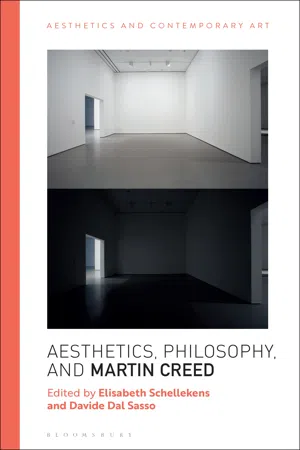
What is the future of conceptualism? What expressions can it take in the 21st century? Is there a new role for aesthetic experience in art and, if so, what is that role exactly? Aesthetics, Philosophy and Martin Creed uses one of this generation's most important and influential artists to address themes crucial to contemporary aesthetics.
Working in an impressive variety of artistic media, Creed represents a strikingly innovative take on conceptualism. Through his ingenious and thought-provoking work, a team of international philosophers, jurists and art historians illustrate how Creed epitomizes several questions central to philosophical aesthetics today and provides a glimpse of the future both of art and aesthetic discourse. They discuss key concepts for Creed's work, including immediacy (in his photographs of smiling people), compositional order (in his geometric paintings), simplicity (in Work No. 218, a sheet paper crumpled into a ball) and shamelessness (in his videos of vomiting people).
By bringing a working artist into the heart of academic discussions, Aesthetics, Philosophy and Martin Creed highlights the relevance of philosophical discussions of art to understanding art today.
eBook - ePub
Aesthetics, Philosophy and Martin Creed
- 192 pages
- English
- ePUB (mobile friendly)
- Available on iOS & Android
eBook - ePub
Aesthetics, Philosophy and Martin Creed
About this book
Information
1
Where in the (art)world is Martin Creed?
David Davies
For reasons that I shall try to clarify in the first three sections of this chapter, Martin Creed is perhaps the most puzzling of the many highly creative and imaginative contemporary visual artists to have emerged from British art schools over the past forty-odd years. Creed is puzzling because he seems to elude the kinds of explanatory strategies that aficionados of late-modern and contemporary art employ to counter the scepticism of those who find such art trivial, or inaccessible, or sophomoric. To answer those who claim to find nothing of artistic interest or value in the kinds of objects that they encounter in presentations of contemporary art – dead sharks suspended in tanks, unmade beds, defaced versions of classical prints and childlike drawings of unrecognizable objects1 – we reach – literally or metaphorically – for Arthur Danto’s response, in his 1964 paper ‘The Artworld’, to those of his contemporaries who voiced similar aesthetic doubts about exhibited stacks of Brillo boxes and heaps of brown felt.2 To see such things – or indeed to see anything – as art, Danto famously said, ‘requires something that the eye cannot descry – an atmosphere of artistic theory, a knowledge of history of art, an artworld’ (1964: 580).
In Section 1, I briefly expand upon Danto’s aphorism and indicate how it might seem to provide an appropriate answer to sceptics about late-modern visual art. In Section 2, I look at some commentators who have offered just such an interpretation of Creed’s works. In Section 3, I consider Creed’s own remarks about his art, remarks that might seem to count against any interpretation or defence of his works that draws in this way on Danto’s dictum. I also raise some philosophical worries about Creed’s remarks. In Section 4, I consider an alternative critical response to Creed that does not take his remarks about his art at face value, but views them as an integral part of an artistic performance in the context of which all of his individual ‘works’ are properly located. This effectively reidentifies the ‘work’ towards which a Danto-like approach is to be taken, placing it at a meta-level respective to the putative ‘works’ as usually conceived.
1
Danto elaborates at much greater length upon his 1964 dictum in the opening chapters of his 1981 monograph The Transfiguration of the Commonplace. By this time, the term ‘Artworld’ had been co-opted for different purposes by George Dickie: Dickie (1979) uses Danto’s term ‘Artworld’ to refer to ‘the broad social institution in which works of art have their place’. As Danto pointedly remarks in the preface to his book, Dickie’s sociological conception of the artworld, as a collection of institutionalized frameworks for the presentation-for-appreciation of those different kinds of artefacts we think of as art, fails to preserve Danto’s stress upon the need to locate such artefacts in a historically developing practice of artistic making and of thinking about things made. While Danto’s term ‘Artworld’ may have been repurposed, the sentiments expressed in the dictum, however, endure in his book; and the more general idea that artworks are partly constituted by the relationships in which they stand to an Artworld in Danto’s sense has been further developed, and generalized across the arts, by a number of other writers (see, for example, Binkley 1977; Levinson 1980; Currie 1989; and more recently, Davies 2004).
As is clear from the fuller presentation of Danto’s ideas in Transfiguration, his point was not merely, or even primarily, about what is necessary for the appreciation of artworks – for ‘seeing something as art’. It was, more fundamentally, about their very constitution and about the conditions under which they come into existence. The famous thought experiment with which the book begins – featuring a gallery of perceptually indistinguishable red rectangles – presents us with two related challenges: (1) to explain how some entities can fail to be artworks, although perceptually identical to entities that are artworks, and (2) to explain how two perceptually identical artworks can be radically different works, belonging to distinct genres and having distinct artistic meanings. Danto offers two further thought experiments to clarify his views on these matters. First, he discusses Jorge Luis Borges’s short fiction Pierre Menard, Author of the Quixote, viewed as itself a kind of thought experiment that explores the nature of the literary artwork. Ex hypothesi, we have two identically spelled texts, which result from two distinct acts of generation taking place in two very different art-historical contexts. While some have argued that literary works are individuated solely by reference to their texts (see, for example, Goodman and Elgin 1988), Danto, citing Borges’s narrator, points to various respects in which the subject and style of the two inscriptions differ in virtue of the time, place and manner of generation of the respective tokens. These differences, Danto claims, are not external to the works but are among their essential characteristics: ‘the works are in part constituted by their location in the history of literature as well as by their relationships to their authors’ (Danto 1981: 35–6).
To further elucidate how art-historical context is partly constitutive of artworks, Danto offers another thought experiment. We are to imagine a work by Picasso, titled Cravat, produced in the heyday of American Abstract Expressionism. The work consists of an ordinary tie covered smoothly with blue paint showing no evidence of brushstrokes. We are also to imagine a child producing a perceptually identical object by identical means – painting a tie of the same manufacture as Picasso’s smoothly with blue paint. The salient question is why (we assume) Cravat is an artwork, whereas the child’s painted tie is not. Rejecting any easy ‘institutional’ answer to this question, Danto suggests that we ask, first, why other artists, such as Cézanne, could not have produced the same work that Picasso did. The answer, in part, is that, as Danto argued in ‘The Artworld’, the ‘concept of art’ only allows for certain things to be created as art at a given time. But, more specifically, Danto claims that Cézanne could not have produced a work with the same subject as Picasso’s work, if, as Danto suggests, the subject of Picasso’s hypothetical work is the fetishization of the brushstroke in Abstract Expressionist art at the time when the work was created: ‘The paint was applied smoothly and carefully, and every trace of brushstroke was purged: it was a repudiation of painterliness (le peinture), of that apotheosis of paint-and-brushstroke (or drip) which defined New York painting of the 1950’s as a movement’ (1981: 40). Obviously Cézanne could not have created a painting with this as its subject, but this is not just because he died long before Abstract Expressionism was born. The child, we can assume, lived after the flourishing of Abstract Expressionism, but would not have internalized knowledge of such features of the artworld so as to be able to draw upon them in conferring content on the physical product of his painting activity. It is in virtue of having properties that stand in this kind of relationship to a history of artistic making and theorizing that Picasso’s Cravat is an artwork, and it is the possession of these kinds of properties that, for Danto, is the defining condition of artworks. Thus, as in the examples in the first and third of his thought experiments, there can be indistinguishable objects, one of which possesses properties of this sort – we may call them ‘artworldly properties’ – while the other lacks them. It is this central claim of Danto’s that I had in mind earlier when I suggested that he provides us with a ready-made strategy for countering those who are sceptical about the artistic status and artistic value of the kinds of entities that we encounter in exhibitions of late-modern visual art. Among the more noteworthy examples of such scepticism is Tom Wolfe’s diatribe against late-modern visual art in his 1976 book The Painted Word. Wolfe proposes a strong discontinuity between late-modern visual art, starting with Abstract Expressionism, and earlier visual art. While traditional artworks are able to ‘speak for themselves’ and provide a ‘visual reward’ to those who yield to their perceptual advances, late-modern works, so Wolfe claims, serve merely to illustrate contemporary art theory. Danto’s account allows us to reject the idea that any artwork can speak for itself and to maintain that what is crucial to the proper appreciation of both late-modern and earlier visual artworks is grasping those artworldly properties that they possess in virtue of their respective histories of making. In this broad sense, all art is about other art, because all artworks possess such properties in virtue of the relationships in which they stand to a history of artistic making and reflection upon that making. There is then no discontinuity in the nature of those entities that are late-modern artworks, merely a discontinuity in the accessibility of late-modernist artworks as art: it is in virtue of the rich and changing nature of artistic creativity over the past seventy-five years that it takes more effort to grasp the distinctive ‘artworldly’ properties that bear upon the appreciation of particular late-modern works (see Davies 2007). It is by properly locating the dead sharks, unmade beds, and defaced drawings of the YBA’s in their respective subregions of the artworld, and thereby grasping the distinctive artworldly properties that each possesses, that we can properly appreciate the artworks of which they are the vehicles or into whose vehicles they enter. In each case, the artist has internalized the relevant features of the artworld and so can confer upon their works artworldly properties grounded in those features.
The same strategy allows us to question the artistic status of much so-called Outsider Art (for an exploration of the latter, see Davies 2009). Like the child’s tie, it might be argued, the artefacts produced by outsider artists, while they might visibly resemble what we take to be unquestioned artworks produced by ‘insider’ artists, fail to possess those artworldly properties that are the distinguishing feature of genuine artworks. The outsider artist’s concern with making things as expressed in the artefacts he or she produces fails to confer such properties on these artefacts since, by definition, the outsider artist has not internalized features of the ‘artworld’ and therefore cannot draw, even if unconsciously, upon those features so as to confer upon her product the kinds of artwordly properties distinctive of works of art.
2
Creed’s work, as is well known, has been subject to considerable critical attack (and even physical attack!) from those moved by a Wolfean scepticism towards his output. To give one well-known example, the ceremony held at Tate Britain to award the 2001 Turner Prize to Creed’s The lights going on and off was accompanied by a demonstration outside the gallery by those who took Creed’s work to epitomize everything wrong with the contemporary British artworld. As The Times reported (10/12/01),
Outside, a group of artists known as The Stuckists, who campaign for traditional artistry, staged a protest. As guests arrived for the evening affair, they mocked Mr Creed’s work by flashing torches on and off and called for the resignation of the Tate’s director, Sir Nicholas Serota. Charles Thomson, a co-founder of The Stuckists, said: ‘It has gone beyond a joke . . . the only people who cannot see how ridiculous this whole thing is are the organisers themselves.’ Mr Thomson said Mr Creed’s work exuded ‘outstanding stupidity’.
The works for which Creed first became known, created in the early to mid-1990s, consisted in a set of typed instructions, on a sheet of A4 paper, for the carrying out of a certain set of operations involving everyday materials. As with all of his creations, the works were numbered by reference to the relative time of their creation and could not be exhibited or sold without the execution of the instructions. In many cases, the instructions were multiply executed in slightly different ways or using slightly different materials that nonetheless complied with the instructions.
Some representative examples are the following:
- Work No. 74: As many one-inch squares as are necessary are cut from one-inch masking tape and piled up, adhesive side down, to form...
Table of contents
- Cover
- Half-Title
- Series
- Title
- Contents
- List of Illustrations
- Notes on Contributors
- Introduction
- Statements
- 1 Where in the (art)world is Martin Creed?
- 2 Martin Creed’s ‘workless’ works of art
- 3 S T U P I D A R T
- 4 How not to be an uncollectible artist
- 5 An expression of the essential: Martin Creed and the celebration of the ordinary
- 6 Martin Creed: Conceptual art and more
- 7 The logical and the phenomenological in Martin Creed’s chairs
- 8 Which ‘Martin Creed’? Or switching from insignificance to significance
- 9 Process art as an aesthetic alternative: Martin Creed’s Glasgow connection
- Index of Names and Works
- Thematic Index
- Copyright
Trusted by 375,005 students
Access to over 1.5 million titles for a fair monthly price.
Study more efficiently using our study tools.
Frequently asked questions
Yes, you can cancel anytime from the Subscription tab in your account settings on the Perlego website. Your subscription will stay active until the end of your current billing period. Learn how to cancel your subscription
No, books cannot be downloaded as external files, such as PDFs, for use outside of Perlego. However, you can download books within the Perlego app for offline reading on mobile or tablet. Learn how to download books offline
Perlego offers two plans: Essential and Complete
- Essential is ideal for learners and professionals who enjoy exploring a wide range of subjects. Access the Essential Library with 800,000+ trusted titles and best-sellers across business, personal growth, and the humanities. Includes unlimited reading time and Standard Read Aloud voice.
- Complete: Perfect for advanced learners and researchers needing full, unrestricted access. Unlock 1.5M+ books across hundreds of subjects, including academic and specialized titles. The Complete Plan also includes advanced features like Premium Read Aloud and Research Assistant.
We are an online textbook subscription service, where you can get access to an entire online library for less than the price of a single book per month. With over 1.5 million books across 990+ topics, we’ve got you covered! Learn about our mission
Look out for the read-aloud symbol on your next book to see if you can listen to it. The read-aloud tool reads text aloud for you, highlighting the text as it is being read. You can pause it, speed it up and slow it down. Learn more about Read Aloud
Yes! You can use the Perlego app on both iOS and Android devices to read anytime, anywhere — even offline. Perfect for commutes or when you’re on the go.
Please note we cannot support devices running on iOS 13 and Android 7 or earlier. Learn more about using the app
Please note we cannot support devices running on iOS 13 and Android 7 or earlier. Learn more about using the app
Yes, you can access Aesthetics, Philosophy and Martin Creed by Elisabeth Schellekens, Davide Dal Sasso, Elisabeth Schellekens,Davide Dal Sasso in PDF and/or ePUB format, as well as other popular books in Philosophy & Art General. We have over 1.5 million books available in our catalogue for you to explore.