Get to know the activities, processes and people involved in wholesaling and its crucial role in the wider fashion industry. From working with fashion vendors and trend forecasting companies, to navigating trade shows, and working in different territories, Fashion Wholesaling is the ultimate guide to an often overlooked but rewarding career path.
Clearly illustrated case studies and industry-focused exercises put the journey from apparel factory to retailer into a practical, real-world context for anyone looking for a way into the business of fashion.
- 160 pages
- English
- ePUB (mobile friendly)
- Available on iOS & Android
eBook - ePub
About this book
Information

Figure 1.1 Window Dressing. Photograph by Albrecht Fietz, Pixabay.
1
The fashion wholesale business
Chapter objectives
After reading this chapter, you will be able to
1discover career options in fashion wholesale selling
2distinguish between the wholesale and retail functions
3explain the various types of sales representatives and their distinctive roles
4identify and give examples of wholesale sales representatives’ typical tasks
5recognize the characteristics of an excellent sales representative
6list the features needed in a vendor–representative contract.
Introduction
Selling is the lifeblood of economies. Without sales, consumers would not have the goods and services they need, and companies could not thrive. As consumers, we are most familiar with business-to-consumer (B2C) selling. This is what we experience when shopping in a retail store. However, as consumers, we would have little to choose from without the services of the fashion wholesale business. Fashion wholesale is the business-to-business (B2B) link between the manufacturer of clothing and accessories and the retail store. This chapter begins with an overview of the career possibilities available in the field of fashion wholesale selling. These options consist of unique positions, each with distinct duties and responsibilities.
The fashion industry is like many businesses except for some key differences that must be considered. In the following sections, the way a product gets from the maker to the seller will be examined first in terms of traditional marketing and then again as it pertains to fashion marketing. The wholesale fashion industry is characterized by sales representatives and their business relationship with manufacturers (also known as vendors). There are three basic types of sales representatives (commonly referred to as reps): (a) manufacturer’s or corporate reps, (b) independent reps, and (c) road reps.
Next, we delve into the typical tasks of a sales rep with an emphasis on what it takes to be a successful sales rep. The vendor–rep relationship is distinct depending on the type of rep and differs still more based on the policies and procedures defined by vendors. However, there are standard practices that are common among most vendors and, therefore, important to know. These practices are captured in a vendor–rep contract, which specifies the business relationship and defines the duties and responsibilities of both sides.
As previously stated, the information presented in this book is derived from the traditional methods of wholesale selling. These methods represent fundamental principles and practices that remain constant across time and situations. In other words, the application and/or operationalization of the methods may be different, but the basics persist.
Wholesale selling as a career option
If you like working with people and are passionate about fashion, wholesale sales may be for you. Unlike retail selling, wholesale selling involves being on the front line. You see upcoming fashions at least six months before the consumer. Being ahead of the fashion adoption curve, wholesale works months in advance of the consumer selling season and even well before retailers receive the merchandise.
As a wholesale sales rep, your income and benefits depend on the company you work for and the contractual relationship. Income potential is often the primary factor for would-be wholesale sales reps. As a wholesale sales rep who is an employee of a company, you earn a salary as well as fringe benefits. However, if you choose to be an independent rep, you own your business and have greater control over your income. In other words, you have a choice between stability or independence.
Unlike retail selling, wholesale selling involves being on the front line. You see upcoming fashions at least six months before the consumer.
In 2016, the median salary for wholesale and manufacturing sales representatives was $61,270.1 The Economic Research Institute agrees with that evaluation, describing the average salary for a clothing sales rep as $60,363, within a range between $34,880 and $76,270 in the USA. The Institute also projects that the average salary will increase by 16 percent to $69,997 by the year 2024.2 However, the salary can be much more lucrative based on the company and your expertise.
Comparatively, the median income of retail sales workers in 2018 was $24,340.3 Therefore, in wholesale selling, you can earn as much as three times (or more) than that of retail jobs. If you are a successful independent rep offering popular apparel lines and with a well-established list of retail accounts, you can often earn more than $100,000 a year.4 Armed with this information, one can see that the wholesale sales business is a better financial option than similar fashion careers.
To learn more about each type of sales rep, keep reading.
Structural overview of the fashion industry
Fashion is not marketed in the same way as other commodities. Fashion is handled much like produce; if allowed to sit too long, it spoils. Therefore, a strategy to get the product to market quickly is the key to providing goods where and when needed without compromising the desirability. In this section, comparisons and contrasts will be presented between the traditional and the fashion industry marketing model.
In the traditional marketing distribution channel, goods travel from the manufacturer, to the wholesaler, to the retailer, and finally to the consumer (see Figure 1.2). In each step of the process, the channel member buys the goods, takes possession of them and warehouses them. Therefore, with each step of the process, the channel member owns the goods, which requires expenditure and financial risk. This process is also time-consuming and costly. This adds to the mark-up making the goods more expensive down the line.
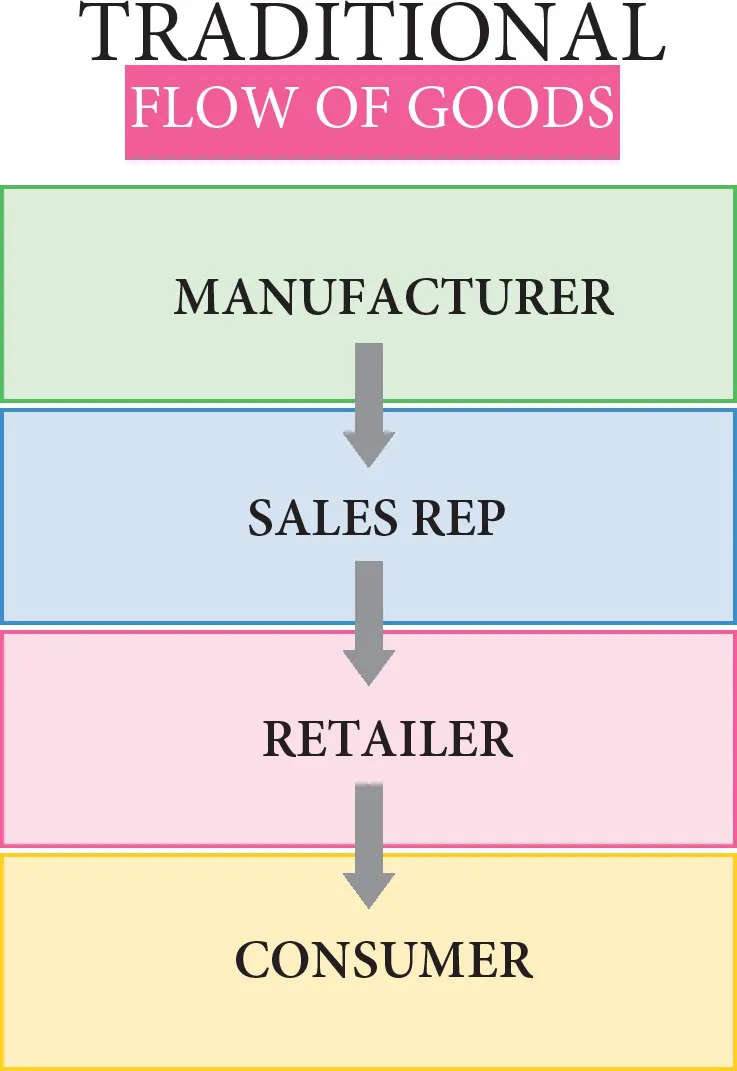
Figure 1.2 Traditional Channel of Distribution Model. In the traditional marketing distribution channel, goods travel from the manufacturer, to the wholesaler, to the retailer, and finally to the consumer.
In the fashion business, the Traditional Channel of Distribution Model does not work well to get goods to the consumer as quickly as possible. Therefore, the Fashion Channel of Distribution Model puts the traditional wholesale operation outside of the distribution channel but does not omit the function. In this distribution model, the sales rep performs the duties of the wholesaler in a traditional marketing chain but does not act as a channel member (i.e. own the goods).
In the Fashion Channel of Distribution Model, the wholesale function is conducted by a selling agent, who then is paid a fee for connecting the vendor and retailer. In this model, the wholesale sales rep acts as a selling agent without owning the goods or taking possession.
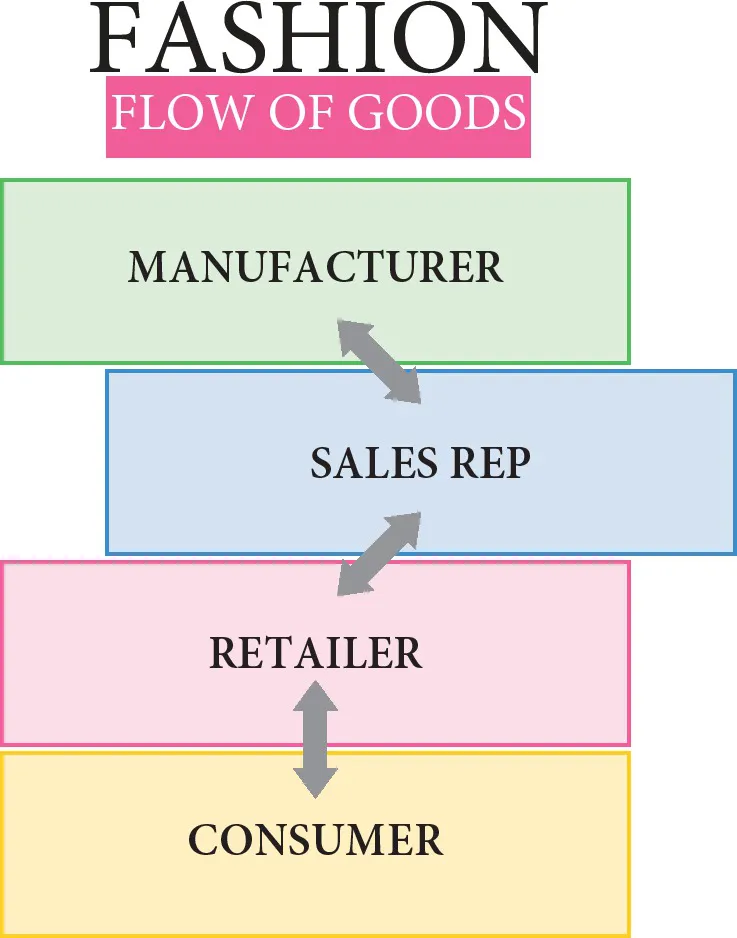
Figure 1.3 Fashion Channel of Distribution Model. In the Fashion Channe...
Table of contents
- Cover
- Title Page
- Contents
- Preface
- Introduction
- 1 The fashion wholesale business
- 2 Fashion vendors and wholesale customers
- 3 The wholesale selling environment
- 4 The wholesale fashion selling process
- 5 Trends in fashion wholesale selling
- Conclusion
- Glossary
- Bibliography
- Index
- eCopyright
Trusted by 375,005 students
Access to over 1.5 million titles for a fair monthly price.
Study more efficiently using our study tools.
Frequently asked questions
Yes, you can cancel anytime from the Subscription tab in your account settings on the Perlego website. Your subscription will stay active until the end of your current billing period. Learn how to cancel your subscription
No, books cannot be downloaded as external files, such as PDFs, for use outside of Perlego. However, you can download books within the Perlego app for offline reading on mobile or tablet. Learn how to download books offline
Perlego offers two plans: Essential and Complete
- Essential is ideal for learners and professionals who enjoy exploring a wide range of subjects. Access the Essential Library with 800,000+ trusted titles and best-sellers across business, personal growth, and the humanities. Includes unlimited reading time and Standard Read Aloud voice.
- Complete: Perfect for advanced learners and researchers needing full, unrestricted access. Unlock 1.5M+ books across hundreds of subjects, including academic and specialized titles. The Complete Plan also includes advanced features like Premium Read Aloud and Research Assistant.
We are an online textbook subscription service, where you can get access to an entire online library for less than the price of a single book per month. With over 1.5 million books across 990+ topics, we’ve got you covered! Learn about our mission
Look out for the read-aloud symbol on your next book to see if you can listen to it. The read-aloud tool reads text aloud for you, highlighting the text as it is being read. You can pause it, speed it up and slow it down. Learn more about Read Aloud
Yes! You can use the Perlego app on both iOS and Android devices to read anytime, anywhere — even offline. Perfect for commutes or when you’re on the go.
Please note we cannot support devices running on iOS 13 and Android 7 or earlier. Learn more about using the app
Please note we cannot support devices running on iOS 13 and Android 7 or earlier. Learn more about using the app
Yes, you can access Fashion Wholesaling by Linda B. Tucker in PDF and/or ePUB format, as well as other popular books in Business & Fashion & Textile Industry. We have over 1.5 million books available in our catalogue for you to explore.