Using Grading to Support Student Learning offers an accessible foundation for using grading practices to support student learning through classroom assessment. Purposeful, defensible grading and reporting mechanisms cannot be neglected in today's reform climate, and new approaches are needed to understand and refine the roles of homework, formative and summative assessments, and standards across grade levels. Evidence-based and full of illustrative examples, this book bridges research and theory on grading and assessment with classroom practices for pre-service and in-service teachers and fresh perspectives for educational researchers studying grading practices.
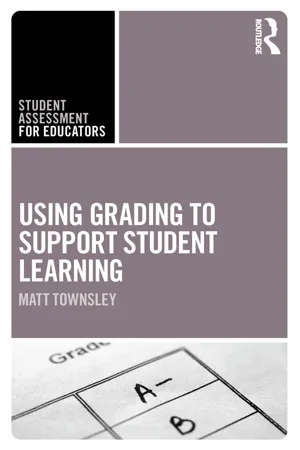
- 136 pages
- English
- ePUB (mobile friendly)
- Available on iOS & Android
eBook - ePub
Using Grading to Support Student Learning
About this book
Information
1 A grading and assessment model that supports student learning
DOI: 10.4324/9781003138815-1
Introduction
The aim of this chapter is to distinguish between grading and assessment. Grading has the potential to be a reliable and valid measure of achievement, if done right at the classroom level (Brookhart, 2017). The terms grading and assessment are often using interchangeably. This has led to both confusion and misunderstanding about the important characteristics and purposes of both. Once these differences are clarified, we will see how grading can be accomplished, with appropriate assessment, to support student learning. For example, a teacher may say to students, “Today, I am going to grade your work so far this unit of study” when in fact she intends to assess the learners’ understanding through classroom observation, a set of exam questions, or a writing prompt. Furthermore, grading tends to be over-emphasized in classrooms, leading students to frequently ask, “How many points is this worth?” rather than “What have I not yet learned according to the feedback I just received?” Cathy Vatterott (2015) calls this the “culture of grading” in that grades do not often reflect learning but instead “a relentless pursuit of the almighty A and the perfect GPA” (p. 18). Earning or receiving high grades ought not to become the goal in your classroom, but instead grades should serve as a reflection of the learning that has taken place.
Getting assessment and grading right matters if teachers desire to create classrooms focused more on learning important concepts and skills rather than merely earning points. In this chapter, I begin by providing a definition of grading followed by a description of the purposes of grading and teachers’ perception and use of grading in their classrooms. I then define assessment, followed by describing its purposes and multiple uses in a classroom setting. The chapter ends by previewing a model for you to use grading that supports student learning.
What is grading?
Susan Brookhart (1994) refers to grades as the “reporting of student achievement or progress for a report card period or term” (p. 280). Yet, the literature suggests the purpose and use of grades in school settings has been inconsistent with this and other expert definitions (Brookhart et al., 2016). Indeed, grading may be one of the most debated topics in education over the past half-century yet remains unaddressed in typical school improvement efforts (Guskey, 2015; Guskey & Brookhart, 2018; Kirschenbaum et al., 1971). Teachers, parents, and students alike may subconsciously assume that “a grade is a grade” (Zoecker, 2007, p. 100) and an A in one class or school is equivalent to an A in another. Extensive research suggests teachers’ grading practices vary from classroom to classroom and school to school (Brookhart, 1994; Brookhart et al., 2016; McMillan, 2018). In other words, if a 7th grade student were to have his/her language arts assignment transferred from Mrs. Jones’ section to Mr. Smith’s section, the grade assigned may differ significantly. In a classic study from the early 20th century, Starch and Elliot (1912) found that high school English teachers in different schools assigned scores varying by as much as 30 percentage points to two identical essays. This finding of discrepancy in scoring was even greater in a study among math teachers with percentage points ranging from 28 to 95 (Starch & Elliot, 1913). About one hundred years later, Hunter Brimi (2011) followed up on the Starch and Elliot studies by providing an essay to 73 teachers trained using a 6+1 traits of writing rubric. Confirming modern-day discrepancies in scoring, the participants assigned 30 different scores ranging from 50 to 96 with a standard deviation of nearly ten points.
Despite significant changes in many areas of education, grading practices remain relatively unchanged. Teachers typically replicate the grading practices they experienced as K-12 learners (Dueck, 2014; Guskey, 2015, 2020b; Olsen & Buchanan, 2019). Teachers continue to assign letter grades such as A, B, C, D, or F, sometimes with additional pluses and minuses. Typically, the grades are based upon a percentage of points earned, to determine a single mark for an assessment of knowledge and skills in a content area, or for a course. In particular, the ubiquitous use of electronic grade books emphasizes points, percentages, and mathematical algorithms in the calculation of grades (Guskey, 2013). While electronic grade books tied to district-wide databases (often filled with family contact information and student demographics) can be an efficient way for teachers to enter scores and correspond with parents, they also create a myth of objectivity in determining letter grades (Guskey, 2002). Perhaps most important, students and parents may assume that an 85%, B, means that 15% of the learning on an assignment was not demonstrated. Yet, the points awarded for many assessments, especially homework, may represent a combination of non-achievement factors such as effort, completion, and accuracy with achievement, while the points awarded on a major test may represent only achievement. Points for performance on a major exam would have greater weight on achievement. As a result, simply adding percentages and/or taking averages with electronic grade books does not necessarily represent a uniform indication of learning. Some grading critics, such as Kohn (2011, 2013), contend that emphasizing points and percentages diminishes students’ interest in learning and prioritizes extrinsic motivation.
By the time students reach upper elementary or middle school levels, grading by point accumulation, what Feldman (2019, p. 33) calls the “commodity of grades,” is ubiquitous. Learning is defined by point accumulation. Points are awarded for completing homework, bringing materials to class, participating in class discussions, answering quiz and test questions correctly, and turning assignments in on time. Further perpetuating extrinsic motivation, the classroom teacher acts as the “Federal Reserve of the classroom who can ‘print’ more currency and inject more points into the classroom economy when needed” (Feldman, 2019, p. 35). Grades using an accumulation of points and percentages miss the mark in providing the honest information stakeholders need; therefore, teachers should not be surprised to see students chasing points rather than learning in their classrooms. Guskey and Brookhart (2019) note that “students need honest information from their teachers about the quality and adequacy of their performance in school. Parents need to know how well their children are doing and whether or not grade-level or course-level expectations are being met” (p. 218).
Since grades will continue to be a staple within educational systems, grading practices need to reflect as well as support student learning, not just the accumulation of points. Attempts to reform grading practices to reflect this change, particularly in secondary schools, have frequently encountered resistance. In one in-depth study of two New York high schools, Olsen and Buchanan (2019) found that teachers had very little, if any, prior professional learning around grading, a theme confirmed by Battistone and colleagues (2019) among new teachers experiencing a similar shift in practice. At the school level, principals report perceived or actual parent pushback as a rationale for curtailing changes in systematic grading practices (Peters & Buckmiller, 2014; Townsley et al., 2019). At the crux of these attempts to reform grading practices, researchers have identified a need to focus on a single and unified purpose of grading related to learning, rather than an inherent lack of clarity around grading more commonly found in schools (Brookhart, 2009; Guskey, 2015; Olsen & Buchanan, 2019).
Purposes of grading
Grading is used for a multitude of purposes. One purpose is to document information about learners in the electronic grade book for students and allow parents to view on a just-in-time basis. In addition, schools provide report cards and transcripts to families at the culmination of a reporting period. At the secondary level, these report cards and transcripts may also be shared with other entities for career and/or post-secondary purposes.
Another purpose of grading is to use grades for making external decisions. Historically, this stems from the need to sort students in schools from highest to lowest achieving (Schneider & Hutt, 2014). Later, as high schools transitioned from private to public, colleges and univ...
Table of contents
- Cover
- Half-Title Page
- Series Page
- Title Page
- Copyright Page
- Dedication
- Table of Contents
- List of Figures
- Preface
- Acknowledgements
- 1 A grading and assessment model that supports student learning
- 2 Grading and homework: Moving from points to practice
- 3 Grading and formative assessment: Transitioning from points to preview
- 4 Grading and summative assessment: Migrating from points to proficiency
- 5 Grading to support student learning: Standards-based grading
- Index
Trusted by 375,005 students
Access to over 1.5 million titles for a fair monthly price.
Study more efficiently using our study tools.
Frequently asked questions
Yes, you can cancel anytime from the Subscription tab in your account settings on the Perlego website. Your subscription will stay active until the end of your current billing period. Learn how to cancel your subscription
No, books cannot be downloaded as external files, such as PDFs, for use outside of Perlego. However, you can download books within the Perlego app for offline reading on mobile or tablet. Learn how to download books offline
Perlego offers two plans: Essential and Complete
- Essential is ideal for learners and professionals who enjoy exploring a wide range of subjects. Access the Essential Library with 800,000+ trusted titles and best-sellers across business, personal growth, and the humanities. Includes unlimited reading time and Standard Read Aloud voice.
- Complete: Perfect for advanced learners and researchers needing full, unrestricted access. Unlock 1.5M+ books across hundreds of subjects, including academic and specialized titles. The Complete Plan also includes advanced features like Premium Read Aloud and Research Assistant.
We are an online textbook subscription service, where you can get access to an entire online library for less than the price of a single book per month. With over 1.5 million books across 990+ topics, we’ve got you covered! Learn about our mission
Look out for the read-aloud symbol on your next book to see if you can listen to it. The read-aloud tool reads text aloud for you, highlighting the text as it is being read. You can pause it, speed it up and slow it down. Learn more about Read Aloud
Yes! You can use the Perlego app on both iOS and Android devices to read anytime, anywhere — even offline. Perfect for commutes or when you’re on the go.
Please note we cannot support devices running on iOS 13 and Android 7 or earlier. Learn more about using the app
Please note we cannot support devices running on iOS 13 and Android 7 or earlier. Learn more about using the app
Yes, you can access Using Grading to Support Student Learning by Matt Townsley in PDF and/or ePUB format, as well as other popular books in Education & Education General. We have over 1.5 million books available in our catalogue for you to explore.