Home articulates a 'critical geography of home' in which home is understood as an emotive place and spatial imaginary that encompasses lived experiences of everyday, domestic life alongside a wider, and often contested, sense of being and belonging in the world. Engaging with the burgeoning cross-disciplinary interest in home since the first edition was published, this significantly revised and updated second edition contains new research boxes, illustrations, and contemporary examples throughout. It also adds a new chapter on 'Home and the City' that extends the scalar understanding of home to the urban.
The book develops the conceptual and methodological underpinnings of a critical geography of home, drawing on key feminist, postcolonial, and housing thinkers as well as contemporary methodological currents in non-representational thinking and performance. The book's chapters consider the making and unmaking of home across the domestic scale – house-as-home; the urban – city-as-home; national – nation-as-home; and homemaking in relation to transnational migration and diaspora. Each chapter includes illustrative examples from diverse geographical contexts and historical time periods. Chapters also address some of the key cross-cutting dimensions of home across these scales, including digital connectivity, art and performance, more-than-human constructions of home, and violence and dispossession. The book ends with a research agenda for home in a world of COVID-19.
The book provides an understanding of home that has three intersecting dimensions: that material and imaginative geographies of home are closely intertwined; that home, power, and identity are intimately linked; and that geographies of home are multi-scalar. This framework, the examples used to illustrate it, and the intended audience of academics and students across the humanities and social sciences will together shape the field of home studies into the future.
What does home mean to you? Where, when, and why do you feel at home? To what extent does your sense of home travel across, and co-exist between, different times, places, and scales? How and why is home politically as well as personally important? What is at stake in thinking about what home means, where it might be located, and whether it is understood and experienced in positive or negative ways, or a mix of the two?
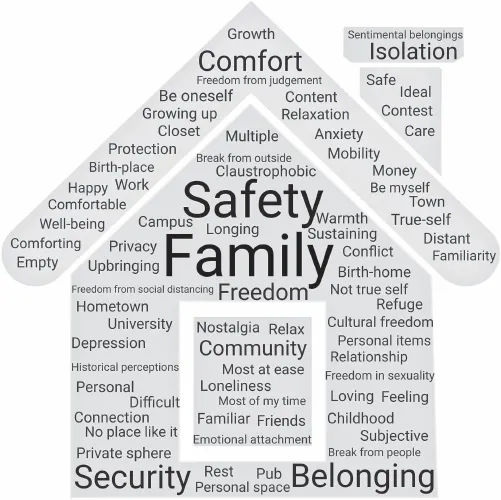
Given the multiple experiences of home and the complexity of home as an idea, we would expect to receive many and varied answers to these questions, some of which are depicted in Figure 1.1. Some may respond by describing the physical structure and location of their house or dwelling; others may refer to relationships or connections over space and time. Some experiences of home are bound up with a sense of security, familiarity, and comfort, whilst for other people home is a place of insecurity, exclusion, and alienation. Ideas and meanings of home might be closely shaped by memories of childhood, alongside present experiences and dreams for the future. They might relate to where one lives and/or where one feels an attachment to people and places much farther away.
Intertwined with such personal meanings and experiences of home, the political significance of home is far-reaching and profound. Shaped by inclusions, exclusions, and inequalities in relation to, for example, gender, race, ethnicity, sexuality, class, age, (dis)ability, and religion, the politics of home, identity, and belonging are multifaceted and intersectional. The politics of home are clearly important within, but also extend far beyond, a domestic dwelling, as shown by inclusions, exclusions, and inequalities in relation to the nation as home and/or homeland and the precarity of home in the context of dispossession and forced displacement (for more on the politics of home, see Brickell 2012; Duyvendak 2011).
Whilst the intertwined connections between the personal and political significance of home were clear when we wrote the first edition of this book, they have become even more prominent over the past 15 years. Home has been disrupted, unsettled, and contested in the context of, for example, housing precarity; ‘home raids’ in Afghanistan and Iraq and in counter-terrorist operations against so-called home-grown terrorists; and the forced displacement of people alongside the tightening of many national borders and increasingly ‘hostile environments’ for migrants and refugees.
Figure1.1 ‘What does home mean to you?’ Responses from third-year undergraduate students taking ‘Geographies of Home’ at Queen Mary University of London in 2020/21
Source: Created by Deepti Prasad
Since the spring of 2020, the directive to ‘stay home’ in many countries has been central to attempts to prevent the spread of the global COVID-19 pandemic. In a blog post introducing the AHRC project on ‘Stay Home Stories’, Alison Blunt (2021) explains, ‘[a]s a site of lockdown and self-isolation, home-working and home-schooling, loneliness and new forms of connection, home has been at the forefront of people’s experiences of the COVID-19 crisis’ (see Box 1.1 and stayhomestories.co.uk for more on this project). Throughout the book we explore home in the context of the global pandemic and during other turbulent times.
Box 1.1 Stay Home Stories
Reflecting the political and personal significance of home, this UK-based project (Stay Home Stories 2020; see stayhomestories.co.uk) analyses the directive to ‘stay home’ alongside people’s differentiated capacities, experiences and emotions bound up in doing so. ‘Stay home’ directives and lockdown restrictions have been a significant response to the COVID-19 pandemic across the world. The ‘stay home’ directive in the UK and elsewhere assumes that home is a site of safety, equates it with the household, and inscribes it with nation- and life-saving significance. Yet, as we argue throughout this book, home can be dangerous and insecure, exists over multiple, co-existing scales from the domestic to the global, and is shaped by the politics of inclusion and exclusion (see, for example, Bowlby and Jupp 2020; Brickell 2020b; Crankshaw, Whitehead, and Scanlon 2020; Grewal et al. 2020; Judge and Rahman 2020; Rogers and Azam Ali 2020; see discussion about home and COVID-19 throughout the book, particularly in Boxes 4.5 and 6.6 and in Chapter 7).
Based at the Centre for Studies of Home, funded by the Arts and Humanities Research Council as part of the UKRI rapid response to COVID-19, and led by Alison Blunt, the project is collecting a wide range of ‘stay home stories’ to understand how ideas and experiences of home have changed because of COVID-19. The need to document and reflect on these stories is timely and pressing, not only to understand how people have experienced home in profoundly different and unequal ways, but also to think about how home might change – for better or worse – into the future. The stories will be shared via podcasts, films, maps, and blog posts and will inform learning resources, policy briefs, an interfaith toolkit, and material for deposit, display, and digital engagement.
Based in London and Liverpool, with a project team at Queen Mary University of London, and the University of Liverpool – including Miri Lawrence, Eithne Nightingale, and Annabelle Wilkins, who have all contributed to this book, as well as Kathy Burrell, Georgina Endfield, Alastair Owens, and Jacqueline Waldock – and a team of community researchers, ‘Stay Home Stories’ combines a nationwide and city-scale approach in its work with adults and children living in a variety of homes and households. The project has three main aims: to document and analyse the ways in which home has been mobilised, experienced, and imagined during and after three national lockdowns; to explore and extend creative and curatorial work that documents diverse experiences and imaginings of home during the pandemic; and to understand how practices, spaces, and meanings of home have changed during and after lockdown, particularly for migrants, people from minoritised ethnic backgrounds, people of faith, and children and young people (see Box 4.5 on domestic thresholds during the pandemic and Box 6.6 on migrant domestic workers and COVID-19).
The project has three interconnected strands. Documenting Home studies the ways in which ‘stay home’ has been represented, reimagined, and contested in political debate and media coverage. It also explores and extends the Museum of the Home’s ‘Stay Home’ rapid response collecting project (see Box 1.2 and Figure 1.2) and will co-curate material, including with artist-in-residence Alaa Alsaraji. Practising Home examines the practices, spaces, and meanings of home during the pandemic for people from different faith communities and/or minoritised ethnic backgrounds, including people who have migrated to the UK. Working with adults from different generations, alongside community, migrant, faith, and inter-faith organisations, we are co-creating reports, short films, podcasts, an interfaith toolkit, and material for the Museum of the Home collections (see Burrell 2021; Lawrence 2021a, 2021b; Owens and Geiringer 2021; Sheringham 2021). Mapping Home explores children’s changing conceptualisations of home at a time of crisis. Working with National Museums Liverpool and the Royal Geographical Society (with Institute of British Geographers), and with their school networks and projects, this strand will co-curate a nationwide initiative inviting children and young people aged 7–16 to map their home spaces; a city-scale project in Liverpool City Region to analyse children’s narratives alongside their maps; and a virtual exhibition and learning resources on children at home during COVID-19 (see Waldock 2021).
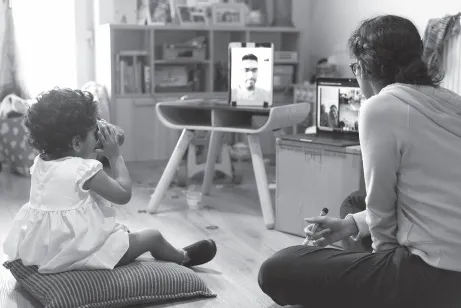
Figure1.2 A photograph submitted to the ‘Stay Home’ collecting project at the Museum of the Home by Lahiru
Source: Photo reproduced with permission from the Museum of the Home
‘Our home has now turned into the multi-functional centre of our lives and we still do most of what we used to do before lockdown, just in our open plan living room! We work, cook, exercise, play, hang out with friends and relatives (virtually) all in the same space… . In a strange way even our relationships with our wider circle of friends and extended families have strengthened. For the first time ever everyone is at home at the same time, which meant that we were able to use Zoom/Skype etc. to virtually spend time with loved ones’ (Lahiru 2020; see Box 1.2 for more on the ‘Stay Home’ collecting project at the Museum of the Home).
Academic and popular interest in home has burgeoned since the first edition of this book was published. The Centre for Studies of Home was established in 2011 as a partnership between Queen Mary University of London and the Museum of the Home (see Box 1.2), and many of the research boxes in the book have been written by its former and current PhD students. The International Encyclopedia of Housing and Home (Smith 2012) was published in 2012, with one of the sections focusing on home and homelessness (Dowling and Fitzpatrick 2012). Demonstrating the breadth and depth of research on home across a range of disciplines, key academic books published in the last five years – amongst many others published since the first edition of this book – include Migration and the Search for Home (Boccagni 2017), Making Homes: Ethnography and Design (Pink et al. 2017), Reimagining Home in the 21st Century (Lloyd and Vasta 2017), Sexuality and Gender at H...
Table of contents
Cover
Half Title
Series
Title
Copyright
Dedication
Contents
List of Figures
List of Tables
List of Boxes
List of Research Boxes
Acknowledgements
1 Setting Up Home: An Introduction
2 Researching Home
3 Residence: House-as-Home
4 Home and the City
5 Home, Nation, and Empire
6 Home, Migration, and Diaspora
7 Leaving Home
Index
Trusted by 375,005 students
Access to over 1.5 million titles for a fair monthly price.
Study more efficiently using our study tools.
Frequently asked questions
Yes, you can cancel anytime from the Subscription tab in your account settings on the Perlego website. Your subscription will stay active until the end of your current billing period. Learn how to cancel your subscription
No, books cannot be downloaded as external files, such as PDFs, for use outside of Perlego. However, you can download books within the Perlego app for offline reading on mobile or tablet. Learn how to download books offline
Perlego offers two plans: Essential and Complete
Essential is ideal for learners and professionals who enjoy exploring a wide range of subjects. Access the Essential Library with 800,000+ trusted titles and best-sellers across business, personal growth, and the humanities. Includes unlimited reading time and Standard Read Aloud voice.
Complete: Perfect for advanced learners and researchers needing full, unrestricted access. Unlock 1.5M+ books across hundreds of subjects, including academic and specialized titles. The Complete Plan also includes advanced features like Premium Read Aloud and Research Assistant.
Both plans are available with monthly, semester, or annual billing cycles.
We are an online textbook subscription service, where you can get access to an entire online library for less than the price of a single book per month. With over 1.5 million books across 990+ topics, we’ve got you covered! Learn about our mission
Look out for the read-aloud symbol on your next book to see if you can listen to it. The read-aloud tool reads text aloud for you, highlighting the text as it is being read. You can pause it, speed it up and slow it down. Learn more about Read Aloud
Yes! You can use the Perlego app on both iOS and Android devices to read anytime, anywhere — even offline. Perfect for commutes or when you’re on the go. Please note we cannot support devices running on iOS 13 and Android 7 or earlier. Learn more about using the app
Yes, you can access Home by Alison Blunt,Robyn Dowling in PDF and/or ePUB format, as well as other popular books in Social Sciences & Emigration & Immigration. We have over 1.5 million books available in our catalogue for you to explore.