The process of talent development (TD) is essential to success in any sport. Drawing on the latest evidence and a considerable experience base, the second edition of this book dispels myths about talent development and offers practical advice on the TD pathway from pre-school to elite level. Aimed at practitioners and other stakeholders involved in the TD process – including coaches, scientists, administrators, educators, students, parents, policymakers and senior development athletes – this is an up-to-date practical guide to TD in sport.
Written by experts with more than 20 years of experience in TD training, coaching and research, it covers key topics from deliberate practice and fundamental movement skills to designing and managing a TD pathway. It also includes contributions from professionals working in a wide range of sports, providing real-world insights into important topics including:
the recruitment process,
academy and apprenticeship preparation,
the coach-athlete relationship,
what to do to stay ahead, and
considerations for parents and coaches.
Talent Development: A Practitioner and Parents Guide is an indispensable resource for all those interested in talent identification, talent development and coaching practice in elite sport.
Within the competitive landscape of sport, there is always a pressure to try and identify, and then select the best young performers. Indeed, Talent Identification and Development (TID) has become a key focus for National Governing Bodies (NGBs), professional clubs, and individuals across all sports. Unfortunately, the efficacy and scientific foundations of most Talent Identification (TI) programmes employed have been strongly questioned. These criticisms are mainly based on the low predictive value and lack of validity attributed to TI programmes; simply, TI programmes have not been very effective at detecting and identifying young people with the potential to develop into successful senior performers. Unfortunately, despite this lack of underpinning evidence AND the considerable data that illustrates the inefficiencies of early TI, sports continue to invest considerable resources, time and funding into ‘talent spotting’ initiatives. A range of different TI approaches exist across sport; some are grounded in skills and expertise (e.g., Faber, Nijhuis-Van Der Sanden, Elferink-Gemser & Oosterveld, 2015), others involve psychometric testing (e.g., Höner, Votteler, Schmid, Schultz & Roth, 2015) or solely current performance (e.g., Allen et al., 2014). There has been increasing attention paid to genetic testing (e.g., Breitbach et al., 2014), and web-based approaches (e.g., Louzada, Maiorano & Ara, 2016) are entering the field. At least until recently, most of the approaches justify the measures used as reflective of current high performers or by testing the power of the test to discriminate between younger performers identified as holding high or low potential. Indeed, in recent times there has been exponential growth in this area that has even spawned a new genre of sport scientist – the ‘talent scientist’! Irrespective of the method used, there is significant evidence to show that early TI, especially when completed pre-maturation, is neither appropriate nor effective and when influences such as the Relative Age Effect or RAE (e.g., Till et al., 2010), where you grew up (e.g., Turnnidge et al. 2014) and just pure luck (Bailey, 2007), are thrown into the mix, TI can seem like a lottery.
In this opening chapter, we explore some ‘myths and truths’ in TID and suggest that it seems more sensible to consider the range of factors that underpin the capacity of a young performer to realise their potential, rather than focus on those ‘snapshot’ characteristics, or once-off performances at ‘trials’, which hint at unrealised capacity. Building on this, we present some health warnings for practitioners working in Talent Development (TD) and some clear criteria that should be used to enable coaches, parents and other stakeholders to act as critical consumers of knowledge.
Transforming Ability Into Talent
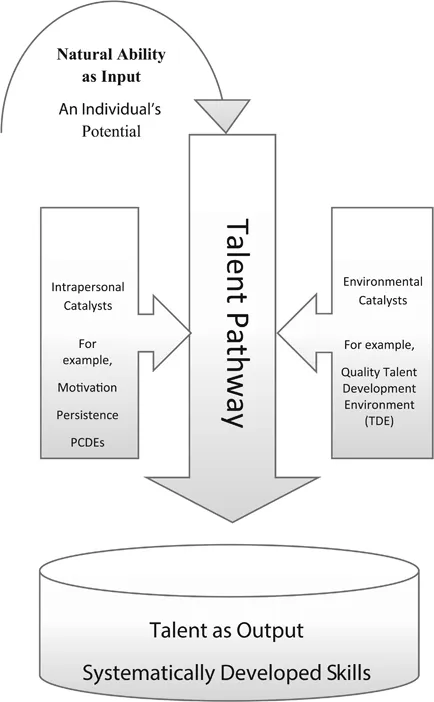
To begin, let's consider what we mean by ‘talent’. It is such a common word, but definitions of talent are inconsistent. Talent is typically viewed as an individual's ability (innate talent) with little consideration of the process of development required to achieve expertise. This misunderstanding presumably underpins TI processes (scouting in soccer or more structured TI models) that seek to ‘talent spot’ young athletes. However, these approaches to TI fail to distinguish between current performance (i.e., how well a young athlete is performing at the time of testing) and that individual's capacity for future development. Furthermore, since these TI models typically select young athletes based on a limited range of discrete variables (typically once-off performance and/or physical measurements), they fail to recognise the dynamic nature of TD. In this book, we are mostly concerned with the process of TD, which refers to the ‘path from rank-novice to the most outstanding and distinguished accomplishments’ (Sternberg, 2003). It might be easiest to think of this in terms of ‘inputs and outputs’ (see Figure 1.1). Giftedness, the possession and use of high levels of natural abilities or aptitudes to a level that places a person in the top 10 per cent of their peers, is essentially the input to the TD pathway. This is the product that you will work within your coaching environment. Talent is the superior mastery of systematically developed abilities or competencies to a level that places an individual in the top 10 per cent of individuals active in that field – essentially the output of the system. Herein lies the complexity – how do we evaluate a young athlete's potential and predict their future success based on their current performance? In this chapter, and throughout the book, we will discuss how talent is influenced by a range of factors within your sport environment (stakeholders, opportunities, challenges), that it involves a process of becoming, and it is individual.
Figure1.1Inputs and outputs on the TD pathway
Gagne's Differentiated Model of Giftedness and Talent (DMGT) is a useful way to understand this process. Essentially, the DMGT describes the coaching process that transforms gifts or natural ability (the input) into expert performance or talent (the output) via learning and practice. When a performer enters the TD pathway, they have potential that can be transformed into talent. Think of talent as a developmental construct (Sternberg, 2003) that is influenced by a range of factors. Gagné’s proposition is that the rate of development is influenced by three significant catalysts: chance factors (e.g., good or bad luck), intrapersonal factors (e.g., motivation, persistence) and environmental factors (e.g., coaching, access to resources). Viewing talent as a developmental construct is important as it places emphasis on the process of development rather than the identification of potential. Simply, talent is something that develops over time and in response to a good coaching and development environment. This is where you will make the difference!
The DMGT considers natural abilities to be the raw materials of talent and even though it is unlikely that an individual will become talented without these natural abilities, the opposite is not always true. In fact, underachievement and talent loss can be seen across performance domains, where outstanding natural gifts remain as untapped potential because of the moderating role of different catalysts and variables. Even if a young performer has a natural ability, he or she must also have the motivation to engage in the requisite practice and training to fulfil this potential. Similarly, a young performer may possess the outstanding natural ability but may have little interest in pursuing excellence unless forced by external agencies (parents, for example). Conversely, there are examples of elite athletes who were able to compensate for physical disadvantages (e.g., height in rugby) with strengths on another factor (e.g., commitment, determination, hard work; Abbott & Collins, 2002). As such, deficiencies in one area of performance can be compensated for by strengths in another. What does this mean for TID? It means that there isn't a single profile that typifies ‘success’ and that different types of performers can get to the top by exploiting their own strengths and compensating for their weaknesses.
To illustrate this point, consider an analogy between abilities and potential muscles; without exercise and training the genetic potential of muscles will not be actualised. This is described in terms of a multiplier effect where individuals with less potential for muscular development may develop more muscle because of their motivation to take advantage of relevant environmental factors (such as access to coaching) associated with skill development. You might be able to name some athletes who have excelled in your sport even though they possessed less than remarkable physical profiles. This ‘compensation phenomenon’ suggests that it is the interaction of different factors, rather than any one single factor, that determines an individual's capabilities. Without an appreciation of this multiplicative approach, there is a risk of underestimating the importance of environmental and intrapersonal factors and overestimating the magnitude of genetic variables. The take-home message? Excellence in sport is not idiosyncratic to a specific set of skills or physical attributes but can be achieved through unique combinations of skills, attitudes and behaviours. Simply, talent emerges from ‘complex and unique choreographies’ between the different groups of causal influences. The suggestion is that greater emphasis should be placed on providing young performers with the opportunities to develop those capabilities that underpin successful development.
This understanding of TD also helps us appreciate that there are many ways to initiate talent and the optimal talent domain may not be stable. As new components develop, the developing performer may discover a greater inclination for a related but distinct domain. For example, a young athlete may begin their journey in one sport but end up excelling in another. This view of TID suggests that talent can develop in different ways for genetically distinct or even genetically similar individuals (Simonton, 2001). In other words, adults with the same talent may have developed that talent through different routes, while adults with different talents may have had similar childhood experiences. Moreover, even adults who have the same mature talent may have experienced contrasting spurt and lull periods during development. TID initiatives must reflect this complexity in their procedures if they are to be worthwhile endeavours and meet the needs of their participants. Unfortunately, prescriptive methods dominate TID; if a performer doesn't fit into the prescribed pathway, they are likely to miss out on lots of development opportunities. How well does your sport or performance domain cater for this non-linearity?
A Summary
Much of what we have presented thus far contradicts some practices that typify applied initiatives in TID – most notably, early selection and specialisation. In fact, the lack of evidence concerning early signs of excellence suggests that the importance placed on these factors is overestimated – an example of the atheoretical approach to TID that currently prevails in sport. Given these arguments, TD (and note the emphasis on development) initiatives must begin to adopt frameworks that conceptualise development as dynamic and non-linear. Thus, TD processes must be aware of the multiple pathways that individuals may take as they progress in their activity. When this non-linearity is coupled with the importance of key events and transitions in the development pathway, the case for support systems that offer flexibility, individual optimisation and return routes as characteristic factors is strengthened. As a consequence, it makes sense to consider both the pathway to excellence and the multiple components that contribute to the realisation of potential. We hope the remainder of the book addresses these questions and importantly provides you with an understanding as to how to optimise your pathway.
Myths, Truths and Health Warnings in Talent Development
Before we move on, we will begin by presenting some of the ‘myths, truths and health warnings’ in TID. As in other domains, some practices have become so embedded in the sporting landscape that they are generally accepted even though they may not reflect best, or even good, practice. It is worth taking a look!
Pyramid Thinking
Development in sport has typically been explained in terms of a pyramid-based model; a broad base of foundation skills participation, with increasingly higher levels of performance, engaged in by fewer and fewer people. Despite its popularity among policymakers, there have been numerous criticisms levelled at the pyramid approach. One line of attack has been the moral one: built into the pyramid's design is the systematic exclusion of players, no matter how good they are in absolute terms, as fewer and fewer players can play at each level. There are a number of other problems with pyramid thinking:
The Problem of Prediction
Pyramid models presume that successful progression from one level to the next is indicative of later or emergent ability; in most cases, this is not accurate. Indeed, the low conversion rates of successful junior performers to successful seniors point to the dangers of predicting who is likely to ‘make it’. Furthermore, identifying talent involves predicting both an athlete's potential and the type of player required for future success in that sport. Sports change and what might constitute the ‘perfect’ athlete in 2021 might look a lot different in 2041, and given that the purpose of TI is to develop athletes for the future, this is problematic. Rugby players, for example, look a lot different now at the start of the professional era in the early 1990s. Indeed, when the time frame between identification and performance is large, the accuracy of predictions will surely decrease. Simply, the performance, anthropometric or skill profiles currently used to identify talent when a child is 12 years of age might look appreciatively different when that child reaches their mid-20s. Therefore, if TI is to be effective, we would have to be able to predict the future and that isn't possible!
The Problem of Participation
Pyramid models also presume that selection for progressively higher levels within the system is based on merit. In practice, participation is influenced by a host of psychosocial and environmental factors, such as the ability to take part in the first place. Consider, for example, the role of the family in high-level sports performance (see Chapter 7). We might also add factors like availability and quality of coaching and facilities, access to funding and choice of sport (see the discussion on the Talent Development Environment in Chapter 9) as variables that influence selection. Since young players can hardly be held responsible for the quality of their families, schools, cities and so on, it seems fair to say that, to some extent, their sporting achievement, or even engagement in sport, is mediated by ‘blind luck’, irrespective of their ability. Another issue with pyramid thinking is that the logic of the model means that the quality of performers at the higher levels is dependent on the experiences and resources offered to those at the lowest levels: a poor fou...
Table of contents
Cover Page
Half-Title Page
Title Page
Copyright Page
Dedication Page
Contents
List of figures
List of tables
About the authors
List of contributors
Preface
Part I Underpinning Talent Development Principles
Part II Developing the Base: Pre-School and Early Preparation
Part III Pre-Academy: What to Do Till You Select Your Chosen Sport
Part IV Entering the Pathway
Part V Making the Most of Your Academy Apprenticeship
Part VI Transitions, Roadblocks and Other Challenges
Part VII Management Considerations
Part VIII Conclusion
Index
Trusted by 375,005 students
Access to over 1.5 million titles for a fair monthly price.
Study more efficiently using our study tools.
Frequently asked questions
Yes, you can cancel anytime from the Subscription tab in your account settings on the Perlego website. Your subscription will stay active until the end of your current billing period. Learn how to cancel your subscription
No, books cannot be downloaded as external files, such as PDFs, for use outside of Perlego. However, you can download books within the Perlego app for offline reading on mobile or tablet. Learn how to download books offline
Perlego offers two plans: Essential and Complete
Essential is ideal for learners and professionals who enjoy exploring a wide range of subjects. Access the Essential Library with 800,000+ trusted titles and best-sellers across business, personal growth, and the humanities. Includes unlimited reading time and Standard Read Aloud voice.
Complete: Perfect for advanced learners and researchers needing full, unrestricted access. Unlock 1.5M+ books across hundreds of subjects, including academic and specialized titles. The Complete Plan also includes advanced features like Premium Read Aloud and Research Assistant.
Both plans are available with monthly, semester, or annual billing cycles.
We are an online textbook subscription service, where you can get access to an entire online library for less than the price of a single book per month. With over 1.5 million books across 990+ topics, we’ve got you covered! Learn about our mission
Look out for the read-aloud symbol on your next book to see if you can listen to it. The read-aloud tool reads text aloud for you, highlighting the text as it is being read. You can pause it, speed it up and slow it down. Learn more about Read Aloud
Yes! You can use the Perlego app on both iOS and Android devices to read anytime, anywhere — even offline. Perfect for commutes or when you’re on the go. Please note we cannot support devices running on iOS 13 and Android 7 or earlier. Learn more about using the app
Yes, you can access Talent Development by Dave Collins,Aine MacNamara in PDF and/or ePUB format, as well as other popular books in Biological Sciences & Sport & Exercise Science. We have over 1.5 million books available in our catalogue for you to explore.