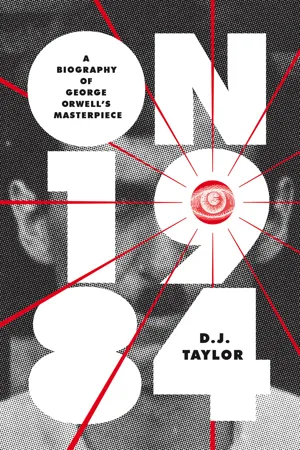
The essential backstory to the creation and meaning of one of the most important novels of the twentieth century—and now the twenty-first.
Since its publication nearly seventy years ago, George Orwell's
1984 has been regarded as one of the most influential novels of the modern age. Politicians have testified to its influence on their intellectual identities, rock musicians have made records about it, TV viewers watch a reality show named for it, and a White House spokesperson tells of "alternative facts." The world we live in is often described as an Orwellian one, awash in inescapable surveillance and invasions of privacy.
On Nineteen Eighty-Four dives deep into Orwell's life to chart his earlier writings and key moments in his youth, such as his years at a boarding school, whose strict and charismatic headmaster shaped the idea of Big Brother. Taylor tells the story of the writing of the book, taking readers to the Scottish island of Jura, where Orwell, newly famous thanks to
Animal Farm but coping with personal tragedy and rapidly declining health, struggled to finish
1984. Published during the cold war—a term Orwell coined—Taylor elucidates the environmental influences on the book. Then he examines
1984's post-publication life, including its role as a tool to understand our language, politics, and government.
In a climate where truth, surveillance, censorship, and critical thinking are contentious, Orwell's work is necessary. Written with resonant and reflective analysis,
On Nineteen Eighty-Four is both brilliant and remarkably timely.
Praise for
On Nineteen Eighty-Four
"A lively, engaging, concise biography of a novel." —
Kirkus Reviews
"The fascinating origins and complex legacy of this enduring masterwork are chronicled in [this] arresting new book." —BookPage
"Brisk [and] focused. . . . Taylor here covers the highlights, giving both an overview of Orwell's career and a survey of his greatest literary achievement." —
Wall Street Journal
"Taylor is an accomplished literary critic and he illuminates Orwell's work in the context of his life, elegantly and expertly charting his course from Grub Street to bestsellerdom." —
The
Guardian
- 208 pages
- English
- ePUB (mobile friendly)
- Available on iOS & Android
eBook - ePub
About this book
Information
PART I
Before (1903–1943)
1. THE TERRORS OF POWER
In the early summer of 1949, the first reviews of a new novel by an English writer named George Orwell began to appear in newspapers and magazines on either side of the Atlantic. If the initial batch of notices weren’t universally ecstatic—several pundits were alarmed by the book’s no-holds-barred torture scenes and its eerie, hallucinatory atmosphere—then no one was in any doubt that here was a work of the profoundest importance: not just a novel, the first band of readers insisted, but a terrifying vision of what the world might become if some of the political tendencies then animating its leaders were allowed to continue unchecked. The American critics were especially enthusiastic. ‘This novel is the best antidote to the totalitarian disease that any writer has so far produced’, Philip Rahv wrote in Partisan Review. ‘Everyone should read it; and I recommend it particularly to those liberals who still cannot get over the political superstition that while absolute power is bad when exercised by the Right, it is in its very nature good, and a boon to humanity once the Left . . . take hold of it’. ‘A brilliant and fascinating novel’, Diana Trilling declared in Nation. British critics were no less vociferous. According to Harold Nicolson in the Observer, the author had set out ‘to write a cautionary tale, by which to convince us of the terrible results which will follow if through inattention we allow our humanistic heritage to be submerged in a flood of materialism’. Over in the Times Literary Supplement, Julian Symons thought that ‘the picture of society in Nineteen Eighty-Four has an awful plausibility which is not present in other modern projections of our future’ and praised a writer ‘who is able to speak seriously and with originality of the nature of reality and the terrors of power’.
Terror. Fascination. Plausibility. Humanity’s heritage in peril . . . As the summer went on, and copies of the book began to be distributed around continental Europe and in the debatable lands beyond it, these rivulets of approbation built into a tidal wave, the harbinger of an all-round media storm to which even Orwell—always downbeat about his chances of literary success—was not immune. ‘The book seems to have had a good reception’, he remarked to his agent, Leonard Moore, late in June, by which time 25,000 copies were available on the British market, ‘i.e. even when unfavourable, I should say they are “selling” reviews’. Of the dozens of responses to Nineteen Eighty-Four filed in the first year of its existence—over sixty in the US alone—only a handful were unrepentantly hostile. One of them came from the American Communist journal Masses & Mainstream, whose reviewer, Samuel Sillen, complained of ‘cynical rot’, ‘threadbare stuff with a tasteless sex angle’, and lamented the ‘ovation’ the novel had received in the ‘capitalist press’. Another could be found in Pravda, the official publication of the Soviet Communist Party, which condemned a work of ‘misanthropic fantasy’, a ‘filthy book’ redolent of the ‘gruesome prognostications which are being made in our times by a whole army of venal writers on the orders and instigation of Wall Street’.
Pravda’s reaction to what it assumed to be a capitalist plot is understandable, for Nineteen Eighty-Four—immediately banned in the Communist states of Eastern Europe and for decades available only in underground samizdat editions—is, transparently, an exposé of the totalitarian mind, the story of a man who rebels against the autocracy that is trampling on his soul. Here in the not-so-distant future, England has metamorphosed into ‘Airstrip One’, itself a part of ‘Oceania’, an agglomeration of territories ostensibly striving for precedence and military domination over the other great land blocs of ‘Eurasia’ and ‘Eastasia’. It is a world of constant surveillance and devious propaganda, commanded by an organisation known as ‘the Party’, bossed by the all-seeing eye of ‘Big Brother’, and characterised by the brutal suppression of dissent (‘thoughtcrime’) and the routine falsification of the past. Winston Smith, its tormented late-thirtysomething hero, may only be a minor cog in this dictatorial wheel—a member of the ‘Outer Party’ with no privileges worth the name—but his part in the complex mechanisms of state control turns out to be a vital one. Sequestered in his cubicle at the fatally misnamed ‘Ministry of Truth’, Winston is charged with doctoring back-numbers of The Times, with a remit to airbrush out of history anyone deemed to have fallen foul of the regime’s constantly changing official line. Ominously, the agent of this corruption is language itself, the savagely reductive code known as ‘Newspeak’, of which Winston’s colleague, the soon-to-be-liquidated Syme, remarks, ‘In the end we shall make thoughtcrime literally impossible, because there will be no words in which to express it’.
By the time this exchange takes place, Winston has embarked on his own particular thoughtcrime: the purchase of an antique, leather-bound book in which he begins to keep a diary; an affair with the much younger Julia, a fresh-faced but hard-bitten member of the puritanical ‘Junior Anti-Sex League’; and late-night study of the legendarily proscribed volume written by the regime’s great hate figure (plausibly to be identified with Trotsky) Emmanuel Goldstein, given to Julia by O’Brien, an apparently sympathetic member of the Inner Party. But O’Brien, alas, is merely an agent provocateur—Julia may even be acting as his willing accomplice—and Winston, dragged from the couple’s refuge over an antique shop, is taken away to the Ministry of Love to be forcibly reintegrated into what passes as Oceanian society. It is at this point that the real implications of Nineteen Eighty-Four’s ideological armature are brought sharply into view. As a totalitarian regime constantly calls into question the historical justifications on which its power is based, turns one-time friends into enemies, and jettisons any position the moment it ceases to be useful, it follows that the concept of objective knowledge must be destroyed. Naturally, the means to destroy this knowledge is knowledge itself. Set against this yardstick, the tyrants of classical legend were merely opportunistic hooligans, altogether lacking the sophistication required to alter the shape of the past. The twentieth-century totalitarian, on the other hand—O’Brien’s lectures on this subject are some of the most chilling passages in the book—is engaged on a far more sinister project: not to tell a man that 2 + 2 = 5 and make him pretend to believe it, but to convince him that it is actually so. Tortured, browbeaten, and brainwashed, reduced to a snivelling pile of acquiescence, Winston wins the victory over himself. He loves Big Brother. The rebellion has failed.
The prodigious impact that Nineteen Eighty-Four had on its original audience was not simply a response to the horrors of Winston’s degradation, his desperate exchanges with Julia (‘Listen. The more men you’ve had, the more I love you. Do you understand that? . . . I hate virtue. I hate goodness. I don’t want virtue to exist anywhere’), or the threatened unleashing of a cage-full of starving rats onto his unprotected face in the torture chamber of Room 101. Rather, it had to with their awareness that the dystopia Orwell had created was an artful projection of some of the geopolitical arrangements of the post-war world. As Orwell’s first biographer, Bernard Crick, once remarked, ‘Nineteen Eighty-Four is misread if not read in the context of its time’. Here in 1949, a bare four years after the end of the Second World War, the context for Oceania’s regime of authoritarian repression was that of the US–Soviet standoff which had followed Nazi Germany’s surrender. Rather than capitalising on the Soviet Union’s popularity on the world stage, and taking credit for the Red Army’s titanic contribution to the war effort, Stalin had spent the period 1945–7 establishing a buffer along his western border and staffing the governments of newly liberated countries with his allies. There was stiff local opposition—the Communist Party managed only 17 per cent of the vote in Hungary’s first (and only) free election of the post-war era—but by the end of 1945, Poland, Romania, and Bulgaria were all effectively satellite states.
If the first manoeuvrings of what came to be known as the ‘Cold War’ were calculated to alarm the US government, then the rhetoric that accompanied them—in particular Stalin’s announcement early in 1946 that capitalism made war inevitable—only exacerbated the situation. It was like ‘a delayed declaration of war against the United States’ the US State Department anxiously proposed.
The idea that the world, or at any rate the western part of it, was ceasing to be a collection of independently minded sovereign states and turning into giant land masses whose future would depend on their military and technological might became a feature of the political discourse of the later 1940s. The multibillion-dollar Marshall Plan of 1947 was a deliberate attempt on the part of the US to support pro-American European states as they attempted to rebuild their shattered economies and protect their political systems from tyranny. ‘I believe it must be the policy of the United States to support free peoples who are resisting subjugation by cruel minorities or by outside pressure’, President Truman observed, as the rollout began. Simultaneously, the arms race begun by the detonation of the first two atomic bombs over Japan in August 1945 proceeded apace—between 1946 and 1948 the US exploded 23 separate devices on Bikini Atoll in the Marshall Islands—while the Soviets continued to tighten their grip on Eastern Europe. ‘I went to Moscow as the foreign minister of an independent and sovereign state’, a Czech politician complained, after a summons to the Kremlin in 1947. ‘I returned as a Soviet slave’.
From the moment of its publication, Nineteen Eighty-Four could be regarded as the first Cold War novel. But to its British readers it had an even greater immediacy. Most previous dystopias—H.G. Wells’s When the Sleeper Wakes, say, or Aldous Huxley’s Brave New World—had been set on remote islands or in artificial never-never lands. Here the scenery is much more recognisable: post-war London cranked up a gear and put to sinister utilitarian purpose. It is not going too far to say that the appeal, and the resonance, of Winston’s fictional struggle to its first audience, who wandered daily through a world of bomb craters and piled-up rubble, stemmed from the fact that it described and perverted a landscape they already knew. To particularise, any reader of Nineteen Eighty-Four who in 1949 headed west along the Strand—Orwell’s bus route home from work during the period 1943–5, as it happens—would, having passed within earshot of the bells of St Clement Danes, the origin of the nursery rhyme ‘Oranges and lemons, say the bells of St Clements’, quoted at the moment when the Thought Police break in on Winston and Julia, very soon chance upon ‘Victory Square’ (Trafalgar Square). There he or she would find Nelson’s Column, replaced in the novel by a statue of Big Brother celebrating his triumph in the Battle of Airstrip One. There, too, stood the church of St Martin-in-the-Fields, supposedly replaced by a propaganda museum full of waxwork tableaux. Other key landmarks were close by. Dominating Airstrip One’s skyline, for example, is the Ministry of Truth (‘an enormous structure of glittering white concrete’), clearly based on the University of London’s Senate House and the wartime home of the Ministry of Information. All this topographical sleight of hand added up, and most post-war Londoners could be forgiven for finding the resemblances between Airstrip One and the world beyond their window a little too emphatic for comfort.
The sheer immediacy of Nineteen Eighty-Four was one of its strongest selling points. Here, unusually, was a novel that purported to be set in the future but appeared to borrow most of its scenery from the present: an alternative universe which, paradoxically, had its roots in the latest manifestations of post-war power politics. By the autumn of 1949, the book had turned into a runaway transatlantic success, been chosen by the US Book of the Month Club, synopsised by Reader’s Digest—this guaranteed a six-figure sale—and eyed up by Broadway. It was all too late for Orwell; by the time the novel began its climb up the bestseller list, he was fatally ill with the tuberculosis that had been undermining his respiratory system for several years. Early negotiations with agent and publisher had been conducted from a sanatorium high up in the Gloucestershire hills. Then, towards the end of the summer, Orwell was removed by ambulance to University College London. There were faint hopes that he might rally—his friend Anthony Powell, who visited him in October, thought that in some respects ‘he was in better form than I had ever seen him show’. Orwell himself acknowledged that a second marriage to a much younger woman named Sonia Brownell, conducted while he lay in his hospital bed by way of the Archbishop of Canterbury’s special licence, had given him something to live for. But this was a false dawn. Another friend who saw him on Christmas afternoon reported that ‘the stench of death was in the air, like autumn in a garden’. Occasionally, in these last days, he would reflect on the bitter irony of his success. ‘I’ve made all this money’, he told visitors, ‘and now I’m going to die’. In the small hours of 21 January 1950, an artery burst in his lungs: he was dead within minutes.
He was much eulogised, and much mourned. Reading the obituaries on the day of his funeral, his friend Malcolm Muggeridge thought that he saw in them ‘how the legend of a man is created’. The legend of Nineteen Eighty-Four—weaponised by the CIA, buttressed by a wall of film and TV adaptations, a potent source of inspiration to other creative artists, a staple of computer games and pop lyricists, quoted by politicians and read by millions of ordinary people—would continue to develop for the next seventy years, to the point where the book would come to be regarded as one of the key texts necessary for an understanding of the twenty-first century. Here in a world of demagogues, ‘fake news’, and ever more intrusive technology, Orwell can seem very much alive.
2. LIFE INTO ART
Most Orwell biography is, necessarily, an exercise in teleology: a journey through his life and times that starts with the achievement of Nineteen Eighty-Four and works backward in an attempt to establish exactly what it was about the years that preceded it that encouraged him to write the novel in the way that he did. What kind of person was he? Or, more important, what kind of person did he imagine himself to be? Nick Jenkins, the narrator of A Dance to the Music of Time, the twelve-volume roman-fleuve by Orwell’s great friend Anthony Powell, once suggested that the crucial thing about the average human life is not what happens in it, but what the person experiencing it thinks happens in it—in other words, that the personal myths we construct around ourselves are just as, if not more, important than the verifiable facts of our existence. Any serious pursuit of Orwell has, consequently, to move on from the basic information of who he was and what he did to the much more enticing question of the kind of person he imagined himself to be.
Like many an early-twentieth-century Englishman, Orwell was a child of the Raj. He was born Eric Blair (a Christian name he always disliked) on 25 June 1903 in Motihari, Bengal, near the border with Nepal, where his father, Richard Walmesley Blair, worked for the Government of India’s Opium Department, supervising the narcotics trade, which provided a large part of the administration’s revenues. Blair senior, a twenty-year veteran of the British Empire’s colonial service, was already in his mid-40s by the time his only son was born. When, in the year after his birth, Richard’s wife, Ida Blair, took the infant Eric and his older sister, Marjorie, back to England, Richard naturally remained at his post. There was a brief period of leave in 1907, which produced a second daughter named Avril, but the result was that Orwell’s childhood, mostly spent in Oxfordshire, was dominated by the figure of Ida Blair. Although Orwell loved his mother, and was loved by her in return, in later life he remembered his father only as a querulous, elderly man always saying ‘don’t’. The post of Sub-Deputy Opium Agent Fourth Class, to which Richard Blair eventually ascended, was a respectable job, but it was not well-paid, and the question of the family’s social status hung like a pall over Orwell’s childhood.
Or rather, Orwell tells us that it did. He was obsessed with class and some of his sharpest writing descends with a kind of homing instinct on the petty social distinctions that were so vital to the early-twentieth-century Englishman’s sense of himself. There were distinguished ancestors—a distant relative had married the daughter of the Earl of Westmorland—family portraits, and antique silver winking from the cutlery drawer, but by the early 1900s the Blairs occupied a shabby-genteel niche in what the Earl’s great-great-great-grandson defined, with characteristic precision, as ‘the lower-upper-middle class’. The lack of money which Orwell diagnosed as the key theme of his upbringing meant that, as he once put it, his family’s social expertise was always theoretical rather than actual. Theoretically, the Blairs were the kind of people who dressed for dinner, but in practice they could not afford sufficient servants to serve the kind of meal that people wearing dinner jackets and evening dresses would sit down to eat. Theoretically, their recreations included the traditional upper-class pursuits hunting, shooting, and fishing, but in practice they were never affluent enough to follow the hounds or slaughter pheasants.
The idea that, socially, the Blairs were there on sufferance followed Orwell into his adolescent life. He was a precociously clever boy, who won a scholarship to a fashionable preparatory school named St Cyprian’s on the south coast of England (it was here that he met his lifelong friend the critic Cyril Connolly) and then, in the summer of 1917, with a second scholarship under his belt, proceeded amid clouds of academic glory to Eton College, near Windsor, the most prestigious of all the great English public schools. Many of the boys he met there would go on to pursue glittering careers, become politicians, diplomats, judges, or distinguished academics: the future British Prime Minister Lord Home was an exact contemporary. Orwell, on the other hand, did as little work as he could, scraped into the school’s sixth form for a single term and exhibited all the classic signs of the disaffection that would colour his adult life: Connolly, who also went to Eton, characterised himself as a ‘stage rebel’. Orwell, he insisted, was the real thing. There was no question of Orwell’s following talented friends to Oxford and Cambridge. Instead, shortly after his eighteenth birthday, he opted to join another department of the British Empire’s administrative outreach: the Burma Imperial Police.
The four and a half years that Orwell spent in the East are sometimes seen as a dreadful sentence of exile: a boy not yet out of his teens sent 8,000 miles to rot in possibly the least hospitable part of Britain’s imperial fiefdom. In fact, for a young man of his age and social background who had failed to distinguish himself at school, it was a perfectly logical choice of career. The Blairs were old colonial hands; his mother’s family, the Limouzins, were long established in the region; he had relatives living there. There is also a suggestion that, as a friend once put it, ‘his imaginative powers, remarkable in one direction, did not run to a grasp of what any given job was really like’. At the same time, the Burma system was a tough one, with poorly trained assistant district commissioners despatched to stations in the wilds where only a solitary sergeant could speak English and the murder rate ran at 300 cases a year: the young men inducted into it grew up fast. The same confusion sometimes attends Orwell’s return from the East in 1927. Orwell came back f...
Table of contents
- Cover
- Title Page
- Copyright Page
- Dedication
- Contents
- A Note on Monetary Values
- Part I. Before (1903–1943)
- Part II. During (1943–1949)
- Part III. After (1949 ad infinitum)
- Appendix: The manuscript of Nineteen Eighty-Four
- Acknowledgements
- Notes and Further Reading
- Chronology
- Index of Searchable Terms
Trusted by 375,005 students
Access to over 1.5 million titles for a fair monthly price.
Study more efficiently using our study tools.
Frequently asked questions
Yes, you can cancel anytime from the Subscription tab in your account settings on the Perlego website. Your subscription will stay active until the end of your current billing period. Learn how to cancel your subscription
No, books cannot be downloaded as external files, such as PDFs, for use outside of Perlego. However, you can download books within the Perlego app for offline reading on mobile or tablet. Learn how to download books offline
Perlego offers two plans: Essential and Complete
- Essential is ideal for learners and professionals who enjoy exploring a wide range of subjects. Access the Essential Library with 800,000+ trusted titles and best-sellers across business, personal growth, and the humanities. Includes unlimited reading time and Standard Read Aloud voice.
- Complete: Perfect for advanced learners and researchers needing full, unrestricted access. Unlock 1.5M+ books across hundreds of subjects, including academic and specialized titles. The Complete Plan also includes advanced features like Premium Read Aloud and Research Assistant.
We are an online textbook subscription service, where you can get access to an entire online library for less than the price of a single book per month. With over 1.5 million books across 990+ topics, we’ve got you covered! Learn about our mission
Look out for the read-aloud symbol on your next book to see if you can listen to it. The read-aloud tool reads text aloud for you, highlighting the text as it is being read. You can pause it, speed it up and slow it down. Learn more about Read Aloud
Yes! You can use the Perlego app on both iOS and Android devices to read anytime, anywhere — even offline. Perfect for commutes or when you’re on the go.
Please note we cannot support devices running on iOS 13 and Android 7 or earlier. Learn more about using the app
Please note we cannot support devices running on iOS 13 and Android 7 or earlier. Learn more about using the app
Yes, you can access On Nineteen Eighty-Four by D.J. Taylor in PDF and/or ePUB format, as well as other popular books in Literature & Literary Biographies. We have over 1.5 million books available in our catalogue for you to explore.