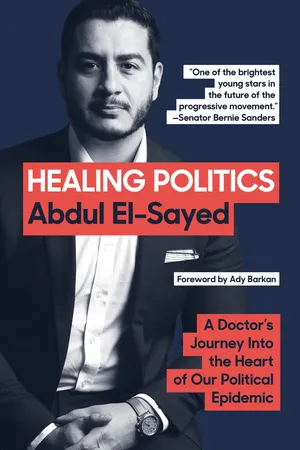
A memoir about restoring the health of our people, and our democracy, from a physician and "one of the brightest young stars" of the progressive movement (Sen. Bernie Sanders).
A child of immigrants, Abdul El-Sayed grew up feeling a responsibility to help others. He threw himself into the study of medicine and excelled—winning a Rhodes Scholarship, earning two advanced degrees, and landing a tenure-track position at Columbia University. At thirty, he became the youngest city health official in America, tasked with rebuilding Detroit's health department after years of austerity policies.
But El-Sayed found himself disillusioned. He could heal the sick—even build healthier, safer communities—but that wouldn't address the social and economic conditions causing illness in the first place. So he left health for politics, running for Governor of Michigan and earning the support of progressive champions like Congresswoman Alexandria Ocasio-Cortez and Senator Bernie Sanders.
This memoir traces the life of a young idealist, weaving together powerful personal stories and fascinating forays into history and science. Marrying his unique perspective with the science of epidemiology, El-Sayed diagnoses an underlying epidemic afflicting our country, an epidemic of insecurity. And to heal the rifts this epidemic has created, he lays out a new direction for the progressive movement. This is a bold, personal, and compellingly original book from a prominent young leader.
"In
Healing Politics, Abdul El-Sayed doesn't just diagnose the causes of our broken politics; he gives us a prescription and treatment plan." —Representative Pramila Jayapal
eBook - ePub
Healing Politics
A Doctor's Journey into the Heart of Our Political Epidemic
- 352 pages
- English
- ePUB (mobile friendly)
- Available on iOS & Android
eBook - ePub
About this book
Information
PART I
PRACTICUM
CHAPTER 1
Home away from home.
In June 1998, I waited in Detroit Metropolitan Airport to board a flight to Egypt for just the second time in my life. I was thirteen. This would be my first visit in ten years—since I had spent a few months there after my parents’ divorce. This time I was traveling without any immediate family. I was nervous. My parents thought it was about time for me to reconnect with the family I had not seen in so many years and to brush up on Arabic—my first language. As a hyphenated-American kid, I had all but jettisoned this native tongue. What was Arabic good for, anyway? I reasoned. No accent meant less teasing. Never mind the worlds and the people it could connect me to.
I boarded the plane to the harmonizing tune of Puff Daddy’s Notorious B.I.G. elegy, “I’ll Be Missing You,” a track on the “Abdul’s Summer Mix” CD my friend had burned for me. If I was going to be leaving America, I was at least going to take a piece of it with me.
I am Egyptian-American. In some ways I am both, in some ways neither.
That summer, some small part of me worried that the balance across the hyphen would shift indelibly—that I would forget how to be American. I was afraid that I’d have to start all over when I got back home—from “home”—in the fall.
Although hyphens are short, they take up a lot of space in the minds of hyphenated kids. W. E. B. DuBois, writing about the psychic load Black-Americans had to bear, called this a “double-consciousness.” Not only must you move in your spaces aware of the world, but you must also be aware of the way the world is aware of you. It’s a lot of work, especially for a kid.
For me, nothing quite reflects that double-consciousness like my name. Most everyone knows me as Abdul. But that’s not my full name, which is Abdulrahman. It means “Devotee of the Most Merciful.” In the Muslim tradition, it is one of God’s most beloved names, which is why my parents chose it (before they realized I would be growing up in America). I love my name, reflecting a connection to a character of the divine that is so lacking in humanity: mercy.
I didn’t become “Abdul” until about a week before I started preschool. My stepmom, Jackie, realized that with its full complement of eleven letters “Abdulrahman” might be a challenge. She gingerly broached the topic with my father, Mohamed.
The traditional Arabic nickname for “Abdulrahman,” “Boody,” pronounced like the body part, was a non-starter for obvious reasons. That was the summer of 1989. Billboard’s number-one hit song was . . . “Straight Up,” by Paula Abdul. And Kareem Abdul-Jabbar had just wrapped up his stellar basketball career. Unlike “Abdulrahman,” with its deep meaning, “Abdul” is nonsensical in Arabic, roughly translating to “Devotee of the,” but given its references in pop culture, it took on meaning in America. So on my first day of preschool in 1989, I introduced myself as “Abdul,” and I’ve been Abdul to most of the world ever since. I still prefer Abdulrahman, if people can say it. One person, two names. Two consciousnesses.
Hyphens connect things—people, places, ideas—but they also bisect, separating out the pieces of those things. I prefer to think of my hyphen as a connector. But that, too, takes work—the constant upkeep of belonging. I imagine that, for most folks, home is an effortless place to be. The rules are automatic. For the hyphenated, home is not one place but many places, and with each home there’s a different set of rules. Make a mistake, break a rule, and you’ll show yourself to be an outsider, even in your own home.
As I boarded that plane, I imagined the home I would find at the other end of my journey. My father had left Egypt behind in his mid-twenties to pursue a PhD in mechanical engineering at Wayne State University in Detroit. Like many children of immigrants, I grew up hearing the legend of my parents—first in their class at this and that. My father was the archetype. After finishing at the top of his class at his public high school in Alexandria, he finished near the top of his class in engineering at Alexandria University, all while working full-time to support his family. He was chosen to join the teaching faculty, where he excelled in front of the classroom. But his political agitation against Egypt’s increasingly brutal military dictatorship, coupled with his proximity to young minds, made him a threat to the regime.
He had to leave. There were a few options. But Detroit, Michigan, was the most compelling. Detroit was, after all, in the United States of America, where his name, the color of his skin, and how he prayed shouldn’t matter. He could be just as American as anyone else. America was also the home of democracy, that thing he had so wanted for Egypt. And Detroit was synonymous with the car, a mecca for this budding automotive engineer. Besides, if it didn’t work out, he didn’t intend to stay forever anyway. He figured that after he’d gotten his fancy American degree, he’d be free to return to Egypt and have his pick of good jobs.
Detroit’s near-arctic winters felt like a personal insult to my father, whose childhood was saturated with the warmth of the Mediterranean sun, but he found Wayne State welcoming. Still, he was lonely. His heart had been broken a number of times before his transatlantic migration, so he decided to apply the exactitude of his engineering training to the work of finding love. He wanted to find a partner who shared his faith-driven values and his intellectual ambitions and who might join him in Detroit while he finished his PhD. My grandmother started to work the horn on his behalf, in a process that sounds more like the pre-auction marketing of a prized bull than romantic courtship.
She kept hearing about Fatten, a medical student and leader on campus. She was the eldest daughter of a biologist and had spent most of her childhood abroad after her mother passed when Fatten was thirteen. Fatten was a mother figure to her siblings and a loving, devoted daughter to her father. She, too, was a top student. Smart, warm, and charismatic, she seemed the right match, at least on paper. They met in person only once when my father had come back to Egypt over the summer. Under the watchful eyes of their parents, they chatted for twenty minutes. Everything looked to be in order. My father was smitten—perhaps less with the complex reality of the person he met than with the idea of her. She was equally taken with the idea of him.
But the future started to flicker. Both of their fathers were strong-willed, uncompromising men who wanted only the best for their eldest children. My paternal grandfather had already scuttled two relationships over petty slights at twenty-minute meetings that devolved into all-out feuds. My father was determined not to lose a third. Mohamed and Fatten married by phone a few months later.
My parents both take after their fathers. Both are strong-willed, charismatic, charming—and both are uncompromising, not only in their beliefs, but also in their approaches to life and their way of doing things. Their traits may make for excellent leaders and empowering parents, but they did not make them excellent life partners for each other. They divorced within a few years. My parents’ relationship had one lasting outcome: me. I comfort myself by thinking that if my parents were a band, they would have been a “one-hit wonder.”
My father decided to stay in America, and after finishing his degree he went to work for General Motors. He would never admit it, but he is a hopeless romantic. He was always destined to marry for love, not convenience. And he met—and soon married—a colleague at GM, one who could not have come from a more different a world. Jackie Johnson was the eldest daughter of Judith Ann and Jan Johnson. Her family has had roots in America since before the Revolution—she being a distant descendant of Abigail Adams. Jackie’s connection to the lands of mid-Michigan was generational. She had been born in Flint, while my Grandma Judy was in nursing school and my Grandpa Jan was studying at General Motors Institute (now Kettering University). Although they moved often, they raised their children in the Midwest. For people like my grandparents, home is etched into who they are. Jackie is smart, hardworking, and warm, a tenacious counter to my father’s hard-driving character.
Mohamed and Jackie met over a conversation about an obscure engineering concept: Mohr’s circle, a graphical representation of how an object changes under varying external stresses. My siblings, Osama and Samia, and I became a sociocultural application of that concept. We grew up in the home they made together, children raised by an immigrant from Egypt and a Daughter of the American Revolution.
My mother remarried as well, to a translator with whom she would live all over the world. Tragically, he passed young, the victim of a heart attack. I have two sisters on that side, Eman and Arwa, as well as a stepbrother, Adam. Collectively, I have five half- or stepsiblings; our love is whole, even if the bloodlines are not.
* * *
On the other side of my two-leg, fifteen-hour journey, I came home to the working-class neighborhood in Alexandria where my father grew up. For a kid raised largely in the bland suburbia of 1990s America, this other “home”—one I had only imagined—offered a glorious assault on the senses, from the street vendors hawking mish, a caramel-brown fermented cheese dip that looked and smelled like a bad moment on the toilet; to the soot of the air polluted by the tailpipes of 1970s-era Soviet Ladas; to the majesty of watching the sun set from the Corniche over the rocks jutting out of Alexandria’s Mediterranean waterfront; to the mystic cacophony of every muezzin’s adhan simultaneously calling the pious to prayer. The place didn’t even really wake up until after the sun went down; people filled the cafés and restaurants until well past 2:00 a.m. The manicured lawns and strip malls of Detroit’s sleepy suburbs were no match for the energy and authenticity of this place.
Yet poverty and its consequences abounded. The ubiquitous beggars and garbage pickers who spent their days sorting through the refuse of the lives of others were the visible tip of an iceberg of poverty. Egyptian society is segregated, though differently than ours is. To be sure, there are posh neighborhoods, exclusive to the ultra-rich, yet many wealthy Egyptians live on the upper floors of apartment buildings shared by a cross-section of all of Egyptian society. At the very bottom were the bawabs, an army of doormen who serve as the social mortar that holds together the bricks of Egyptian life.
The face of Ali, our bawab, bore the crags of his many days under an unmerciful sun spent fetching this or haggling over that. Ali wore the traditional Egyptian galabia, a gray, loose-fitting, collarless version of the robes made famous by the Saudis. Ali’s family had been in the bawab business for a generation, and he became my Sherpa, helping me decode the sights and sounds of Egyptian life. Because his role was to be the monitor, arbiter, and catalyst of all that went on in building, he knew the secrets held just beyond each apartment door. He knew about the crooked businessman on the eighth floor—and his mistress younger than his daughter—and the young woman on the fourth whose parents wouldn’t let her go to medical school. When I had questions that I was too embarrassed to ask my family, I would ask Ali.
“Why can’t the farmers who bring their goods to market on a donkey afford a truck?”
“Why is there a group of young women who come to that coffee shop a few blocks away every night, and why do they leave with different men?”
“Why does that man beat his son?”
His answers were almost always the same: “Miskeen.” Because, Ali said, they were poor.
I began to realize just how narrow was the tightrope my predecessors had walked, how circumstances had threatened to knock them off at every turn—and just how fortunate I was that they never fell off. My people, too, had been poor.
Teta, my grandmother, was illiterate. She is the wisest, most intelligent person I have ever met, but she never spent a day in a classroom. She was denied that right. The fifth of nine children born to a streetlamp repairman and his illiterate wife, my grandmother grew up between her parents’ home and that of an eccentric couple without children who lived a few floors up. The husband was an inventor who had made his money designing quick-action cameras that could be used to snap photos of tourists on the Corniche.
Though separated only by a few floors, the two homes might as well have been different worlds. A far cry from the overcrowded rooms downstairs, the upstairs flat was a local salon for intellectuals and activists of the moment. Teta, an apprentice of sorts to the matron, would help with odd jobs around the house. With guests from all over Egypt, North Africa, Europe, and the Levant, she learned to cook in their various styles. Her proximity to the conversations shared over her meals gave her an ease with ideas and viewpoints to which few young women in her social circumstances would have been exposed. They were ever impressed with her wit, her memory, and her grace. And yet it never occurred to any of them that this intelligent, precocious, and charming young woman should be given access to formal education. I often wonder what my grandmother might have achieved had she been born in a different place in a different time.
Teta married my grandfather, then eighteen, when she was just fifteen. Giddo, my grandfather, had an eighth-grade education and sold tomatoes at a local fish market. He had spent much of his childhood as the eldest son of a wealthy landowner in Alexandria. But his father died when Giddo was thirteen, and when his uncles moved in for his inheritance, he was powerless, forced onto the street to fend for his mother and siblings. Although he was a rough man, ground down by life’s misfortunes, my grandfather loved my grandmother, for whom he reserved all the softness left in him. Teta had an extraordinary temperament. She was never angry, only disappointed—and not with you but with the version of you that you were choosing to be at the moment. She had the rare gift of seeing the best in you even when you could not see it in yourself, charming it out with a friendly parable or a caress of the hand. She was a natural leader, a towering figure of all of five feet one inch and much shorter in her usual pose, squatting over a little burner stove from which she would coax feasts of Egyptian cuisine. She’d hold court in that kitchen, helping a cousin with marital issues or settling a dispute between friends—always with a smile on her face, a story on her lips, and her heart firmly on the side of the powerless.
My father had a special reverence for his mother, and among the many gifts she gave me—the one for which I am most thankful—is the capacity for tenderness she showed me in him. My father was the eldest of her eight children, two of whom died before their first birthdays. My grandmother wanted him, her eldest son, to be a doctor. But watching two infant siblings die in hospitals left him with a lifelong aversion to the medical institutions that had failed them. He would oblige her somehow, though, ultimately earning a different kind of doctorate on a path he paved with books. He would start his day in the local market, helping set up my grandfather’s tomato stall before heading off to school, where he was expected to be the best student in his class.
My grandfather wanted better for his kids but knew only one way of wringing it from them: brute force. As you can imagine, my dad would dutifully make his way back to the market after school to help break the stall down. By the time he’d finish his chores in the market, the sun would have gone down. With only one bedroom for a family of eight, he was left to study on the rooftop, by the light of a streetlamp. Night after night, alone on that rooftop, my father studied my future into existence. That summer I often sat in his place, imagining the other versions of my life that might have been had he not sat there so many nights, so many years ago.
CHAPTER 2
An imperfect science.
Most of the time, when I tell people that I am an epidemiologist, they think I’m a skin doctor. It’s a fair mistake, owing to the similarity between the words “epidemiologist” and “epidermis.” We’re not skin doctors, and we don’t make nearly as much money.
Epi is Greek for “what is upon,” and demos means “the people.” Epidemiologists want to understand “what is upon the people,” what is plaguing them. Epidemiology is the basic science of public health, the study of the distribution and determinants of disease in populations. We count things having to do with why people get sick so we can understand how often—and why—they happen so that we can stop them from happening.
To get a sense of why this matters, consider this: if I asked you what the biggest health risk was among women, you’d probably think it was breast cancer. After all, everything turns pink every October for breast cancer awareness. But the most common killer in women is actually heart disea...
Table of contents
- Cover
- Title Page
- Copyright Page
- Dedication
- Contents
- Foreword
- Prologue
- Part I: Practicum
- Part II: America’s Insecurity Epidemic
- Part III: Healing Politics
- Epilogue: Empathy for Our Future
- Notes
- Acknowledgments
- Index of Searchable Terms
Trusted by 375,005 students
Access to over 1.5 million titles for a fair monthly price.
Study more efficiently using our study tools.
Frequently asked questions
Yes, you can cancel anytime from the Subscription tab in your account settings on the Perlego website. Your subscription will stay active until the end of your current billing period. Learn how to cancel your subscription
No, books cannot be downloaded as external files, such as PDFs, for use outside of Perlego. However, you can download books within the Perlego app for offline reading on mobile or tablet. Learn how to download books offline
Perlego offers two plans: Essential and Complete
- Essential is ideal for learners and professionals who enjoy exploring a wide range of subjects. Access the Essential Library with 800,000+ trusted titles and best-sellers across business, personal growth, and the humanities. Includes unlimited reading time and Standard Read Aloud voice.
- Complete: Perfect for advanced learners and researchers needing full, unrestricted access. Unlock 1.5M+ books across hundreds of subjects, including academic and specialized titles. The Complete Plan also includes advanced features like Premium Read Aloud and Research Assistant.
We are an online textbook subscription service, where you can get access to an entire online library for less than the price of a single book per month. With over 1.5 million books across 990+ topics, we’ve got you covered! Learn about our mission
Look out for the read-aloud symbol on your next book to see if you can listen to it. The read-aloud tool reads text aloud for you, highlighting the text as it is being read. You can pause it, speed it up and slow it down. Learn more about Read Aloud
Yes! You can use the Perlego app on both iOS and Android devices to read anytime, anywhere — even offline. Perfect for commutes or when you’re on the go.
Please note we cannot support devices running on iOS 13 and Android 7 or earlier. Learn more about using the app
Please note we cannot support devices running on iOS 13 and Android 7 or earlier. Learn more about using the app
Yes, you can access Healing Politics by Abdul El-Sayed in PDF and/or ePUB format, as well as other popular books in Politics & International Relations & Medicine Biographies. We have over 1.5 million books available in our catalogue for you to explore.