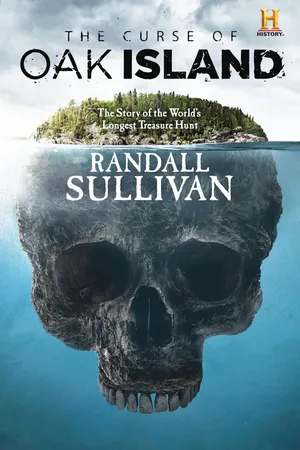
An in-depth look into the history of a Canadian island rumored to hold buried treasure and of centuries of failed attempts to claim the riches.
Updated with new material from the author
In 1795, a teenager discovered a mysterious circular depression in the ground on Oak Island, in Nova Scotia, Canada, and ignited rumors of buried treasure. Early excavators uncovered a clay-lined shaft containing layers of soil interspersed with wooden platforms, but when they reached a depth of ninety feet, water poured into the shaft and made further digging impossible.
Since then, the mystery of Oak Island's "Money Pit" has enthralled generations of treasure hunters, including a Boston insurance salesman whose obsession ruined him; a young Franklin Delano Roosevelt; and film star Errol Flynn. Perplexing discoveries have ignited explorers' imaginations: a flat stone inscribed in code; a flood tunnel draining from a man-made beach; a torn scrap of parchment; stone markers forming a huge cross. Swaths of the island were bulldozed looking for answers; excavation attempts have claimed two lives. Theories abound as to what's hidden on Oak Island–pirates' treasure, Marie Antoinette's lost jewels, the Holy Grail, proof that Sir Francis Bacon was the true author of Shakespeare's plays–yet to this day, the Money Pit remains an enigma.
The Curse of Oak Island is a fascinating account of the strange, rich history of the island and the intrepid treasure hunters who have driven themselves to financial ruin, psychotic breakdowns, and even death in pursuit of answers. And as Michigan brothers Marty and Rick Lagina become the latest to attempt to solve the mystery, as documented on the History Channel's television show
The Curse of Oak Island, Sullivan takes readers along to follow their quest firsthand.
Praise for
The Curse of Oak Island
"Sullivan writes with open-minded balance, rendering the Oak Island story into a weirdly fascinating mystery." —
Booklist
"A definitive read for fans of the History Channel television show. Sullivan delves deeper into the history, personalities, and theories presented only briefly on the show. . . . The book is incredibly well researched and the presentation . . . is very readable. If you've watched
The Curse of Oak Island and were frustrated that snippets and possibilities were left tantalizingly unexplored, this is the book for you." —Heather Cover, Homewood Library (Birmingham, Alabama)
"Sullivan isn't writing about Oak Island the TV show; his subject is Oak Island the place, largely as seen and imagined by the show's viewers. So, if you've ever been more entranced by the show's long trips into history and theoretical island encounters across history, Sullivan's book probably needs to be on your Christmas list." —Starcasm
- 488 pages
- English
- ePUB (mobile friendly)
- Available on iOS & Android
eBook - ePub
About this book
Trusted by 375,005 students
Access to over 1.5 million titles for a fair monthly price.
Study more efficiently using our study tools.
Information
Print ISBN
9780802126931
Subtopic
Historical BiographiesCHAPTER ONE
Oak Island sits off the coast of Nova Scotia just north of the 45th parallel, the halfway point between the equator and the North Pole, about forty-five miles southwest of Halifax. It’s almost a mile long and not quite a half mile wide at its broadest point, narrowing to only a little more than a thousand feet at its sunken center, which is filled mostly with swamp and marsh. The island is commonly described as peanut shaped, but when I’ve looked at it from above I’ve always seen a baby elephant, mainly because of the curve of an incipient trunk that protrudes from its east end, wrapping around the southern shore of a compact, crescent-shaped bay that was once known as Smuggler’s Cove. Small hills of glacial drift, known geologically as drumlins, rise to about 35 feet above sea level on both ends of the island. The composition of the island’s two sides is very different: on the east layered with limestone, gypsum, and sandstone, on the west mainly quartzite and slate. Because the geologic structures of the island’s east and west ends are so dissimilar, and because the swamp divides them, some theorists think Oak Island was once two islands, very close together, that may or may not have been joined by the work of men.
While there are more than 350 other islands in the churning silver-gray waters of Mahone Bay, it’s not difficult to imagine why this one would have stood out to the mariners of the sixteenth, seventeenth, and eighteenth centuries. It is larger than most of the other dots of land in those waters and very close to shore, barely two hundred yards from a protrusion of the mainland that’s been known for the past two and a half centuries as Crandall’s Point. What most impressed the first Europeans to live in the Mahone Bay area, though, was that the island was covered with a magnificent forest of mature oak trees, with deep roots and stout trunks that supported massive, spreading limbs, leaving most of the ground in the shadow of their canopy. It may have been the only island in Mahone Bay where oak trees grew, and certainly it was the only island covered with them. Those trees were what gave the island its eventual name, though it was designated simply as Island No. 28 by Charles Morris, the surveyor general of the province, who between 1762 and 1765 conducted the first survey of the island and divided it into thirty-two four-acre lots. In 1776, a British cartographer named Des Barres attempted to name it Glouster Isle, but he was overruled by the locals’ insistence on calling it Oak Island.
The island’s oaks, growing so close to the mainland, were an especially attractive feature to the settlers who in 1759 accepted pieces of the hundred-thousand-acre Shoreham Grant that brought hundreds of men and dozens of families to the south shore of Nova Scotia from New England. They were mostly English and Welsh, with names like Monro, Lynch, and Seacombe, and populated a village they called Chester Township. On the south end of the bay, a mostly German and Swiss population was in the process of creating the great seagoing and shipbuilding town of Lunenburg, famous for the Georgian mansions topped with five-sided dormers that were the homes of sea captains in that epoch of tall ships. The settlers in the Chester area, though, were mostly farmers, plus a few ambitious souls who prospered by building and operating lumber mills. Most of the trees on the other islands of Mahone Bay and on the mainland as well were evergreen softwoods—spruce and pine predominated—making the island a primary source of hardwood timber. That a single island among the dozens in Mahone Bay should be covered with oak trees was for a period of sixty years or so the principal mystery of the place. The first to describe the island in print and to remark on its impressive forest of oak trees was a French nobleman named Nicolas Denys, who had helped establish LaHave, the settlement at the entrance to Mahone Bay, in 1632. Denys could conceive of no explanation for how the oaks had gotten there.
AMONG THE POINTS DRIVEN HOME by a study of Oak Island is how much of what we call history is hearsay and supposition, conflation and apocrypha. Even revisionists go back to the earliest written sources, created by men who were putting to paper what they’d heard from people who were themselves often repeating stories they’d been told by someone else. Historians since the time of Herodotus and Thucydides have been deciding what version of events to include and what version to leave out; readers can only hope they’ve chosen wisely.
If one person is identified as the first to discover the works on the island, the name Daniel McGinnis is almost unanimously put forward. As the story is told, McGinnis was sixteen years old in the late spring of 1795 when he rowed to Oak Island one fine morning to explore it, all alone. It was still early in the day, the story goes, when the teenager stumbled upon an unusual saucer-shaped depression in the earth, about 13 feet in diameter, on the elevated ground of the island’s east drumlin. The forked limb of a giant oak extended over the clearing, cut off at a point where its two branches were still almost as thick as a man’s thigh. Attached to the limb, about 15 feet above the ground, was a weatherworn wooden tackle block that was held in place with a wooden peg or “treenail” of the type used in the construction of wooden ships. Taking all this in, young Mr. McGinnis surmised that he had happened upon the hiding place of a pirate treasure.
During the seventeenth and early eighteenth centuries, when buccaneers terrorized shipping lanes across the globe, Mahone Bay had been one of the world’s great pirate havens. Tales of buried treasure were endemic to the region, but the legends that surrounded Oak Island were particularly ominous. According to several of Nova Scotia’s numerous amateur historians, the citizens of nearby Chester Township had for years shared stories of “strange lights” that glowed on the island after dark. Author Edward Rowe Snow, who embraced this bit of apocrypha as historical fact, wrote that a number of fishermen claimed to have seen on the island human figures “silhouetted against bonfires,” as one local chronicler put it. Eventually, Snow had written, two men overcome with curiosity had ventured out to Oak Island to investigate. They never returned.
Daniel McGinnis did make it back to Chester, according to the story, where he recruited two young friends, also teenagers—John Smith and Anthony Vaughan—to help him dig for the treasure he was certain must have been buried at this mysterious spot on Oak Island. The first thing the three did was attempt to remove the tackle block hanging from the forked limb of the oak tree. But it slipped off the treenail and fell to the ground, where it shattered into powdery fragments, suggesting to the boys that it must be very old. They went to work on the ground then, armed with pickaxes and shovels. They had reached a depth of only 2 feet, though, when they hit a tier of carefully laid flagstones. (They would later decide after some investigation that the rocks were not from Oak Island but instead had been moved there from Gold River, about two miles north on the mainland.) Eagerly tossing the stones aside, McGinnis and his friends found themselves at the entrance to a large shaft. The sides were made of hard, packed clay, but the earth inside was loose and easy to shovel. Driven by the excitement of discovery, the three dug within a few days to a depth of 10 feet, where they struck solid wood. Assuming they had hit the top of a treasure chest, the teenagers shoveled feverishly, only to discover that what they had found was a level platform of oak logs, all about 6 to 8 inches in diameter, the ends of which had been embedded in the walls of the shaft. Removing these, the boys kept digging over the next few days, clearing out the loose soil with a pickaxe, two shovels, a rope, and a bucket. When they hit solid wood for a second time at 20 feet, the three again dug feverishly, convinced that his time they really had found the top of the treasure chest. What they had struck with their shovels, though, was another tier of oak logs, with their rotting ends embedded in the sides of the shaft exactly as the logs at 10 feet had been. At that point, the three looked up at the walls of clay towering above them and realized that even a partial collapse would bury them alive. It was agreed that they needed to mount a much more substantial operation, involving both a far larger workforce and more expensive materials and equipment if they were to go deeper into the shaft.
The three youngsters bought land on Oak Island, as the story goes, where they supported themselves as farmers while making regular trips to nearby towns, seeking out men of means who might help them recover what they were calling Captain Kidd’s treasure.
I HAD RETURNED TO NOVA SCOTIA determined to test every major theory and to question all received wisdom about Oak Island. After four weeks of research, assisted by, among others, the Nova Scotia Archives, the South Shore Genealogical Society, and local historian Charles Barkhouse, I was convinced that the tale was mostly true. This is not to say entirely true. There were a number of details in the narrative that I either doubted or was convinced couldn’t be right, and several others that I believed might be embellishments added as the story was told and retold.
For the moment, I was leaving aside the deeper mystery of who was behind the works on Oak Island and concentrating instead on the story of how those works had been discovered. Even then, the best answers I could find to my questions about who, what, and when were so unclear that nebulousness may have been their most defining feature. At least I didn’t have much doubt that the first to find the massive hole in the ground, now world-famous as the Money Pit, had been the young man Daniel McGinnis. While McGinnis himself was dead by the time the treasure hunt on Oak Island hit high gear in the mid-nineteenth century, his former partners, Vaughan and Smith, had been alive to describe what took place on the island in the early days—dating back to the discovery of the Money Pit—to those who produced the earliest written accounts. Both said there was no question Daniel was the first to spot the features that had inspired the three of them to start digging. Who Daniel McGinnis had been, though, was still a puzzle with a lot of missing pieces to me.
McGinnis was described as “an enigma” by R. V. Harris, the lawyer whose 1958 book The Oak Island Mystery had made the Money Pit story known outside Nova Scotia: “His age in 1795 is unknown. His origin and parentage is unknown.” So where had the story of the sixteen-year-old boy who discovered the Money Pit come from? From Anthony Vaughan, mostly, it seemed. Vaughan, an old man by the time his memories were recorded for posterity, had been a main source for the first published account of what had taken place on Oak Island, which appeared in the October 16, 1862, edition of the Liverpool Transcript, a now-defunct weekly newspaper that was distributed throughout southwestern Nova Scotia during the mid- and late nineteenth century. Vaughan had actually told his story at length more than twelve years earlier, in an 1849 interview with a devout Presbyterian named Robert Creelman, who was a member of a treasure-hunting group known as the Truro Company. The author who made use of the Creelman interview for the Transcript article was Jothan (sometimes called Jotham) B. McCully, who had been part of both the Truro Company and the Oak Island Association, separate treasure-hunting groups that had worked on Oak Island between 1849 and 1865. McCully may also have written the second and far more detailed published account of the discovery of the Money Pit, which appeared in three consecutive editions of a Halifax triweekly called the Colonist in January 1864, although the author was identified only as a “member” of a team that had searched for treasure on Oak Island in 1861. The Transcript and Colonist articles each had relied on interviews with John Smith (who died in 1857) as well as those Creelman had conducted with Anthony Vaughan, but Smith apparently had been more taciturn than his old friend. Not so Smith’s daughter, Mary, who worked as the housekeeper for Judge Mather Byles DesBrisay, the county magistrate and local eminence who authored History of the County of Lunenburg (originally published in 1870), which included a two-page account of the discovery of the Money Pit that was the first to appear between hard covers. Mary Smith, apparently quite voluble, had told Judge DesBrisay the story from her family’s perspective on multiple occasions.
Those three accounts, published sixty-seven, sixty-nine, and seventy-five years after the putative date of the Money Pit’s discovery, were the core versions of the Oak Island story before Harris’s book was published. There were of course various documents and records dating back to the early nineteenth century that related to the assorted treasure-hunting companies that had formed to attempt the recovery of whatever might be buried on Oak Island. And the scene at the Money Pit had been briefly described in an 1863 volume titled Rambles among the Blue-Noses, written by British author Andrew Learmont Spedon, whose aim was to amuse the people back home with tales from the provincial wilds of eastern Canada. There was also an account of the discovery of the Money Pit written in 1866 by one Israel Longworth, but his work, “History of the County of Colchester,” had never been published. And only a fragment remained of a manuscript written in 1863 by another early treasure hunter, James McNutt, that described the early search for treasure on Oak Island.
So the early story of the treasure hunt on the island was based largely on the recollections of Anthony Vaughan and Mary Smith, along with various others who claimed to have heard it from Daniel McGinnis and John Smith. This paucity of sources and questions about their reliability have fueled rampant speculation about what really happened on Oak Island in those early days, everything from the allegation that the three young men cooked up a story to cover their tracks after finding a huge treasure trove on Oak Island to the claim that McGinnis, Smith, and Vaughan were the front men for a conspiracy of Yankee loyalists operating a smuggling operation out of Oak Island during the Revolutionary War. The evidence offered to back up these and the dozens of other alternative theories of what took place on Oak Island in the last years of the eighteenth century is of course even more meager than the evidence that supports what has become the more or less official version.
R. V. Harris wrote in The Oak Island Mystery that most of what could be actually known about Daniel McGinnis’s background had to be derived from “the origins and lineages” of Vaughan and Smith, whose family histories were much easier to find in Nova Scotia’s early public records. In my opinion, no one was in a better position to make such an assertion than Harris, who had served as the attorney to the two men who drove the treasure hunt on Oak Island for seventy years between 1895 and 1965 and who had inherited and relied on the vast collection of records and documents that now made up the bulk of the huge Oak Island file at the Nova Scotia Archives in Halifax. So I took his advice.
I began with Vaughan. Government and church records established that he was the son of an Anthony Vaughan Sr., who had come to Nova Scotia from Massachusetts in 1768 to claim his piece of the British Crown’s Shoreham Grant: two hundred acres on the mainland almost directly across from Oak Island. Anthony Vaughan Jr. was thirteen years old in 1795, which offered at least some tangential confirmation that his friend Daniel McGinnis probably had been a teenager also. Judge DesBrisay, in his book, described Vaughan and his family as living on the mainland in 1795 and that jibes with what other early writers up to and including R. V. Harris have maintained. But there was little question in my mind that the boy’s family owned land on Oak Island well before the discovery of the Money Pit. There are deeds that show Anthony Vaughan Sr. acquired lots 15 and 17 on Oak Island in 1765 (which wouldn’t seem possible if he had emigrated to Canada in 1768) and lot 14 in 1781. One of Vaughan Sr.’s brothers bought lot 13 in 1781. It is also clear that the Vaughans were operating a lumber mill on the mainland directly across from Oak Island. In 1788 they petitioned the Surveyor General of Woods in the province of Nova Scotia for permission to cut down “Sundry Pine Trees” on nine hundred acres of land for the purpose of farming the land and milling the trees. So there seems little doubt that by 1795 the Vaughan brothers were using or intended to ...
Table of contents
- The Curse of Oak Island
- Also by Randall Sullivan
- Title Page
- Copyright
- Dedication
- Map
- INTRODUCTION
- CHAPTER ONE
- CHAPTER TWO
- CHAPTER THREE
- CHAPTER FOUR
- CHAPTER FIVE
- CHAPTER SIX
- CHAPTER SEVEN
- CHAPTER EIGHT
- CHAPTER NINE
- CHAPTER TEN
- CHAPTER ELEVEN
- CHAPTER TWELVE
- CHAPTER THIRTEEN
- CHAPTER FOURTEEN
- CHAPTER FIFTEEN
- CHAPTER SIXTEEN
- CHAPTER SEVENTEEN
- CHAPTER EIGHTEEN
- CHAPTER NINETEEN
- CHAPTER TWENTY
- CHAPTER TWENTY-ONE
- CHAPTER TWENTY-TWO
- CHAPTER TWENTY-THREE
- CHAPTER TWENTY-FOUR
- CHAPTER TWENTY-FIVE
- CHAPTER TWENTY-SIX
- CHAPTER TWENTY-SEVEN
- POSTSCRIPT
- AFTERWORD
- 2020 POSTSCRIPT
- Oak Island Time Line
- Photo Insert
- Image Credits
- Back Cover
Frequently asked questions
Yes, you can cancel anytime from the Subscription tab in your account settings on the Perlego website. Your subscription will stay active until the end of your current billing period. Learn how to cancel your subscription
No, books cannot be downloaded as external files, such as PDFs, for use outside of Perlego. However, you can download books within the Perlego app for offline reading on mobile or tablet. Learn how to download books offline
Perlego offers two plans: Essential and Complete
- Essential is ideal for learners and professionals who enjoy exploring a wide range of subjects. Access the Essential Library with 800,000+ trusted titles and best-sellers across business, personal growth, and the humanities. Includes unlimited reading time and Standard Read Aloud voice.
- Complete: Perfect for advanced learners and researchers needing full, unrestricted access. Unlock 1.5M+ books across hundreds of subjects, including academic and specialized titles. The Complete Plan also includes advanced features like Premium Read Aloud and Research Assistant.
We are an online textbook subscription service, where you can get access to an entire online library for less than the price of a single book per month. With over 1.5 million books across 990+ topics, we’ve got you covered! Learn about our mission
Look out for the read-aloud symbol on your next book to see if you can listen to it. The read-aloud tool reads text aloud for you, highlighting the text as it is being read. You can pause it, speed it up and slow it down. Learn more about Read Aloud
Yes! You can use the Perlego app on both iOS and Android devices to read anytime, anywhere — even offline. Perfect for commutes or when you’re on the go.
Please note we cannot support devices running on iOS 13 and Android 7 or earlier. Learn more about using the app
Please note we cannot support devices running on iOS 13 and Android 7 or earlier. Learn more about using the app
Yes, you can access The Curse of Oak Island by Randall Sullivan in PDF and/or ePUB format. We have over 1.5 million books available in our catalogue for you to explore.