eBook - ePub
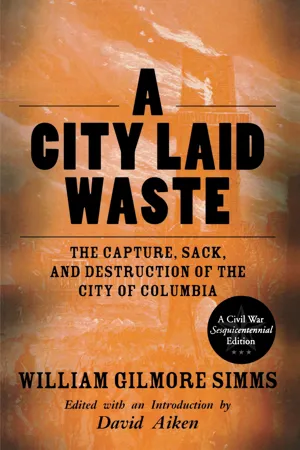
A City Laid Waste
The Capture, Sack, and Destruction of the City of Columbia
- 152 pages
- English
- ePUB (mobile friendly)
- Available on iOS & Android
eBook - ePub
A City Laid Waste
The Capture, Sack, and Destruction of the City of Columbia
About this book
"A graphic account of the horrors, the brutality and sometimes wanton destruction of warfare, particularly of civil war." — Charleston (SC) Post and Courier
In the first reissue of these documents since 1865, A City Laid Waste captures in riveting detail the destruction of South Carolina's capital city. William Gilmore Simms (1806-1870), a native South Carolinian and one of the nation's foremost men of letters, was in Columbia and witnessed firsthand the city's capture and destruction. A renowned novelist and poet, who was also an experienced journalist and historian, Simms deftly recorded the events of February 1865 in a series of eyewitness accounts published in the first ten issues of the Columbia Phoenix and reprinted here. His record of burned buildings constitutes the most authoritative information available on the extent of the damage. Simms historian David Aiken provides a historical and literary context for Simms's reportage. In his introduction Aiken clarifies the significance of Simms's articles and draws attention to factors most important for understanding the occupation's impact on the city of Columbia.
"A shrewd viewer of the war scene in Columbia, famed Southern writer William Gilmore Simms published stinging, courageous exposés of the doings of the Northern forces, even when threatened with arrest. The restoration of his candid firsthand accounts of the destruction wrought by Sherman's forces against the South Carolina capitol and its inhabitants is a great service to all who study and appreciate Southern history and literature." —James Everett Kibler, author of Our Fathers' Fields
Information
THE CAPTURE, SACK, AND DESTRUCTION OF THE CITY OF COLUMBIA
William Gilmore Simms
From the Columbia Phoenix
Published by Julian A. Selby
COLUMBIA, S.C., TUESDAY, 21 MARCH 1865, VOL. 1, NO. 1.
I.
It has pleased God, in that Providence which is so inscrutable to man, to visit our beautiful city with the most cruel fate which can ever befall States or cities.1 He has permitted the cruel and malignant enemy2 to penetrate our country almost without impediment; to pollute our homes with his presence; to rob and ravage our dwellings, and to commit three-fifths of our city to the flames. Eighty-four squares, out of one hundred and twenty-four (!) which the city contains, have been destroyed, with scarcely the exception of a single house. The ancient capitol building of the State—that venerable structure which, for seventy years, has echoed with the eloquence and wisdom of the most famous statesmen—is laid in ashes; six temples of the Most High God have shared the same fate; eleven banking establishments; the schools of learning, the shops of art and trade, of invention and manufacture; shrines equally of religion, benevolence, and industry; are all buried together in one congregated ruin. Humiliation spreads her ashes over our homes and garments, and the universal wreck exhibits only one common aspect of despair. It is for us, as succinctly but as fully as possible, and in the simplest language, to endeavor to make the melancholy record of our wretchedness, so that our sons may always remember, and the whole Christian world everywhere may read.
II.
When, by a crime, no less than blunder, Gen. Johnston3 was removed from the command of our armies in Georgia, which he had conducted with such signal ability, there were not a few of our citizens who felt the impending danger, and trembled at the disastrous consequences which they partly foresaw. The removal of a General so fully in the confidence of his troops, who had so long baffled the conquests, if he could not arrest the march, of the enemy, was of itself a proceeding to startle the thoughtful mind. The enemy loudly declared his satisfaction at the event, and on repeated occasions since has expressed himself to the same effect. He was emboldened by the change, and almost instantly after, his successes became rapid and of the most decided character.
Gen. Johnston was by nature, no less than training and education, the very best of our generals to be opposed to Gen. Sherman. To the nervo sanguine temperament, eager and impetuous, of the latter, he opposed a moral and physical nature—calm, sedate, circumspect; cool, vigilant and wary—always patient and watchful of his moment—never rash or precipitate, but ever firm and decisive—his resources all regulated by a self-possessed will, and a mind in full possession of that military coup d’ oeil which, grasping the remotest relations of the field, is, probably, the very first essential to a general having the control of a large and various army.
The error which took Hood4 into the colder regions of Tennessee, at the beginning of winter, was one which the Yankee General was slow to imitate, especially as, in so moving, Hood necessarily left all the doors wide open which conducted to the seaboard. It required no effort of genius—nay, did not need even the suggestions of ordinary talent—to prompt the former to take the pathways which were thus laid open to him. Even had he not already conceived the propriety of forcing his way to the Atlantic coast, and to a junction with his shipping, the policy of then doing so would have been forced upon him by the proceeding of his rival, and by the patent fact that there were no impediments to such a progress. We had neither army nor general ready to impede his march. It suggested itself. The facility of such a progress was clear enough, and, with that quickness of decision which distinguishes the temperament of Sherman, he at once rushed into the open pathway.
The hasty levies of regular troops, collected by Hardee,5 and the clans of scattered militia, gathered with great difficulty and untrained to service, were rather calculated to provoke his enterprise than to impede his march; and, laying waste as he went, after a series of small and unimportant skirmishes, he made his way to the coast, made himself master of Savannah, and, from the banks of that river, beheld, opened before him, all the avenues into and through South Carolina. It is understood that Hardee had in hand, to oppose this progress, something less than 10,000 men, while the force of Sherman was, in round numbers, something like 50,000, of which 38,0006 consisted of infantry—the rest of artillery and cavalry.
III.
The destruction of Atlanta, the pillaging and burning of other towns of Georgia, and the subsequent devastation along the march of the enemy through Georgia, gave sufficient earnest of the treatment to be anticipated by South Carolina, should the same commander be permitted to make a like progress in our State. The Northern press furnished him with the cri de guerre to be sounded when he should cross our borders. “Voe victis!”—wo to the conquered!—woes unmitigated, unqualified, remorseless—in the case of a people which had been the first to sound the bugles of resistance to the encroachments of the Northern tyranny and usurpation! The howl of delight (such was the language of the Northern press) sent up by Sherman’s legions, when they looked across the Savannah to the shores of Carolina, was the sure forerunner of the terrible fate which threatened our people, should the demonic furies be once let loose upon our lands. Our people felt all the danger. They felt that it required the first abilities, the most strenuous exertions, the most prompt and efficient reinforcements, to prevent the threatening catastrophe.
South Carolina had, for a long season, been made a sort of nursery for sick generals, and a sort of pasture ground for incompetence and imbecility. Hardee, though of acknowledged ability, and considered able as the leader of a corps, was not the man to grasp the business of a large army. All eyes looked to Gen. Johnston as the one man, next to Lee, to whom the duty should be confided and the trust. It was confidently hoped and believed that he would be restored to the command, and that adequate reinforcements would be furnished, to enable him, not only to meet the enemy, but to take the initiate in beating him from the ground which he had won. At all events, no one doubted that, with adequate supplies of men and materiel, Johnston would most effectually arrest the farther progress of the invaders.
Applications of the most urgent entreaty were addressed by our delegates and leading men in Congress to the President, urging these objects. But, with that dogged and obstinate will which our President seems to regard as a virtue, he declined to restore the commander whom he had already so greatly wronged, and, in respect to reinforcements, these were too tardily furnished, and in too small number to avail much in offering the requisite resistance to the foe. The reinforcements did not make their appearance in due season for a concentration of our strength at any one point, and our opposition to Sherman, everywhere, consisted of little more than a series of small skirmishes, without result on either side. No pass was held with any tenacity; no battle fought; the enemy were allowed to travel one hundred and fifty miles of our State, through a region of swamp and thicket, in no portion of which could a field be found adequate to the display of ten thousand men, and where, under good partisan leaders, the invaders might have been cut off in separate bodies, their supplies stopped, their march constantly embarrassed by hard fighting, and where, a bloody toll exacted at every defile, they must have found a Thermopylae7 at every five miles of their march. We had no partisan fighting, as in the days of old.8 We had a system which insisted upon artillery as paramount—insisted upon arbitrary lines for defence, chosen without any regard to the topography of the country. “We will make a stand,” said our chiefs, “at this river crossing or that; then fall back to the next river, and so on to the last.” Although, in a thousand places of dense swamp, narrow defile, and almost impenetrable thicket, between these rivers, it would have been easy to find spots where three hundred men, under competent commanders, who knew the country, might most effectually have baffled three thousand. At this very moment, while we write, we doubt if the scattered members of our army have yet been able to rendezvous together for the arrest of Sherman’s progress to the coast or through North Carolina. But to return.9
IV.
The march of the enemy into our State was characterized by such scenes of brutality, license, plunder and general conflagration, as very soon showed that the threat of the Northern press, and of their soldiery, were not to be regarded as mere brutum fulmen.10 Day by day, brought to the people of Columbia tidings of newer atrocities committed, and a wider and more extended progress. Daily did long trains of fugitives line the roads, with wives and children, and horses and stock and cattle, seeking refuge from the wolfish fury which pursued. Long lines of wagons covered the highways. Half naked people cowered from the winter under bush tents in the thickets, under the eaves of houses, under the railroad sheds, and in old cars left them along the route. All these repeated the same story of brutal outrage and great suffering, violence, poverty and nakedness. Habitation after habitation, village after village—one sending up its signal flames to the other, presaging for it the same fate—lighted the winter and midnight sky with crimson horrors. All houses which had been left vacant were first robbed and then destroyed; and where the families still ventured to remain, they were, in most instances, so tortured by insult, violence, robbery and all manner of brutality, that flight became necessary, and the burning of the dwelling soon followed the flight of the owner. No language can describe the sufferings of these fugitives, or the demonic horrors by which they were pursued; nor can any catalogue furnish an adequate detail of the wide-spread destruction of homes and property. Granaries were emptied, and where the grain was not carried off, it was strewn to waste under the feet of their cavalry or consigned to the fire which consumed the dwelling. The negroes were robbed equally with the whites of food and clothing. The roads were covered with butchered cattle, hogs, mules and the costliest furniture. Nothing was permitted to escape. Valuable cabinets, rich pianos, were not only hewn to pieces, but bottles of ink, turpentine, oil, whatever could efface or destroy, upon which they could conveniently lay hands, was employed to defile and ruin. Horses were ridden into the houses. Sick people were forced from their beds, to permit the searc...
Table of contents
- Cover
- Title Page
- Copyright
- Dedication
- Contents
- List of Illustrations
- Acknowledgments
- A Note on the Text
- Introduction: War News
- The Capture, Sack, and Destruction of the City of Columbia
- Index
Trusted by 375,005 students
Access to over 1.5 million titles for a fair monthly price.
Study more efficiently using our study tools.
Frequently asked questions
Yes, you can cancel anytime from the Subscription tab in your account settings on the Perlego website. Your subscription will stay active until the end of your current billing period. Learn how to cancel your subscription
No, books cannot be downloaded as external files, such as PDFs, for use outside of Perlego. However, you can download books within the Perlego app for offline reading on mobile or tablet. Learn how to download books offline
Perlego offers two plans: Essential and Complete
- Essential is ideal for learners and professionals who enjoy exploring a wide range of subjects. Access the Essential Library with 800,000+ trusted titles and best-sellers across business, personal growth, and the humanities. Includes unlimited reading time and Standard Read Aloud voice.
- Complete: Perfect for advanced learners and researchers needing full, unrestricted access. Unlock 1.5M+ books across hundreds of subjects, including academic and specialized titles. The Complete Plan also includes advanced features like Premium Read Aloud and Research Assistant.
We are an online textbook subscription service, where you can get access to an entire online library for less than the price of a single book per month. With over 1.5 million books across 990+ topics, we’ve got you covered! Learn about our mission
Look out for the read-aloud symbol on your next book to see if you can listen to it. The read-aloud tool reads text aloud for you, highlighting the text as it is being read. You can pause it, speed it up and slow it down. Learn more about Read Aloud
Yes! You can use the Perlego app on both iOS and Android devices to read anytime, anywhere — even offline. Perfect for commutes or when you’re on the go.
Please note we cannot support devices running on iOS 13 and Android 7 or earlier. Learn more about using the app
Please note we cannot support devices running on iOS 13 and Android 7 or earlier. Learn more about using the app
Yes, you can access A City Laid Waste by William Gilmore Simms, David Aiken in PDF and/or ePUB format, as well as other popular books in History & American Civil War History. We have over 1.5 million books available in our catalogue for you to explore.