Waste management is one of the major challenges for environmental and public health organizations for maintaining safety standards in any area. Population growth and urbanization increase the difficulty in maintaining a sustainable waste management system. Bioremediation refers to the use of living organisms in processes designed to remove toxic chemicals present in waste material. Bioremediation represents a sustainable way to remove a range of environmental pollutants. Bioremediation: Challenges and Advancements covers the subject of bioremediation in eight chapters that focus on a broad range of waste sources, their adverse impacts on the ecosystem, and the advanced strategies for their remediation. Each chapter also highlights the problems encountered in bioremediation processes. Key features: - Comprehensive coverage of bioremediation in 8 reader-friendly chapters - Highlights methods and challenges of bioremediation in one volume. - Introduces the reader to bioremediation - Explains recent biotechnological methods for removing heavy metals and xenobiotic compounds - Describes strategies including physical, chemical, and biological methods to mitigate radioactive waste from contaminated sites and water bodies - Details the use of microbial-aided remediation techniques for the management of biomedical and electronic wastes, and its impact on the ecosystem - Describes bioremediation technologies for decontamination of solid waste pollutants - Showcases the application of Omics approaches such as genomics, transcriptomics, proteomics, and metabolomics to improve bioremediation processes. - Covers bioremediation of agro-wastes - Includes detailed references This book is an informative reference for scholars (researchers, undergraduate and graduate students of environmental sciences, microbiology and biotechnology) professionals (environmental engineers) and researchers, giving each a good understanding of the significance of bioremediation in solid waste management and the restoration of contaminated sites.
eBook - ePub
Bioremediation: Challenges and Advancements
- English
- ePUB (mobile friendly)
- Available on iOS & Android
eBook - ePub
Bioremediation: Challenges and Advancements
About this book
Trusted by 375,005 students
Access to over 1.5 million titles for a fair monthly price.
Study more efficiently using our study tools.
Information
Bioremediation of Hydrocarbons and Xenobiotic Compound
Suman Singh1, Sucheta Singh2, Ramesh Kumar Kushwaha3, *
1 Department of Botany, University of Lucknow-226007, India
2 Molecular Biology and Biotechnology Division, CSIR-National Botanical Research Institute, Lucknow-226001, India
3 Department of Biochemistry, REVA University, Bangalore-560064, India
Abstract
In the last few decades, the increase in population, the industrial revolution, and modernization have produced numerous problems in the form of hazardous pollutants in the ecosystem rapidly. These hazardous pollutants such as polycyclic aromatic hydrocarbons (PAHs), heavy metals, manmade pesticides (xenobiotics), radioactive materials, toxic chemicals, and dyes created an imbalance in the ecosystem and increased risks to human, plants, and animal’s health. Furthermore, the use of chemical fertilisers, pesticides, and sewage releases toxicants into the soil and potable water, where they enter the food chain and endanger food security. Many strategies and practices have been used to prevent harmful effects of these pollutants up to a certain extent. Various physical and chemical methods have been implemented to remove these contaminants, but due to some limitations, it has not been applied successfully. Despite this, appropriate biological methods are currently applied to decrease pollutants’ concentrations from the soil, water, and the environment. The use of biological methods for bioremediation should be cost-effective, eco-friendly, and biodegradable, decreasing the danger to the ecosystem and living beings. Microbe-assisted remediation technology has been developed to degrade xenobiotic compounds through various biosynthetic mechanisms. The objective of this chapter is to discuss different methods of bioremediation, their process, and mechanisms, employing potential plants and microbes in the remediation of pollutants from the environment. In addition, the present chapter highlighted the significance of recent biotechnological methods in improving the capability of microbial remediation methods. These methods successfully degrade pollutants, emphasizing current advances in microbe-assisted remediation along with phytoremediation as well as related challenges, future outlooks, and limitations.
Keywords: Bioremediation, Chemical Fertilizers, Ecosystem, Heavy Metals, Microbial Remediation, Pesticides.
* Corresponding author Ramesh Kumar Kushwaha: Department of Biochemistry, REVA University, Bangalore-560064, India; Tel:+918004425060; E-mails: [email protected], [email protected]
1. INTRODUCTION
The global population has exploded and calls attention towards excess production of grains, fibers, and herbal medicines. This leads to tremendous pressure on the environment in order to feed the ever-increasing population. So, the demand for food exceeded the population on earth. To obtain higher productivity and yields, we are compelled to use man-made chemical fertilizers and protectors, which show damaging effects on the environment and human health. Moreover, agricultural, domestic and industrial processes haphazardly introduced several contaminants into the environment, such as polyaromatic hydrocarbons, heavy metals, polychlorinated biphenyls, chlorinated phenols, radioactive, fertilizers, biocides, dyes, and plastics [1, 2]. Since the past decade, a mixture of contaminants, such as hydrocarbons, greenhouse gases, heavy metals, plastics, micropollutants, etc., have caused a severe threat to the functioning of the earth’s homeostasis globally. These contaminants cause soil, air, and water pollution, ensuing severe infections in life form, or impacting biodiversity completely [3, 4]. In developing countries, agricultural workers/farmers are prone to use a high content of agricultural chemicals, including pesticides, due to a lack of awareness about the application of biofertilizers or biopesticides and related information [5]. These contaminants’ exposure is highly susceptible for farmers, followed by production workers, food processors, and loaders. Besides, environmental contamination leads to a polluted ecosystem entirely, which causes deaths and chronic diseases due to contaminants poisoning concentrations to approximately one million per year globally [6, 7]. These contaminants are recalcitrant, therefore, degrade gradually.
To eliminate their lethal and toxic effect on living beings, special measures are required to remove these contaminants from the environment. Since ancient times, various physicochemical methods and their combinations have been employed to solve the problem to a certain extent. But these methods have some limitations and are, therefore, not very successful. Conventional waste disposal processes such as landfilling and incineration are highly expensive to clean up polluted areas in various countries [8]. Since ancient times, waste disposal has been done by throwing it into the river directly or burning it in the field and through incineration methods. At present, human beings have applied remediation practices such as bioremediation for removing these contaminants [9].
Among the biological techniques, bioremediation strategies have evolved as the most promising one because it is cost-effective, fast, efficient, safe, and has a permanent solution to clean up xenobiotic contaminants [10]. Bioremediation is described as the manipulation of biological systems to diminish the toxicity of hazardous wastes from contaminated areas [11]. It is also known as the use of living systems to fetch preferred chemical and physical changes in a limited environment [12]. It is a technology that utilizes biological activity to decrease the concentration of pollutants. It usually applies methods through which microorganisms transform or degrade toxic chemicals in the environment [13]. Bioremediation is a multidisciplinary organic approach to neutralize or remove something detrimental from the atmosphere by the application of biological agents such as microbes and plants [14].
Bioremediation methods are preferred over other methods because of eco-friendly, risk-free, less expensive, and acceptable methods. The limitation of bioremediation techniques is that it is applied only to biodegradable substances [15]. A variety of factors such as type of organisms, nature, and concentration of contaminants, chemical and geological situation at the polluted place, the end product of the procedure, and the environmental policies affect the completion of bioremediation (Fig. 1) [16].
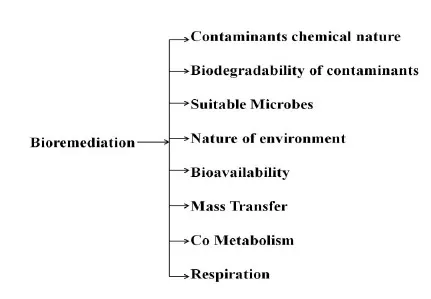
Factors affecting the bioremediation process.
2. Types of Bioremediation
Bioremediation has been categorized into ex-situ and in situ based on the location of waste materials treatment [17, 18]. In situ bioremediation helps in the treatment of waste material at the site of its origin. Ex-situ bioremediation facilitates the elimination of waste material from the site ...
Table of contents
- Welcome
- Table of Content
- Title
- BENTHAM SCIENCE PUBLISHERS LTD.
- FOREWORD
- PREFACE
- List of Contributors
- Bioremediation of Hydrocarbons and Xenobiotic Compound
- Bioremediation of Heavy Metal Contaminated Sites
- Bioremediation of Radioactive Contaminants/ Radioactive Metals
- Microbial Aided Bioremediation and Sources of Biomedical Waste
- Electronic Waste Management: An Emerging Challenge to the Environment
- Bioremediation Strategies for the Decontamination of Solid Waste Pollutants
- Application of “OMICs” Approaches in Bioremediation
- Management of Agriculture Waste: Bioconversion of Agro-Waste into Valued Products
Frequently asked questions
Yes, you can cancel anytime from the Subscription tab in your account settings on the Perlego website. Your subscription will stay active until the end of your current billing period. Learn how to cancel your subscription
No, books cannot be downloaded as external files, such as PDFs, for use outside of Perlego. However, you can download books within the Perlego app for offline reading on mobile or tablet. Learn how to download books offline
Perlego offers two plans: Essential and Complete
- Essential is ideal for learners and professionals who enjoy exploring a wide range of subjects. Access the Essential Library with 800,000+ trusted titles and best-sellers across business, personal growth, and the humanities. Includes unlimited reading time and Standard Read Aloud voice.
- Complete: Perfect for advanced learners and researchers needing full, unrestricted access. Unlock 1.5M+ books across hundreds of subjects, including academic and specialized titles. The Complete Plan also includes advanced features like Premium Read Aloud and Research Assistant.
We are an online textbook subscription service, where you can get access to an entire online library for less than the price of a single book per month. With over 1.5 million books across 990+ topics, we’ve got you covered! Learn about our mission
Look out for the read-aloud symbol on your next book to see if you can listen to it. The read-aloud tool reads text aloud for you, highlighting the text as it is being read. You can pause it, speed it up and slow it down. Learn more about Read Aloud
Yes! You can use the Perlego app on both iOS and Android devices to read anytime, anywhere — even offline. Perfect for commutes or when you’re on the go.
Please note we cannot support devices running on iOS 13 and Android 7 or earlier. Learn more about using the app
Please note we cannot support devices running on iOS 13 and Android 7 or earlier. Learn more about using the app
Yes, you can access Bioremediation: Challenges and Advancements by Manikant Tripathi,Durgesh Narain Singh, Manikant Tripathi, Durgesh Narain Singh in PDF and/or ePUB format, as well as other popular books in Biological Sciences & Microbiology. We have over 1.5 million books available in our catalogue for you to explore.