This technical reference covers information about modern nanocatalysts and their applications in organic syntheses, electrochemistry and nanotechnology. The objective of this book is to present a review of the development of nanocatalysts in the fields of organic synthesis and electroanalysis over the last few decades. It provides readers comprehensive, systematic and updated information about the relevant topics. The reader is introduced to nanocatalysts, with the following chapters delving into the different chemical reactions in which they are involved. The topics covered include: carbon-carbon coupling reactions, aryl and organic carbon hetero atom coupling reactions, oxidation-reduction reactions, photocatalysis, heterocyclic reactions and multicomponent catalysis. The concluding chapters cover applications of nanocatalysts in electrochemical synthesis and sensing. The thirteen chapters demonstrate the value of a variety of catalysts that are important in chemical engineering processes. Advanced Nanocatalysis for Organic Synthesis and Electroanalysis delivers a quick and accessible reference on advanced nanocatalysis for a broad range of readers which includes graduate, postgraduate and Ph. D. students of chemical engineering as well as faculty members, research and development (R&D) personnel working in the industrial chemistry sector.
eBook - ePub
Advanced Nanocatalysis for Organic Synthesis and Electroanalysis
- English
- ePUB (mobile friendly)
- Available on iOS & Android
eBook - ePub
Advanced Nanocatalysis for Organic Synthesis and Electroanalysis
About this book
Information
Recent Trends in Metal Nanoparticles (MNPs) Catalyzed Synthesis of Aza- and Oxa-Heterocycles
Tejas M. Dhameliya1, *, Rutvi J. Patel1, Normi D. Gajjar1, Rajvi H. Amin1, Kunjan B. Bodiwala1, Dipen K. Sureja1
1 L. M. College of Pharmacy, Navrangpura, Ahmedabad 380 009, Gujarat, India
Abstract
Most of the currently marketed and approved drugs possess nitrogen and oxygen-containing heterocycles in their scaffolds. The importance of metal nanoparticles (MNPs) catalyzed synthesis of such aza- and oxa-heterocycles should not be underestimated due to their versatile applications. Previously, we reported the decennary update on MNPs catalyzed synthesis of N- and O-containing heterocycles reported during 2010-2019. In the present work, attempts have been made to summarize the prospects to highlight those promising MNPs of worthy catalytic potential reported during the year, 2020. The present compilation shall provide the new thought processes to address the unmet synthetic needs for the construction of nitrogen and oxygen-containing heterocyclic scaffolds.
Keywords: Catalysis, Heterocycles, Metal nanoparticles, Nanocatalysis.
* Corresponding author Tejas M. Dhameliya: L. M. College of Pharmacy, Navrangpura, Ahmedabad 380 009, Gujarat, India; E-mail: [email protected]; [email protected] Tel: +91 79 2630 2746.
INTRODUCTION
The medicinal importance of heterocyclic scaffolds should not be underestimated due to their wide spectrum of biological activities against pathogenic mycobacterial [1-7], bacterial [8] fungal [9], and viral strains [10]. Among the United States food and drug administration (USFDA) approved drugs, nitrogen [11] and oxygen [12] containing heterocycles ranked among the predominant heterocycles. Organic synthetic chemistry has been considered as the bottleneck for the transformation of drug discovery through new avenues such as C-C, C-heteroatom bond formation, and C-H activation [13]. To achieve the synthesis of these scaffolds, the enriched medicinal chemists’ synthetic armory or toolbox [14] can be easily constructed using the green chemistry protocols such as reaction in water [15], ionic liquids [16-18], and nanoparticles (NPs) [19, 20].
SCOPE AND APPLICATIONS of NPs IN SYNTHESIS OF HETEROCYCLES
Nowadays, the avenue for the growth of nanotechnology has opened several new vistas in synthetic chemistry, peculiarly in the arena of synthesis of novel biodynamic heterocycles [21]. To catalyze the organic transformations, the catalytic assistance of MNPs has emerged as sustainable alternatives to conventional materials, as robust, high surface-area containing heterogeneous catalysts with the potential of extendable recyclability [22]. MNPs have attained significant importance in green chemistry developments in benign aqueous reaction media for the construction of heterocycles [23]. Despite some potential hazards [24], MNPs still have greater triumph in the field of material chemistry with the positive spirit of versatile reactions to catalyze the synthetic transformations. Plasmodic gold NPs (AuNPs) have also emerged as important NPs in the field of advanced energy, environmental and biomedical applications [25].
Recently, we have reviewed the synthesis of N- and O-containing heterocyclic scaffolds catalyzed by MNPs for the decade of 2010 to the end of 2019 [26]. In the present work, we have presented the most recent trends of MNPs catalyzed synthesis of aza and oxa-heterocyclic scaffolds reported by several research groups during 2020 (Fig. 1), which shall impart the inherent intuitions to the readers to design the synthetic strategy of desired heterocyclic scaffolds using NPs in catalytic amount along with the mechanistic insights of MNPs.
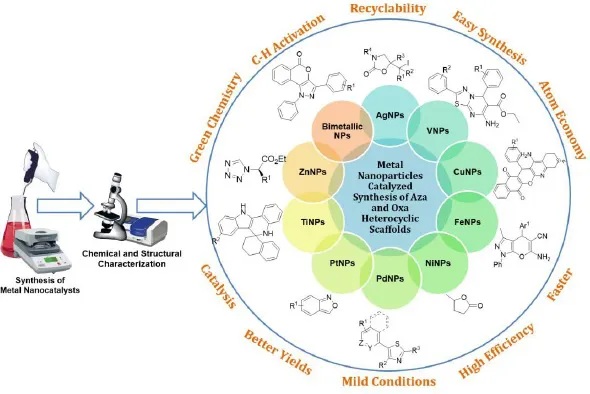
Schematic representation of NPs with their catalytic applications in the synthesis of aza and oxa heterocycles.
AgNPs Catalyzed Synthesis of Heterocycles
Differently shaped silver nanoparticles (AgNPs) have been recognized in several forms such as cubic, rods, wires, bars, pyramidal, prisms, flower-shaped, and spherical due to their unique morphological properties [27]. Zhang et al. have performed carboxylative cyclization of propargylic alcohols (1) with CO2 under atmospheric pressure using silver (0) nanoparticles [(Ag-rGO)] as catalyst and tetra butyl ammonium triazolide [N4444][Triz] (0.02 mmol) at 30 oC for 12 h (Scheme 1) [28]. Ag-rGO has been prepared from the reduction of graphene oxide and AgNO3 and has been characterized by X-ray diffraction (XRD), energy-dispersive XRD (EDX), scanning electron microscopy (SEM), transition electron microscopy (TEM), Fourier-transform infrared (FT-IR), and X-ray photoelectron spectroscopy (XPS). Ag-rGO catalysts show good stability and can be reused up to at least five times without obvious ...
Table of contents
- Welcome
- Table of Content
- Title
- BENTHAM SCIENCE PUBLISHERS LTD.
- PREFACE
- List of Contributors
- Principles and Concepts of Nanocatalysis
- Nanocatalytic Carbon-Carbon Coupling Reactions
- Nanocatalysis in Aryl Carbon-Hetero Atom Coupling Reactions: Special Emphasis on Copper Free Protocols
- Organic Carbon-Heteroatom Cross-Coupling Reactions Mediated by Supported Transition Metal-Based Catalysts
- Oxidation Reactions Using Nanomaterials as Heterogeneous Catalyst
- Nanocatalysis for Reduction/Hydrogenation Reactions
- Recent Trends in Metal Nanoparticles (MNPs) Catalyzed Synthesis of Aza- and Oxa-Heterocycles
- Nanomaterials-Based Photocatalytic Reactions
- Multicomponent Reactions Using Nanocatalysts
- Synthesis of Heterocycles Involving Nanomaterials as Heterogeneous Catalysts
- Role of Nanocatalyst in Electrochemical Sensing of Heavy Metal Ions
- Fundamentals and Advances in Transition Metal Oxide-Based Nano-Electrocatalyst for OER
- Need and Scope of Nanocatalysis for Synthesis and Sensing
Trusted by 375,005 students
Access to over 1.5 million titles for a fair monthly price.
Study more efficiently using our study tools.
Frequently asked questions
Yes, you can cancel anytime from the Subscription tab in your account settings on the Perlego website. Your subscription will stay active until the end of your current billing period. Learn how to cancel your subscription
No, books cannot be downloaded as external files, such as PDFs, for use outside of Perlego. However, you can download books within the Perlego app for offline reading on mobile or tablet. Learn how to download books offline
Perlego offers two plans: Essential and Complete
- Essential is ideal for learners and professionals who enjoy exploring a wide range of subjects. Access the Essential Library with 800,000+ trusted titles and best-sellers across business, personal growth, and the humanities. Includes unlimited reading time and Standard Read Aloud voice.
- Complete: Perfect for advanced learners and researchers needing full, unrestricted access. Unlock 1.5M+ books across hundreds of subjects, including academic and specialized titles. The Complete Plan also includes advanced features like Premium Read Aloud and Research Assistant.
We are an online textbook subscription service, where you can get access to an entire online library for less than the price of a single book per month. With over 1.5 million books across 990+ topics, we’ve got you covered! Learn about our mission
Look out for the read-aloud symbol on your next book to see if you can listen to it. The read-aloud tool reads text aloud for you, highlighting the text as it is being read. You can pause it, speed it up and slow it down. Learn more about Read Aloud
Yes! You can use the Perlego app on both iOS and Android devices to read anytime, anywhere — even offline. Perfect for commutes or when you’re on the go.
Please note we cannot support devices running on iOS 13 and Android 7 or earlier. Learn more about using the app
Please note we cannot support devices running on iOS 13 and Android 7 or earlier. Learn more about using the app
Yes, you can access Advanced Nanocatalysis for Organic Synthesis and Electroanalysis by Vijai K. Rai,Manorama Singh,Ankita Rai, Vijai K. Rai, Manorama Singh, Ankita Rai in PDF and/or ePUB format, as well as other popular books in Physical Sciences & Chemistry. We have over 1.5 million books available in our catalogue for you to explore.