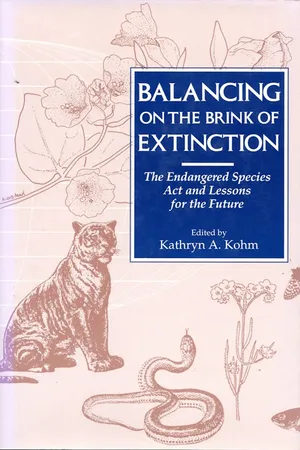
Balancing on the Brink of Extinction presents a comprehensive overview of the Endangered Species Act -- its conception, history, and potential for protecting the remaining endangered species.
eBook - ePub
Balancing on the Brink of Extinction
Endangered Species Act And Lessons For The Future
- English
- ePUB (mobile friendly)
- Available on iOS & Android
eBook - ePub
Balancing on the Brink of Extinction
Endangered Species Act And Lessons For The Future
About this book
Information
PART I
REFLECTIONS ON THE ACT
In the relations of man with the animals, with the flowers, with the objects of creation, there is a great ethic, scarcely perceived as yet, which will at length break forth into light and which will be the corollary and complement to human ethics.
—VICTOR HUGO
The first prerequisite of intelligent tinkering is to save all the pieces.
—ALDO LEOPOLD
THE ENDANGERED SPECIES ACT: LEGISLATIVE PERSPECTIVES ON A LIVING LAW
SEVENTEEN YEARS AGO, the Endangered Species Act of 1973 (ESA) became law. Its goal was unparalleled in all history. Our country resolved to put an end to the decades—indeed, centuries—of neglect that had resulted in the extinction of the passenger pigeon and the Carolina parakeet, as well as the near extinction of the bison and many other species with which we share this great land. If it were possible to avoid causing the extinction of another species, we resolved to do exactly that. It was my distinct pleasure to serve then as chairman of the Subcommittee on Fisheries and Wildlife Conservation and Environment of the House Committee on Merchant Marine and Fisheries and to introduce the bill, H.R. 37, which eventually became the Endangered Species Act.
When Congress passed the Endangered Species Act, it set a clear public policy that we would not be indifferent to the destruction of nature’s bounty. Our duty to stem that destruction derives from more than ethical considerations, though such considerations would be a sufficient basis for action. Living plants and animals have, through the centuries, developed a means of coping with disease, drought, predation, and myriad other threats. Understanding how they do so enables us to improve the pest and drought resistance of our crops, discover new medicines for the conquest of disease, and make other advances vital to our welfare. Living wild species are like a library of books still unread. Our heedless destruction of them is akin to burning that library without ever having read its books. The Endangered Species Act is the means by which we seek to avoid complicity in that senseless destruction.
Some people in 1973, and unfortunately still some today, belittle the goals of this great act by belittling the species it seeks to protect. How easy it is to dismiss the protection of a fish, a mollusk, even a plant, as a frivolity, an example of foolish environmental excess. But who will belittle the lowly mold from which the wonder drug penicillin was discovered? Who will belittle the rosy periwinkle, a species of African violet? Had it been allowed to become extinct, we would be without the drug that has made it possible for most victims of childhood leukemia to survive that dread disease. Preventing the extinction of our fellow creatures is neither frivolous nor foolish. It is the means by which we keep intact the great storehouse of natural treasures that make the progress of medicine, agriculture, science, and human life itself possible.
The Endangered Species Act, like our United States Constitution, was written as a flexible document, but durable enough to withstand the evolutionary alterations that have since occurred. Yet in 1978 the ESA, belittled and nearly eradicated, withstood harsh attacks through negotiations between environmentalists and industry. The construction of the Tellico Dam project in the Tennessee Valley Authority (TVA) system was near completion when in 1977 it was halted because of a rare fish called the snail darter. Before its construction, the dam had repeatedly been the subject of attack from the area’s property owners concerned about the impact of the dam on property values and actual land possession. The 1973 discovery of the rare snail darter in waters of the Tellico project, and its subsequent listing as an endangered species, resulted in litigation to stop construction. In January 1977, the Sixth Circuit U.S. Court of Appeals upheld the operation of the act and halted dam construction. The Tellico developers, outraged that their project could be ended because of a conflict with an endangered species, appealed the case to the United States Supreme Court. After much deliberation, the court upheld the lower court decision in June 1978. The Supreme Court’s ruling sparked a major assault on the very heart of the Endangered Species Act.
Spearheaded by congressional leaders from the Tennessee delegation, the industry sought to eliminate Section 7 of the act, which requires federal agencies to take the necessary steps to prevent any destruction of habitat of an endangered species. The elimination of Section 7 would have gutted the effective protective mechanism of the act. Fortunately, a compromise was reached to create an independent board and an administrative procedure to resolve conflicts between federal projects and endangered species habitat. The first decision by the board was the Tellico Dam project and, once again, the project was put to rest. But not forever.
In 1979, over my objections and those of others intent on preserving the integrity of the ESA, Congress passed a measure to continue construction of the Tellico Dam project. The dam’s proponents made an end run around the act by attaching a rider to a House energy and water appropriations bill. Despite considerable opposition to this legislatively created exception to the act, the Senate narrowly voted to continue the project after the snail darters were removed to nearby waters.
In fifteen years, we have learned it is possible to reverse the road to extinction. In 1973, the symbol of our nation, the bald eagle, was en route to extinction because the pesticide DDT had so poisoned its environment that the eagle could no longer lay hatchable eggs. When the government proposed to ban DDT, cotton farmers, citrus growers, and countless others rushed to tell us they could not possibly stay in business without DDT. The sky did not fall, we still have strong cotton and citrus industries, and the bald eagle is well on the road to recovery, aided by active programs of protection and restoration under the authority of the Endangered Species Act.
Other travelers on the road to extinction have turned around and begun the road to recovery. More whooping cranes fly south across the U.S.—Canadian border each fall and return north each spring than at any time in the past half century. Added insurance for the survival of that species has been purchased in the form of a new population established by the ingenious method of putting whooper eggs into the nests of sandhill cranes. Similar intensive management efforts aided by the Endangered Species Act have made possible the reintroduction of the peregrine falcon into the eastern United States, from which it had once been completely extirpated. The American alligator, once decimated throughout the South by poachers supplying illegal leather markets, has rebounded dramatically. It is no longer classified as endangered. Neither is the black pelican in the Southeast, where pesticide poisoning once drove it to the brink of extinction.
Behind these success stories and others like them lies a truth too seldom recognized. From fifteen years of experience with the Endangered Species Act, we have learned that it is almost always possible to conserve endangered species—and thereby promote our long-term welfare—without significantly harming our short-term interests. The number of truly irreconcilable conflicts between endangered species and worthy development projects is astonishingly small. So too is it possible to adjust the ways in which we do business to benefit endangered species without harming our business. The recent effort to reduce the drowning of endangered sea turtles in the shrimp fishery is no exception. Turtle-excluder devices, four or five varieties of which have been developed by fishermen themselves, offer a means of giving essential protection to several imperiled species without harming the shrimp industry. They save turtles, and they catch shrimp. They are a positive solution to a serious environmental problem, a solution that can benefit both the environment and the shrimp industry. All that is needed is the will to make the transition to their use, just as our farmers made the transition from DDT to less hazardous pesticides not so many years ago. Farmers who had used DDT all their lives were understandably reluctant to give it up when its hazards became known. But once they did, the miraculous recovery of the bald eagle, the symbol of the nation, resulted.
Though many great successes have been achieved under the Endangered Species Act, other efforts have ended in disappointment or failure. On June 16, 1987, the last dusky seaside sparrow, a songbird of Florida’s Atlantic coastal marshes, died in captivity. Across the continent, in California, the Palos Verdes blue butterfly has vanished. The California condor and the black-footed ferret, two species that were targets of rescue efforts even before the Endangered Species Act was passed, no longer survive in the wild, though captive populations of each may lead to their eventual reintroduction.
Thus while the Endangered Species Act has enabled us to make great progress in protecting many species, the problem to which it is directed remains very much with us. Each day, somewhere in the world, a desperate drama of survival takes place with little notice and little fanfare, but with vital consequences for our future. Despite our efforts, the world continues to experience an alarming, and accelerating, loss of its wild plant and animal species. Scientists believe that never, in all of human history, has the rate of extinction been so rapid as it is today. Human activity may be wiping out yet another species every day, whereas perhaps only one species a century disappears through natural causes.
The Endangered Species Act commits us to make our very best efforts to stem these unprecedented and irreversible losses. Today, slightly more than a thousand species enjoy the nominal protection of the Endangered Species Act. Somewhat more than half of these occur in the United States and its territories; the remainder are found entirely outside U.S. borders. The number of species from within the United States that have been identified as deserving the act’s protection, but are not yet listed for protection, exceeds a thousand—twice the number of species currently listed. Most of the species in danger of extinction will wait years, perhaps decades, before they are listed and protected under the act. In a time of deficit reduction, Congress simply has not made available the resources necessary even to list these species formally for protection, much less carry out the action necessary to ensure their survival and recovery. For species already listed, the nominal protection afforded by that listing may be all that the species receives. Recovery plans have thus far been prepared for less than half the listed species, and most of these plans are yet to be implemented.
In the years since the Endangered Species Act became law, we have learned that the problem it seeks to solve is far more serious and affects far more species than previously understood. At the same time, however, we have also learned that the reasons for preventing the extinction of other species are even more compelling. The discovery, within that short period, of the principles of biotechnology have added an urgent new reason to protect the genetic diversity of nature. Suddenly we have learned how to harness the unique genetic attributes of one organism and implant them in another. This discovery has opened the possibility for advances in agriculture and medicine undreamed of two decades ago. But the raw material for this potential revolution in human welfare, bestowed upon us by nature’s great diversity, is threatened by our mindless destruction of its diversity. Herman Melville’s classic observation that “there is no folly of the beasts of the earth which is not infinitely outdone by the madness of men” aptly describes our willingness to countenance the destruction of yet another species, while its very peculiarity may hold the key to advances in human welfare.
To fulfill the commitment Congress made in 1973, we need to reinvigorate the nation’s endangered species program. In particular, we need to provide it with the resources necessary to carry out its basic objectives. The administration that assumed office in January 1989 could make no clearer signal of its commitment to an improved environment than by seeking the expanded resources necessary to carry out the Endangered Species Act.
THE POWER AND POTENTIAL OF THE ACT
THE ENDANGERED SPECIES ACT (ESA) became law in December 1973; I had been named director of the U.S. Fish and Wildlife Service two months before. Thus, this remarkable legislation and I have had a long association. This retrospective assessment of one of the most powerful environmental laws of the century is that of a nonlawyer who,...
Table of contents
- ABOUT ISLAND PRESS
- Title Page
- Copyright Page
- ACKNOWLEDGMENTS
- Table of Contents
- INTRODUCTION
- THE ACT’S HISTORY AND FRAMEWORK
- PART I - REFLECTIONS ON THE ACT
- PART II - COMPONENTS OF THE FEDERAL ENDANGERED SPECIES PROGRAM
- PART III - IMPLEMENTATION CHALLENGES
- PART IV - CONSERVING BIODIVERSITY
- INDEX
- ABOUT THE CONTRIBUTORS
- ALSO AVAILABLE FROM ISLAND PRESS
- ISLAND PRESS BOARD OF DIRECTORS
Trusted by 375,005 students
Access to over 1.5 million titles for a fair monthly price.
Study more efficiently using our study tools.
Frequently asked questions
Yes, you can cancel anytime from the Subscription tab in your account settings on the Perlego website. Your subscription will stay active until the end of your current billing period. Learn how to cancel your subscription
No, books cannot be downloaded as external files, such as PDFs, for use outside of Perlego. However, you can download books within the Perlego app for offline reading on mobile or tablet. Learn how to download books offline
Perlego offers two plans: Essential and Complete
- Essential is ideal for learners and professionals who enjoy exploring a wide range of subjects. Access the Essential Library with 800,000+ trusted titles and best-sellers across business, personal growth, and the humanities. Includes unlimited reading time and Standard Read Aloud voice.
- Complete: Perfect for advanced learners and researchers needing full, unrestricted access. Unlock 1.5M+ books across hundreds of subjects, including academic and specialized titles. The Complete Plan also includes advanced features like Premium Read Aloud and Research Assistant.
We are an online textbook subscription service, where you can get access to an entire online library for less than the price of a single book per month. With over 1.5 million books across 990+ topics, we’ve got you covered! Learn about our mission
Look out for the read-aloud symbol on your next book to see if you can listen to it. The read-aloud tool reads text aloud for you, highlighting the text as it is being read. You can pause it, speed it up and slow it down. Learn more about Read Aloud
Yes! You can use the Perlego app on both iOS and Android devices to read anytime, anywhere — even offline. Perfect for commutes or when you’re on the go.
Please note we cannot support devices running on iOS 13 and Android 7 or earlier. Learn more about using the app
Please note we cannot support devices running on iOS 13 and Android 7 or earlier. Learn more about using the app
Yes, you can access Balancing on the Brink of Extinction by Kathryn A. Kohm in PDF and/or ePUB format, as well as other popular books in Biological Sciences & Public Policy. We have over 1.5 million books available in our catalogue for you to explore.