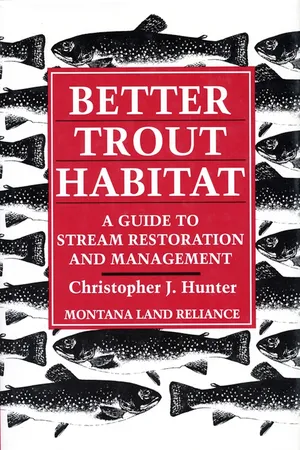
Better Trout Habitat explains the physical, chemical, and biological needs of trout, and shows how climate, geology, vegetation, and flowing water all help to create trout habitat.
eBook - ePub
Better Trout Habitat
A Guide To Stream Restoration And Management
- English
- ePUB (mobile friendly)
- Available on iOS & Android
eBook - ePub
Better Trout Habitat
A Guide To Stream Restoration And Management
About this book
Information
Chapter 1
STREAM RESTORATION: CURRENT INTEREST AND HISTORICAL PERSPECTIVE
THE sport of trout fishing is growing and it is growing fast. By the year 2000, there will be 10 million trout anglers in North America. Many of them will simply take up rod and reel to escape the pressures of their daily lives and seek the solitude they expect trout fishing to offer.
Thoreau said that many a man went fishing all of his life without ever realizing that it was not fish he was after. Modern surveys of trout anglers are showing that Thoreau was at least half right. Trout anglers are on an outdoor quest to lose themselves in the scenery and catch a wild trout in the process. Unfortunately, the number of streams capable of supporting wild trout—trout that are actually products of a natural stream system—is dwindling.
Sadly, we are all to blame. In too many places the cost of economic prosperity has been the destruction of trout habitat. With that destruction go the natural environments trout anglers find such fine complements to their fishing trips.
Our domestic and industrial wastes have polluted streams and eliminated wild-trout populations. The evidence can be found in West Virginia’s Cranberry River, Oregon’s Camp Creek, Pennsylvania’s West Valley Creek, and other streams described in this book. Even the seemingly innocent removal of streamside vegetation by livestock, farming, logging, mining, and urban development has led to wide, shallow, and warm troutless streams.
Straightening stream channels, a surprisingly common flood-control practice, has caused water to gouge wide, shallow channels, resulting in related changes in the streamside vegetation. Perhaps such streams in now-barren landscapes could still be stocked with hatchery trout, but, in the end, it would not take a lifetime to discover that wasn’t what one was after.
The growing population and increased interest in trout fishing, coupled with decreasing trout habitat, have heaped new pressures on fish and game agencies to provide quality trout-fishing opportunities. All of the fish and game agencies of trout-producing states have, at some time, developed programs of planting hatchery-reared trout to meet the increasing demand for trout fishing.
In 1983 approximately 54 million catchable-sized trout were stocked in 43 states at a cost of $36 million. At the same time, our stream resources were dwindling, and by 1988 the U.S. General Accounting Office’s study of streamside management on public rangelands showed that in some states as much as 90 percent of federally managed streams were in a degraded condition.
The easily managed stocked fishery allows many anglers to catch and keep trout that are genetically programmed to die quickly in the wild from waters that need not be capable of supporting naturally reproducing wild-trout populations. But for many anglers, hatchery-reared trout are a poor substitute for wild trout. A hatchery trout doesn’t look or fight as well as a wild trout, and, for growing numbers of anglers, much of the mystery and beauty of trout fishing is lost when the quarry is just another mass-produced product.
RESTORATION—AN ALTERNATIVE SOLUTION
One could look at it as a simple problem of supply and demand, but at the heart of the movement to restore degraded trout streams is a desire to set things right. As you shall see, stream restoration is not a simple process. It is often difficult and costly, but the benefits—such as gaining a deeper understanding and appreciation of the complex relationships among the trout, the stream, and the valley through which it flows—go far beyond improved trout fishing. There is also a sense of satisfaction in returning to the land some of its former productivity.
Stream restorationists invariably confront a wide range of trout-habitat problems linked to poor land use within the drainage. For instance, soon after an eastern Pennsylvania chapter of Trout Unlimited (TU) looked into restoring a local stream’s trout habitat, the members realized that new housing and industrial developments posed a larger problem to the stream than did the one channelized section that originally sparked their interest.
The new construction introduced large sediment loads, removed riparian vegetation, and led to increased water temperatures in the stream and its trout-spawning and trout-rearing tributaries. That, in turn, began to instill a new concern within the TU chapter about the potential of chemical spills in light-industrial areas and the possibility of toxic substances in urban storm-water runoff, which find their way into the stream.
With that experience behind its membership, today TU’s Valley Forge chapter is devoted to working with city councils, land developers, and the state Department of Transportation to ensure that as land use changes, the character of the stream and its tributaries remains relatively unaltered.
A more extensive example of the effect land use has on trout habitat can be found along the John Day River, a famous central Oregon tributary to the Columbia River, which provides important spawning and rearing habitat for steelhead trout and chinook salmon.
Prior to 1964 the John Day River gracefully meandered down its valley, and bridges spanned the river along its course. Adding to the picturesque scene were hay meadows scattered along the river’s rich floodplain, and willows and cottonwoods that hugged the stable stream banks. Because the shallow, streamside groundwater aquifer was near the surface, the hay meadows required little or no irrigation. All that changed in 1964 when a major flood occurred.
The flood’s extremely high, fast flows eroded stream banks, threatening a number of hay meadows. To assure that it wouldn’t happen again, the U.S. Army Corps of Engineers undertook a significant stream-rehabilitation project.
As an erosion- and flood-control measure, the Army Corps straightened a section of the John Day River to allow the water to move through the valley more quickly during high flows. But, by any measure, the result was a disaster. The increased water velocities in the straightened reach actually increased the erosive power of the stream, and the John Day River began to cut away at both bed and bank, severely degrading the stream’s steelhead and chinook habitats.
As the channel became wider and shallower, the streamside groundwater level dropped, and the ranchers in the area had to step up the irrigation of their hay meadows. At first, that didn’t seem to be such a bad trade-off because with the straightened channel the ranchers had developed larger, contiguous hay meadows.
When the highway was rebuilt, it was constructed in a straight line down the valley, nearly parallel to the straightened river. Traffic moved faster, the river moved faster, and tractors moved faster in the fields. However, somewhere in these fast lanes someone realized that to keep everything moving along, the river had to remain in its straightened channel or the new hay meadows and the new highway would be ruined. That realization cost some landowners $10,000 to $15,000 per year for riprap and channel maintenance. From the comforting distance of one generation, the damages and costs associated with the 1964 flood pale in comparison to those that resulted from the stream-rehabilitation project. Spawning populations of steelhead and chinook have been greatly reduced.
These two examples illustrate how important streamside, or riparian, vegetation is to the health of the stream. Riparian vegetation is a critical aspect of trout habitat. The vegetation influences stream-channel shape, reduces erosion, and contributes to trout habitat when tree branches and logs are washed into the channel. The vegetation also is an important source of organic material, such as leaves, twigs, and berries, that eventually becomes food for the stream’s many life forms.
HISTORICAL PERSPECTIVE
For most of this century, the desire to provide sport-fishing opportunities through habitat restoration has experienced a series of fits and starts. In the United States, the first real commitment to trout-habitat restoration emerged in the early 1930s, a decade marked by a renewed enthusiasm for wildlife conservation and preservation.
In 1934 the U.S. Bureau of Sport Fisheries (USBF) was about to undertake the first nationwide program of stream surveys and habitat improvements. H.S. Davis, chief of USBF, addressed the 1934 annual meeting of the American Fisheries Society and actually attempted to douse the swell of enthusiasm by saying that he felt the small dams and other devices used to create shelter for trout were being overdone. “In some instances,” Davis told the crowd, “hardly a foot of stream has been left in its original condition.... Of what benefit to a stream is it to construct cover for many times the number of fish the stream [food resources] can support?”
Even in the face of Davis’s reservations, in 1934 USBF moved to enhance a number of national forest streams. By activating the tremendous labor resources available during an era of national economic depression, an incredible number of in-stream habitat structures were built between 1933 through 1937. For example, from 1933 through 1935, a total of 31,084 stream structures were constructed on 406 mountain streams. Many of the dams, which created pools, and deflectors, which forced streams to follow a more meandering flow, are still in place.
Unfortunately, durability is not the best measure of a successful habitat restoration program. Both pre- and post-construction surveys of trout, aquatic insects, and physical habitat components, which are necessary to evaluate the success of any habitat management program, were sorely limited. But it should be remembered that the fishery biologists of the thirties were forging new ground and had little more than their own enthusiasm to guide them.
In 1952, the U.S.D.A. Forest Service published its second Fish Stream Improvement Handbook. The opening paragraphs indicate that important lessons were learned from mistakes made in the 1930s:
Many mistakes were made in the earlier stages of the work, but much has been learned as a result. At first, considerable emphasis was placed on a large variety of stream improvement structures. Stream improvement was looked upon by some as a cure-all for the environmental ills of a trout stream. Experience showed that only a relatively few types of simply designed structures were necessary and that stream improvement fell far short of making a desirable stream habitat if destructive forces were at work in the watershed.
Unless stream improvements are carefully planned much damage may result. One of the first things learned in the earlier stream improvement work was that it could be easily overdone.
In addition to a description of structural devices, the handbook notes that streamside conservation is one of the best, and least expensive, methods of stream improvement. The handbook is an extremely enlightened and important divergence from earlier volumes, particularly in its description of how streamside vegetation reduces erosion, provides cover for trout, is a source of terrestrial insects, and helps to reduce water temperatures by providing shade.
The Trout-Stream Habitat Revolution
A great deal of interest in trout-stream improvement was piqued by the 1967 publication of Ray J. White and O.M. Brynildson’s Guidelines for Management of Trout Stream Habitat in Wisconsin. The bulletin quickly became the manifesto of the trout-habitat improvement revolution.
White and Brynildson’s contribution to the literature was a quantum leap for trout-stream management. They began by stating that trout-stream habitat improvement in Wisconsin was largely a task of restoration and went on to sternly warn against overmanage-ment of unspoiled waters. It was White and Brynildson’s radical idea that the remaining unspoiled waters in Wisconsin were highly valuable aesthetically and that management efforts should be directed toward preserving these streams and their surroundings.
When the discussion addressed provision of more cover and increased living space for trout, White and Brynildson began by describing techniques to protect and manage bank vegetation before they described more traditional structural techniques, such as dams, wall-like stream-flow deflectors, and riprap.
This 1967 publication made several significant contributions to the literature, but perhaps its most important contribution is its emphasis on preproject planning. White and Brynildson’s work has greatly broadened the scope of stream habitat improvement because they made it obvious that professional fishery biologists need to confer with professionals of other disciplines, such as vegetation specialists and stream geomorphologists, to properly plan and execute a habitat improvement project.
TWENTY YEARS LATER: INTEREST AGAIN ABOUNDS
In 1987 TU and U.S.D.A. Forest Service entered an agreement to help anglers catch more trout and salmon by improving salmonid habitat in the national forests. The agreement is a reflection of the burgeoning interest in stream restoration shared not only by many conservation organizations, state fish and game, and federal land-management agencies but also by private landowners who want to protect and enhance their trout fisheries.
Although the role of private landowners in t...
Table of contents
- ABOUT ISLAND PRESS
- ABOUT MONTANA LAND RELIANCE
- SPONSORS
- Title Page
- Copyright Page
- Dedication
- Table of Contents
- FOREWORD
- PREFACE
- ACKNOWLEDGMENTS
- INTRODUCTION
- Chapter 1 - STREAM RESTORATION: CURRENT INTEREST AND HISTORICAL PERSPECTIVE
- Chapters 2 - THE TROUT AND THE STREAM
- Chapter 3 - HOW THE STREAM AND ITS VALLEY MAKE TROUT HABITAT
- Chapter 4 - INVENTORY, MONITORING, AND EVALUATION
- Chapter 5 - DETERMINING LIMITING FACTORS, DESIGNING, AND INITIATING THE PROJECT
- Chapter 6 - THE ROLE AND FUNCTION OF IN-STREAM STRUCTURES
- Chapter 7 - STREAMS AFFECTED BY AGRICULTURE
- Chapter 8 - FORESTED STREAMS
- Chapter 9 - URBAN STREAMS
- Chapter 10 - A MISSION TO SET THINGS RIGHT
- GLOSSARY
- SPONSORS
- ABOUT THE AUTHOR
- ABOUT THE EDITOR
- ABOUT THE ILLUSTRATOR
- INDEX
- ALSO AVAILABLE FROM ISLAND PRESS
- ISLAND PRESS BOARD OF DIRECTORS
Trusted by 375,005 students
Access to over 1.5 million titles for a fair monthly price.
Study more efficiently using our study tools.
Frequently asked questions
Yes, you can cancel anytime from the Subscription tab in your account settings on the Perlego website. Your subscription will stay active until the end of your current billing period. Learn how to cancel your subscription
No, books cannot be downloaded as external files, such as PDFs, for use outside of Perlego. However, you can download books within the Perlego app for offline reading on mobile or tablet. Learn how to download books offline
Perlego offers two plans: Essential and Complete
- Essential is ideal for learners and professionals who enjoy exploring a wide range of subjects. Access the Essential Library with 800,000+ trusted titles and best-sellers across business, personal growth, and the humanities. Includes unlimited reading time and Standard Read Aloud voice.
- Complete: Perfect for advanced learners and researchers needing full, unrestricted access. Unlock 1.5M+ books across hundreds of subjects, including academic and specialized titles. The Complete Plan also includes advanced features like Premium Read Aloud and Research Assistant.
We are an online textbook subscription service, where you can get access to an entire online library for less than the price of a single book per month. With over 1.5 million books across 990+ topics, we’ve got you covered! Learn about our mission
Look out for the read-aloud symbol on your next book to see if you can listen to it. The read-aloud tool reads text aloud for you, highlighting the text as it is being read. You can pause it, speed it up and slow it down. Learn more about Read Aloud
Yes! You can use the Perlego app on both iOS and Android devices to read anytime, anywhere — even offline. Perfect for commutes or when you’re on the go.
Please note we cannot support devices running on iOS 13 and Android 7 or earlier. Learn more about using the app
Please note we cannot support devices running on iOS 13 and Android 7 or earlier. Learn more about using the app
Yes, you can access Better Trout Habitat by Christopher J. Montana Land Reliance,Christopher J. Hunter in PDF and/or ePUB format, as well as other popular books in Biological Sciences & Ecosystems & Habitats. We have over 1.5 million books available in our catalogue for you to explore.