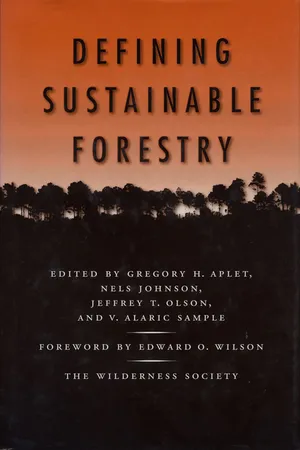
Before the transition in forestry can be made from conventional approaches of the past century to the ecosystem approach of the next, a consensus must be reached on the meaning of "sustainable forestry." Defining Sustainable Forestry presents the results of a national conference convened by The Wilderness Society, American Forests, and the World Resources Institute to help establish a common framework upon which to guide the future development of forestry.
eBook - ePub
Defining Sustainable Forestry
- English
- ePUB (mobile friendly)
- Available on iOS & Android
eBook - ePub
Defining Sustainable Forestry
About this book
Information
PART I

Sustain What? Exploring the Objectives of Sustainable Forestry
Introduction
Nels Johnson
World Resources Institute
World Resources Institute

During the past decade, sustainability has become the central concept invoked in the pursuit of redefining human relationships with nature. To be sustainable is the goal of a growing list of human activities that place demands on the environment—agriculture, fisheries, energy production, economic development, and, certainly not least, forestry. If only we could do these things right—sustainably, that is—society could get what it needs from the environment now while leaving nature’s diversity and productivity unimpaired for future needs. Virtually everyone is for sustainability in much the same way that nearly everyone is for justice. The notion of sustainability is attractive, in part, because it seems to offer a middle ground between choosing extremes: ill-informed, inefficient, short-term, and unsustainable consumption on the one hand and no consumption at all (sustainable for the environment perhaps but not for humans) on the other.
Earlier in this century, spurred in part by the destructive practices of the timber barons, American foresters developed sustained timber yield principles based on the “scientific forestry” first developed in Europe. For decades, these principles have been at the core of forestry education and silvicultural practice around the world. Nevertheless, from the island of Borneo to the Pacific Northwest, new debates on forest sustainability have been fueled by more sophisticated ecological and social research and by widespread evidence of the negative environmental effects of logging in natural forests. Although the most damaging evidence against current forest practices comes from areas where sustained timber yield principles have not been seriously applied, the new pursuit of sustainability is pushing aside earlier conceptions of sustainable forestry. It is no longer enough simply to sustain timber yields if it is ultimately the forest that one wants to sustain.
If sustained yield is no longer considered sufficient to sustain forests, what will replace it? For what and for whom is forestry to be sustainable? Since forests embody many things—products, services, and values—for both humans and nature, which things do we wish to sustain and why? It is here that the concept of sustainability, as it is applied to forestry, begins to encounter problems. Can forests sustain demands for more housing, more paper, and more recreation, while simultaneously maintaining biological diversity, supplying quality water, moderating climate, and supporting local and regional economies? Upon closer examination, sustainable forestry is about making choices, not avoiding them. Indeed, as the prominent tropical forester Duncan Poore noted, it is questionable whether one universal definition of sustainable management is useful (Poore 1989). Sustainability is in the eye of the beholder. The reality of sustainable forestry demands choosing what is to be sustained—and for whom—and moving in that direction sooner rather than later.
In this section, the authors consider some of the choices that will have to be made in developing new paradigms for the management of forests and the human uses of them. If there are no universal ideal definitions of sustainability, these authors suggest that there are certainly more optimal definitions than today’s prevalent practices.
Reed Noss approaches forests and forestry with a landscape ecologist’s eye for space (large) and time (long). Such perspectives can be discomforting to those whose views are shaped by concerns that are both shorter in time and less expansive in area. Noss begins by stating that trying to determine what sustainable forestry is answers the wrong question. The real issue is to find ways to sustain forests, not forestry; they are not the same thing. Forestry, he maintains, is not enough to sustain forests, with its preoccupation on the continuous production of wood and other forest products. Forests are worth more than the sum of those products and more even than the added sum of such “environmental services” as climate regulation, water supply, pest control, gene banks, or recreation. “Forests,” states Noss, “are valuable and must be sustained for their own sake.”
Such views are likely to strike many as reflecting a strong biocentrist bias, to which Noss would readily agree. In a world of climate change, ozone depletion, human population growth, and pestilence, however, biodiversity is likely to be the ultimate key to sustainability, including that of the human species. A landscape with a great diversity of habitats, species, and genotypes is more adaptable to change than is a monoculture. In essence, it is sustainability that depends on biodiversity, not the other way around.
Like many others who have seriously contemplated the subject, Noss believes that sustainability is a multifaceted and relative concept. In the end, he thinks that it must be defined in relation to two elements: the time period and the proportion of ecosystem structure, function, and composition that is maintained. The path to sustainable forests can only be found by first understanding what he calls the “trajectories of impoverishment.” For example, biotic forest impoverishment has been fueled by replacing older forests with younger forests; replacing complex, uneven-aged stands with simplified, even-aged stands; and reducing large forest patches to ever smaller forest patches.
To reverse these trajectories is to move toward (ecologists never move back) sustaining forests. We should thus strive for older forests, growing in larger and more well-connected patches of structurally complex stands where prescribed fires are a major management tool and roads are less common. These transitions will allow the maintenance and recovery of biodiversity and the restoration of forests where they have been seriously degraded.
With five and a half billion people on earth (and growing), Noss acknowledges the need for land management—we simply have no choice. The most important question to ask with respect to sustainability, he asserts, is about making choices: What do we wish to sustain and why? What goals do we wish to attain with our land management programs, and what values are behind those goals? These fundamental questions must be answered before we can define sustainable forestry.
Hal Salwasser’s conceptual approach to sustainability borrows from the “fire triangle” familiar to most forest managers, in which fuel, oxygen, and heat are necessary to sustain a fire; take away any one element, and the fire will go out. Echoing remarks made by Gary Hartshorn at the outset of the workshop, Salwasser and his coauthors note that “to conserve ecosystems, regardless of the specific goals and objectives, management must be ecologically sound, economically viable, and socially responsible.” A failure to devote adequate attention to any one of the three legs of the triangle will result in a system that cannot be sustained.
Salwasser et al. also note that although much of the debate over sustainable forestry has addressed the necessary change in focus from stands to landscapes, real sustainability must account for even larger scales up to and including the global environment. If we have instituted sustainable forestry in our own backyard—but have done so through exporting the ecological effects of our demands for forest products to nations with fewer environmental safeguards on timber harvesting—have we truly achieved sustainability? With the recognition that we live in a global economic market as well as a global environment, we have no choice but to consider the consequences of our actions at multiple scales, including the globe.
Finally, Salwasser et al. suggest some basic principles of sustainable forest management that define the approach being taken by the USDA Forest Service in the management of the National Forest System. The essence of the new approach is to conserve biologically diverse and productive landscapes within local, regional, national, and global contexts. Citing the chief of the Forest Service and noted conservationist Aldo Leopold, they conclude that sustainable forestry will require “renewed vigor in pursuit of the ideals of conservation, land stewardship, and multiple-use management” and call for renewed “individual responsibility and the sense of community among the people, land, and resources.”
What motivates people and institutions to seek and accept change, particularly changes that may affect their livelihoods and futures? George Honadle reflects on the experience in the tropics with changing behavior away from overexploitative resource use to the more sustainable stewardship of forests.
Those involved in forest conservation in the tropics have addressed sustainability issues more directly and at an earlier date than have foresters in North America. In many tropical areas, conservation efforts that do not address local people’s needs or acknowledge their right to survival are doomed to failure. At the same time, many people’s livelihoods depend on the resources the forest provides beyond timber. Thus, the need to integrate human and societal needs to survive with actions to protect and conserve forest ecosystems has provided strong impetus for developing sustainable—or at least sustainable enough—forestry.
Despite the more widespread recognition of the need for sustainable forestry in the tropics, its practice continues to be extremely limited. The fundamental reason for this, Honadle believes, is that the problem has been oversimplified to one of inadequate information—“if only people knew what they were doing, they would stop!” In other words, the solution to unsustainable forest use is better conservation education. Honadle suggests that there is a wide gap between knowledge and behavior. The solution is most likely to be found by recognizing that people respond to incentives for behavior that enhance their chances for survival. Those incentives, not surprisingly, are created by a combination of economic market forces and bureaucratic policies, rules, and institutions.
Honadle’s analysis implies that reforming institutional structures and behaviors is perhaps the most important avenue for changing unsustainable forest uses. At the very least, all paths to a more sustainable forestry cross important institutional ground. Honadle identifies a set of three key institutional imperatives that will be essential to the transition to sustainable forestry, whatever its definition.
This first institutional imperative is what Honadle calls “institutional mapping.” This basically involves identifying all forestry-relevant institutions and developing, analyzing, and monitoring indicators of institutional performance on forest issues. Second is selective institutional strengthening with an emphasis on creating institutional checks and balances, promoting individual and community access to institutional processes, and favoring the development of training, protective, and monitoring functions of forestry-related institutions over exploitative functions. Last, more sustainable forestry will require institutional invention. As Honadle notes, “we use organizational mechanisms not because they are necessarily what we need, but because they are there.”
Honadle concludes with the identification of seven areas of concern for the promotion of sustainable forestry in North America. Some of these needs—a population policy, for example—are commonplace considerations in the tropics, but are rarely thought of in the North American context.
The recurrent theme throughout this section is the realization that there is no one perfect definition of sustainable forestry. Part of the reason for our present forest sustainability crisis is that we have trusted one version—sustained yield—for too long and to the exclusion of any alternatives. The solutions to achieving more sustainable forests will be diverse. Sustainable forestry is likely to remain a frustrating concept without more careful consideration of what we want to sustain, for whose benefit, and why.
REFERENCE
Poore, D. 1989. The sustainable management of natural forests: The issues. In No timber without trees: Sustainability in the tropical forest, eds. D. Poore, P. Burgess, J. Palmer, S. Peitbergen, and T. Synott. London: Earthscan Publications.
1
Sustainable Forestry or Sustainable Forests?
Reed F. Noss
College of Forestry, University of Idaho
College of Forestry, University of Idaho

Sustainability is the motherhood and apple pie of modern conservation. We invoke the concept in discussions of economic development, agriculture, forestry, fisheries, wildlife management, and general relationships between human beings and nature. Sustainability is a goal that no one, from the most determined of environmentalists to the most aggressive of developers, can oppose (at...
Table of contents
- About Island Press
- About The Wilderness Society
- Title Page
- Copyright Page
- Table of Contents
- FOREWORD - Forest Ecosystems: More Complex Than We Know
- INTRODUCTION - Defining Sustainable Forestry
- PART I - Sustain What? Exploring the Objectives of Sustainable Forestry
- PART II - Designing Sustainable Ecological Systems: A Regional Approach
- PART III - Social and Policy Considerations in Defining Sustainable Forestry
- CONCLUSION - Prospects for a Sustainable Future
- About the Contributors
- Index
- Island Press Board of Directors
Trusted by 375,005 students
Access to over 1.5 million titles for a fair monthly price.
Study more efficiently using our study tools.
Frequently asked questions
Yes, you can cancel anytime from the Subscription tab in your account settings on the Perlego website. Your subscription will stay active until the end of your current billing period. Learn how to cancel your subscription
No, books cannot be downloaded as external files, such as PDFs, for use outside of Perlego. However, you can download books within the Perlego app for offline reading on mobile or tablet. Learn how to download books offline
Perlego offers two plans: Essential and Complete
- Essential is ideal for learners and professionals who enjoy exploring a wide range of subjects. Access the Essential Library with 800,000+ trusted titles and best-sellers across business, personal growth, and the humanities. Includes unlimited reading time and Standard Read Aloud voice.
- Complete: Perfect for advanced learners and researchers needing full, unrestricted access. Unlock 1.5M+ books across hundreds of subjects, including academic and specialized titles. The Complete Plan also includes advanced features like Premium Read Aloud and Research Assistant.
We are an online textbook subscription service, where you can get access to an entire online library for less than the price of a single book per month. With over 1.5 million books across 990+ topics, we’ve got you covered! Learn about our mission
Look out for the read-aloud symbol on your next book to see if you can listen to it. The read-aloud tool reads text aloud for you, highlighting the text as it is being read. You can pause it, speed it up and slow it down. Learn more about Read Aloud
Yes! You can use the Perlego app on both iOS and Android devices to read anytime, anywhere — even offline. Perfect for commutes or when you’re on the go.
Please note we cannot support devices running on iOS 13 and Android 7 or earlier. Learn more about using the app
Please note we cannot support devices running on iOS 13 and Android 7 or earlier. Learn more about using the app
Yes, you can access Defining Sustainable Forestry by Greg Aplet, Nels Johnson, Jeffrey T. Olson, Al Sample, Greg Aplet,Nels Johnson,Jeffrey T. Olson,Al Sample in PDF and/or ePUB format, as well as other popular books in Biological Sciences & Botany. We have over 1.5 million books available in our catalogue for you to explore.