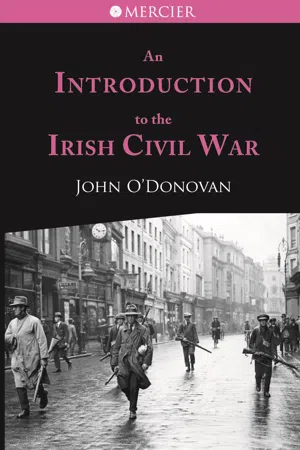
- 160 pages
- English
- ePUB (mobile friendly)
- Available on iOS & Android
eBook - ePub
About this book
During the Irish Civil War, events of late 1922 and early 1923 together with waves of 'dishonourable' killings created poisoned relations between Republicans and 'Free Staters' which would last for several generations. The most enduring of these controversies, a policy of summary executions carried out by the Provisional Government from November 1922, continues to surround the argument.
This book offers a fresh perspective on the causes, development and consequences of the Irish Civil War. Triggered by the signing of the Anglo-Treaty, there were those that would accept nothing less than complete Irish independence. Very few IRA commanders active in the field supported the Treaty and, as happens often in the dissection of civil wars, controversy over the conduct of both sides figures heavily within the text, where, at a local and national level, it left bitter legacies.
This book offers an overview of the war in all regions of Ireland.
Information
Phase 1
July – December 1922
With the noise of the shells raining on the Four Courts ringing in their ears, Republican IRA leaders met at the Clarence Hotel across the River Liffey. De Valera, Brugha, Lynch, Moylan, Deasy, P.J. Ruttledge and new chief of staff Maurice (‘Moss’) Twomey attended, along with offiers of the Western Division. The decision to support the Four Courts garrison was swiftly arrived at, after which Lynch, Deasy, Seán Moylan, Con Moylan, Twomey and Seán Culhane set out for Kingsbridge Station to catch a train for Mallow. On their way, they were halted by a squad of National Army troops under the command of Liam Tobin, placed under arrest, and taken to Wellington Barracks on Dublin’s South Circular Road. There Eoin O’Duffy questioned them before they were released and allowed continue their journey.
At the Four Courts, the shelling continued for two further days. On 30 June, the building caught fire and spread quickly to adjoining buildings. The Public Record Office, containing thousands of precious documents dating back to 1174, was destroyed in an explosion. O’Connor and the garrison surrendered and were lined up on the quay outside to be marched to Mountjoy Jail. On the way six, including O’Malley, escaped.
An impromptu coalition of Labour Party leader Thomas Johnson, lord mayor of Dublin Laurence O’Neill and the Catholic archbishop of Dublin Edward Byrne twice attempted in the first weeks of fighting to bring about a truce. On both occasions, their overtures were rejected by the Provisional Government, which had determined at a meeting on 1 July ‘that the attack on other Irregular [Republican] strongholds should be vigorously continued’. A further attempt by a large delegation of women from across the political divide led by Maud Gonne, Hannah Sheehy-Skeffington, Louie Bennett and Rosamund Jacob to mediate between Traynor and Griffith was rejected by the latter. Mulcahy was given de facto com-mand of the National Army, with Collins assuming the portfolio of Minster for Defence while continuing to act as commander-in-chief.
Following their escape from the Four Courts, Dublin Republican IRA members under the command of Oscar Traynor seized several buildings in Sackville Street, Parnell Street, and Capel Street. Other buildings were later taken overlooking Gardiner Street, Lower Abbey Street, and the ruins of the Customs House. Together these streets acted as the boundaries of a cordon in the north inner city. Traynor’s headquarters was in ‘The Block’ on Marlborough Street.
In the defence of this cordon, women played a promi-nent role. Constance Markievicz acted as a sniper from the roof of a building on Earl Street, Delia Larkin ferried ammunition to snipers on City Quay, and many members of Cumann na mBan (including Máire Comerford, Nora Connolly and her sister Ina) worked as nurses, drivers and messengers. In his memoirs O’Malley expressed his admiration for women practising their driving skills under heavy barrage: ‘[T]hey practised gear changes up and down streets, and back lanes until they felt themselves sufficiently skilled to act as despatch carriers’. Madge Clifford worked as a secretary to the Four Courts garrison, issuing proclamations and declarations. After the fall of the buildings, she escaped with O’Malley and continued working as his secretary.
Outside Dublin, Republicans mobilised to relieve Traynor. The South Dublin and Mid-Kildare brigades rallied in and around Blessington. O’Malley mobilised several brigades in Tipperary to join them. Together these units were to march on Dublin, their objective being the capture of the Provisional Government’s seat in the Royal College of Science on Merrion Street.
These plans failed, because on 2 July the National Army attacked Traynor’s positions in and around ‘The Block’. Although Republicans fought hard, for example around the Swan public house on York Street, many evacuated south across the Liffey. Those that remained surrendered outside the Hammam Hotel on 5 July. Controversially, Cathal Brugha was shot in the leg at some stage during this surrender; he died two days later. His death came as a shock to many in the Republican leadership, but it was not the only controversial episode during this period of fighting. National Army officers alleged that Republicans used the Red Cross flag as cover for military operations, including using nursing stations as military posts and having vehicles em- blazoned with the Red Cross flag and logo smuggling guns and ammunition out of the city.
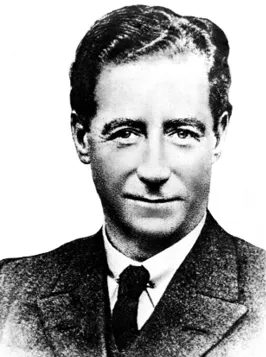
Cathal Brugha
From 7 to 10 July 1922 Republicans and National Army units fought across three counties to the south and west of Dublin: Kildare, Wicklow and Wexford. Sporadic fighting broke out in Kilkenny also.
A pause in the fighting followed. At the start of August, Republicans attempted to cut off communications between Dublin and the rest of the country via a series of attacks called ‘the night of the Bridges’. These attacks were foiled when a raid in Rathfarnham uncovered the plans. The following night 100 Republican soldiers were captured. Follow-up searches in Wicklow led to fifty-five more arrests. By the end of the month, another 310 Republicans had been captured in the city and county.
Once the initial fighting in Dublin had subsided, the focus on both sides switched to Munster. From July to September 1922, some of the most prolonged fighting of the war took place in the province. National Army forces from Dublin attacked from two directions. Units from Dublin and Kilkenny moved south to Waterford and west through Tipperary. At the other end of the province Brennan’s FWD combined with units travelling from Kildare, Leix and King’s County to battle for Limerick city before turning south and west towards Cork and Kerry. On the Republican side, Liam Lynch (who had succeeded Moss Twomey as chief of staff) moved GHQ from Dublin to Limerick shortly aft...
Table of contents
- Acknowledgements
- Introduction
- Phase 1 July – December 1922
- Phase 2 December 1922 – May 1923
- Controversy, Reprisal and Execution during the Civil War
- Biographies
- Bibliography
- About the Author
- Appendix
Trusted by 375,005 students
Access to over 1.5 million titles for a fair monthly price.
Study more efficiently using our study tools.
Frequently asked questions
Yes, you can cancel anytime from the Subscription tab in your account settings on the Perlego website. Your subscription will stay active until the end of your current billing period. Learn how to cancel your subscription
No, books cannot be downloaded as external files, such as PDFs, for use outside of Perlego. However, you can download books within the Perlego app for offline reading on mobile or tablet. Learn how to download books offline
Perlego offers two plans: Essential and Complete
- Essential is ideal for learners and professionals who enjoy exploring a wide range of subjects. Access the Essential Library with 800,000+ trusted titles and best-sellers across business, personal growth, and the humanities. Includes unlimited reading time and Standard Read Aloud voice.
- Complete: Perfect for advanced learners and researchers needing full, unrestricted access. Unlock 1.5M+ books across hundreds of subjects, including academic and specialized titles. The Complete Plan also includes advanced features like Premium Read Aloud and Research Assistant.
We are an online textbook subscription service, where you can get access to an entire online library for less than the price of a single book per month. With over 1.5 million books across 990+ topics, we’ve got you covered! Learn about our mission
Look out for the read-aloud symbol on your next book to see if you can listen to it. The read-aloud tool reads text aloud for you, highlighting the text as it is being read. You can pause it, speed it up and slow it down. Learn more about Read Aloud
Yes! You can use the Perlego app on both iOS and Android devices to read anytime, anywhere — even offline. Perfect for commutes or when you’re on the go.
Please note we cannot support devices running on iOS 13 and Android 7 or earlier. Learn more about using the app
Please note we cannot support devices running on iOS 13 and Android 7 or earlier. Learn more about using the app
Yes, you can access An Introduction to the Irish Civil War by John O'Donovan in PDF and/or ePUB format, as well as other popular books in History & Irish History. We have over 1.5 million books available in our catalogue for you to explore.