- 368 pages
- English
- ePUB (mobile friendly)
- Available on iOS & Android
eBook - ePub
About this book
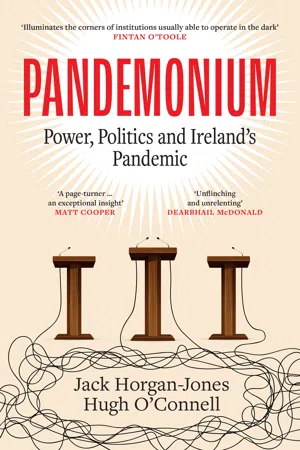
The Inside Story of Ireland's Pandemic: Every Decision, Every Player, Every Text, Every Leak
Ireland's lockdowns were among the harshest and longest in Europe. As the state was battered by waves of disease time and again, unparalleled pressures and untold tensions emerged as the country went to war with Covid, and policymakers and politicians did battle with each other.
How were the key decisions made? Who held all the power?
Boasting unrivalled access to the key decision-makers and drawing on hundreds of hours of interviews and thousands of pages of documents, including confidential and unpublished material, Pandemonium reveals the moves, the power-plays and the – at times jaw-dropping – tactics of a government with the health of a nation in its hands.
'If a movie is ever made of how Ireland responded to the Covid-19 pandemic, Pandemonium may well provide the script … You will feel as if you were in the room when key conversations happened and decisions were made.' Professor Luke O'Neill
'Illuminates the corners of institutions usually able to operate in the dark' Fintan O'Toole
'A page-turner … an exceptional insight' Matt Cooper
'Unflinching and unrelenting' Dearbhail McDonald
Information
CHAPTER 1:
THE PHONEY WAR
24 January 2020
Cases: 0
Deaths: 0
Seven-day average of new cases: 0
Paul Reid was on the second hole at Carrick-on-Shannon golf course in Leitrim and his phone was hopping. There were cases of coronavirus infection associated with travel in Paris and Bordeaux. ‘This was here and it was in Europe. It had reached us and it was for real,’ he would later recall.
The chief executive of the Health Service Executive (HSE) soon had to give up on golf. ‘Lads, this just isn’t working, I have to pack it in.’ He was getting nowhere, and, in any case, his golf buddies had already moved forty yards ahead of him.
It would be a long time before Reid would get back out on the course. A small group within the HSE – the High Consequences Infectious Diseases Group – had been meeting since early January, but now the decision was being taken to elevate the response.
Reid pulled together a National Crisis Management Team (NCMT). Much like its counterpart in the Department of Health – NPHET – there had been NCMTs before, periodically formed in response to disease outbreaks in hospitals, severe weather events, or other unpredicted threats. This would be different.
—
The first ripples of Covid-19 reached Ireland in early February. Passengers on a flight arriving from Moscow late on the evening of 1 February were greeted with the unexpected sight of public health doctors in hazmat suits, who had scrambled after being alerted that a passenger could be carrying the virus. Passengers were told to ‘avoid contact with other people as much as possible tonight’. The person suspected of carrying the virus was taken to the Mater Hospital, tested negative, and released.
In early 2020, the official position in Ireland was that the State was ready for whatever might be coming. On 28 January, the Cabinet was told of the Department of Health’s view that ‘Ireland is adequately prepared to address any potential cases of the novel coronavirus (2019-nCoV)’.
A full two weeks later, a briefing note by the Health Threats Coordination Group, a high-powered gathering of officials from across government departments, the Defence Forces, the HSE and elsewhere, said there were ‘advanced plans in place as part of its comprehensive preparedness to deal with public health emergencies such as novel coronavirus’. They were, the note said, the plans that had previously been used for pandemic influenza, SARS and MERS. ‘Ireland is, therefore, well-positioned to detect and respond to any case of the novel coronavirus (2019-nCoV) that might arise here,’ it concluded.
Through January and February, diplomatic cables from China detailed the advance of disease, but it was not a headline on the dispatches. It was there if you looked for it, but it ‘wasn’t up in lights or anything like that’, a source in the Department of Foreign Affairs later said. As days turned into weeks, no single urgent communiqué received in Iveagh House, the Department of Foreign Affairs headquarters on St Stephen’s Green in Dublin, sounded alarm bells about Covid-19. But a drumbeat was beginning to signal trouble.
On the eve of the general election, 7 February, it was confirmed that an Irish couple were passengers on the Diamond Princess, a cruise ship that would become a real-life petri dish for what the virus could do in an enclosed setting. Fourteen deaths would eventually be linked with 712 infections on the ship. In fact, six Irish passengers were on board the cruise ship, two of whom caught the virus. Nine more Irish citizens were later caught up in an outbreak on the Westerdam cruise ship in Cambodia. Irish people were being flown out of Wuhan, which had been placed under a severe lockdown on 23 January, but in small numbers. The Chinese city was the epicentre of the coronavirus outbreak and had by this stage reported more than 10,000 cases and nearly 550 deaths. Gradually, the virus was moving from being stock content in diplomatic cables to something more substantial. Something was out of step with the normal hubbub of activity and intelligence gathered from across the globe.
Early NPHET meetings were small gatherings of experts who were usually called upon in the face of public health threats. The meetings were held in person in room 631 on the sixth floor of the Department of Health, a sprawling complex of buildings at Miesian Plaza in the heart of Dublin 2. The first meeting was chaired by Tony Holohan, who had served as chief medical officer for over a decade. There were ten people there, largely drawn from the HSE and the Department of Health.
In addition to what one participant later recalled as an ‘optimism bias’ in the wider health system at the time, members of the team were unsure how reliable information emerging from China was. In early February the Health Protection Surveillance Centre (HPSC) began engaging with the Chinese embassy, which shared documents on the characteristics of the new virus, including one that said that, to date ‘there is no reliable evidence from the field investigations that the disease is contagious during the incubation period’. This assessment would later prove to be devastatingly wrong. Equally, documents suggest the Chinese didn’t always get prompt responses from the Irish side. On 11 February, the first secretary of the embassy emailed the HSE to say that a ‘Chinese patient’ had been trying to get in touch with their local Department of Public Health in Ireland. The embassy said, ‘We are also concerned that the phone calls made […] were not answered after 13:00 on Saturdays and Sundays.’
The first meeting of NPHET on 27 January discussed how supplies of personal protective equipment (PPE) were ‘sufficient’, with contracts in place to access more ‘as required’. While the European Centre for Disease Control’s assessment of risk to the EU was ‘moderate’, the threat of onward transmission of the virus was rated as ‘low’.
On the evening of 26 January, the first messages began to flow out from HSE headquarters to the hospital network. ‘The CEO is calling an emergency meeting in the morning about the Chinese coronavirus,’ a senior HSE official emailed an executive in the Dublin Midlands Hospital Group. ‘Can I check if there’s any major red flags or gaps in your hospitals around PPE or preparation levels that we need to be aware of?’ the official asked, before almost casually pointing out that this was landing amid the chronic chaos of winter in the Irish health system: ‘Apart from the obvious that your [emergency departments] are likely out the doors and isolation facilities are full up already. Thanks.’
In the Department of Health, Holohan’s team were working on pandemic preparedness plans based on old models for other diseases, in a vacuum, with limited information about the new threat. They were looking back at work done for influenza, as well as SARS and MERS. Holohan would later admit to being ‘troubled’ by the lack of real disease modelling as he began to assemble a larger team in early March. But in February it was, one senior department official later recalled, still a ‘phoney war’.
The parts of the State apparatus that were nominally supposed to plan for and react to medical threats were gradually warming up. Holohan, his deputy, Ronan Glynn, and their small team worked away in Miesian Plaza, as did the HSE in its Dr Steevens’ Hospital headquarters in Dublin 8. But the brain, the heart and the soul of the system was elsewhere – because, in late January and early February, everyone else was off having an election.
—
Faced with a motion of no confidence in Minister for Health Simon Harris, Leo Varadkar called a general election in mid-January just as the Dáil had been due to return from its Christmas recess. In so doing, he called time on the confidence and supply agreement with Fianna Fáil, a deal that had spanned the previous four years. It involved Micheál Martin’s party abstaining on Dáil votes in return for the delivery of certain key priorities, which were laid out in a short document that the two parties had agreed in summer 2016.
For the two parties that emerged from the ashes of the Civil War nearly a century earlier, the 2020 general election was a period of intense pressure. Their leaders had to make good on promises not only to the electorate, but also to their own parties.
For Varadkar, the thrust of his leadership campaign in 2017 had been that Fine Gael seats were safer with him in charge – and that he could deliver more of them. His allies believed his reputation as a straight-talking politician who was not afraid to be blunt and to court controversy, who would transcend party lines and win new voters. Alongside this was his compelling backstory as the son of an Indian doctor and an Irish nurse, who grappled with his sexuality before publicly revealing in 2015 that he is gay.
But the local and European elections in 2019 had been the first, and unconvincing, test of his pitch. Varadkar then hesitated over calling a general election when, on the crest of a wave after helping to secure a Brexit deal in late 2019, he stood to benefit. Yet in early 2020, the post-Brexit shine had worn off and Varadkar’s hand was being forced by the political vulnerability of his health minister.
His government was also deeply unpopular, a position compounded by a disastrous attempt to hold a commemoration event for Ireland’s pre-partition police forces. After the emergence of the plan caused widespread anger and claims that Fine Gael were in effect commemorating the brutal regime of the Black and Tans, the idea was abandoned in early January 2020.
The damage was done in the minds of an electorate who were already deeply frustrated with Fine Gael’s handling of seemingly intractable housing and health crises. It hammered home a deeper Fine Gael vulnerability: the sense that it did not understand the electorate, and that it was remote, detached from them after nearly a decade in power – a well-trodden path for many political parties after two terms.
Meanwhile, Micheál Martin, the only true veteran of government in the senior echelons of Fianna Fáil, faced being the first leader of his party not to occupy the Taoiseach’s office. The local and European elections had been largely positive for Fianna Fáil. The party retained its position as the largest in local government, taking back council seats ceded to Sinn Féin five years earlier and making gains in Dublin, where its fortunes had nosedived since 2011, including winning a European Parliament seat.
But large swathes of the Fianna Fáil parliamentary party and the wider membership had been unhappy with the confidence and supply arrangement. They fumed at Martin’s unilateral decision to extend it in December 2018 – without consulting the party – because of his concerns about creating political instability as Brexit loomed. But as the election dawned, it still seemed Martin stood a chance of leading the next government and closing the book on one of the most remarkable recovery stories in Irish political history.
On the campaign trail, ministers were briefed to expect questions on Covid-19, but it didn’t feature. Instead, the election was dominated by housing issues. Health featured, as always, but it was the stock barrage of issues around waiting lists, clinical outcomes and the fallout from recent scandals like that surrounding CervicalCheck, the State’s screening programme for cervical cancer. Countless debates, interviews and doorsteps with leaders, frontbench members and ministers came and went, but coronavirus received scant attention.
While out canvassing in Dublin towards the end of the campaign, Micheál Martin told a group of young Fianna Fáil members, ‘Watch out for this, there’s not much comment on it now, but this could be something.’ He had read a newspaper report about the new virus emerging from China and had what he later described as ‘a hunch’. Martin had been health minister when SARS emerged in 2003. It had left an impression on him.
To most others the new virus was something that was ‘over there’ – in China. ‘Everybody in the West did not pay enough attention to what was going on in the East,’ Professor Mark Ferguson, the government’s chief scientific adviser at the time and a future member of NPHET, later said. ‘I would say that’s collective Western arrogance. We didn’t look carefully enough at what was happening in China and elsewhere.’
Both Fine Gael and Fianna Fáil failed to capture the public appetite for change. There was a surge of support for Sinn Féin, and the two Civil War parties’ bitter and personal attacks on each other continued, while they also expanded into the familiar territory of targeting Sinn Féin’s murky links with the IRA.
Their stuttering campaigns led to dramatic setbacks on 8 February when Sinn Féin surprised itself by gaining 15 seats and winning the popular vote. ‘Mary Lou for Taoiseach’ became a popular refrain among its buoyant supporters. The party proceeded to hold a series of post-election rallies across the country that would soon have to be curtailed.
After the election there was no clear route to power for any party, while the caretaker government was shattered. The ranks of Cabinet were depleted – Shane Ross, Katherine Zappone and Regina Doherty had lost their seats – but they retained their Cabinet seats until a new government could be formed. Finian McGrath was a lame duck minister who had not sought re-election. Housing minister Eoghan Murphy, once the architect of Varadkar’s successful campaign to lead Fine Gael, was an opposition hate figure and although he had clung on to his Dáil seat, he would resign it a year later. Varadkar’s demeanour after the election, Cabinet colleagues thought, ranged from despondency to acceptance that Fine Gael would be going into opposition. Most of his parliamentary party demanded Fine Gael get out of government. It was just about the worst time for an identity crisis, given what was coming over the horizon.
Worldwide, the virus was stealing a march on governments and healthcare systems that failed to grasp its insidious nature. The election compounded this in Ireland, creating a political vacuum.
CHAPTER 2:
‘AN EXPLOSIVE EFFECT’
13 February 2020
Cases: 0
Deaths: 0
Seven-day average of new cases: 0
Simon Harris, his adviser Joanne Lonergan and Dr Colette Bonner, one of Tony Holohan’s deputy chief medical officers, boarded the government jet at Casement Aerodrome just outside Dublin. They were bound for Brussels and a meeting of EU health ministers, known by the acronym EPSCO. Three days earlier, on 10 February, Harris had been re-elected as a TD for Wicklow on the fifteenth count without reaching the quota. At the age of 33, the Minister for Health was embarking on his third Dáil term, having been just 24 when he was first elected in 2011, but the election outcome meant this could be the last time he was on board the Learjet 45. Some of the party took selfies to mark the occasion.
At the EPSCO meeting, Croatia’s health minister Vili Beros confidently told journalists that there was a ‘high degree of preparedness’ within the EU for the emerging Covid-19 threat. Briefing materials circulated to journalists afterwards focused on information sharing and co-ordinated action to avoid shortages of medicine. There were presentations from the WHO and the European Centre for Disease Prevention and Control (ECDC), which brought home the growing seriousness of the emerging situation surrounding the virus. Harris’s public comments mirrored the bravado of his colleagues on the continent. He told the Irish Times that he was satisfied Ireland had a ‘significant level of preparedness’ for the virus.
But on the plane home, the mood was darker. At the summit, EU member states had wrangled over the wording of a joint declaration. For all the affirmations about common cause, health was not a core EU competency, with member states retaining autonomy; in a pinch, some countries could go it alone. ‘We were having all these meetings, but Europe didn’t act as a cohesive bloc; that had devastating consequences,’ Harris later said. ‘We were suspending normal rules in our own country and everywhere else, we didn’t seem to suspend the normal rules in Europe. We left ourselves really exposed as a geopolitical bloc.’
On 20 February, Harris signed an order designating Covid-19 a ‘notifiable disease’, meaning that doctors would have to inform the HSE when a case was diagnosed. There was a growing acceptance that Covid-19 would come to Ireland, but the view remained that it would be controlled, and perhaps only a few cases would be reported.
‘Even public health officials thought this was something we could kind of weather,’ Harris would later recall. ‘There was a period from January to mid-March where there was a sense of “this is a pandemic, we’ve had lots of difficult times before, Minister – SARS, whatever else – we got through it, we’ll get through it, [even though] we’ll probably see cases”.’
But before a case was even diagnosed in Ireland, the power of the virus to stop life in its tracks would be vividly illustrated.
—
Late on the night of Sunday 23 February, Austrian authorities stopped a train from Italy crossing the border through the Brenner Pass on suspicion that two passengers might be infected with Covid-19. Later that evening, the authorities stopped all services crossing the border. Deaths from the virus were now being reported in Italy, and 50,000 people were quarantined across the Veneto and Lombardy regions.
The Department of Foreign Affairs would soon issue advice against travel to northern Italy as the virus began to strike at the commercial and industrial heartland of the country. The north of Italy is the centre of much of the country’s power and wealth, home to its fashion and automotive industries. In Milan, the biggest city of the region, the Borsa Italiana saw billions wiped off its publicly q...
Table of contents
- Cover
- Title Page
- Dedication
- Contents
- Authors’ Note
- Prologue
- Chapter 1: The Phoney War
- Chapter 2: ‘An Explosive Effect’
- Chapter 3: The Black Line
- Chapter 4: ‘Pay Attention’
- Chapter 5: Complex Relationships
- Chapter 6: No Masks
- Chapter 7: No Swabs
- Chapter 8: 15,000 a Day
- Chapter 9: Bonos Días
- Chapter 10: The Unknown Man
- Chapter 11: The Army Council
- Chapter 12: Cancelled
- Chapter 13: Suppressed
- Chapter 14: Reopening and Replacing
- Chapter 15: ‘This Is Going to Be Complicated’
- Chapter 16: Two Drinks, One Dinner
- Chapter 17: Gobshitery on Speed
- Chapter 18: Living with Covid
- Chapter 19: October Surprise
- Chapter 20: The Ugliest Meeting
- Chapter 21: Lockdown
- Chapter 22: 1 Government Centre
- Chapter 23: Level Fun
- Chapter 24: Serious Trouble
- Chapter 25: The Surge
- Chapter 26: The Tunnel
- Chapter 27: Shot in the Arm
- Chapter 28: Snake Oil
- Chapter 29: Quarantined
- Chapter 30: Happy Tony
- Chapter 31: Delta
- Chapter 32: Omicron
- Chapter 33: Subversives
- Epilogue
- A Note on Sources
- Acknowledgements
- Copyright
- About the Authors
- About Gill Books
- Praise for Pandemonium
Trusted by 375,005 students
Access to over 1.5 million titles for a fair monthly price.
Study more efficiently using our study tools.
Frequently asked questions
Yes, you can cancel anytime from the Subscription tab in your account settings on the Perlego website. Your subscription will stay active until the end of your current billing period. Learn how to cancel your subscription
No, books cannot be downloaded as external files, such as PDFs, for use outside of Perlego. However, you can download books within the Perlego app for offline reading on mobile or tablet. Learn how to download books offline
Perlego offers two plans: Essential and Complete
- Essential is ideal for learners and professionals who enjoy exploring a wide range of subjects. Access the Essential Library with 800,000+ trusted titles and best-sellers across business, personal growth, and the humanities. Includes unlimited reading time and Standard Read Aloud voice.
- Complete: Perfect for advanced learners and researchers needing full, unrestricted access. Unlock 1.5M+ books across hundreds of subjects, including academic and specialized titles. The Complete Plan also includes advanced features like Premium Read Aloud and Research Assistant.
We are an online textbook subscription service, where you can get access to an entire online library for less than the price of a single book per month. With over 1.5 million books across 990+ topics, we’ve got you covered! Learn about our mission
Look out for the read-aloud symbol on your next book to see if you can listen to it. The read-aloud tool reads text aloud for you, highlighting the text as it is being read. You can pause it, speed it up and slow it down. Learn more about Read Aloud
Yes! You can use the Perlego app on both iOS and Android devices to read anytime, anywhere — even offline. Perfect for commutes or when you’re on the go.
Please note we cannot support devices running on iOS 13 and Android 7 or earlier. Learn more about using the app
Please note we cannot support devices running on iOS 13 and Android 7 or earlier. Learn more about using the app
Yes, you can access Pandemonium by Jack Horgan-Jones,Hugh O'Connell in PDF and/or ePUB format, as well as other popular books in Politics & International Relations & Political Philosophy. We have over 1.5 million books available in our catalogue for you to explore.