- 316 pages
- English
- ePUB (mobile friendly)
- Available on iOS & Android
eBook - ePub
About this book
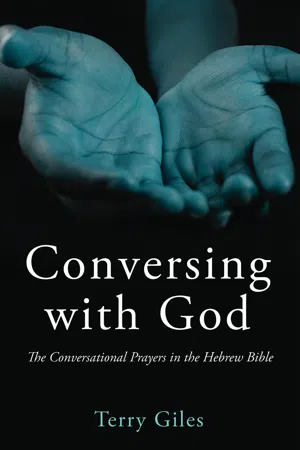
Talk is essential to human social life. Through conversation we form friendships, share dreams and hopes, and develop a common outlook on the world around us. Talk with God can achieve the same thing. This book examines the conversational prayers in the Hebrew Bible, their structure and content, to understand how talk with God forms friendship, shares dreams and hopes, and develops a Divine-human outlook on the world. Conversation forces the petitioner to surrender control of the encounter and become susceptible to unscripted give and take with the Divine. Conversation with God is always a risk, but the rewards can be great. Through conversation Abraham and Moses became friends with God. The same can be true for us.
Information
1
Introduction
“Talk is at the heart of human social life.”1
Is talk also at the heart of the Divine human life together? Is the human relationship to the Divine built on talk? Is it truly possible to engage in conversation with God, to participate in give and take, to listen and be listened to? If so, it’s only sensible to understand and be intentional about engaging in these Divine human talks. This book is an investigation into the conversational prayers contained in the Hebrew Bible to see if help can be found for conversing with God.
In 1983, Moshe Greenburg published a small book presenting a series of lectures on non-psalmic prayer he delivered at the University of California during the 1981–82 academic year.2 In these lectures, Greenburg concluded, “the biblical narrators all portrayed speech between man and God on the analogy of speech between humans.” To be sure, Greenburg recognized the “literary shaping” of speech that occurs when embedded in prose, but nevertheless asserted that direct speech patterns are still present among these prayers.3 In Greenburg’s view, human conversation with God is patterned after typical human to human conversation. How we talk with each other provides the structures for how we talk with God.
Greenburg’s observation serves as the impetus for this book. If conversational prayers appearing in a prose literary context are structured according to the same speech patterns found in human to human conversation, can Conversation Analysis (CA), the social scientific methodology for the analysis of conversation, assist in understanding the discourse of conversational prayer in the Hebrew Bible, even if those prayers are shaped by the literary concerns of their prose context? It follows that just as the presentation of inter-human dialogue in literary prose retains some of the characteristics of normal conversation, so, too, conversational prayer (prayer in the form of a dialogue with God), even when appearing in prose, retains some of the characteristics of conversational activity and analysis of those characteristics can help us to understand the human Divine interaction. But this formation of the problem guiding our study has in it two embedded assumptions that must be addressed before we progress any further.
Does the Literary Context of Conversational Prayer Preclude Conversation Analysis?
First, does the prose setting of the prayers invalidate a conversational structural analysis?4 Has the prose writer altered conversation structure in order to achieve his or her own designs in a manner that makes those conversations hopelessly lost? Others have asked the same question and concluded yes. Samuel Balentine notes, “Whatever the original, spontaneous utterings were, one no longer has the luxury of hearing them directly.”5 And on this point, surely Balentine is correct—the conversational prayers are preserved in texts. That means some of the characteristics we seek most—spontaneity and immediacy, the unfiltered dynamics shared by the conversationalists, have been shrouded in the formalization of prose construction. But does this mean that we are at a methodological impasse? Perhaps not.6 The conversational prayers embedded in narrative are literary constructions. We are examining literary constructions in conversational form. But does this mean that CA, which has to do with “normal” or naturally occurring conversation,7 has no contribution to make when applied to the analysis of conversation in texts or other more “institutionalized” settings? No. While differences do exist between conversation appearing in texts and normal conversation, the evidence points to a closer connection rather than a disconnection between the two forms of communication.8 Even while appearing in texts, conversation is still recognizable as conversation, even if now functioning for a purpose determined by a narrator and not the conversationalists. CA will allow us to compare the literary conversation constructs to normal, direct conversation and allow us to make observations. Those resulting observations can then be used to analyze the prayers as the heart of the Divine human interaction.
Are Conversation Structures Culture Specific?
The second preliminary question we must ask is: Are speech patterns culturally specific so that transference of analysis from one culture to another is misleading if not unattainable altogether? Can modern CA be applied to ancient texts with an...
Table of contents
- Title Page
- Preface
- Abbreviations
- Chapter 1: Introduction
- Chapter 2: Conversation Analysis
- Chapter 3: Abraham Cycle
- Chapter 4: Jacob Cycle
- Chapter 5: Moses
- Chapter 6: Balaam, Joshua, and the Judges
- Chapter 7: Parallel Prayers
- Chapter 8: Elijah/Elisha Cycle
- Chapter 9: Conversational Prayers Only in Chronicles
- Chapter 10: Prophets
- Chapter 11: General Observations
- Postscript: The Last Word
- Appendix 1: Genesis 3:9–19: Adam and Eve
- Appendix 2: Non-Conversational Prosaic Prayers
- Bibliography
Trusted by 375,005 students
Access to over 1.5 million titles for a fair monthly price.
Study more efficiently using our study tools.
Frequently asked questions
Yes, you can cancel anytime from the Subscription tab in your account settings on the Perlego website. Your subscription will stay active until the end of your current billing period. Learn how to cancel your subscription
No, books cannot be downloaded as external files, such as PDFs, for use outside of Perlego. However, you can download books within the Perlego app for offline reading on mobile or tablet. Learn how to download books offline
We are an online textbook subscription service, where you can get access to an entire online library for less than the price of a single book per month. With over 1.5 million books across 990+ topics, we’ve got you covered! Learn about our mission
Look out for the read-aloud symbol on your next book to see if you can listen to it. The read-aloud tool reads text aloud for you, highlighting the text as it is being read. You can pause it, speed it up and slow it down. Learn more about Read Aloud
Yes! You can use the Perlego app on both iOS and Android devices to read anytime, anywhere — even offline. Perfect for commutes or when you’re on the go.
Please note we cannot support devices running on iOS 13 and Android 7 or earlier. Learn more about using the app
Please note we cannot support devices running on iOS 13 and Android 7 or earlier. Learn more about using the app
Yes, you can access Conversing with God by Terry Giles in PDF and/or ePUB format, as well as other popular books in Theology & Religion & Biblical Criticism & Interpretation. We have over 1.5 million books available in our catalogue for you to explore.