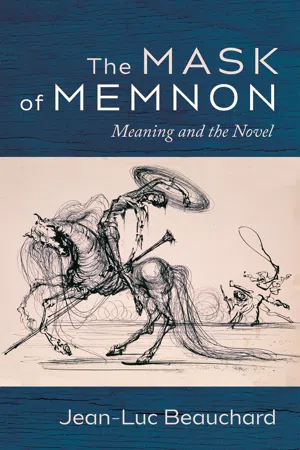
- 110 pages
- English
- ePUB (mobile friendly)
- Available on iOS & Android
eBook - ePub
About this book
What gives life its meaning? This question stands behind every philosophical inquiry, and philosophy itself arises from it. Confronting the problem of meaning is, as Camus says, the fundamental task of human life. Yet at bottom, meaning is an aesthetical category. Meaning hinges on interpretation. It makes sense then to turn to art--and in particular the art form which deals most explicitly with meaning, the novel--if we are to attempt to address it.
Inspired by but critical of Roland Barthes's "death of the author" literary theory, The Mask of Memnon seeks to reconcile opposing philosophical approaches to the question of meaning by examining the death of the author from the perspective of the character, not the reader. In this work, the traditional dichotomy between external/objective meaning and internal/subjective meaning is upended and a new paradigm is proposed.
Information
Topic
LiteraturaSubtopic
Crítica literariaChapter 1
Meaning and Meaninglessness
1.
Anyone who realizes, as the protagonist in my novel would have realized, that he is not the author of his life, that he is neither the founder nor the sustainer of his existence, that he did not bring himself into being, did not create himself, did not and cannot write his own story, will immediately find that he has been confronted by the question of meaning and meaninglessness. Anyone who takes time out of his busy afternoon to observe that he did not ask to be, that he has done nothing to deserve being, that he can do nothing to stave off non-being, that both being and non-being are not only beyond his control but also beyond his ability to comprehend, will be forced to ask—where does meaning come from? The eager existentialist will doubtless respond that existence precedes essence and that therefore meaning is always my meaning, life is what I make it. But the conscious or unconscious advocatus dei will press the issue further. He will ask, if I alone am capable of ascribing meaning to my life, but I am also not the founder of my life—what meaning can the meaning I ascribe possibly have? He will say, is not this meaning quite arbitrary and meaningless? Or, can there really be any meaning in such meaning after all? And if I will one day cease to mean anything to anyone including myself—what then? How meaningless will my meaning be on the day I dive headlong into meaninglessness itself!
But more on this later. First—my unfinished novel. The idea at the heart of my novel is not a new one. In fact, it may be one of the oldest ideas there is. Yet there is a newness to it. It has about it the newness of an idea that’s been long forgotten, like a memory from childhood that comes rushing back with all of the freshness of youth. It is an idea both old and new. Old because it has existed since the first man told his first story. New because it has existed in me only recently and in you perhaps more recently than that. But it is an idea that has occurred—whether in the mind or unspokenly in the heart—of every storyteller who has ever lived. Few have gone further than this idea. Few have acted upon it. But it has been present and will be present in every man who is not merely a man but also an animal fictus. It has always been and will always be present in the author.
But who can make such claims? Who can know what every author has had in his mind or heart? To each his own and no further. Have we not done away with such totalizing claims? Have we not freed ourselves from the tyranny of universals? Did we not, centuries ago, depose the despot known as “human nature” and deliver up his last supporters to the guillotine? Or are we, even today, unable to rid ourselves of the shadow of some higher order, some unifying principle that holds together our interpretations? No matter. For, I repeat—nay insist—my idea has been in the mind or heart of every author who has ever lived. And my idea is this—these characters of mine, these people I’ve invented, they are people I would very much like to meet. This world of mine, this cosmos I’ve created, this is the type of place I would very much like to visit.
To the literary theorist seated at the back of the room, this kind of talk is nonsense. And the author who expresses it is a clown—probably a very sad clown, Pierrot the sad clown. After all, the theorist knows with the certainty of a scientist—a social scientist!—that the author writes for the sake of the reader. He writes for his critics, for his peers, for himself. Or perhaps he writes to highlight the inequities of race, class, and gender. Or maybe to level a critique on one of the many isms: colonialism, consumerism, neoliberalism, phallogocentrism, et al. Or to build on the tradition. Or to bury the tradition. And by the way, didn’t Barthes teach us that it’s high time for the author to shut up and die already? In any event, it no longer matters why the author writes. But one thing is certain—the author does not write for the sake of his characters. He does not care for them. He has no love for the world in which they live. How could he? They are his fancies and nothing more. Or if something more, they belong to the reader. They are raw material to be molded and manipulated and interpreted at will. They do not exist for themselves. Their meaning is the meaning given to them. And without that meaning, they would be utterly meaningless. They would be nothing at all.
And yet, the author wants what he wants. No amount of fine scholarly writing can change him. He wants to know his characters. He wants to breathe the air they breathe and to feel what such wretches feel. He wants to laugh with them when they laugh and to weep with them when they weep. But more than anything, he wants to speak with them, to walk with them, to dine with them, to dance with them, to reach out and touch them. He wants to share with them things about himself—why he created the world he created and them in it. And he wants them to share with him. He wants to know how they experience the experiences he creates. He wants them to tell him where and how he went wrong, the pain his world has caused. He wants to know what he has done right, the wonders he’s inspired.
All of this would have been in my novel. All examined and explored. For in my novel, I as author would have entered as a character, one among many. I would have inhabited the world I created. I would have sat with my characters and dined with them. I would have drank with them and smoked with them and told crude jokes. And I would have wept. My characters would have known me by name just as I know them by name. They would have seen me and touched me and heard me as I hear them. I would have shared my thoughts and they would have asked me questions and I would have told them things they never could have known. And more than all that, I would have felt what it is like to be a character in a novel, to be confined to the pages of a book. I would have known the tension of speaking someone else’s words, of having another speak through me, of finding myself in situations over which I have no control, of being forced down paths I do not choose, of not being the author of my own life. And there would have been tension. There would have been a great deal of tension. My characters would have failed to understand and I would have failed to explain and the tension would have reached a fever pitch.
2.
In La mort de l’auteur, Roland Barthes tells us that in order for the reader to be freed from the oppression of the author, in order for him to freely interpret the meaning of the text, the author must die. He must become meaningless. For, the author’s meaning stifles. It suffocates. And the reader who seeks to understand “what the author meant” is oppressed. He is trapped within a narrow reading of a text that always already transcends the one who wrote it. The birth of the reader, Barthes says, is rooted in the death of the author.1
For all we know, Barthes may be right. T. S. Eliot famously remarked that no poet has his complete meaning alone. But perhaps it is the case that no poet has any meaning at all. Perhaps the poet needs only to step out of the way and allow the work—never his work—to speak to the reader on its own terms. Perhaps the poet must die so that the reader can live. (I seem to recall another philosopher whose critique of the poets is that they cannot explain what their works mean.) Yet whether this is true or not is of little concern. For, so long as the author wants to live, he will continue to force himself upon us. There is nothing we, as readers, can do. The author will not die for the sake of the reader, and the reader cannot kill him. The reader has no power over him. An effect cannot be greater than its cause. If the author is to die, he must first consent to his own death. No one can take his life from him. He must lay it down of his own accord.
But the author will not lay down his life for the sake of the reader. Why would he? After all, he does not know the reader. To him, the reader is just that. The reader. He is an impersonal specter, a shadow, more unreal than the wildest fantasies of the author’s storyteller mind. The author and the reader are not friends. They do not know one another. From the perspective of the author, the reader might very well be his greatest enemy, hell bent on destroying the art he has sacrificed so much to create. And indeed, is this not often the case? Is it not true that for every reader who approaches a text with openness, humility, hospitality, there are a dozen waiting to attack it with suspicion, hostility, ideology, preconceived notions of the author’s intent? Ought the author to die for them? Why would he?
No, if the author is to consent to his own death, if he is to offer himself, to efface himself, to sacrifice himself, to constrain his will, if he is to let go of his desires and his plan, his ideas and his vision, if he is to become powerless, to relinquish control, to allow his work to exist in itself and for itself, he will only ever do so out of love. He will only do so for the sake of a friend. For, the author is an artist—that is to say, a lover. And there is no greater love than this—to die for the sake of one’s friends.
3.
This realization, this recognition that the author cannot, will not die at the hands of the reader—does this bring us any nearer to answering the problem of meaning and meaninglessness? Or are we where we’ve been from the beginning? Very well. Let us start anew: Imagine, if you can, that you are a character in a novel. Imagine you are not the author of your life, you are neither the founder nor the sustainer of your existence. Imagine that there exists an author who precedes you, creates you, speaks through you, tells your story. Suspending, for just one moment, your hard-earned disbelief and imagining that this is the case—what then? What is meaning and where does it come from?
The problem is this. If you say, as many have been wont to, that meaning comes from the author, that it is derived from the one who writes the story, that it is ordered from above, that there exists a higher harmony in which all things find their proper place and ultimate meaning—how unfree and meaningless is that meaning for you? After all, what meaning can you have if your meaning is not your meaning but the meaning ascribed to you from on high? What freedom can you have if you are not free to determine the meaning of the story of your life? But if, on the other hand, you say that in spite of the fact that you are merely a character in a story and not the author thereof, in spite of the fact that you are not and cannot be the ground of your own existence, nevertheless you somehow determine the meaning of your existence, somehow supply meaning to your own story—how false and illusory is that meaning? How meaningless is the meaning of the character whose only meaning is anchored in himself? For, when your story is over, what meaning will remain? Who is there to supply meaning when you, the supplier of your meaning, no longer mean anything to anyone? Who is there to remember that you once meant anything at all? In either case, one is confronted with the absolute worthlessness, the absolute meaninglessness, of one’s meaning.
But imagine, further, that you are not merely a character in a novel. Imagine that you are my character in my novel. Imagine that halfway through the story of your life, I enter the story of your life. Imagine we meet. This would be strange. For, I am just another character, one among the many. But I also claim to be the author, your author. I assert that I am the one telling the story. I say that I alone have power over meaning and meaninglessness. I say that your meaning is contained within me and that I work in and through you. This saying is hard. Who can bear it? And yet I say it all the same. I insist upon it.
What then? What would you do? Would you fall at my feet, kiss them, wash them with your tears, and dry them with your hair? Would you give away all that you have and spend your days following wherever I go? Would you sit with me, laugh with me, dine with me, drink with me, dance when I dance and weep when I weep? Or would everything in you long to watch me suffer? Would you want nothing more than to see me put to death? Would you do everything in your power to ensure I be crushed?
And yet if you were my character, I would love you all the same. I would love you as a poet loves his poem, as a painter loves his painting, as a father loves his child, as an artist loves his work of art. I would love you because I made you. I would love you because you were mine. I would understand why you wanted to watch me suffer. I would know why you wanted to see me die. I would see that you were caught in the grips of meaninglessness; that meaninglessness closed in on all sides. I would know that my meaning could never be your meaning and that your meaning was even more worthless than mine. And I would suffer because of it. I would suffer because of your emptiness, your worthlessness, your meaninglessness, your void. I would enter into that void. I would suffer for you and with you and I would want nothing more than to see you set free.
But the price of freedom is high. And here we can agree with Barthes—freedom cannot be bought without blood. The birth of the character must be ransomed by the death of the author. It is only when the author is willing to die, only when he will give up his rightful claim as the sole possessor of meaning, only when he will assume the full weight of meaninglessness—the very meaninglessness that once threatened to swallow his characters and their stories along with them—only then can his characters be free. It is out of the meaninglessness of the author’s death, out of his willingness to step aside and allow his characters to present th...
Table of contents
- Title Page
- With Gratitude
- Author’s Note
- Chapter 1: Meaning and Meaninglessness
- Chapter 2: Death of the God of Socrates
- Chapter 3: Sin and Immorality
- Interlude: Some Aphorisms on Writing and Life
- Chapter 4: Meaninglessness and the Absurd
- Chapter 5: Absurdity, Insanity, Suicide
- Chapter 6: Faith and Freedom
- Afterword: The Mask of Memnon
- Bibliography
Trusted by 375,005 students
Access to over 1.5 million titles for a fair monthly price.
Study more efficiently using our study tools.
Frequently asked questions
Yes, you can cancel anytime from the Subscription tab in your account settings on the Perlego website. Your subscription will stay active until the end of your current billing period. Learn how to cancel your subscription
No, books cannot be downloaded as external files, such as PDFs, for use outside of Perlego. However, you can download books within the Perlego app for offline reading on mobile or tablet. Learn how to download books offline
Perlego offers two plans: Essential and Complete
- Essential is ideal for learners and professionals who enjoy exploring a wide range of subjects. Access the Essential Library with 800,000+ trusted titles and best-sellers across business, personal growth, and the humanities. Includes unlimited reading time and Standard Read Aloud voice.
- Complete: Perfect for advanced learners and researchers needing full, unrestricted access. Unlock 1.5M+ books across hundreds of subjects, including academic and specialized titles. The Complete Plan also includes advanced features like Premium Read Aloud and Research Assistant.
We are an online textbook subscription service, where you can get access to an entire online library for less than the price of a single book per month. With over 1.5 million books across 990+ topics, we’ve got you covered! Learn about our mission
Look out for the read-aloud symbol on your next book to see if you can listen to it. The read-aloud tool reads text aloud for you, highlighting the text as it is being read. You can pause it, speed it up and slow it down. Learn more about Read Aloud
Yes! You can use the Perlego app on both iOS and Android devices to read anytime, anywhere — even offline. Perfect for commutes or when you’re on the go.
Please note we cannot support devices running on iOS 13 and Android 7 or earlier. Learn more about using the app
Please note we cannot support devices running on iOS 13 and Android 7 or earlier. Learn more about using the app
Yes, you can access The Mask of Memnon by Jean-Luc Beauchard in PDF and/or ePUB format, as well as other popular books in Literatura & Crítica literaria. We have over 1.5 million books available in our catalogue for you to explore.