- 162 pages
- English
- ePUB (mobile friendly)
- Available on iOS & Android
eBook - ePub
About this book
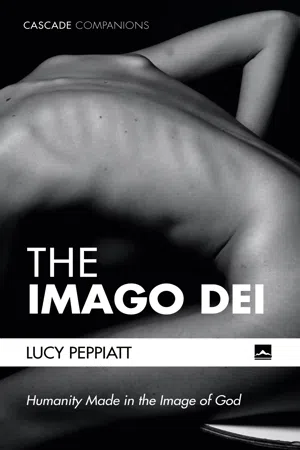
The doctrine of the imago Dei, that human beings are created in the "image and likeness of God," is an endlessly fascinating topic. Not only is it a central doctrine to Christian life and practice but also touches, perhaps even helps to form, every other doctrine of the Christian faith in one way or another. We do not think about God, in a Christian sense, as any other than the God who creates humanity in God's image. However, many of the details of this claim and what it means for human beings are left undefined by Hebrew and Christian Scriptures and it is not even mentioned in the creeds. This space leaves room for exploration. So the quest for what it means for human beings to be made in the image and likeness of God has never ceased to occupy theologians, clerics, and the laity alike. In this Companion, Peppiatt charts the developments of the doctrine through the ages, summarizing each position and perspective up to the modern day. This volume offers a compact but rich overview of the various ways in which this doctrine has been and is understood as well as pointing readers to further questions for consideration.
Information
Topic
Theologie & ReligionSubtopic
Biblische Studien1
Substantialist and Noetic Perspectives
Introduction
In the first three chapters we consider, in turn, the three main perspectives on the imago Dei that have dominated the church’s understanding over the centuries. In the subsequent two chapters, we will look at the ways in which these views are deemed to be problematic and explore some of the alternative perspectives offered in contemporary scholarship. Out of the main three perspectives, the two predominant views are described as the substantialist (or ontological) account and the functionalist accounts of the imago Dei. John T. Swann classifies these as either (a) a characteristic or condition of humankind or (b) a commissioning or commandment for humankind.2 The third is a relational account. In this chapter we consider the substantialist account.
For many centuries, the substantialist account of the imago Dei dominated the church’s teaching, with theologians largely defining the image in terms of an attribute that human beings possessed that was believed to mirror an attribute of God. This is why it is called the substantialist or ontological account, as if we were able to identify an inherent and concrete aspect of human being that we share with God. Or in other words, the aspect or faculty of human being that is most like God. In this respect, whatever or wherever this was in a human being, it would have to be an aspect of human creatureliness identifiable in the whole of humanity. Neither the creation stories in Genesis nor references in other books of the Bible to the creation of humanity tell us precisely what it is that human beings possess that mean they bear God’s image and likeness. However, it is clear from the text that whatever it is about humanity, it is something unique to human beings that they do not share with their fellow nonanthropic creatures. The animals, although created by God, are created neither in the same way nor for the same purpose. They do not receive the breath of God, nor do they converse with God in the way that humans do. They receive no instruction as to what they may or may not do in the garden, and no commissioning in relation to their role within creation. Thus, as part of attempting to locate the essence of the imago Dei in humanity, it was also thought that the aforementioned aspects of human beings were those that differentiated humans from animals. As Kathryn Tanner puts it, the substantialist accounts are ones in which humans are deemed to be “higher on the ontological scale of created beings by possessing certain faculties such as intelligence and will; their rationality, freedom from necessity, and capacity for self-determination.” It is these faculties that make them like God.3
Other faculties that are sometimes identified as reflections of the image of God in humanity are the ability to love and be loved, spirituality, immortality, conscience, memory, language, and personhood. As many point out, however, the more we discover of the nonanthropic world, the harder it is to make a case for a sharp differentiation between human and animal faculties. As the early church wrestled with the question of what it was in humanity that was “like” God, there were two errors they wanted to avoid. The first was the mistake of anthropomorphizing God or bringing him down to our level. This is the age-old error of creating God in our own image. The second was the mistake of divinizing humanity and thus erasing the boundary between the infinite and ineffable God and mortal human beings. Both spring from the fundamental error of collapsing the distinction between the creature and the creator. From the beginning, those reflecting on the connection between God and humanity were adamant that orthodox Christian thought maintains this distinction between the two. Creation is not God; therefore, the creatures made in his image are both like and unlike him.
Image and Likeness
In the Introduction, we cited Gen 1:26–27 as the locus classicus for our thinking on humanity and the image of God. One topic under discussion is whether the two words used in Gen 1:26, image (tselem) and likeness (demuth) are synonymous, or whether they denote distinct characteristics of humanity, distinct modes of relating to God, or both. Scholars are divided on this issue. Some argue that because tselem indicates some physicality (sometimes referring to a concrete form such as a statue), it is referring to a copy or image of an original whereas demuth refers to the likeness or similarity to God in a less tangible form. This also communicates that human beings are not exact copies of God as it were. It is difficult to demonstrate conclusively that the writers of the text were making a strong distinction between the two concepts; thus many commentators identify Gen 1:26 as a hendiadys (naming a single reality using two expressions). What we can say is that together they tell the reader that humanity somehow resembles and represents God without being exactly like him.
Both Irenaeus and Thomas Aquinas make some distinction between the two categories of image and likeness, but more with reference to how humanity relates to God. For this they focus on the prepositions. Rather than translate the phrase as “in” or “according to” the image and likeness of God, Irenaeus uses the preposition “after” the image of God, and Aquinas chooses the preposition “to” the image of God.4 These choices nuance the relation of humanity to God’s image in slightly different ways from if we say that humanity is made in the image of God. In both cases (with Irenaeus and Aquinas), this is followed by the proposal that those who are made after or to the image, are then subsequently made “into” God’s likeness in relationship with him through Christ. In my view, this reading of the text also gives a sense of movement towards becoming the image of God rather than imagining that humans possess the image solely as a static quality. We will come back to this idea in a later chapter.
The Rational Soul
In early Christian thinking, it was the rational soul or psyche which was thought to be the faculty that mirrored something of God. It makes sense in an ancient context to identify this particular aspect of human creatures as the reflection of the image, as it was the rational soul where one would locate the powers of knowing and willing. This then is where one could find the capacity for rationality, freedom from necessity, and self-determination mentioned above. The fact that this was labeled as the rational soul is somewhat confusing for those influenced by modern Western thought. Many people in the West today associate the term ratio...
Table of contents
- Title Page
- Acknowledgments
- Introduction
- Chapter 1: Substantialist and Noetic Perspectives
- Chapter 2: Kingship, Priesthood, and Stewardship
- Chapter 3: Relational Models of the Imago Dei
- Chapter 5: Modern Perspectives I
- Chapter 6: Modern Perspectives II
- Conclusion
- Bibliography
Trusted by 375,005 students
Access to over 1.5 million titles for a fair monthly price.
Study more efficiently using our study tools.
Frequently asked questions
Yes, you can cancel anytime from the Subscription tab in your account settings on the Perlego website. Your subscription will stay active until the end of your current billing period. Learn how to cancel your subscription
No, books cannot be downloaded as external files, such as PDFs, for use outside of Perlego. However, you can download books within the Perlego app for offline reading on mobile or tablet. Learn how to download books offline
Perlego offers two plans: Essential and Complete
- Essential is ideal for learners and professionals who enjoy exploring a wide range of subjects. Access the Essential Library with 800,000+ trusted titles and best-sellers across business, personal growth, and the humanities. Includes unlimited reading time and Standard Read Aloud voice.
- Complete: Perfect for advanced learners and researchers needing full, unrestricted access. Unlock 1.5M+ books across hundreds of subjects, including academic and specialized titles. The Complete Plan also includes advanced features like Premium Read Aloud and Research Assistant.
We are an online textbook subscription service, where you can get access to an entire online library for less than the price of a single book per month. With over 1.5 million books across 990+ topics, we’ve got you covered! Learn about our mission
Look out for the read-aloud symbol on your next book to see if you can listen to it. The read-aloud tool reads text aloud for you, highlighting the text as it is being read. You can pause it, speed it up and slow it down. Learn more about Read Aloud
Yes! You can use the Perlego app on both iOS and Android devices to read anytime, anywhere — even offline. Perfect for commutes or when you’re on the go.
Please note we cannot support devices running on iOS 13 and Android 7 or earlier. Learn more about using the app
Please note we cannot support devices running on iOS 13 and Android 7 or earlier. Learn more about using the app
Yes, you can access The Imago Dei by Lucy Peppiatt in PDF and/or ePUB format, as well as other popular books in Theologie & Religion & Biblische Studien. We have over 1.5 million books available in our catalogue for you to explore.