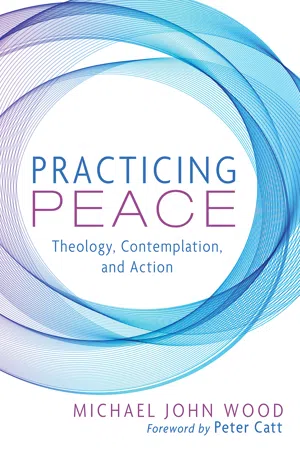
This book is about the practice of peace in daily life. Although most of us want peace, we often struggle to live it. Someone annoys us and we find ourselves in a vortex of conflict. When we care deeply about something it can be easy to burn relationships if we encounter people whose values differ from ours. We may ask ourselves, “How can we make a positive difference in the world without diminishing others or ourselves?” Michael Wood explores the practice of peace through the lenses of theology, contemplation, and action. Containing numerous real-life anecdotes, thought-provoking questions, and practical tools, this is a useful resource for anyone who wants to foster peace in their family, workplace, or community.
A free group study guide for churches for Practicing Peace is available by contacting the author at www.openspacecoachingandfacilitation.com.
- 270 pages
- English
- ePUB (mobile friendly)
- Available on iOS & Android
eBook - ePub
About this book
Trusted by 375,005 students
Access to over 1.5 million titles for a fair monthly price.
Study more efficiently using our study tools.
Information
Topic
Theology & ReligionSubtopic
Peace & Global Development1
Introduction
Who is this book for?
Firstly, this is a book for lay and ordained church leaders and for those responsible for their formation. It is for those who want to inspire, model, and foster positive relationships in their church communities; “walk the talk” of the gospel of peace; and be catalysts and enablers of peace. This does not require us to be heroic experts who have all the answers. Rather, I believe that those of us in formal leadership roles need to unlearn a few destructive self-expectations and habits of being in control. I am advocating a gentler and more genuinely collaborative approach to leadership, which can leave us feeling energized rather than exhausted.
Secondly, this is a book for any Christian who wants to contribute more intentionally to peace in the world, at home, in the community, at church, or at work. In our relationships, we sometimes experience a disconnect between Sunday and the workweek. We run into conflict with our partner or children or someone at church or work, and, before we know it, we are immersed in a quagmire. We may feel a vocational imperative or desire to be agents of God’s transformational peace in the world but feel lacking in the confidence and capability to do this. This book provides theological and practical frameworks and tools for practicing peace, regardless of whether we are in structural positions of authority.
Thirdly, this is a book for young and emerging leaders of any (or no) faith background who want to make a difference in the world but are not sure where to start. As a university chaplain, I am constantly impressed by the deep compassion and intellect that young people bring to the world’s challenges. The complexity of many of these challenges is enormous, and many young people I encounter are feeling overwhelmed, depressed, and anxious. These things can manifest as cynical withdrawal or as a generalized anger that has no outlet beyond street protest and yelling in the echo chamber of social media. Such anger is understandable, and protesting is certainly an important mechanism for raising awareness and driving change. However, it can also leave protestors feeling discontented and powerless, because protest still requires someone else to change; it does not necessarily increase a sense of personal agency.
This book is about taking responsibility for what we love, as an act of service to the world. Saint Therese of Lisieux (1873–1897) spoke of doing ordinary things with extraordinary love, and this inspired Mother Theresa to begin an order of sisters that has cared for countless thousands of the poorest of the poor. All initiatives that contribute to the peace and wellbeing of the world start with small groups of committed people sitting together to get clear on their shared story and a shared intention to act. When these thousands of little initiatives are added together, the collective effect can lead to transformational tipping points of change.
Structure
I propose that the practice of peace requires attention to three interrelated ways of knowing (epistemologies) around which I have structured the book. The terminology I have used for these ways of knowing, or lenses, through which we perceive and make sense of the world are:
1.Theology
2.Contemplation
3.Action
These aspects of the spiritual journey are not independent of each other. I am teasing them apart for the sake of investigation, but one of my goals is to consistently draw links between them. It is possible to start reading the book at whichever of the three parts you are most interested in. For example, if you are less interested in the theological foundations and more interested in the how-to of collaborative/dialogic methods, then you can go straight to the action section (pt. 3). Then, to learn more about the theological rationale for using such methods, or the contemplative stance that would help you to implement such methods, you can go back and read the earlier chapters (pts. 1 and 2 respectively).
You will find prompts to reflect dotted throughout the book. These can be used as moments to pause and reflect on your own responses and/or can be used for conversation in a book study.
Overview of Part 1: Theology
The gospel of Christ is the gospel of peace: the foundation of knowing who God is, who we are, and how God transforms culture nonviolently.
Theology is derived from two words, theos (God) and logos (reasoning). Theology is “reasoning about God.” St. Anselm of Canterbury (1033–1109) said that theology is “faith seeking understanding.” As soon as the mystery of God starts to tug at our hearts, we may begin to reflect on what is happening to us. That question is the beginning of theology.
When I started to read the Bible seriously, in my early twenties, I was immediately troubled by some of the appalling violence it contained and how this could possibly be reconciled (or not) with the beauty of the Jesus story and the “peace of Christ which surpasses understanding” (Phil 4:7).1 The questions that I started asking forty years ago have continued to percolate.
One thing that has become clear over the years is that we human beings tend to make God in our own image, to support our own desires and wish fulfillments. Someone who saw this acutely was the twentieth-century theologian Karl Barth. As Barth observed the rise of the German imperial war machine in the early twentieth century, along with the e’n’thusiastic endorsement of its operations by 90 percent of the church-attending Christians in Germany, Barth discerned that this massive political and ethical failure was underpinned by a profound theological error. This error was to begin theology somewhere other than the decisive revelation of God in Jesus Christ.2 This led to Barth’s role in framing The Barman Declaration and his expansive theological project in his multi-volume Church Dogmatics. Barth’s project was to keep reminding Christians of the absolute centrality of the person of Jesus Christ, out of which healthy ethics and politics will follow.3
Saint Benedict of Nursia in the sixth century also realized the importance of beginning everything with the contemplation of God. Benedict begins his Rule for monastic life with the word listen (incline the ear of the heart to God). In the seventh chapter of the rule, Benedict outlines twelve degrees of humility, the first of which is “keep the awe of God continually before your eyes.” Why is this so important? As Barth realized, we become what we worship.4 If we worship a God who is love (peace), our lives are more likely to take on the character of peace. It has become clear to me that when our image of God is shaped by Christ, it is impossible to make God into a god of war.
There are lots of ways of making peace if we think of peace as the absence of immediate conflict. For example, we can make conflict go away in the short term by silencing, expelling, or killing those who disagree with us. In this way, we conceive of peace as the absence of conflict, because we have driven the confli...
Table of contents
- Title Page
- Foreword
- Preface
- Acknowledgments
- Chapter 1: Introduction
- Part 1: THEOLOGY
- Chapter 2: Touchstone 1
- Chapter 3: Touchstone 2
- Chapter 4: Touchstone 3
- Chapter 5: Touchstone 4
- Chapter 6: Nonviolence and Scripture
- Chapter 7: Nonviolence, Judgment, and Wrath
- Chapter 8: Nonviolence and Hell
- Part 2: CONTEMPLATION
- Chapter 9: Integrating Perception
- Chapter 10: Loving God
- Chapter 11: Loving Neighbor
- Chapter 12: The Inner Work of Forgiveness
- Part 3: ACTION
- Chapter 13: Natural Living Systems
- Chapter 14: Collaboration
- Chapter 15: Collaborative Emergent Design
- Chapter 16: Conversational Frameworks and Tools
- Chapter 17: Conclusion
- Appendix A: The Inner Work of Planning for a Conversation
- Appendix B: The Inner Work of Forgiveness
- Appendix C: The Dialogic Dance between Power and Love
- Appendix D: How Circle Processes Help to Structure Out Rivalry and Structure In Collaboration
- Appendix E: Talking Circles Principles (Generic)
- Appendix F: Coaching Approach to a Conversation
- Appendix G: Sample Questions for Reflective Practice
- Appendix H: Joining the Dots: Integrating Theology, Contemplation, and Action in the Practice of Peace
- Bibliography
Frequently asked questions
Yes, you can cancel anytime from the Subscription tab in your account settings on the Perlego website. Your subscription will stay active until the end of your current billing period. Learn how to cancel your subscription
No, books cannot be downloaded as external files, such as PDFs, for use outside of Perlego. However, you can download books within the Perlego app for offline reading on mobile or tablet. Learn how to download books offline
Perlego offers two plans: Essential and Complete
- Essential is ideal for learners and professionals who enjoy exploring a wide range of subjects. Access the Essential Library with 800,000+ trusted titles and best-sellers across business, personal growth, and the humanities. Includes unlimited reading time and Standard Read Aloud voice.
- Complete: Perfect for advanced learners and researchers needing full, unrestricted access. Unlock 1.5M+ books across hundreds of subjects, including academic and specialized titles. The Complete Plan also includes advanced features like Premium Read Aloud and Research Assistant.
We are an online textbook subscription service, where you can get access to an entire online library for less than the price of a single book per month. With over 1.5 million books across 990+ topics, we’ve got you covered! Learn about our mission
Look out for the read-aloud symbol on your next book to see if you can listen to it. The read-aloud tool reads text aloud for you, highlighting the text as it is being read. You can pause it, speed it up and slow it down. Learn more about Read Aloud
Yes! You can use the Perlego app on both iOS and Android devices to read anytime, anywhere — even offline. Perfect for commutes or when you’re on the go.
Please note we cannot support devices running on iOS 13 and Android 7 or earlier. Learn more about using the app
Please note we cannot support devices running on iOS 13 and Android 7 or earlier. Learn more about using the app
Yes, you can access Practicing Peace by Michael John Wood in PDF and/or ePUB format, as well as other popular books in Theology & Religion & Peace & Global Development. We have over 1.5 million books available in our catalogue for you to explore.