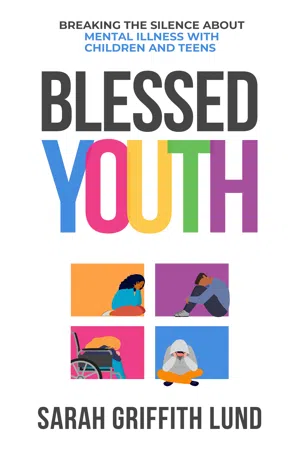
Through vivid and powerful storytelling, Blessed Youth: Breaking the Silence about Mental Illness with Children and Teens will remove the barriers of stigma and shame associated with mental illness in children and teens. Readers will know they are not alone and be reminded of God's grace and loving presence in the midst of the heartache and struggle of mental illness. In addition to stories of children and youth experiencing mental health challenges, Blessed Youth includes practical resources such as prayers and a guide for having age-appropriate talks with children about warning signs and how to get help for themselves and friends. Ultimately, this important resource offers hope and help for everyone who loves a child or youth with mental health challenges. Also available is Blessed Youth Survival Guide, a pocket-size companion guide for youth.
eBook - ePub
Blessed Youth
Breaking the Silence about Mental Illness with Children and Teens
- 128 pages
- English
- ePUB (mobile friendly)
- Available on iOS & Android
eBook - ePub
About this book
Information
Topic
Theology & ReligionSubtopic
ReligionChapter 1: Blessed Youth
I am writing Blessed Youth to break the silence about mental illness.
I want to answer the fundamental human question “How are the children?” through the lens of mental illness. How is the mental health of our children?
Mental health challenges, regardless of whether they are due to a diagnosed condition or not, affect the brain and the entire body. Medical professionals have identified over three hundred types of mental illnesses, and most can be treated through a combination of talk therapies, medications, and behavioral changes. Mental illnesses are complex physical health conditions; they can be caused by a combination of factors including environment, genetics, epigenetics (when behaviors and environment cause changes to the way our genes work), events, medical conditions, and various unknowns. Since many forms of mental health challenges have a genetic causation, they can present themselves as early as infancy, childhood, or adolescence.
Mental illness touches all of us, in the form of our own personal mental health challenges, illnesses of a loved one, a coworker, or a friend. Here are some key statistics about mental illness compiled by the National Alliance on Mental Illness.3
1 in 5 U.S. adults experience mental illness each year
1 in 20 U.S. adults experience serious mental illness each year
1 in 6 U.S. youth aged 6–17 experience a mental illness each year
50% of all lifetime mental illness begins by age 14, and 75% by age 24
Blessed Youth is part of a global and intergenerational movement to break the silence about mental illness. Today’s youth are generally more comfortable talking openly about mental health than older generations. Still, the stigma and shame historically associated with mental illness have kept too many people silent about their emotional and mental health challenges.
Stigma is a form of discrimination and can be directed towards oneself or others, and typically arises from ignorance or the fear of being bad, broken, or unwanted. Mental illness can be a highly stigmatized health condition when misunderstood. Mental illness is not a sign of weakness or failure, however. Mental illness is a common part of human life.
Shame is the feeling of humiliation and is often felt as a deep sense of embarrassment. Shame comes from thinking that we are to be blamed for being or doing something wrong. It is a shadow that keeps us silent and afraid to talk about what we are experiencing. Shame can lead us to withdraw from others and prevent us from seeking help. There is no shame in having mental illness.
Blessed is a word that honors our whole story. Blessed means we are more than the shame and stigma. Blessed means we are more than the labels. Blessed means we are holy and whole. We are blessed.
The good news is that today’s youth generally experience less stigma and shame around mental illness than previous generations thanks to the work of mental health advocates and educators. The problem is not with youth. The issue lies with many adults experiencing shame and stigma, being overwhelmed by a sense of failure and fear and not knowing how to help the youth who are experiencing mental health challenges. The problem is often within the systems (health, family, schools, faith communities) that are failing to successfully meet the mental health needs of youth.
We, as adults and parents, often don’t know how to help youth because it is difficult to know what is going on inside their minds and bodies. Christine is a colleague of mine who works as a licensed youth mental health counselor. She says that in her practice many of the youth report feeling as if they cannot talk to their parents about their mental health challenges. If youth are not able to talk openly and honestly with parents, telling us what they are thinking and feeling, then parents feel an added pressure to know the warning signs of mental health challenges. The signs can look a lot like typical growing pains, moodiness, or hormonal changes. How do we tell the difference between developmentally appropriate behaviors, such as emotional meltdowns, and signs of mental illness, such as a panic attack?
Another reason we don’t know how to help is that, even when youth do tell adults about their mental health challenges, we often don’t listen closely enough or for long enough. Sometimes we are distracted or overwhelmed or tired or too busy to listen. When we do tune in, we sometimes don’t believe what we are hearing, or we deny what the child or teen is saying. These responses can arise from our discomfort. What if helping requires skills and knowledge we don’t have? Our responses can also arise from fear, or resentment (we might think, no one cared about my mental health back then), or simply from not knowing how common it really is for people to experience mental health challenges.
Christine says that the most helpful way to listen to youth is to try not to overreact or over insert yourself into the child’s story. As soon as we hear about something challenging, like being bullied at school, it’s natural to be reminded of something we went through growing up and we might even be triggered. Yet the key is to stay focused in the present and actively listen to the child. She says that she hears youth being discouraged when parents immediately shift the conversation to themselves, saying something like, “Well, when I was growing up, I experienced [fill in the blank].” Child clinical psychologist Dr. Becky Kennedy says, “Feelings don’t scare kids. Being alone with feelings scares kids. Talking about feelings doesn’t make them worse. Talking about feelings makes them manageable.”4
Our role as adults is to listen and, according to child clinical psychologist Dr. John Duffy, to “bear witness to our child’s story.”5 We bear witness to the stories of children and youth when we give them our full, undivided attention. To be a witness means being fully present and open to hearing the truth, even if it is painful. The power of bearing witness to a child’s story is in creating space for our children to express their feelings and emotions as they make meaning of their experiences.
Not only do we adults have a hard time listening, but we also struggle to pay close enough attention to the warning signs, or we miss the warning signs altogether because we don’t know what those signs look like in children and teens. Sometimes, even when the warning signs are there, we don’t want to admit it because of our shame and fear or because of the stigma of mental illness. It can be difficult for us parents to accept the realities of mental health challenges in our children.
This book explains how to listen to youth when they do talk openly about their mental health, how to watch for signs that there is a problem, and what to do to get support. It is a resource for the whole community: families, adults in helping and support roles, and for anyone who cares about the mental health of our youth. The more people who make mental health a priority for our young people, the better for all.
This book is a guide for how to get the conversation started. I invite you to take what is useful and share it, and to leave behind what is not. Add your own ideas, thoughts, and most of all, stories and dreams. Your story matters. My story is only one story, but it is not the only story. I speak from my lived experiences as a person with privilege—a white, heterosexual cisgender woman who is a highly educated, middle-class, mainline Christian, wife and a mother. The world is a better place with your story and your life in it. I hope this book will encourage you to break the silence about mental illness in your life, in your family, and in your communities. The world needs to hear your stories. We especially need to hear the stor...
Table of contents
- Advance Praise for Blessed Youth
- Preface
- Chapter 1: Blessed Youth
- Chapter 2: Blessed Children
- Chapter 3: Blessed Teens
- Chapter 4: Blessed Families
- Chapter 5: Blessed Schools
- Chapter 6: Blessed Faith
- Chapter 7: Blessed Way Forward
- Epilogue
- Acknowledgments
- Resources
Trusted by 375,005 students
Access to over 1.5 million titles for a fair monthly price.
Study more efficiently using our study tools.
Frequently asked questions
Yes, you can cancel anytime from the Subscription tab in your account settings on the Perlego website. Your subscription will stay active until the end of your current billing period. Learn how to cancel your subscription
No, books cannot be downloaded as external files, such as PDFs, for use outside of Perlego. However, you can download books within the Perlego app for offline reading on mobile or tablet. Learn how to download books offline
Perlego offers two plans: Essential and Complete
- Essential is ideal for learners and professionals who enjoy exploring a wide range of subjects. Access the Essential Library with 800,000+ trusted titles and best-sellers across business, personal growth, and the humanities. Includes unlimited reading time and Standard Read Aloud voice.
- Complete: Perfect for advanced learners and researchers needing full, unrestricted access. Unlock 1.5M+ books across hundreds of subjects, including academic and specialized titles. The Complete Plan also includes advanced features like Premium Read Aloud and Research Assistant.
We are an online textbook subscription service, where you can get access to an entire online library for less than the price of a single book per month. With over 1.5 million books across 990+ topics, we’ve got you covered! Learn about our mission
Look out for the read-aloud symbol on your next book to see if you can listen to it. The read-aloud tool reads text aloud for you, highlighting the text as it is being read. You can pause it, speed it up and slow it down. Learn more about Read Aloud
Yes! You can use the Perlego app on both iOS and Android devices to read anytime, anywhere — even offline. Perfect for commutes or when you’re on the go.
Please note we cannot support devices running on iOS 13 and Android 7 or earlier. Learn more about using the app
Please note we cannot support devices running on iOS 13 and Android 7 or earlier. Learn more about using the app
Yes, you can access Blessed Youth by Sarah Griffith Lund in PDF and/or ePUB format, as well as other popular books in Theology & Religion & Religion. We have over 1.5 million books available in our catalogue for you to explore.