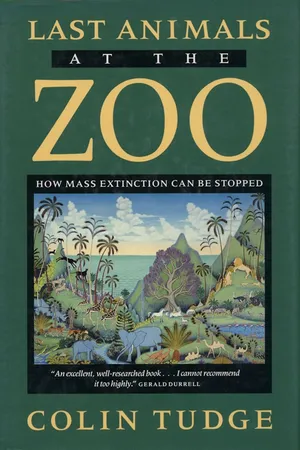
In Last Animals at the Zoo, Colin Tudge argues that zoos have become an essential part of modern conservation strategy, and that the only real hope for saving many endangered species is through creative use of zoos in combination with restoration of natural habitats. From the genetics of captive breeding to techniques of behavioral enrichment, Tudge examines all aspects of zoo conservation programs and explains how the precarious existence of so many animals can best be protected.
- English
- ePUB (mobile friendly)
- Available on iOS & Android
eBook - ePub
About this book
Information
FOUR
THE THEORY OF CONSERVATION BREEDING
The task is defined: to keep as many species as possible alive in captivity for as long as is necessary (which could well mean several centuries) in a state in which they are capable of returning to the wild. Most animals can be kept alive. Most can be induced to breed, at least from time to time. Yet all we have done so far is to stake out the ground. What we have seen, as Winston Churchill said in a somewhat different context, is ‘the end of the beginning’. The problems that remain are those of biology, and in particular of genetics; and of logistics. These problems are the subject of this chapter. The first of these problems – one that pervades all further considerations – is that of numbers.
A MATTER OF NUMBERS
Noah, according to Genesis, saved all the creatures that were then alive simply by taking a pair of each kind into the ark. At first sight, this seems a reasonable strategy. A healthy young male and a healthy young female are enough to start a family; and if you can start a family, then (it seems) you can found an entire lineage, with generation following generation, and so on ad infinitum. There are some well-attested cases, too, of modern lineages beginning in just this way. Most famously, all the golden hamsters known in the world are the descendants of only one pregnant female who was found in the 1930s. The wild ancestors have never been found; and neither was the male who made her pregnant. Why is conservation breeding so difficult, then? It doesn’t seem so hard, even among animals reduced to extreme rarity, to find one fertile male and one healthy female.
But Noah was blessed with divine intervention. In practice, in its absence, three different kinds of factor ensure that to begin a lineage that has a serious chance of surviving for more than a few generations you need a great many more founders than two. In some species, too, there are additional reasons why populations need to be large, in addition to the basic three.
The first factor is accident, which includes disease and the possibility of infertility. All of Noah’s animals remained in miraculous good health. None of them broke legs, was eaten by another, or fell foul of infection. If key individuals drop out (and if you begin with only two, then they are both key individuals), then the future of the entire lineage is jeopardised. In real life, even in protected environments, such events are commonplace. In some species (such as cheetahs) infertility is common; and until reproduction techniques are perfected infertility is as decisive as fatality. Indeed if you simulate an animal population with a computer model, showing accidents occurring at the kind of rate they occur in real life, then you can show that a population is extremely likely to go extinct within a dozen generations or so unless it contains at least 50 individuals at any one time.
Then there is the matter of demographic stochasticity. Demographic means ‘pertaining to population’. Stochasticity means ‘things that have to do with the nature of statistics’. The chief of these demographic glitches concerns sex ratio. In general, most animals produce an equal number of male offspring as females. By the same token, if you toss a coin a million times then you get roughly half-a-million heads and half-a-million tails. But if you toss a coin only half-a-dozen times, then you could easily get five heads and one tail, or even six tails or six heads. That does not happen very often, but it happens every now and again. Similarly, small populations of animals can produce an entire generation of offspring who are all of one sex. For slightly different demographic reasons (including selective mortality) the dusky seaside sparrow (a subspecies of seaside sparrow) in Florida was once reduced to six individuals, who were all male. (I will pick up on the story of the dusky seaside sparrow later.) For the first seven years of ‘Operation Oryx’ – the project to save the Arabian oryx, which I will discuss in Chapter 5 – all the calves born in the ‘world herd’ were male. Even after only limited experience, then, we can already see that what statistical theory predicts can happen does sometimes happen. It is difficult to say how many individuals are needed to avoid the problems of demographic stochasticity: it depends on so many other factors such as length of breeding life (can the parents breed again?) and fecundity (number of offspring). But again, we see that we would be far safer with dozens, or scores of individuals; and that some at least of Noah’s pairs of animals would be bound to come to a sticky end.
We have seen, too, that some species simply do not breed well unless there is a crowd. Flamingos breed only in company, and pandas and perhaps sperm whales are among the creatures who possibly benefit from male competition. In very small populations, the stimulus for breeding may simply be too weak. However, the greatest reasons why populations need to be large in order to survive have to do with genetics. Here there are two main kinds of consideration. First – at the level of the individual – it is important to avoid inbreeding, brought about by the mating of animals who are closely related to each other. Second – at the level of the population – it is vital for long-term success to conserve genetic variation.
As we will see, the number of individuals needed in a breeding population to avoid inbreeding varies enormously from species to species; but a rough, ball-park figure, to cover most eventualities, and sometimes regarded as a ‘magic number’, is 500. Five hundred is an enormous number to keep in captivity. Even in the wild, many populations are now below it. Note, too, that what counts in this context is not the total number of animals alive at any one time, for some of those may be infertile or senile; or there could be only one breeding female among 100 males – the majority of whom clearly would not have opportunity to breed; or half the animals could be identical twins of the other half, which means that matings between them would exacerbate inbreeding. What really matters is the number of animals capable of breeding; and indeed, to be really rigorous, the number capable of breeding who are not related to each other. This number is called the effective population. In reality (because some individuals in a population are likely to be infertile or senile, and many will be close relatives, and the sex ratio is not likely to be ideal) the effective population is liable to be less than the perceived population. Thus there are estimated to be between 34,000 and 54,000 elephants in Asia, which seems an enormous number. But only a few are breeding, or in a position to breed. So the effective population is much less than this.
Even 500, however, is not enough to maintain sufficient genetic variation to allow further evolution to continue in any one lineage. To preserve 500 or so individuals of any one kind must be seen, then, only as a holding operation. That core population must multiply again before any lineage can truly be considered to be back on the rails.
But we are running ahead of ourselves. Inbreeding (or the lack of it) and genetic variation are not the same phenomenon, though they are related. We should discuss each of them separately. First, though, we should establish the most basic of all concepts: the idea of the gene.
THE IDEA OF THE GENE
In the mid-19th century Charles Darwin solved, or at least outlined the answer to, the greatest of life’s mysteries. He argued (as others had done before) that today’s creatures had not been created in their present form; that they had evolved – ‘descent with modification’ – from ancestors that were different from their present-day descendants. He presented a plausible mechanism for this evolution: evolution by means of natural selection, which meant that in any one generation some individuals in any particular lineage would be better adapted to the prevailing conditions than others, and that these favoured individuals (the ‘fittest’ – meaning ‘most apt’) would be the ones to survive. He argued, furthermore, not simply that creatures change from generation to generation but that entire species could and did transform into new species; and, indeed, that any one ancestral species could branch to form many new, distinct species. That there could be change from generation to generation was not doubted in the mid-19th century; after all, cattle, sheep, horses, dogs, chickens, pigeons and all manner of plants had already been changed enormously in appearance and behaviour by the breeders of crops and livestock. But that species could change into new species, and that one species could branch into many – in other words, that ‘descent with modification’ could lead to radical change and to branching of lineages: those were, indeed, revelations. Many of Darwin’s fellow scientists had as much difficulty with these ideas as did any theologian. Indeed the church embraced Darwin (for there is no reason why the Creator should not create by evolution if He chose to) while many excellent contemporary biologists protested throughout their lives.
But Darwin, odd though it may seem in retrospect, failed to solve a problem that now may seem to be crucial for a proper understanding of evolution. Though he wrestled with the issue all his life, he could never make head nor tail of heredity. He showed in general terms how the descendants of ancient apes could have evolved into us. Yet as he complained in his seminal Origin of Species:
. . . no-one can say why the same peculiarity in different individuals . . . is sometimes inherited and sometimes not so; why the child often reverts in certain characters to its grandfather or grandmother or other much more remote ancestor; why a peculiarity is often transmitted from one sex to both sexes, or to one sex alone, more commonly but not exclusively to the like sex.1
Curiously, the answer to Darwin’s perennial puzzle was effectively solved within his own lifetime – indeed was being solved at the time he was writing Origin of Species in the 1850s – by an Austrian monk (working in what is now Czechoslovakia), Gregor Mendel. Mendel showed by breeding experiments how certain ‘characters’ (characteristics) in certain varieties of peas, such as wrinkliness of seeds and flower colour, were passed from generation to generation in an orderly fashion. Thus, he argued, each character must be conferred by the possession or non-possession of some ‘factor’ which the particular plant did or did not inherit from one or other of its parents. The notion that each character was determined by such a ‘factor’ was radically different from Darwin’s notion – one shared by many of his contemporaries – that the inheritance of characters from generation to generation was like the mixing of inks.
It has often been suggested that if only Darwin had known of Mendel’s work, then biology would have been advanced by 50 years. The reason he did not, it is suggested, is that Mendel published his seminal results with peas in an obscure Czech journal. However, Mendel’s abbey at Brunn (now Brno) was by no means obscure. It was known for its excellent researches in plant breeding. Darwin was extremely widely read, and others were keen to bring key papers to his attention. It is at least possible, not to say quite likely, that he did know of Mendel’s work. However, neither he, nor any of Mendel’s close associates (who included some highly competent biologists) nor, it seems, Mendel himself, appreciated that the mechanism of heredity that appeared to apply to some characters of some peas would apply in principle in almost all characters in all creatures – animals, plants, fungi, and often in bacteria. Mendel knew even before he started his experiments that he would not get simple patterns of inheritance if he looked at other characters in other plants, or even in peas. He chose to measure the particular characters in the particular pea varieties because he knew from his previous observations that there was a simple pattern of some kind, and that measurement would yield instructive results. Many other characters, in peas as well as in other creatures, looked as if they were indeed conveyed from generation to generation as if by the random mixing of inks. Indeed there was absolutely no reason to suppose – in fact there was plenty of reason for not supposing – that the mechanisms of inheritance were the same for all characters, in all kinds of creature. Perhaps they had to be worked out ad hoc: character by character, species by species.
It was for such reasons, and not especially because Mendel was ‘a simple monk’ or because his workplace was ‘obscure’, that his work on heredity was effectively forgotten almost as soon as he published it in 1860, and that Mendel himself began increasingly to concern himself with the affairs of the abbey, rather than with plant breeding. His experiments were not re-discovered, indeed, until the early-20th century, by three different European biologists working independently, who realised its potentially resounding significance. One of them, William Bateson in England, coined the felicitous term ‘gene’ in place of Mendel’s bland ‘factor’, to denote the unit of inheritance. The total complement of genes within any one individual is now called its genome.
Once the significance of Mendel’s work was appreciated, the mysteries that had brought his researches to a stop, and which had continued to puzzle Darwin, fell away. Mendel himself perceived that any one gene (to use the modern term) could exist in more than one form (with each form now known as an allele. He also proposed that every creature contains each of its genes in duplicate: one copy from one parent, and one from the other. But each parent passed on only one of the duplicate pair to its offspring. In practice, any one offspring might inherit the same form (allele) of any one gene from each of its parents, in which case it is said (in modern parlance) to be homozygous for that gene (or for the character conferred by that gene); or that it could, in principle, inherit a different allele of any one gene from each of its parents, in which case it would be heterozygous for that gene.
In practice, Mendel found that if he crossed pure-breeding round-seeded peas with pure-breeding wrinkled-seeded peas then all the offspring would have round seeds. He did not throw up his hands in despair, however. Indeed he did the exact opposite. With remarkable percipience (he really was an excellent scientist) he argued as follows. Each of the offspring must inherit a round-seeded allele (again, in modern parlance) from one parent, and a wrinkled-seeded allele from the other. But, he said, the round-seeded allele is dominant (and the wrinkled-seeded one is recessive). So the offspring all have round seeds.
However, in the language of modern genetics, the round-seeded offsrping are, in reality, heterozygous for the particular gene of seed-coat structure. When heterozygous creatures become parents, then they have an equal chance of passing on either one of the two alleles. So if the offspring of two peas that were heterozygous for wrinkled seeds or round seeds were crossed, then some of their offspring would inherit a round-seeded allele from each of the parents, and they would be homozygous, pure-breeding round-seeded plants; some would inherit a wrinkled-seed allele from each parent, and be homozygous, pure-breeding wrinkled-seed plants; and some would inherit a round-seeded allele from one parent and a wrinkled-seeded allele from the other, and they would be heterozygous, round-seeded plants that did not ‘breed true’ (because they in turn could pass on either a wrinkled- or a round-seeded allele to their offspring).
Mendel was able to infer all this because he crossed a great many peas, and when you do produce a great many, then simple patterns of inheritance begin to emerge. Thus, when heterozygous peas are crossed with each other, one-quarter of the offspring inherit a round-seeded allele from both parents; half inherit a round-seeded allele from one parent and a wrinkled-seeded one from the other; and a quarter inherit a wrinkled-seeded allele from both parents. The quarter that inherit two round-seeded alleles of course produce round seeds; the half that have one round-seeded and one wrinkled-seeded allele also produce round seeds, because the round-seeded allele is dominant; and the quarter with two wrinkled-seeded alleles have wrinkled seeds. Thus the ratio of round-seeded to wrinkled-seeded offspring is three to one; and if you are Gregor Mendel, and do further crossing experiments with other combinations, you can infer the notions – in modern terminology – of genes, alleles, heterozygosity and homozygosity, and of dominance and recessiveness.
Note just three points from this most elementary example. First, the physical appearance of a plant or animal – its phenotype – may not give you an accurate picture of the kinds of genes it contains – its genotype. Thus, the round-seeded plants could be either homozygous or heterozygous; you just cannot tell by looking at them which is the case. But when round-seeded plants are mated with each other, you can see whether they were heterozygous or homozygous by looking at their offspring. If all the offspring are round-seeded, then the parents must have been homozygous for the round-seeded allele. But if some are wrinkled-seeded, then the parents must both have been heterozygous for that gene, for only then could some of the offspring have inherited two wrinkled-seeded alleles, which they have to do if they are to have wrinkled seeds. However, you do know that all plants with wrinkled seeds are homozygous for that gene, because if they possessed a round-seeded gene then they would indeed have round seeds, because the round-seeded allele is dominant.
The second point is that this example really is simple: Mendel chose to work on characters that he knew (because he was an extremely knowledgeable plant breeder, apart from being a scientist) would give simple patter...
Table of contents
- Title Page
- Copyright Page
- Table of Contents
- ACKNOWLEDGEMENTS
- INTRODUCTION
- ONE - WHY CONSERVE ANIMALS?
- TWO - THE SCOPE OF THE PROBLEM
- THREE - FIRST GET YOUR ANIMALS TO BREED
- FOUR - THE THEORY OF CONSERVATION BREEDING
- FIVE - PROJECTS IN PROGRESS
- SIX - THE FROZEN ZOO?
- SEVEN - THE WHOLE ANIMAL: BEHAVIOUR CONSERVED
- EIGHT - THE FUTURE
- NOTES - AUTHOR’S NOTE
- INDEX
Trusted by 375,005 students
Access to over 1.5 million titles for a fair monthly price.
Study more efficiently using our study tools.
Frequently asked questions
Yes, you can cancel anytime from the Subscription tab in your account settings on the Perlego website. Your subscription will stay active until the end of your current billing period. Learn how to cancel your subscription
No, books cannot be downloaded as external files, such as PDFs, for use outside of Perlego. However, you can download books within the Perlego app for offline reading on mobile or tablet. Learn how to download books offline
Perlego offers two plans: Essential and Complete
- Essential is ideal for learners and professionals who enjoy exploring a wide range of subjects. Access the Essential Library with 800,000+ trusted titles and best-sellers across business, personal growth, and the humanities. Includes unlimited reading time and Standard Read Aloud voice.
- Complete: Perfect for advanced learners and researchers needing full, unrestricted access. Unlock 1.5M+ books across hundreds of subjects, including academic and specialized titles. The Complete Plan also includes advanced features like Premium Read Aloud and Research Assistant.
We are an online textbook subscription service, where you can get access to an entire online library for less than the price of a single book per month. With over 1.5 million books across 990+ topics, we’ve got you covered! Learn about our mission
Look out for the read-aloud symbol on your next book to see if you can listen to it. The read-aloud tool reads text aloud for you, highlighting the text as it is being read. You can pause it, speed it up and slow it down. Learn more about Read Aloud
Yes! You can use the Perlego app on both iOS and Android devices to read anytime, anywhere — even offline. Perfect for commutes or when you’re on the go.
Please note we cannot support devices running on iOS 13 and Android 7 or earlier. Learn more about using the app
Please note we cannot support devices running on iOS 13 and Android 7 or earlier. Learn more about using the app
Yes, you can access Last Animals at the Zoo by Colin Tudge in PDF and/or ePUB format, as well as other popular books in Biological Sciences & Zoology. We have over 1.5 million books available in our catalogue for you to explore.